

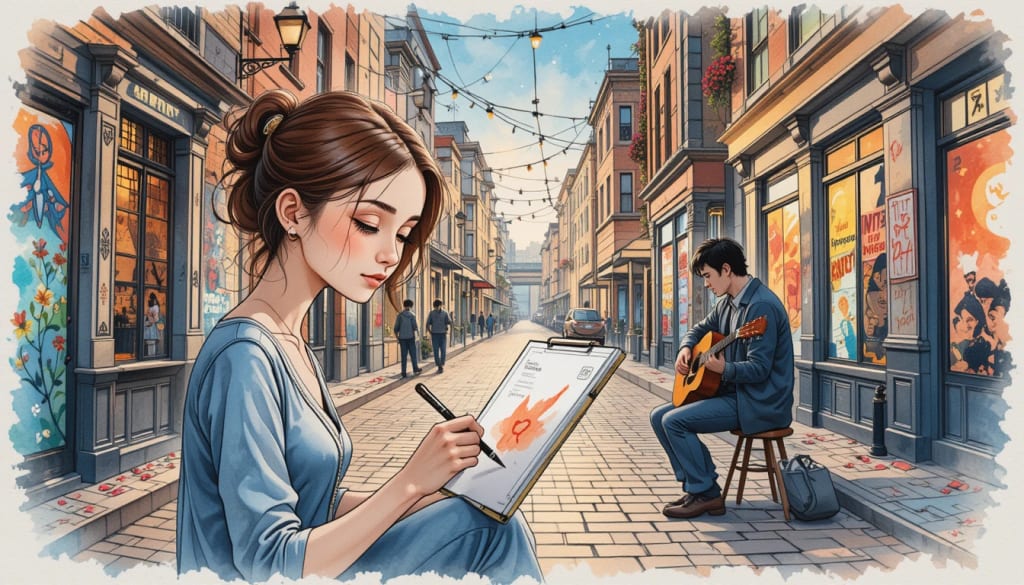
In the vibrant chaos of Melbourne, Australia, in the spring of 2025, the city pulsed with the promise of renewal. For 26-year-old Amara, a barista with a knack for sketching faces on latte foam, the word "new" was both a hope and a challenge. After years of running from her past, she found herself at a crossroads, where a single act of courage would paint her life with colors she’d never dared to dream. This is the story of Amara’s journey to embrace a new beginning, woven through the connections she forged and the art she dared to create.
Amara’s life in Melbourne was a patchwork of survival and quiet ambition. She lived in a cramped flat in Fitzroy, its walls covered with sketches she’d never shown anyone—portraits of strangers she’d seen in cafes, their eyes holding stories she longed to tell. Born in a small town in Queensland, Amara had fled at 18, escaping a family fractured by her father’s addiction and her mother’s silence. Art was her refuge, but self-doubt kept her from pursuing it, leaving her to pour coffee and sketch in secret. Melbourne, with its laneway murals and eclectic heartbeat, felt like a place where she could start anew, if only she could find the courage.
Her days revolved around The Bean Haven, a cozy cafe where she crafted lattes with intricate foam designs—a heart, a fern, a fleeting face. Her boss, Ravi, a 50-year-old immigrant from Mumbai with a laugh like a monsoon, saw her talent. “You’re wasting those hands on cups,” he’d say, nudging her to join a local art collective. Amara smiled, brushing him off, but his words lingered, a seed in her cautious heart.
One rainy morning, a new customer caught Amara’s eye. Leo, a 28-year-old musician with tousled hair and a worn guitar case, ordered a flat white and lingered, humming softly. His presence was magnetic, his eyes carrying a quiet resilience that Amara recognized. She sketched his face in foam—a quick, delicate portrait—expecting him to laugh. Instead, he studied it, his smile soft. “You’ve got a gift,” he said, his voice warm. “Why hide it?” Amara flushed, unaccustomed to praise, but Leo’s sincerity cracked her defenses.
Their connection grew over weeks. Leo became a regular, sharing stories of busking in Flinders Street Station and his dream to record an album. He’d grown up in foster care, music his anchor through instability. Amara, hesitant at first, opened up about her sketches, showing him her notebook one evening over chai. “These are alive,” Leo said, tracing a portrait of an old woman from the cafe. “You’re telling their stories.” His belief stirred something in Amara—a spark of possibility, a whisper of "new."
The turning point came when Ravi announced a community art fair, part of Melbourne’s spring festival. He’d reserved a booth for Amara to display her work, a surprise that left her reeling. “You’re ready,” he insisted, his eyes kind but firm. Amara panicked—her sketches felt too personal, too raw. Leo, sensing her fear, offered to perform at her booth, his music a backdrop to her art. “We’ll make it ours,” he said, his hand brushing hers. Amara agreed, her heart racing with equal parts dread and excitement.
Preparing for the fair was a whirlwind. Amara spent nights refining her sketches, turning them into vibrant ink-and-watercolor portraits on canvas. Leo helped, framing her work with salvaged wood, his guitar strumming softly as they worked. Their late-night talks revealed deeper truths—Amara’s guilt for leaving her family, Leo’s fear of never belonging. “We’re both starting over,” he told her, his voice steady. “That’s what makes it beautiful.” Their first kiss, under a string of fairy lights in her flat, felt like a brushstroke on a blank canvas, bold and new.
But the past wasn’t easily erased. A letter arrived from Amara’s mother, pleading for her to return home. Her father was in rehab, and her mother was struggling alone. The words stirred old wounds—anger, shame, the weight of a childhood spent parenting her parents. Amara nearly abandoned the fair, but Leo and Ravi rallied her. “You can’t fix them by losing yourself,” Ravi said, his hand on her shoulder. Leo added, “Your art is your voice. Use it.” Amara, torn but resolute, decided to stay, channeling her pain into a new piece—a portrait of her younger self, eyes bright with hope.
The fair was a kaleidoscope of Melbourne’s spirit—street performers, food trucks, and stalls bursting with color. Amara’s booth, draped in fabric and fairy lights, showcased her portraits, each one a story of the city’s people. Leo’s music—soulful folk with lyrics of resilience—drew a crowd, their applause mingling with the hum of the festival. Amara, nervous but proud, spoke about her work, her voice growing steadier with each visitor. A local gallery owner, Maya, offered to exhibit her pieces, calling them “raw and alive.” Amara’s heart soared, her dream no longer a sketch but a reality.
The night ended with a setback. Amara’s phone buzzed with a voicemail from her mother, her voice fragile, asking for forgiveness. Amara, overwhelmed, retreated to the Yarra River’s edge, the city’s lights reflecting like scattered stars. Leo found her, his guitar silent but his presence loud. “You don’t have to go back to who you were,” he said, sitting beside her. “You’re allowed to be new.” Amara cried, not from sadness but from the weight of possibility. She decided to write back, offering love but setting boundaries, choosing herself for the first time.
In 2026, Amara stood in Maya’s gallery, her first solo exhibit a success. Her portraits, now bolder, lined the walls, each one a testament to her journey. Leo’s album, recorded with funds from busking, played softly, his voice a thread in their shared story. Ravi, beaming, brought her a latte with a foam heart, a nod to her beginnings. Amara’s family remained a work in progress—letters exchanged, healing slow but steady. She and Leo, now partners, planned a mural project for Fitzroy, a canvas for the city’s dreamers.
Melbourne’s spring sun warmed Amara’s face as she sketched by the river, Leo strumming nearby. Her life, once a tangle of fear, was now a tapestry of second chances, each stroke a new beginning. The tides of her heart had shifted, and in their flow, she found love—for herself, for Leo, for the city that gave her wings.
About the Creator
Shohel Rana
As a professional article writer for Vocal Media, I craft engaging, high-quality content tailored to diverse audiences. My expertise ensures well-researched, compelling articles that inform, inspire, and captivate readers effectively.
Keep reading
More stories from Shohel Rana and writers in Fiction and other communities.
Love in the Time of Tides
In the windswept village of St. Ives, Cornwall, in the summer of 1946, the sea whispered secrets to those who dared to listen. For Clara Penrose, a 24-year-old seamstress with dreams larger than her small world, the tides brought both solace and longing. Her story, woven with threads of love, loss, and quiet courage, unfolded against the backdrop of a post-war England, where the heart’s desires battled the scars of time. This is the tale of Clara and Finn, two souls bound by the sea, whose love would ebb and flow like the tides themselves.
By Shohel Rana7 months ago in Fiction
Again
The sun pierced through the gaps in the bamboo blinds across our bedroom window. Though I was already on the precipice between the waking and the sleeping world, I allowed myself the leisured pleasure of basking in the quiet contemplation that came only from lying alongside the slight but warm curves of my dear Marguerite.
By Paul Stewart2 days ago in Fiction


Comments
There are no comments for this story
Be the first to respond and start the conversation.