
Navigating the 21st Century: Humanity’s Challenges and Opportunities
Exploring Our Evolutionary Path, Present Challenges, and the Boundless Possibilities Ahead
Being human in the 21st century is often a paradoxical experience. On one hand, we are living in the most prosperous and advanced period in our species’ history. Health, wealth, and well-being have reached unprecedented levels for many. On the other hand, the world remains rife with suffering. Just yesterday, over 15,000 children died, and 700 million people still live in extreme poverty. Inequality is rampant even in wealthy societies, and humanity seems more divided than ever, struggling to solve its problems while inadvertently creating new ones, often at the expense of our planet.
Many of us are overwhelmed by this grim reality. It’s easy to feel hopeless and disconnected, burdened by the weight of global issues that seem too big to tackle. The sense of doom and sadness is palpable, and it’s one of the defining narratives of our time. Yet, while there’s undeniable truth to these feelings, it’s also important to acknowledge another story—one of hope and possibility.
As the renowned author Terry Pratchett once said, "We are the storytelling ape." Humans live through narratives, weaving stories that define how we see the world. Without diminishing the darkness that surrounds us, let’s explore a more optimistic story, one that could guide us forward.
### The Beginning of Everything
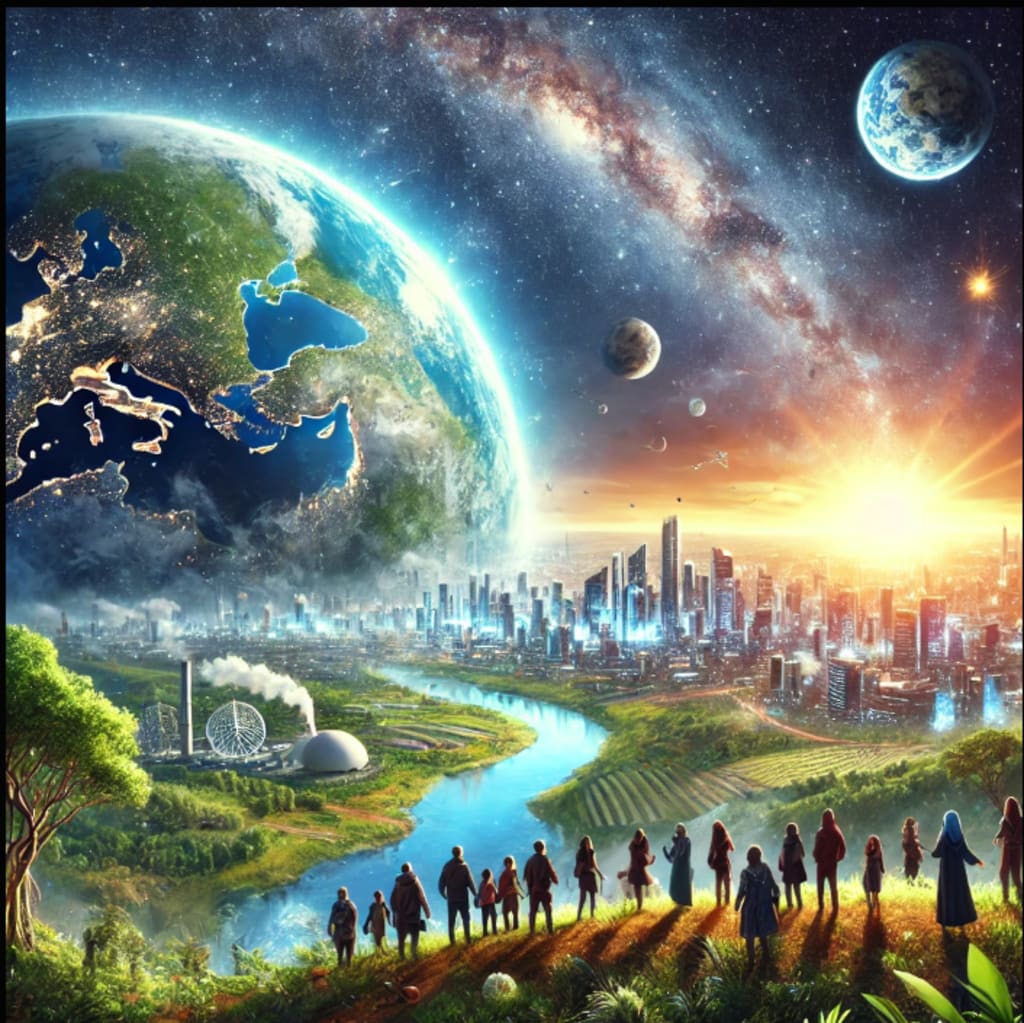
Our story starts 14 billion years ago with the birth of time and space. From a moment of pure energy, the universe expanded, forming forces and particles, stars and galaxies. Chaos gave way to order, and complexity began to emerge. Over eons, stars created heavier elements through their violent deaths, scattering these materials across the cosmos.
On one special planet, where conditions were just right, life took its first tentative steps. Perhaps it was destiny, or perhaps it was a cosmic accident, but life—now the most complex thing in existence—began to spread. Cells evolved into plants, animals, and fungi, first in the oceans and later on land. Life’s story is one of resilience, with species rising, falling, and adapting, each setback only making life stronger and more diverse.
### Humanity’s Dawn
Six million years ago, an animal on this planet had a revelation. It looked at its reflection in a puddle, gazed at the stars, and realized it existed. This was the beginning of human consciousness. What started as a small group of hominins evolved over the next few million years into us—Homo sapiens.
Our ancestors were just one species among many, but they were driven by a fierce desire to survive and improve their lives. They tamed fire, created tools, and developed cultures. They told stories about the world, sharing knowledge and wisdom through generations. For 250,000 years, they built the biological foundation that allowed humanity to thrive.
About 200,000 years ago, humanity as we know it came into existence. And we didn’t waste time. Agriculture, villages, kingdoms, and eventually civilizations followed. Through technology, writing, science, and philosophy, we transformed the world. In just a few short generations, we went from hunter-gatherers to space explorers.
### The Modern Paradox
Today, the Earth is ours. We’ve reshaped it beyond recognition, creating cities, machines, and technologies that our ancestors couldn’t have imagined. We split the atom, walked on the moon, and now manipulate the very code of life. But despite all these achievements, one thing hasn’t changed: humans.
We are still driven by the same instincts that helped our ancestors survive in a hostile world. We crave food, resources, and social approval. We fear the dark, both literal and metaphorical. And although we have the ability to change the world, we remain territorial and possessive, unwilling to let go of what we have or adapt to the needs of others.
In many ways, our most significant challenge today isn’t external—it’s internal. We are incredibly powerful beings, but we have yet to fully awaken to our potential. We’re trapped in an outdated mindset, rooted in scarcity and survival, when in reality, we have the means to create abundance and peace.
### The Path Forward
It’s easy to look at the state of the world and believe that we are living in the end times. However, history shows that humanity has always feared the apocalypse, and yet we’ve persevered. There’s a strong chance that our story is just beginning, that future generations will look back at us as the ancestors of something much greater.
If we can shift our perspective and start thinking in terms of decades and centuries, we’ll see that it’s possible to solve the problems we face today. We could eliminate poverty, cure diseases, and even tackle climate change. The technological advancements we’re making—AI, biotechnology, sustainable energy—offer unprecedented opportunities for growth and transformation.
The road ahead won’t be easy. We’ll encounter setbacks, and some things may get worse before they get better. But if we’re willing to put in the effort, we can create a world that’s far better than the one we inherited.
### The Best World, Yet Far from Perfect
Despite all its flaws, the world we live in today is the best it has ever been. And it’s up to us to make it even better. We have the chance to reduce suffering, inspire progress, and create a future that aligns with the best version of ourselves.
The human story is far from over. We are not defined by the darkness that surrounds us, but by the light we choose to create. Now, more than ever, it’s time to embrace the challenges we face and work toward a better world—one that future generations can be proud of.
About the Creator
THiNK
Think - Your go-to destination for exploring captivating mysteries, insightful psychology, intriguing facts, and the latest news. Our mission is to spark curiosity and inspire learning. Join us as we uncover the unknown!
Bomb Scare
It was 2027, and the world never thought it would happen. A missle hit the United States, but it wasn't where they had anticipated. A little town in the northeast was hit by a missile strike, they didn't know why, and they didn't know exactly where it hit, but they did know it was a coastal community, somewhere between Maine and Delaware.
By Gregory Paytonabout 17 hours ago in Fiction
THE SIREN THAT NEVER STOPS
The siren began on a Tuesday at 9:17 a.m. It was a clean, mechanical sound; steady, mid-pitched, not urgent enough to demand panic but too present to ignore. It rose above the hum of traffic and threaded itself through open office windows, bakery doors, classroom vents.
By Ajan Lori Abei7 days ago in Fiction
A Knight of the Seven Kingdoms Series Review (Season 1)
As one of the biggest properties in fantasy, A Song of Ice and Fire remains immensely popular with audiences. After reaching far into the past with House of the Dragon, a second spin-off was on the cards. A Knight of the Seven Kingdoms serves up a bite-sized slice of action and drama, but it still claims a spot among the best small-screen titles.
By Robert Cain7 days ago in Geeks


Comments
There are no comments for this story
Be the first to respond and start the conversation.