

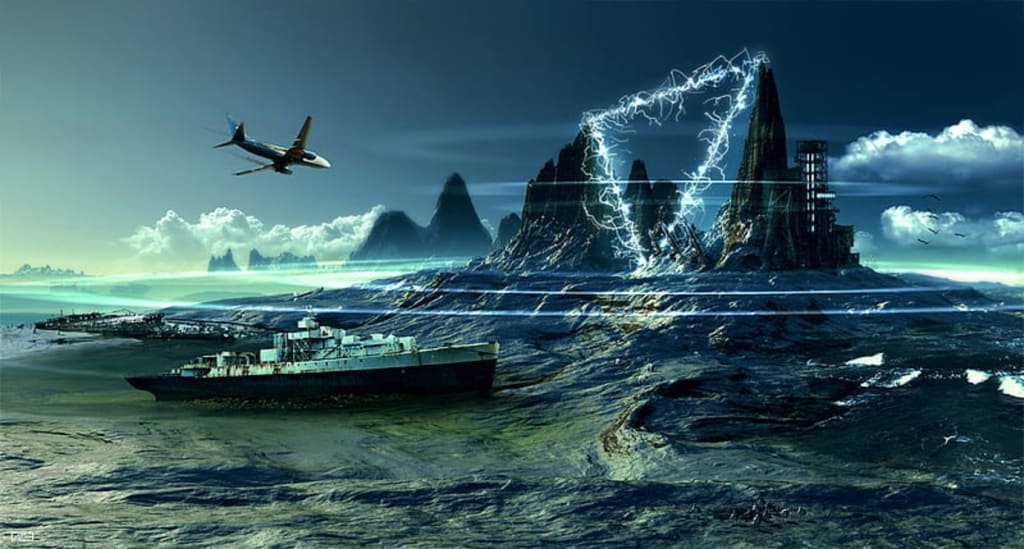
The Devil's Triangle, sometimes referred to as the Bermuda Triangle, is an ill-defined area in the western North Atlantic Ocean. Bermuda, San Juan (Puerto Rico), and Miami (Florida, USA) are commonly recognized as the triangle's vertices. The Bermuda Triangle has become well-known over time for being the supposed location of multiple unexplained ship and aircraft disappearances. It's crucial to remember, though, that a lot of the tales involving the Bermuda Triangle have been exaggerated, and there is frequently little scientific proof to back up allegations of paranormal activity.
Among the alleged mysteries and occurrences connected to the Bermuda Triangle are:
trip 19: One of the most well-known events happened in December 1945 when five bombers from the United States Navy, also known as Flight 19, vanished while on a training trip. A rescue plane that was dispatched after the planes vanished, and the planes were never located. Fuel fatigue, navigational errors, and compass problems have all been blamed for the mystery.
USS Cyclops: The 1918 disappearance of the U.S. Navy cargo ship USS Cyclops occurred in the Bermuda Triangle. Its disappearance is still under investigation, and it ranks among the U.S. Navy's biggest non-combat losses.
SS El Faro: During Hurricane Joaquin in 2015, the cargo ship SS El Faro sank close to the Bermuda Triangle. Thirty-three crew members perished. Rather than being the result of unexplained forces, the episode was primarily attributed to the strong hurricane.
Flight DC-3: Over the Bermuda Triangle in 1948, a Douglas DC-3 aircraft went missing. Nothing was found in the way of wreckage, even after a thorough search.
Despite the fact that these instances are sometimes described as mysterious, it's important to approach the Bermuda Triangle phenomenon logically. Natural events like hurricanes, mistakes made by people, and technological failures can all be used to explain a large number of the disappearances. The incidence of shipwrecks and plane catastrophes in the Bermuda Triangle is not appreciably higher than in other popular areas of the globe.
The Bermuda Triangle is typically regarded by scientists and researchers as a navigational and environmental difficulty rather than a location of supernatural or paranormal activity. The region's magnetic anomalies can skew compass readings, and it is prone to abrupt and severe weather fluctuations. The idea that the Bermuda Triangle is intrinsically more dangerous or mysterious than other regions of the ocean is unfounded, notwithstanding the persistent stories.
The Devil's Triangle, sometimes referred to as the Bermuda Triangle, is an ill-defined area in the western North Atlantic Ocean. Bermuda, San Juan (Puerto Rico), and Miami (Florida, USA) are commonly recognized as the triangle's vertices. The belief that this region is linked to an unusually high number of strange ship and aircraft disappearances has made it well-known.
The following are some salient details and attributes linked to the Bermuda Triangle:
Geographical Boundaries: Neither the United States government nor any other international body formally recognizes the Bermuda Triangle as a separate physical area. Although opinions on its borders vary, it is generally accepted that they are established approximately by joining the three aforementioned vertices.
Mysterious Disappearances: Reports and tales of ships and airplanes inexplicably going missing in the area are largely responsible for the Bermuda Triangle's notoriety. These instances have frequently been explained away by paranormal or alien phenomena, despite the dearth of scientific data to support such theories.
Natural Explanations: A number of experts and academics contend that natural processes are responsible for the alleged mysteries surrounding the Bermuda Triangle. Hurricanes and other extreme weather events are common in the area. Navigational devices may also be impacted by local magnetic abnormalities, which could result in compass malfunctions.
Statistical Perspective: In contrast to other popular tourist destinations, the Bermuda Triangle does not exhibit a noticeably greater incidence of mishaps or disappearances, despite its well-known reputation. The quantity of traffic in the Bermuda Triangle is directly correlated with the number of incidents that occur there.
Dispelling Myths: Despite the public's fascination with the Bermuda Triangle, many of its alleged mysteries have been disproved or explained by conventional methods. Investigations have frequently turned up commonplace explanations for the disappearances, like natural disasters, technological malfunctions, and human mistake.
In conclusion, despite the fact that the Bermuda Triangle is frequently connected to enigmatic and unexplained occurrences, a thorough investigation shows that the majority of incidences are the result of human error and natural causes. More myths and sensationalized tales than empirical data have contributed to the region's reputation as a dangerous and enigmatic place.
About the Creator
Keep reading
More stories from Vijay Kumar and writers in Fiction and other communities.
Mars: Humanity's Next Frontier
The fourth planet from the Sun, Mars, has long captured people's attention. Mars is one of the most alluring planets in the universe for study and settlement because of its rusty-red terrain, enigmatic surface features, and the presence of life. The idea of visiting Mars is now closer than ever thanks to developments in space exploration technology and a resurgence of interest from both commercial and governmental space agencies.
By Vijay Kumar2 years ago in Fiction
TUS NUA - ch 53
TUS NUA – ch 53 New Beginnings – Mia and Midnight (*)(*)(*) Finola knew Ali’s brother-in-law needed to put his mind at rest. She fed her arm through his and led him outside. “We’ll sit here. If you like, I can put a block around us so our conversation will be private.”
By Margaret Brennanabout 17 hours ago in Fiction


Comments
There are no comments for this story
Be the first to respond and start the conversation.