
“My Heart Has Expired: Please Insert Another Coin”
n a near-future city, emotional burnout becomes literal — people’s hearts display their energy levels like vending machines. When a woman’s “heart meter” hits zero, she goes on a quest to find what can refill it.
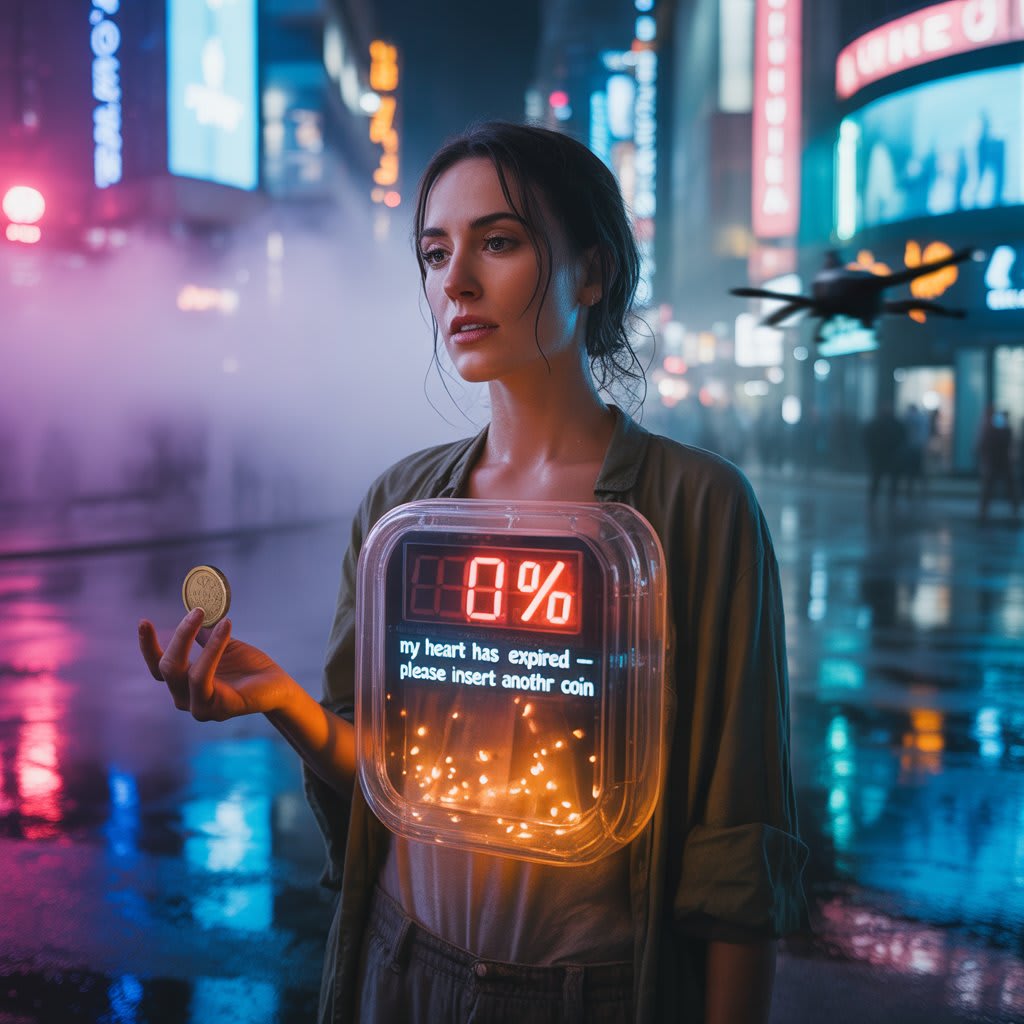
My Heart Has Expired: Please Insert Another Coin
In Meridian City, everything beeped.
Doors beeped. Sidewalks beeped. Even the sky beeped a low mechanical hum as drones cut across its blue surface like silver stitches. But the loudest, most personal beep belonged to the hearts — or rather, the glass meters implanted over them.
Mine had been blinking red for three days.
A soft rectangle glowed beneath my collarbone, humming with each heartbeat. Normally it showed a soft gradient of color — greens and oranges, sometimes a cheerful yellow on good days. But now it pulsed an angry crimson, flashing ERR: 0%. A tiny slot below it displayed the message:
MY HEART HAS EXPIRED.
PLEASE INSERT ANOTHER COIN.
Of course, we didn’t actually drop coins into our chests. The phrase was just a metaphor built into the design, a cruel little joke by an engineer who once said emotions were “just biological expenses waiting to be taxed.”
Still, the message felt like a slap.
My name is Aria Vale, and I was officially emotionally bankrupt.
The heart meters had been installed across the nation after a decade of burnout epidemics. Overwork, constant notifications, and the rise of synthetic companionship had slowly hollowed people out. So Meridian Tech developed the Pulse-Monitor Implant — a device that tracked emotional stamina and gave visual warnings.
Green meant balanced.
Yellow meant tired.
Orange meant dangerously drained.
Red meant collapse.
But zero… zero meant empty.
I hadn’t even known it was possible to hit zero. The commercials always showed smiling people who just needed a day off or a vacation. They never showed someone like me, standing in the middle of a crowded subway as her heart meter chimed a shrill, final beep.
Passengers turned to look.
A few stepped back, as if burnout were contagious.
I tugged my coat closed and hurried off the train.
My first stop was the Emotional Wellness Center. A sterile, white building where holographic receptionists floated like silent ghosts.
“Hello, Aria,” the system greeted. “We see your heart is at 0%. Please select from the following options: Synthetic Joy Boost, Dopamine Patch, Digital Comfort Companion—”
“Yes, yes, I know.”
All the options were expensive. And useless.
Synthetic Joy felt fake.
Dopamine Patches wore off in hours.
Digital Companions only drained me faster.
There was something wrong deep inside me, something no machine could fix.
“Do you have anything… natural?” I asked.
The hologram flickered. “Define natural.”
“Something that isn’t programmed. Something human.”
“Error,” it responded. “Human-based treatments are unregulated and inefficient.”
Of course they were. The city had replaced kindness with subscriptions long ago.
I left.
Outside, the sky had darkened into a bruised purple. Screens flickered across buildings, displaying cheerful ads of people with perfect green meters.
I wondered if any of them were real.
My meter beeped again — a soft, pitiful sound, like a tired bird. I placed my hand over it. Beneath the synthetic glass, I felt nothing.
No warmth.
No pulse.
Just emptiness.
I wandered without direction until the city’s neon slipped away behind me. I didn’t know where I was going, but I followed the one thing that still worked inside me: instinct.
Eventually, I stopped in front of an old wooden door squeezed between two skyscrapers, like an afterthought left from another century. A small sign hung above it:
HEART REPAIR —
NO TECH. NO CHARGE. NO GUARANTEES.
Strange.
Stranger still that I walked inside.
The room smelled of jasmine tea and old paper. A woman sat cross-legged on a woven rug, her silver hair tied in a loose braid.
“You’re empty,” she said. Not a question.
“Completely,” I whispered. For a moment I feared she would shove a gadget into my chest like everyone else.
But she only patted the rug.
“Sit.”
I obeyed.
“What happened to you?” she asked gently.
I expected a clinical questionnaire, but her voice held something different — curiosity, not calculation.
“I stopped feeling anything,” I said. “Little by little. Work. Pressure. Expectations. Everyone needed more from me than I had. I kept giving and giving, and one day... there was nothing left.”
She nodded, as though she’d heard the story a thousand times.
“You know,” she said softly, “hearts were never meant to be managed like devices. You can’t refill a soul with chemicals or programs. Only life can do that.”
I stared. “So how do I fix it?”
The woman smiled. “You don’t fix it. You feed it.”
She reached into her coat and pulled out a tiny coin.
It was wooden, hand-carved, warm to the touch.
“Take it,” she instructed.
“But what does it do?”
“It reminds you of something real.”
When my fingers closed around it, my heart meter flickered. Not green, not even yellow — but a faint, trembling orange. A spark.
My breath caught. “You… did something.”
“No,” she said. “You did. You felt something.”
“What did I feel?”
“Hope.”
I left the shop clutching the coin, uncertain and trembling. My meter flickered again, as if testing its own heartbeat.
On the way home, I noticed things I had forgotten to see — a child laughing, a street musician drumming on buckets, an elderly couple sharing an umbrella.
Little things.
Real things.
And with each one, my heart meter brightened.
Not because I inserted a coin.
But because I finally remembered I had a heart worth refilling.
The city still beeped.
Machines still hummed.
But now, beneath their noise, I could feel the quiet thrum of life again.
Maybe tomorrow I’d be yellow.
Maybe next week green.
For now, orange was enough.
I was alive again.
About the Creator
Lightning Never Strikes Twice
The distant rumble, the sudden deluge, the crescendo of sound, the flash of light, the explosive energy — it never gets old. I became an amateur storm chaser about two years ago. My wife, Cindy suggested it. Sort of. She said, "Alex, you know this cancer is killing me. I've come to terms with that, but you're smothering me. Go join a band, write a book, or become a storm chaser, for all I care. I love you, but you need a hobby."
By Julie Lacksonen6 days ago in Fiction


Comments
There are no comments for this story
Be the first to respond and start the conversation.