
My Grandfather’s Watch Stopped the War
It was just a watch — brass, battered, and ticking out of sync. But the moment it stopped, history split open like a fault line.
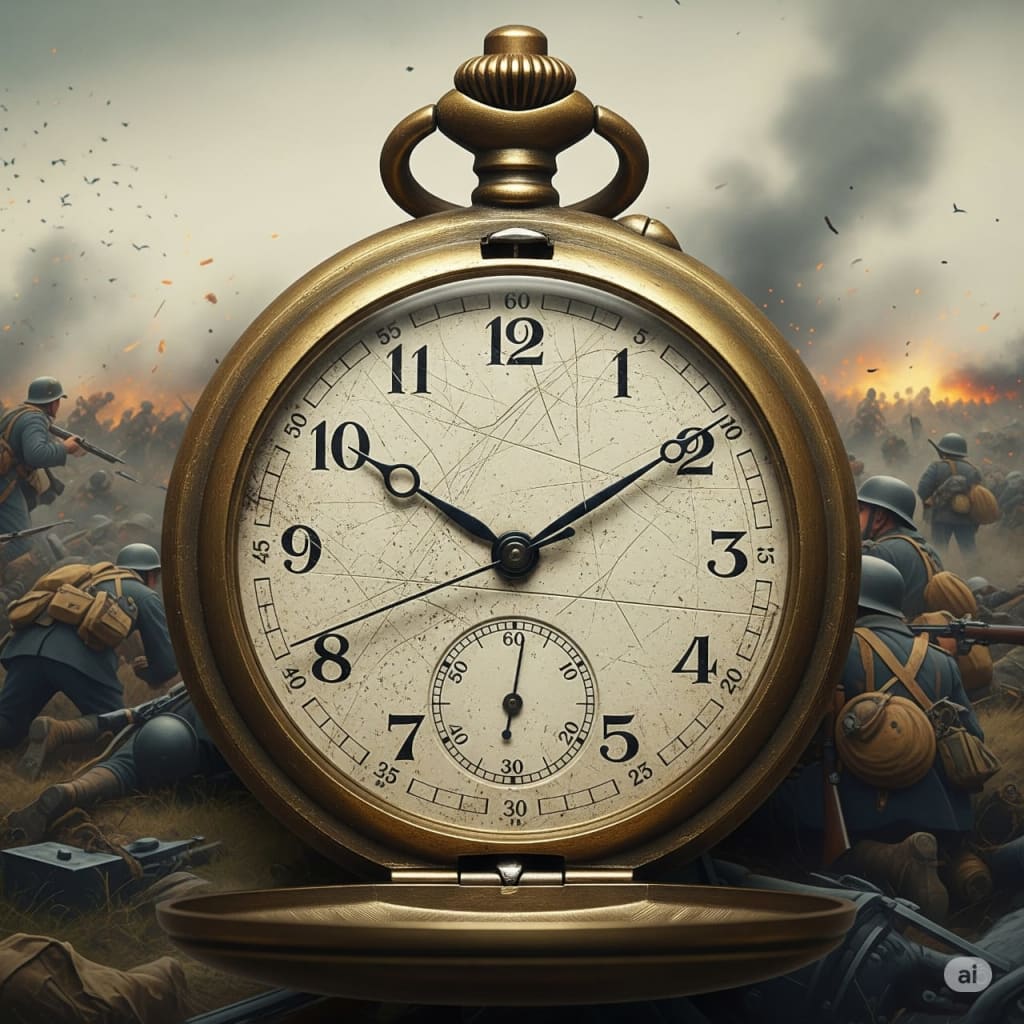
The watch hadn’t ticked properly in years.
It lay nestled inside a velvet box, buried under yellowed letters and a faded photograph of my grandfather in uniform — tall, somber, and unmistakably holding the very same timepiece. I found it while clearing out my father’s attic the summer after he died. The house had been silent too long, and I think, in some way, the silence made the watch speak again.
It was nothing remarkable to look at — brass, aged, the glass slightly fogged. The engraving on the back had long since faded, save for a few scratches shaped like initials, or maybe a date. Still, when I held it in my palm, I felt something sharp — not physical, but a prick at the edge of memory.
That night, I wound the crown just once.
It began ticking.
And the moment it did, everything in the room changed.
I blinked. The attic was gone. In its place was a field — muddy, loud, alive with the clamor of boots and shouted commands. I was standing in what looked like a trench, surrounded by men in dusty green. No one seemed to notice I’d appeared. The sky was a bruise-colored dusk, the air laced with the scent of cordite and cold metal.
A voice shouted:
> “Courier’s late. Orders should’ve arrived by now!”
Another man leaned against the trench wall, lighting a cigarette with trembling fingers.
> “If they delay one more time, we’re going over before sunrise. We won’t survive that.”
I looked down. The watch was still in my hand, ticking louder than before. Its face had changed — just slightly. The hands weren’t pointing to any hour, but to a symbol — a small triangle etched in silver, glowing faintly beneath the glass.
Without thinking, I pressed the center of the face.
Everything froze.
Time, literally, stopped. The cigarette ember hung in mid-air. A fly hovering above a soldier’s helmet stopped flapping its wings. Even the clouds above seemed to still.
Then came a voice. Not spoken aloud, but inside my skull. Familiar. Worn.
> “You have to deliver it.”
I turned. No one. Just silence and the strange sensation that my grandfather had spoken.
“Deliver what?” I whispered.
The triangle on the watch blinked once. Then the world resumed.
Before I could question anything further, a figure dashed into the trench — a boy barely old enough to shave, carrying a satchel. “Message from command!” he gasped, handing over a sealed envelope.
The commanding officer tore it open and swore.
> “Too late. They’ve already begun the march.”
Panic rippled through the trench. Men began grabbing rifles, fastening helmets. I looked down at the watch again.
And I understood.
---
The rest of the story came to me in fragments over days. Each time I wound the watch, I was taken back to a different moment — not in my life, but in his. My grandfather’s war. A war I had only heard about in black-and-white terms, in books and footnotes. But now it breathed, it bled, it roared.
Each time, the watch pulsed with one singular instruction: Change it.
And somehow, I could.
A note slipped under a captain’s tent flap. A tripwire disarmed before dawn. A false order re-routed to the enemy’s flank. Small things. Subtle changes. The kind you’d never notice in a history book.
But someone noticed.
An intelligence officer in a trench coat. She cornered me in a field hospital tent, her eyes hard and voice colder than the steel in her sidearm.
> “You’re not part of this battalion. Or any battalion.”
“I’m… helping,” I said, lamely.
She looked at the watch in my hand. “Where did you get that?”
I swallowed. “It was my grandfather’s.”
She stared at me for a long time. Then nodded.
> “So you’re the one.”
She told me the story then — of the Watchmakers. A secret unit hidden in plain sight across generations, tasked not with fighting wars but redirecting them. Slipping time slightly sideways. Undoing atrocities before they began.
> “We don’t win wars,” she said. “We end them early.”
She said the watch had appeared during every major conflict. In the pocket of a silent farmer who convinced soldiers to lay down arms. On the wrist of a diplomat who gave the right speech at the wrong time. Hidden in the lining of a nurse’s coat who chose mercy over revenge.
> “Your grandfather,” she said, “used it well.”
---
When I finally returned to the attic — or rather, when the watch allowed me to return — hours had passed. Or maybe years. It’s hard to measure time when you’ve bent it so many ways.
The watch no longer ticked.
But I no longer needed it to.
Because the final letter I found, tucked behind the photo, wasn’t addressed to my father. It was to me.
> “If the world changes, it’s not because of guns or bombs,” my grandfather had written.
“It’s because someone made a different choice at the right moment. If you’re holding this watch, you’re one of those people. Use it well. Don’t try to be a hero. Just make sure there’s something left to come home to.”



Comments
There are no comments for this story
Be the first to respond and start the conversation.