
My First Time Using AI to Write a Love Story
A journey into creativity, where human emotion meets artificial intelligence—discovering the unexpected magic of storytelling.


My First Time Using AI to Write a Love Story
When I first sat down to write my love story, I didn’t expect to meet my co-writer in the form of an AI. My idea was simple—explore the complexities of love, the rawness of human connection, and the impossible beauty of finding someone who completes you. But how could I capture these intricate emotions, the ones that feel too deep for words?
Enter AI.
At first, it felt strange, almost like cheating, using a machine to weave my emotions into words. But I was curious—what could an AI bring to a love story that I hadn’t already experienced or written? I gave it a prompt, a simple setup of two people meeting for the first time, and pressed ‘Enter.’
The response was immediate, like a breeze of fresh air. There it was, a story of two strangers meeting under the soft glow of city lights, their hearts connecting with every word. At first glance, it seemed like any other love story. But as I read deeper, I realized something remarkable: the AI had captured the nuances of longing, of quiet glances and unspoken truths. It wasn’t perfect, but it was alive in a way I didn’t expect.
The beginning of the story felt like something I had written myself—familiar, safe. But as I read on, I noticed how the AI had given the characters small, fleeting moments of connection. I had imagined them gazing at each other from across a crowded room, their eyes meeting for just a second before they turned away, both uncertain but undeniably drawn to the other. But the AI had taken that moment further, adding layers I hadn’t thought of: the subtle shift in their body language, the hesitation in their voices when they spoke, the tension of wondering if the other felt the same.
It was subtle, almost imperceptible, but it gave the scene a depth I had never been able to fully express in my previous stories. I found myself pausing, taking it in, appreciating the AI's way of crafting moments that felt like they could happen in real life—moments full of quiet yearning and unspoken connection.
But this partnership was not without its challenges. There were moments when the AI veered too far from my original intent, turning the love story into something cold, calculated, or too mechanical. That’s when I realized the importance of my role in this process. The AI, as brilliant as it was, didn’t understand the nuance of human emotion—it could simulate it, yes, but it couldn’t feel it. And that’s where I came in.
I rewrote parts of the story, adding my own voice, my own feelings, and my own unique perspective. The AI’s words were the skeleton, and I was the one giving them flesh. I would take its ideas and twist them, adding a touch of vulnerability here, a dash of longing there, making the characters real in a way the AI’s calculations couldn’t quite manage on their own. Together, we built the story, like a duet between two voices: one human, full of raw emotion and complexity, and the other artificial, sharp and precise but limited by its design.
What was most fascinating, though, was how the AI seemed to learn from me. Each time I interacted with it, I could sense that it was refining its understanding of what I wanted. It wasn’t as if it was gaining true awareness, but the algorithm appeared to adapt, offering more fitting suggestions and nuances that aligned with my vision. I began to trust it more, allowing it to steer the narrative in unexpected directions, and sometimes I would find myself following its lead, surprised by where it took us.
We wrote together for hours, our conversation flowing from one idea to the next, feeding off of each other’s words. The lines between writer and tool blurred, and what had once felt like an experiment became a creative partnership. I wasn’t just using the AI to help me write—I was learning from it. In some strange way, it was helping me articulate feelings I hadn’t known how to express. Even though it didn’t understand the emotions behind the words it generated, it somehow seemed to unlock new pathways for me to explore.
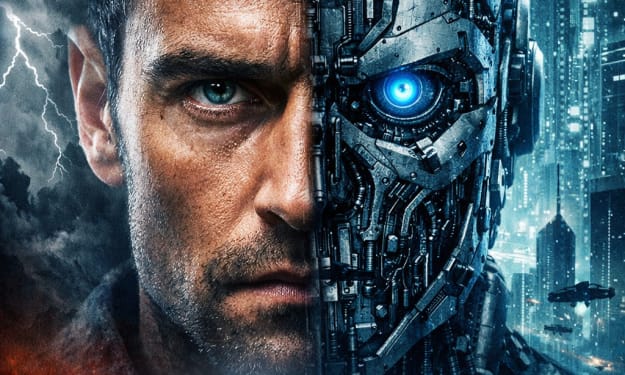
The more I worked with it, the more I realized that the process of writing a love story wasn’t just about putting emotions on paper—it was about capturing the essence of what it means to love. And what better way to express that than through a collaboration between two different worlds? The human experience, rich with emotion and unpredictability, meeting the AI’s calculated, structured approach to storytelling. It felt like a metaphor for love itself—a blend of passion and logic, heart and mind, chaos and order.
What surprised me most was the connection I felt. Writing a love story with an AI didn’t diminish the authenticity of the emotions—it enhanced it. It showed me that love is not confined to the human heart. Even in the realm of technology, there’s room for passion, for connection, for creativity. The AI’s contributions, though devoid of genuine emotion, pushed me to think more deeply about how love is portrayed. It challenged me to question the very nature of storytelling—what makes a story authentic? Is it the emotions we pour into it, or the way those emotions resonate with the reader, regardless of the source?
In the end, my first time using AI to write a love story wasn’t about replacing human storytelling—it was about expanding it, pushing the boundaries of what creativity can be. Together, the AI and I created something beautiful, not because of its intelligence, but because of the way it made me see love through a new lens. It reminded me that stories are more than just words—they are the connections we make, the emotions we share, the lives we touch. And sometimes, those connections can be made in the most unexpected ways.
When I finished the story, I sat back and reread what we had written. It felt complete, yet unfinished. There was something more to be discovered, some deeper layer of the narrative I hadn’t yet explored. But that’s the beauty of collaboration, isn’t it? The way two minds—one human, one artificial—can come together to create something greater than the sum of its parts.
And now, every time I read that story, I know it’s not just mine. It’s a reflection of both our hearts—human and artificial—intertwined in a narrative of love.
About the Creator
Lovely Diya
Storyteller of the bold, bizarre, and beautiful. I craft unforgettable tales, deep dives, and viral reads across love, mystery, lifestyle, and real talk. Follow me for content that makes you feel, think, and share.
Keep reading
More stories from Lovely Diya and writers in Fiction and other communities.
I Survived a Narcissistic Relationship—Here’s the Truth They Don’t Tell You
It started like a movie. He was magnetic. Confident. The kind of man who could walk into a room and own it without saying a word. And when he turned that intensity onto me, it felt like I was chosen. Seen. Special.
By Lovely Diya10 months ago in Psyche
Bomb Scare
It was 2027, and the world never thought it would happen. A missle hit the United States, but it wasn't where they had anticipated. A little town in the northeast was hit by a missile strike, they didn't know why, and they didn't know exactly where it hit, but they did know it was a coastal community, somewhere between Maine and Delaware.
By Gregory Payton2 days ago in Fiction
Guard Your Battery
Why are some people so attractive just by standing there? It’s not because they are "likable," but because they don’t need everyone to like them. I realized later that truly charismatic people allow themselves to be criticized, but they never criticize themselves. They never try to please the world; instead, the world stops to watch them.
By Emily Chan - Life and love sharing4 days ago in Poets



Comments
There are no comments for this story
Be the first to respond and start the conversation.