
Mr. Feldman’s Marigolds
Or, how to create the best school you can in a ghetto in a dying town.

Before the evening news was all about angry people, dogs, tear gas, blackjacks, and fire hoses, it was just us. A nerdy, idealistic math teacher, a battle-ax nurse, and their three perfect little progeny. My big brother, with glasses and inquisitive eyes. My big sister with petty-coats and a mean left hook. And me—toe-headed, pink scalped, cowlick-riddled sponge—learning everything whether it was true or not. We had a perfect life. Then, I turned five, and everything fell apart.
Grandpap died. Grandma grieved herself into early dementia. My dad flunked the son of the mine owner, because the kid couldn’t do physics and found himself looking for a job. We picked up and moved to Daulton, a former mill-town with an uncertain future (or present for that matter), where there was a middle school math job.
My dad took it all in stride—he always took everything in stride— as a sign that he should look at his work as a ministry. And so, we found a place to live in the neighborhood where he taught.
#
The week we moved in, my mom dressed us up—my older brother, older sister, and me—and took us down to register for school. I was wearing navy suit pants (with suspenders), black oxfords, red socks, and a short-sleeved dress shirt. My hair was tamed with some stuff that was translucent blue, the consistency of toothpaste, and smelled like a barber shop. That’s the day I first laid eyes on Ben Feldman.
His office was strategically situated so he could look out the window to watch the kids arriving or see all the way down the second-floor hall through his office door.
When we arrived, he greeted us like guests in his home.
“Hello, Mrs. Davis. Please come in and have a seat. And I suppose this would be Dean, Jean, and Jimmy,” he said, shaking each of our hands. “Mrs. Davis, I see you pay wonderful attention to how your children are groomed and dressed. I imagine you take great pride in how they present themselves, and I can see why. I think it’s a wonderful thing, but I do want to caution you about something. Your children will be in class with some children who are not as well dressed as they are. We have all sorts of families here, including a good number of ‘colored children’. Everyone gets along fine; there’s never been a problem.”
He stopped and looked out the window. Looked down the hall. Straitened his papers on his desk. And when he looked up, he had the look of a mama bear protecting cubs. He whispered in what was almost a snarl, “Everyone gets along fine. There’s never been a problem. And there’s not going to be.” Then, as quickly as his countenance had shifted, it shifted back. And he gently continued, “You have some very well-mannered children. You must be very proud. I’m delighted to meet all of you. I think we’re all going to have a wonderful school year.” Then he looked at me and said, “Don’t you agree, Jimmy?”
#
Over the next seven years, I learned a lot from Mr. Feldman and his faculty of misfits. It seems he was the Pappy Boyington of the Daulton School System, adopting black sheep from all the other schools. Mrs. Evans, who was mostly brilliant, but sometimes needed a substitute because she just couldn’t get out of bed that day. Mrs. Mathers, who wore way more makeup than any of the other teachers, and whose husband sometimes showed up at school for no reason. The amazing Mr. Jackman, who embodied the characters we learned about in literature class (including genders, gestures, and accents). Mrs. McMillan, who had been the secretary to the Superintendent of Schools, when she observed that so many teachers were idiots, surely, she could do it better. So, at 52 she went to college, got her teaching certificate, and began teaching in such an unorthodox (yet effective) style, that she went through four schools in four years, before landing with Mr. Feldman.
#
When I turned seven, my mom threw me a birthday party. She sent me to school with invitations for my whole class.
My mom got a phone call.
“Mrs. Davis, this is Mary Howard. My Pete came home with an invitation to a birthday party for your Jimmy.”
“Yes. I’m glad he got them all passed out.”
“Well, Pete tells me that Jimmy is a white boy.”
“Well, yes.”
“We’re colored, Mrs. Davis. And I appreciate the invitation. But I want to you know that Pete gets his feelings hurt easily. I’m sending him someplace where he’s not welcome.”
“Thank you, Mary, for calling me. I assure you that Pete will be welcome. In fact, I’m interested in meeting all of Jimmy’s friends.”
After some hesitation, Mrs. Howard responded, “Well, then, I suppose Pete can come. But if it’s all right, I’d like to come along, just to make sure he’s doing okay.”
“That would be wonderful! I could use some help with the games.”
Pete came. Gave me a pair of yellow socks. His mom served the cake, oversaw the games, and refereed the tomfoolery of seven-year-old boys on a sugar rush. Pete and I became good friends and so did our moms. They were confidants for years to come. In fact, it was Mary who invited my mom to join “the posse.”
#
Of course, there was a PTA. But the real behind-the-scenes action was done by this unofficial band of moms, called “the posse.” They got stores to donate stuff. Supplies. Sports equipment. Food. Clothes. And then, the stuff would turn up exactly where it was needed. One kid’s trash became another kid’s new baseball glove.
One day we had a slushy overnight snow. Back then, we all walked to school, so they didn’t usually cancel for snow. So, we all traipsed through about five inches of snow, with a good bit of mud and slush mixed in.
When we got to school, teachers were stationed at the side and back doors, telling us to go to the front door and line up by grade, youngest-to-oldest. So, there we were, every kid in the school, lined up with our classes. And when the bell rang, they opened the front door and we walked in single file. Mr. Feldman was in the front hall with a broom. And he was in a grumbly mood.
As we walked in, he swept the snow off each kid’s feet. And he snarled. “You kids can’t get from here to there without getting a bunch of mud and snow all over everything. Well I’m not going to have a bunch of little kids tracking mud all over my school. You can just wait your turn. You can get in line. If you can’t sweep off your own shoes, I guess I’m going to have to do it for you. We’re not going to have a big mess for the custodians to clean up, just because we got a few snowflakes last night.” And he went on like that until he had swept every kid’s feet.
Then, all day long, Mr. Feldman would come on the PA system in the classrooms. “Would Jennifer DeLong please come to the office.” “Would Donald Edwards please come to the office.” “Would Eric Wilson please come to the office.” One after another, all day long. My friend Jeff was called to the office. He said it was weirder than anything.
“Feldman called me down there,” Jeff told me later. “When I got there, he told me to sit down, like we were friends or something. And he said, Jeff, Mrs. Mathers says you’re doing really well in reading. I know your mom will be excited to know how well you’re doing. Keep up the good work.” And then, he went into this closet (the posse closet) and came out with a pair of new shoes and socks, exactly in my size. And he said, “I noticed you’re not wearing socks today, Jeff. And your shoes look like the soles might be coming loose. Why don’t you put these on. See how they fit. It’ll might make the walk home more comfortable.”
Helping Ben Feldman use a wet snow to uncover who needs shoes and socks, and then providing them was the kind of guerilla warfare the posse was always waging. That day, they probably distributed fifty pairs of shoes. Years later, when asked about it, Ben said, “I have no recollection of anything like that. But it sounds like a great idea. That sort of thing would help kids stay healthy, so they wouldn’t miss as many school days.”
#
Mr. Feldman’s long retired now, and the school has been boarded up for years. But, a lot of college ball players, some professional musicians, a couple of writers, general manager of a power plant, some lawyers, doctors, college professors, five consecutive high school drum majors, and some other really well-adjusted people came out of that school. You have to believe that it outperformed what anyone would reasonably expect from a dumpy little underfunded public elementary school in a declining, mixed-race neighborhood. But who knows?
Anyhow, I went K-6 there. Then I moved on. Didn’t really think about it for years.
#
When I was in college, I was taking a horticulture class as an elective. I had to interview an accomplished gardener for a paper. My mom said, did you know that Ben Feldman was a gardener. Why don’t you call him. So, I did.
“Mr. Feldman, this is James Davis. I’m not sure if you remember me, but…”
“Jimmy, of course I remember you! Did you ever tame those cowlicks?”
“Well, I’ve kind of learned to live with them. But thanks for remembering.”
“Hard to forget. Hard to forget. How can I help you?”
“I wondered if I could come interview you about gardening for a class project.”
“Well, I’m happy to show you my garden and tell you anything I can. Not sure it’s really what you’re looking for.”
His front yard was ablaze with perennials. He said, “These perennials look like shrubs, so even when they’re not blooming, they still look like something. It’s a nice way to welcome people.”
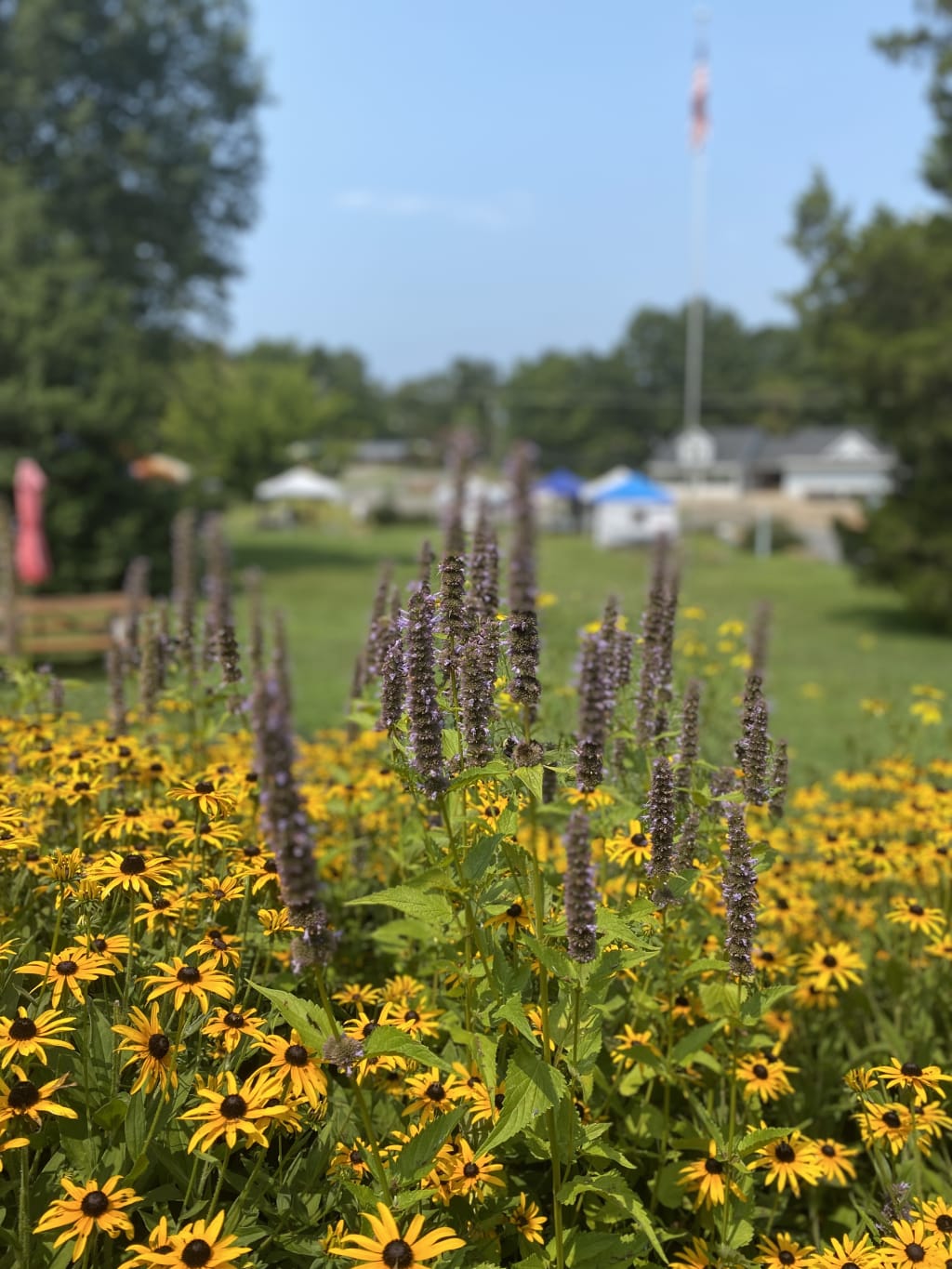
Around back, he had several beds laid out. Vegetable plots. Some roses. Some annuals in neat rows. About every third bed was growing wild with marigolds.
“This area is a constant work in progress,” he said. “Some plots are working to feed us fresh tomatoes. And we like peppers. If you ever want a trunk-load of zucchinis, you know where to find them. I’ll never miss’em.
“Mrs. Feldman likes fresh flowers on the dinner table, so I keep these beds over here. You can put together a decent bouquet, if you poke around a little.”
“What’s the story with these wild beds?” I asked.
“Oh, the marigolds! Marigolds only grow in bad soil. You can plant them anywhere nothing else will grow. The only thing they don’t like is if you fuss over them. You irrigate or fertilize a marigold, it might just get insulted and go dormant on you. They’re not that pretty, but you can plant them and leave them alone. And they’ll flower and flourish. And they’ll actually improve the soil. So, next year, I can put something else in these beds…something that wouldn’t have grown here before. And I can put marigolds in the depleted soil over there.”
#
It was a pleasant day in Mr. Feldman’s garden. I think I got a good grade on the paper. I graduated, moved on, had a life of ups and downs like everyone else. Never saw Mr. Feldman again. But I sometimes think about his marigolds. And I wonder if he was telling me how to garden, or how to run the best school you can in a ghetto, in a dying mill town.
###
About the Creator
James Gibbons
I’m starting to write fiction, poetry, and commentary again. Been writing other things for other folks for quite a while. I’d love for you to read my work and let me know what you think.
Keep reading
More stories from James Gibbons and writers in Fiction and other communities.
A Love Forboding
The chipped stone slope caused unbearable footing. I slid, skirting on my heels. I cast my shield, relinquishing my guard to stay upright. Left with my double-edge and a prayer to the maker, I skated toward my objective. The earthly stubble gave way to solid ground. I found myself restored, a trail of dust in my wake.
By James U. Rizzi2 days ago in Fiction
Ballet of the Butcher Star
The air backstage at the Grand Theatre was a palpable entity, thick with the ghosts of a thousand performances. It clung to Elara’s skin like the faint, sweet-sour scent of sweat and rosin, a perfume she wore more constantly than any designer fragrance. This was not merely her workplace; it was her sanctuary, her confessional, and increasingly, her cage. The polished oak floorboards, worn smooth by the endless procession of pointe shoes, reflected the dim, amber glow of the utilitarian work lights, transforming the labyrinthine corridors into a gilded, echoing maw. Velvet drapes, once a vibrant crimson, now sagged like weary eyelids, their nap worn thin by the caress of countless hands, each touch leaving an infinitesimal residue of longing, of aspiration, of despair.
By LaRae Pynas7 days ago in Fiction


Comments
There are no comments for this story
Be the first to respond and start the conversation.