
Mirror: 11:11

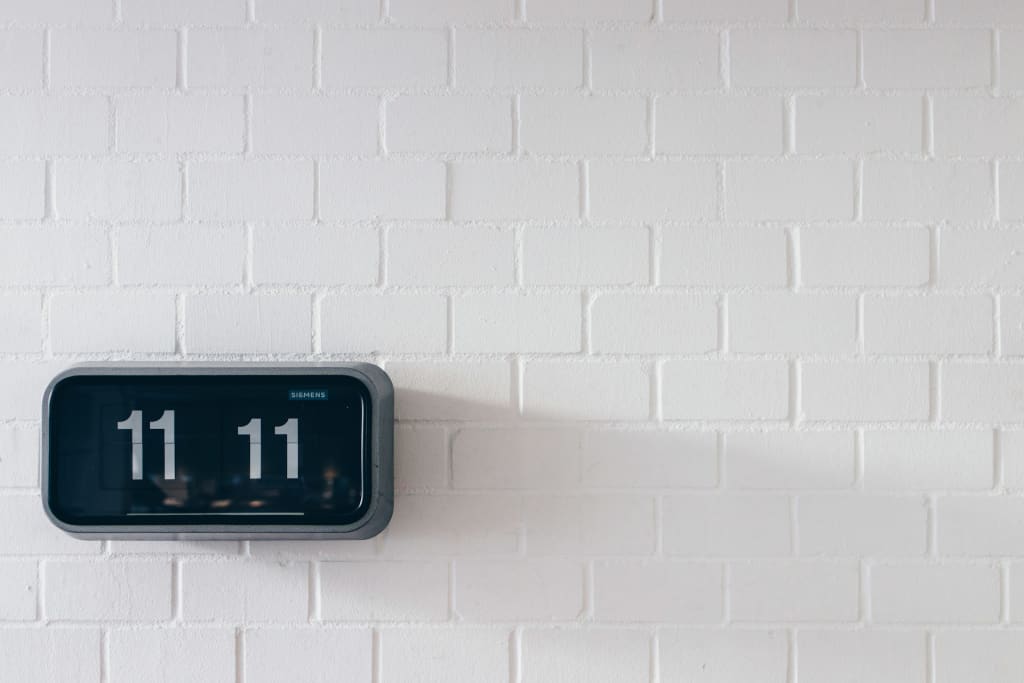
The morning the timelines started bleeding, the clocks forgot their loyalties. My oven blinked 11:11, my phone swore it was 9:03, and the radio was half weather, half poetry reading, both insisting I bring an umbrella.
“Don’t make the coffee,” a voice said behind me, which was offensive because coffee was my religion.
I turned. I was looking at me: same scar along the wrist from the time a mug exploded, same messy braid, same chipped nail polish, different shoes.
“Don’t make the coffee,” she said again, and lifted one of my mugs to sniff it. “In my version it ignites the ceiling fan and we have to explain it to three different fire departments.”
“In my version, it wakes up this neighborhood,” I said, reaching past her for the grinder. “Who are you?”
“I’m what happens if you take the job in Portland,” she said, as if that explained anything. “Also, the grinder jams.”
“The grinder always jams,” I said, and then the grinder made a sound like a trapped bee and jammed.
We looked at each other. She laughed first.
“Okay,” I said, “I’ll get the French press. You ... other me ... what do you go by?”
“Dee,” she said.
“I’m Dee,” I said.
“Right,” she said. “Well. That’s inconvenient.”
The bell over the cafe door gave up on choosing a timeline and just rang twice, overlapping. People came in like they’d been poured from different pitchers. A man in a firefighter’s jacket over a tuxedo. The regular who always orders peppermint mocha when it’s too hot, except she had a bandage over one eye and a tattoo she didn’t yesterday. A kid on a scooter streaked in and then was not there, and then was, holding a different scooter, like he’d leveled up.
“Is this ... ” the peppermint mocha woman began.
“ ... where I find,” the firefighter said at the same time, “a phone that ... ”
“ ... still dials home,” the kid finished confidently, as if that had been the plan.
My other self clapped her hands like a teacher trying to make a classroom settle. “Okay! Welcome to Dee’s, where reality is taking turns. We’re going to try not to panic. Also, please don’t touch the espresso machine. I’m pretty sure it’s a time organ now.”
“Um,” said a new person who was also the barista we hired last month, except he had purple hair and a ring I’d never seen. “Do I work here today?”
“Yes,” we both said, and he seemed relieved.
Outside, sirens attempted a duet. In the bakery across the street, two bakers argued in two languages and then, mid-argument, swapped the language they were speaking and carried on without missing a beat. A woman sat on the curb drawing lines with chalk across the sidewalk, straight, purposeful lines.
“What are you drawing?” I asked her when I brought out a tray of scones, because that, at least, made sense in every world I knew.
“Seams,” she said. She looked up at me and then up a little more, like she was adjusting for a different height I might have had elsewhere. “My grandmother said when the quilt gets old, you see where the pieces meet.”
People were listening to the radio. It kept switching voices, same script delivered by different versions of the same news anchor.
“Officials advise citizens to remain calm,” said one.
“Officials remind citizens that calm is a social construction,” said the next, and then laughed on-air. “But try anyway.”
My alternate handed me a towel and leaned close. “In mine, there’s a city office that shows up right about now. Continuity Liaison. We called them Stitchers because they hated it.”
“They hated being called Stitchers?”
“They had branding decks about it,” she said gravely. “Oh ... here they come.”
A woman in a high-visibility vest stepped into the cafe. She had a notebook labeled Municipal Office of Continuity and a face that looked like it had memorized every kind of paperwork.
“Hi,” the woman said briskly. “I’m Alvarez. We’re asking gathering spots to run anchor practice. It helps.”
“Anchor practice?” I said.
“You pick a simple story about the moment,” Alvarez said, flipping to a foreword with diagrams. “You tell it together. The same way. That helps the bleed slow down. A sort of narrative phase lock, if you want the jargon. If you don’t, think chorus.”
“Like a chant,” Peppermint Mocha said, wary.
“Like a chorus,” Alvarez repeated, reassuring. “No monks necessary.”
“Okay,” I said, and climbed onto the counter because if there’s a day for standing on furniture, this was it. “Everyone, let’s anchor to a coffee order. We all know coffee.”
“Except the ones of us who don’t drink it,” my other self murmured.
“Tea later,” I said. “Right now: we’re going to say, ‘At Dee’s, we start the day with a cup of coffee that smells like toast and the promise of rain.’ Ready?”
We said it, lurching and overlapping, some voices insisting the coffee smelled like cedar, one substituting cardamom. We said it again. By the third time, the words found each other. Outside, the sirens settled on a key. The radio held one anchor’s voice a whole sentence long.
The kid with two scooters put one down and it stayed one. He grinned like a magician after the trick works.
“It won’t fix the big stuff,” Alvarez said, softer. “But it gives the city fewer edges to trip over.”
“Does it bring back the people who ... ” the firefighter began and couldn’t finish the sentence.
“No,” Alvarez said. “But it makes it easier to find them, if they’re nearby. Think of the city like a crowded station. Anchors are announcements over the din. ‘Meet you by the fountain,’ that kind of thing.”
My heart remembered something it had been doing all morning ... worrying constantly ... and picked it up again with urgency. “I have to get to the school,” I said. “My daughter ... ”
“In mine,” my other self said, meeting my eyes, “I didn’t make it in time and she walked home with a version of me who taught her to whistle like a bird. You will want to be the version who arrives.”
We left the cafe with Alvarez’s card taped to the door and a hand-lettered note: If your timeline makes you allergic to muffins, tell us. The street was a film on a bad streaming connection, buffering and snapping back. The skyline had acquired a building that was not there yesterday, a glass needle that flickered as if shy about existing. The soccer field down the block kept remembering old festivals: we walked through a carnival crowd in clothes from a hundred summers; for three steps we were ghosts in someone else’s parade.
We kept speaking like we were laying down rails.
“Okay,” I said, loud, like a declaration makes a path. “We pass the mural with the blue whale.”
“It’s an octopus where I’m from,” my other self said, “but let’s call it a whale today.”
A teenager on a balcony was running a hairdryer at the sky.
“What are you doing?” my other self called.
“Blending!” they called back. “My aunt says it helps smooth the seams! It’s science! Or witchcraft! Or art!”
“Keep it up!” I said, because we needed the world full of people trying.
At the corner, a man argued with his own reflection, which had stopped mimicking him and was smoking a cigarette with disdain.
“You left,” the man said.
“You did,” the reflection said. “You just didn’t admit it.”
“Do you need help?” I asked, and when he didn’t answer, my other self said, “Anchor practice?”
We made him say his name. He said it three different ways and then one way and then he cried. The reflection dropped the cigarette and it fell down instead of up and we walked on.
At the school, the playground was a mosaic of afternoons. The monkey bars were briefly a scaffolding for junior astronomers; a second later they were hung with paper cranes from an art day that happened and didn’t. Kids sat in a circle on the chipped blacktop and sang the alphabet song like a spell. Each letter was a little boat they launched together. Their teachers sat with them, eyes bright with relief when they saw me, and then that relief doubled when my other self peeled off to hug a version of the teacher she knew.
“Iris,” I said, and my kid looked up and her face did an expression I had never seen: the exact mix of “you made it” and “I was making it without you” that belongs to children in all universes.
“You look tired,” she said.
“You look like a scientist,” I said, which was true because she had goggles pushed up on her head like an idea she would get back to.
“Can we go home?” she asked. In her other hand, she held a paper crane and also a smooth, flat piece of glass that wasn’t glass, like a lens from a future I didn’t know.
“We can try,” I said.
“Do we have to walk through the ocean?” she asked, very calm about it, pointing at the soccer field, which now had waves lapping it like it had remembered being a lake, or was trying to be one.
“Only ankle-deep,” my other self said. “We can narrate it into being shallow.”
“Everyone,” I called, and twenty kids looked up. “We’re going to go home. The puddles are only ankle-deep, even if they look big. The sidewalks are sure of themselves. The doors remember us.”
They repeated it. The puddles are only ankle-deep. The sidewalks are sure. The doors remember us. We stepped into the water. It was cold, and in one version of my life it came up to my knees, and in another, we were already dry, and in this one, we laughed and made a game of choosing stones to step on.
On the other side of the field, the street sorted itself into a Tuesday like it was trying on an outfit and didn’t hate it. My other self stopped at the corner where our paths split.
“You’re going to take the job in Portland?” I asked her.
“I think I already did,” she said. “In some places I’m coming back next month. In one I never leave. In this one… I don’t know yet.”
“Will we bleed again?” I asked.
“Probably,” she said. “But maybe we’ll be better at it. Maybe we’ll learn to talk across the seams before they split.”
We looked at each other like mirrors do, not copying, but translating.
“Hey,” she said. “In mine, Iris learns to whistle like a bird.”
“We can make room for that,” I said. “After homework.”
Alvarez’s voice came over a loudspeaker somewhere, steady and human. “If you can hear me,” she said, “tell someone a small true thing. It helps.”
“My shoes are wet,” Iris said seriously.
“I hate the French press,” I said, and my other self laughed like she’d been waiting for me to admit it for years.
“Tomorrow,” she said.
“Tomorrow,” I said, and the day, contrite and rumpled, pretended to be one thing for a while, because we asked it to be together.
- Julia O’Hara 2025
THANK YOU for reading my work. I am a global nomad/permanent traveler, or Coddiwombler, if you will, and I move from place to place about every three months. I am currently in Peru and heading to Chile in a few days and from there, who knows? I enjoy writing articles, stories, songs and poems about life, spirituality and my travels. You can find my songs linked below. Feel free to like and subscribe on any of the platforms. And if you are inspired to, tips are always appreciated, but not necessary. I just like sharing.
YouTube Top Song List.
https://www.YouTube.com/results?search_query=julia+o%27hara+top+songs
Amazon PlayList
https://www.amazon.com//music/player/artists/B0D5JP6QYN/julia-o'hara
Spotify PlayList
https://open.spotify.com/artist/2sVdGmG90X3BJVn457VxWA
You can also purchase my books here:
https://www.lulu.com /spotlight/julie-ohara
I am also a member of Buy Me A Coffee – a funding site where you can “buy me a cup of coffee”
https:www.buymeacoffee.com/JulieOHara
About the Creator
Julie O'Hara - Author, Poet and Spiritual Warrior
Thank you for reading my work. Feel free to contact me with your thoughts or if you want to chat. [email protected]
Keep reading
More stories from Julie O'Hara - Author, Poet and Spiritual Warrior and writers in Fiction and other communities.
Spiritual Graffiti
“Leave it,” Javi said, leaning on the pressure washer. “It’s half art, half therapy.” “It’s a job,” I said, rolling my sleeves. The underpass wall screamed with thick black letters: NOT MINE NOT MINE NOT MINE. The city seal flapped on a tarp nearby like a scolding parent.
By Julie O'Hara - Author, Poet and Spiritual Warrior4 months ago in Fiction
THE EMBER AND THE ECHOES
Episode 7: The Hollow Lord The groan of the rising portcullis was the sound of the world shifting. Kaelen walked through the gate’s shadow, the eyes of the Talons boring into him. No one moved to stop him. No one touched him. The name ‘Morvath’ had acted as a key more potent than any steel.
By Akua Anita3 days ago in Fiction


Comments
There are no comments for this story
Be the first to respond and start the conversation.