

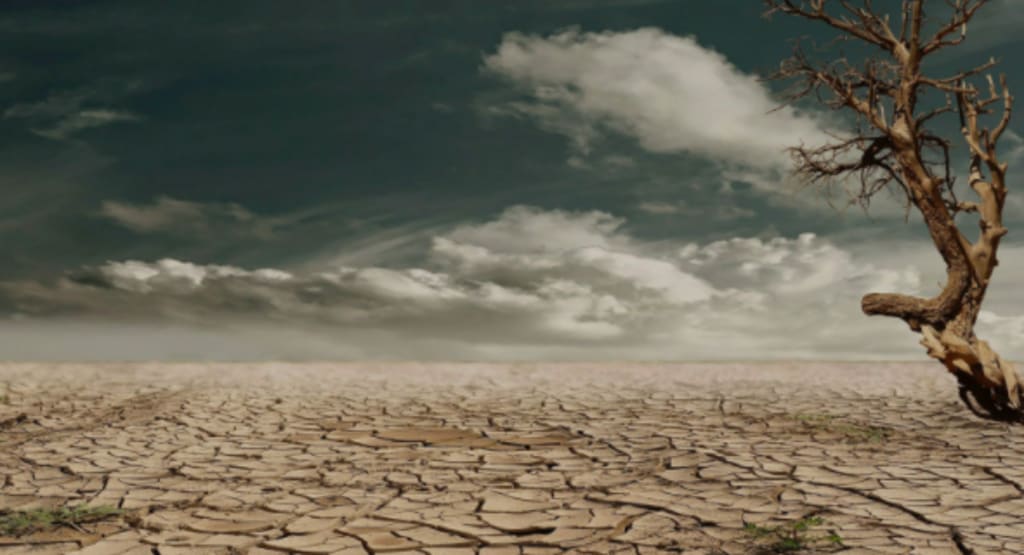
As Margot sat out on the dry dusty porch of the home she shared with her mother, she cleaned her rifle with rote methodicalism. She let her mind drift back 20 years to Bones, Baker, and Sampson. The only friends she could remember having had in her entire 35 years of life.
Life.
What kind of life was this?
Margot huffed a sardonic laugh. It was a life of mercy.
It started with one dry winter. Then another. And another. Then the fires started. Northern California turned into a tinderbox. But they weren’t alone. Across the continent, the rains stopped, grass grew brittle and brown. The entitled and posh first complained about not being able to water their lawns. Then began the political fights about which communities were entitled to the reservoirs. Farmers were denied access in favor of corporate interests like Coca-Cola. Power outages increased as power substations fueled by running water were shuttered. Earth began to look more and more like Mars. Ancient evidence on the faraway planet indicated that, it too, was once a lush wonderland of water and biological life. But now was a parched sphere of desolation and despair. Earth’s condition was not as far removed as its residents once imagined.
The foresight that had Margot’s mother filling every square foot of their tiny yard with a “survival garden” years ago had led neighbors in their small conservative town to roll their eyes and declare the pair, “liberal-leaning fear mongers”. Now, twenty five years later, Margot and her mother monitored the quarter acre plot 24 hours a day. The little garden was watered with the very slim allotment of water they trudged back from the city center every week.
Most of the town had vacated after Lake Oroville, the largest reservoir in the Sacramento Valley, had dried up completely. They had filled their large gas-guzzling SUVs and even their recently purchased RVs to head toward the East. Hoping to find literal greener pastures.
What they left behind was plundered and scavenged. Margot had not felt guilt as she found items of any value at abandoned and desolate homes and lugged them to the scrap yards, and resale shops, or even bartered for an extra jug of potable water (a rare transaction to be sure). An old man she mercifully brought food to from their garden had given her his stockpile of guns and ammunition.
Margot and her Mom had been staunchly anti-firearm prior to the drought but soon realized the necessity of protecting their valuable little plot of sweet potatoes, beans, spinach and cabbage. She scavenged, while her mother took her shift guarding the garden. Then she would take a shift while her Mother slept. When her mother woke, Margot would sleep for a few hours and their monotonous routine of survival would begin again.
A few years ago, Margot had been able to barter with an old Punjabi man; trading an entire barrel of beans for a camel and llama he had been preparing to slaughter. Those animals now occupied the tiny backyard where Margot’s beloved pit bulls had once frolicked and rough-housed. Where squirrels had taunted them. Until the squirrels disappeared. So many had been shot for food.
To be sure, the dogs would have been long gone now even had they lived long, comfortable lives.
But no one on this Earth was expected to live long, comfortable lives. Especially animals not raised for stock. They were an expenditure most could not justify. They did, after all, need water to survive and human survival usually won out in the battle of survival of the fittest. Margot fought as hard as she could for Bones, Baker, and Sampson during the early years of the drought. Her mother had wanted to cut their expense immediately. For Margot though, the animals were more than pets, they were family. They earned their keep for those first few winters without electricity when their body warmth kept Margot and her mother warm. For Margot, their emotional contribution was justification enough. But the drought wore on and it became more and more apparent that this dry, dusty world was to become a permanent reality. The arguments between mother and daughter became more and more frequent.
Margot knew her mother made logical sense. But every day, as the dogs greeted her return home with kisses and tail wags, she found it difficult to give them up.
Before the drought started and, if she were honest, for quite awhile after; the dogs were given as much water as they wanted or needed. A large Tupperware bowl sat in the kitchen and was filled whenever Margot noticed it was getting low. Then, it was filled only once a day. Eventually, they were only given a small bowl with their two meals a day. Three years later, they were only fed once a day and water was only given then. She watched them grow thin and lose their energy. They were growing older too and she tried to write their decline off to that, but she knew in her heart that they wouldn’t survive much longer without proper nutrition and hydration.
None of them would.
As much as she felt that their lives were as valuable as hers, she knew that without her, they wouldn’t survive anyway. After all, the dogs couldn’t farm. They couldn’t access water.
Perhaps she could have just opened the gate and let them wander. Perhaps a traveller would have picked them up. More likely, they would have run wild for a few hours and come home tongues hanging thirsty and just as full of love.
She had taken weeks to make her decision. She considered selling them. She knew they would be killed immediately for their meat, bones, and teeth but at least it wouldn’t be her who had to kill them. However, she knew she couldn’t watch them be carried away, scared and curious. She had decided on her fifteenth birthday. She would have to be the one to betray them.
Her mother attempted to console her, reminding Margot that she had provided an act of mercy and love, not betrayal. But her heart still broke. Her hand still shook. Her lungs still wailed. Her sorrow was so great for the days after the three shots rang out that she could not leave the house. Neighbors stopped by the garden to offer words of wisdom and comfort when she took up her post on the broken dusty sidewalk in front of their home.
Now, so many years later, she fondled the heart-shaped locket she had carved from Sampson’s skull. The string it hung from was worn and tattered. She thumbed it as she lifted her now-loaded rifle with her right hand. Her shooting hand. Her mother had grown as faded and frail as the miniature photograph framed inside the smooth bone. She headed inside to complete one more act of sad mercy. She vaguely wondered who would be around to do the same for her someday.
About the Creator
Megan R Williams
Born in Lawrenceburg IN, I live CA with my 2 human kids and my 3 canine kids. I went back to school in my 30s to become the teacher I was always supposed to be. Teachers don't have much spare time, but when I can, I love to read and write.
Keep reading
More stories from Megan R Williams and writers in Fiction and other communities.
Nostalgia
She waited an appropriate amount of time before she slipped out the side door. Not that she would be missed. She was barely known to anyone at the wake and those that remembered her decades-old connection to the old man thought it was just sweet that she had come and shook her hand before moving on to other well wishers. She had eaten a devilled egg, sipped a glass of wine and circled among the crowd once. Now she crossed her arms tightly across her chest bending against the brittle late autumn wind wishing she had stopped to grab her coat.
By Megan R Williams5 years ago in Fiction
Pandora’s Burden
“My brother warned me to not accept gifts from the one who commissioned you,” said Epimetheus to the woman clad in silvery raiments standing at the entrance to the temple. Her silver tiara and the silver rings on her fingers and toes glinted in the firelight cast by torches set on either side of the doorway. Lingering in the shadows, beyond the reach of the flames as she was, he could not tell what she held in her hands. At first what appeared to be a box was perhaps a funerary urn, or maybe merely an apple.
By J. Otis Haasa day ago in Fiction
A System That Isn’t Working Challenge Winners
Systems promise order. They organize behavior, distribute opportunity, and suggest that if everyone follows the rules, things will work. The entries in A System That Isn’t Working look closely at what happens when that promise begins to slip.
By Vocal Curation Team3 days ago in Resources


Comments
There are no comments for this story
Be the first to respond and start the conversation.