

The mariachi band had drifted to sleep by the town's stone fountain another night, snoring and squirming, on occasion scratching at one place or another, ignorant of the town's wakefulness as people began to rise, remember life's demands, and move through the streets under the purple dawn sky. The pigeons cooed in their morning choir as the fattest and baldest of the three men laid flat on his hide against the concrete hugging his guitar. His black, white embroidered sombrero laid beside, mounting the dirt. The discordant chirps reached him, navigating through the deep dark slumber, and poking him to agitation. He turned, shuffling onto his side, and raised his knees to a fetal position. The two other men, one young and thinly and bare faced, the other a few pounds from butch and fashioning a thick moustache, were leaned against the fountain's stoned circular wall, their eyes closed, shoulders kissing, and their white shirts stained caramel with liquor. Glass bottles, dull green and some clear, were scattered around them, and a few stood on the wall, still holding reasonable drink. Silver coins speckled the concrete, tapering the three and glinting as if the dust of broken stars.
~*~
The old water fountain centered the small town of Medei. A commemorative piece saluting the arduous efforts of the native politician Miguel Santos who three decades ago strived to have the town, at last, join the country's railway line. The people had long sought such connections for the town, which in most paths of its radial degrees was surrounded by dry, barren, and uninhabited earth. The grounding of the metal tracks was undertaken by rail-technicians from the inner cities who labored through the long summer days, under a blistering sun. Their white vests clung to their sweat coated skins, which glistened as if metallic, and dripped onto the cracked earth. With unashamed greed the workers sucked the cooled drinks brought to them by Medei's residents throughout the day, and they rested in the shades of the cotton tents that had been erected by the tracks.
With the rattling of the carriages, a tremendous elixir of growth was injected to all limbs of the town's miniature economy. The new convenience allowed for the import of foreign goods and nourishments, and the carriages too were stocked by Medei's merchants to fill the little demand existing beyond, mostly of wheat, barley and honey. As the residents' rail rides to the inner-cities grew in frequency and the exotic pull of the novel realities lingered within minds on their return, and reeled behind closed eyes, new colours and habits germinated and flecked the town. Garments of different shapes, and tones shuffled through the streets. Fantastical and magical appliances to ease ones work dotted homes, Martha's blender, or as the town's folk called the little mechanical beast, Fruit-crusher, would often trip to the kitchen of one house or another, and it had splattered Sofia Marine's walls with red streaks of tomatoes after she left the lid sitting loosely. There came in wooden crates foods and cooking spices with unusual sweetness, or face-contorting bitterness, or unpalatable foulness in which instance the importing of neatly packeted disposable napkins proved quite useful. The first television of Medei arrived on the tracks. The frugal Mr Hermes, monobrowed and gauntly, had closed his salon for the day to make the trip to the city. On his return, he alighted the carriage carrying the thing in both arms, his back arched as if the crescent of a new moon. The man ignored the offers of help hurled at him, and a river of the town's people jostled at his rear, moving through the streets as if a slithering reptile. That afternoon, for the first time, as trays of fizzing lemonade was passed within the jammed living room and to those stood outside by the open window, they watched the news - in all its black and white glory. The heart of the town pumped with a new vigor, and a little of the gloom of the ordinary was lifted, replaced with obesed dreams and hopes.
~8~
Amongst all the newness worn by the town's folks stood a little girl, Maria Hurgle, who had not found her treasure beyond Medei for some time. With head-raising hope, she would cling onto the hand of her mother, or father, for their trips to the inner cities but they would always end with the sour-faced girl jumping off the returning train at Medei with her arms folded, her lips downturned, and her eyes trawling the mud, not rising to the calls of her parents as if congealed wax had saturated her eardrums.
Maria was a quiet girl. She often did not look towards another let alone speak, and for a while a rumor had swirled around the town that the girl was a mute.
"She is a little shy," her mother would say to another's concern. As the two scurried through Medei, attending to the house's daily demands, her mother would be seen kneeling and placing an ear at the girl's lips during their talking.
The 'silent girl', as the people uttered when without her presence, became the town's ailed Bambi, at least amongst the older folk. They would often work to allay the girls hurt as she trod behind her mother or father who hefted bags filled with foods, or clothes, or other household items. 'You'll find something one day Maria,' Aunt Rosa would shout as she stood outside her second-hand clothes store, a cherry infused tobacco leaf lighted at her lips. 'Don't worry dear, here take a candy,' would say the grocer Armado as he threw a sweet towards the girl, only for it to meet the sole of her shoe.
The curious children of Medei had grown to suspect the girl of enigmatic wickedness, and their disparate tales held such obscenities that they dared not allow an adult to hear of them. One such tale accused the girl of slaughtering Helio, a gauntly and malnourished, stray cat the children had adopted, and who of a sudden had disappeared. It was whispered the girl had drank its blood and plucked out its eyes, holding them in jar under her bed. Often peering from beneath her jutted brows, the girl held some inkling of the nature of what was said by the sniggering children who always stood away, at a distance. And, it did not help her image the least the day the girl found her treasure.
The late-July sun blasted its hot rays onto the train-station's concrete platform as Maria Hurgle, dressed in a blue floral frock, alighted behind her mother. On this occasion, however, the girl's visage was not soured. The edges of her lips were not drooped, but instead straight and, her arms were not folded but rather clutched by her small hand was the wooden handle of a black steel cage.
From within the cage, two black beady eyes peered from a white face as if a pair beetles burrowing into pale sand. A sharp nail-like beak hung as if a misplaced talon. Its feathers were white and sparsely dotted, except the wings which hung browned. The girl had bought a barn owl. The poor thing was obviously too big for its home as its head almost touched the roof of the cage.
Looking on from the streets, and peering from shops, faces holding looks of curiosity, utter bemusement and concern flanked Maria and her mother as they walked home that afternoon.
It was said Alberto Sella, a farmer who had experience in bird-keeping had visited the Hurgle household concerned of what he had heard, and had advised against the keeping of such a thing within the house, nor in a cage. The girl however was inseparable from her new companion, and was no longer sighted without the cage at her hand.
To the children of Medei, it seemed the owl stared out from the cage with a strange knowing, with a superior conscience and comprehension beyond any other bird, or animal. Unsurprising, their stories had grown in new directions and obscenities, amongst them, however, some now stood with their lips unmoving, in a new silence and unease. For them, the tales began to lose their fictitiousness, and held a touch of reality within their infantile minds.
In turn, Maria Hurgle's silence became splintered with the rare word. It was less frequent that her mother would bend her ear to the girl's mouth. But more than her parents, or the residents of Medei, Maria was seen to speak to her owl. The girl walked through the town with a pump at her feet, and her eyes floated taking all in. The girl was once seen running, struggling to hold the cage high in the air. As her mother took respite outside Aunt Rosa's shop, the two ladies sitting on the wooden chairs set out by the entrance, the girl would place her cage on the old wooden bench on the street, beside town's library.
It was late-afternoon on a Saturday when Maria Hurgle sat on that bench, waiting as her mother had walked into Aunt Rosa's clothes shop, the pair brewing a kettle of tea at the shop's rear. The skies had glowed orange as the sun began its departure. The girl sat in deep conversation with her friend.
'I shall buy myself a mansion, and I shall buy you a zoo,' she had said to the owl. 'But don't worry, I will take all the animals out of the zoo, so it will just be you alone, and you will be safe from the lions. I promise. And we shall drink tea and-'
'You weirdo,' a voice interrupted.
Maria turned to see Tito Marcos stood on the mud, his arms folded. His broad face held fattened cheeks, and brows severely arched and menacing. His tousled black hair clung to his sweat glistening forehead. Tito was not of the children who had grown with fear on the owl's arrival to the town of Medei. Rather, he found it an ingredient to darken his tales.
'Why do you talk to a bird, you weirdo?' he said, picking up a stone from the ground.
Maria sat silent. Her eyes glanced towards Aunt Rosa's shop. Her mother was not in sight.
'They're busy having tea,' Tito laughed, as he stepped forward and hurled the stone at the owl's cage.
The girl's face had gone pale with terror, and she stood up, arching her head, and looking again towards the shop. her mother was not in sight.
The boy picked up another stone, and another. He balled his hand and flung with all his might. The second stone struck the owl's head.
Maria's jaw muscles had hardened her teeth rigid in clench.
Kneeling over and picking at the mud, Tito picked out another stone, enjoying its weight on his palm, his lips upturned in a smirk. He raised his balled hand above his head.
'Stoooopppp!'
The girl's shout was ferocious. For a moment, the boy caught a hellish blaze in her eyes, which lay simmering.
A pang of fear sprang into his limbs, and his legs grew a hollowness. He gulped. He felt his chest warm in his agitation. The distant chirps of crickets filled the pairs silence.
'Why-why do you even speak to it? It's just a dumb owl.' Tito said at last, wanting break the angered-mould of the girl who he saw had fisted her hands.
Maria found her mouth no longer held the constraints of reservedness. 'He is not a dumb owl!' She wrapped an arm around the cage. 'He understands everything I say.'
The little discourse, a hop towards civility, lessened the boy's anxiety, and his lungs became full with air. Cunning flecked his thoughts. Never again was he to feel the girl's protective-wrath, which conjured a sensation he often felt under his drunkard father's belt.
'If he understands you, then you could tell him what to do?'
The girl's eyes met his, and turned away looking to the late-afternoon skies, in thought. 'Well, yes, I can.'
A grin flashed on the boy's face, and he hurried to place a deceiving palm across his mouth.
'In that case, why don't you let him out of the cage. Tell him to stand at your side.'
Maria remained silent. She looked towards her shoes, and then again, turned her face towards the horizon.
'You won't because it can't understand anything you say. It's a dumb owl, and you're a weirdo,' the boy's courage had returned with full cavalry. 'Just a dumb owl,' he finished, his eyes bursting wide, dutifully watching the affects of his words.
A mysterious pull tugged at the girl, and she allowed her hidden inner-sense to be veiled by loyalty, or maybe it was pride. Her hands moved towards the cage's latch as if puppeteered by an insurmountable force. She pulled open the steel door.
For a few seconds nothing happened. The owl stood still, unmoving, staring. Then of a sudden it lurched forward, attempting to escape the cage in a sudden raucous. Its tremendous wings however, stopped its escape. It settled, and tried again. It was out, stood on the bench looking towards the boy, who felt the unease of before return as he stepped back. It padded along the bench. Stood still, and looked towards Maria.
'See,' the girl said, turning towards Tito. 'It knows to stay with me, as it my friend and we-'
The owl sprang up into the air from the bench, it wings terrifying and wide. It landed onto the dry mud. It scuttled forward. 'Stop!'Its wings flapped once again, giving it little flight. Maria Hurgle snatched up the cage and hurried towards it. 'Stop!' The owl flapped with more zeal and lifted smoothly into the air, gliding in splendor towards the horizon. The girl trailed at his rear, her running silhouette marked with a door-flailing steel cage in hand. 'Stop! I didn't tell it to stay.' Mrs Hurgle and Aunt Rosa hurried out from the shop, the tea cups dribbling in their hands.
~8~
As is life's decree, lips soon stopped their utterances of the advent of the railway line in Medei, and the work of the great man, of the results of his life-long labored hands, and of his name. And, only a few of the locals tripped to the main city to stand by Miguel Santos' hospital bed as his lungs cycled their last breaths, and his grey glaucoma-painted eyes witnessed their final light. Death, however, holds the purest and clearest of voices, a relentless shrill shaking one's body to waken, though it be for a brief while. On his passing, a great fervor took a hold of the town, and a desire arose to engrave the man's name in history. The standing of a memorial was ordered.
For weeks, donation collection baskets were lugged door to door, and marked every turn of a street corner. Shops, and halls, and public offices did not fail in their duties, and nor did the town's governor who wrote a pressing letter to the main city of the affairs which had gripped the town, requesting finances to allay the grief. Within the town's assembly hall, following discussions amongst the residents, a list of potential candidates was narrowed at the scratch of a pen. A young but highly admired architect from south of the country was trammed in to undertake the great task. And for the first two weeks, to the annoyance of the town's folk, who stood with arms folded and in grimacing watch, the man just sat on the concrete floor against the library wall, often rummaging his hair and squinting his eyes as if battling-thoughts inhabited in his narrow cheeked head. His eyes would widen, telling all he had grasped on to a strong idea, and he would jut his chin towards the uninhabited space, only for both to fall again. A tale follows that Old Lady Herma trudged into Armado's grocery store, bought the largest loaf of bread on his shelves, and hurled it at the architect's head, and then hurried to clutch him to her soothing bosom. The hate and love of man is often a mutually inclusive state. Then one day he raised his eyes, and his chin jutted out, and he rose to his feet, and the engineers were called, and the builders were heralded, and the holy work began. Liberated by the innovations of electricity in the century past, the young man erected a three tiered water fountain which continuously pumped water.
The water sparkled golden infested with the sun's rays, and would trickle down into a stone-walled circular pool in which coins were seen to shine white. As the decades past, the monument become but a fountain, and the people busied along without thought, yet the water, the thing from which all grows, still trickled through the day.
~*~
Often unsheathed under the mid-afternoon sun, as they stood before the fountain, the melodious strings of the three man mariachi band, uniformed in white shirts, black jackets and pants along with wide-rimmed sombreros, would accompany residents who passed on their way. Taking a brief respite from the callings of life, feet would still, and small crowds formed in congregation, and eardrums soaked in the opiate sounds. Coins were lifted from pockets and purses, and fell at the tattered shoes of the three. Copious, stenching liquor fattened their bellies and loosened their tongues, and often, by the sunset would puddle at their feet, gleaming as slates of lava. The songs were cried late into the night Mariaaaa!. And when the melodies would mutate from err and drunkenness, under slow and blistered fingers, and their beauty became tainted with harsh discord, and when a heavy drowsiness took a seat within the mind of the entertainers, the last pluck of a string strummed through the night air, and silence fell on the town of Medei.
About the Creator
Captain Willem Sterling George Braunbauer, IV
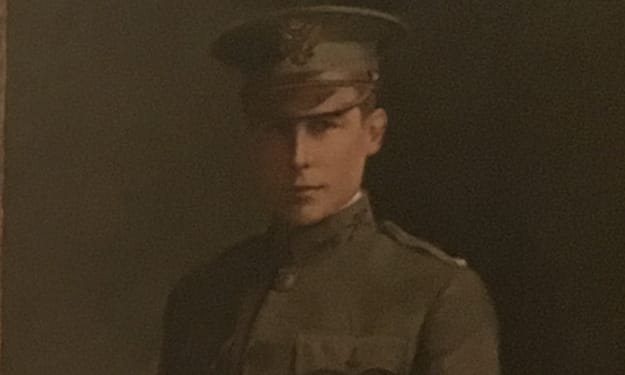
Willem Sterling George Braunbauer, IV wasn’t a Grandpa Bill or Billy. Grandfather Willem, the W pronounced like a V, was actually Captain Willem Sterling George Braunbauer, IV. The epaulettes of his drab green military uniform and piercing slate eyes sear from across the room, even after so many years. The oil painting, stark but beautiful, is accurate in its dismal precision: back, ramrod straight, strong jawline, blazing eyes with no hint of smile. Sterling could nearly smell the sweet acrid scent of the cigar aura that swirled around his father as he sat by the fire each evening, reading his papers.
By Cathy Schieffelinabout 10 hours ago in Fiction

Comments
There are no comments for this story
Be the first to respond and start the conversation.