

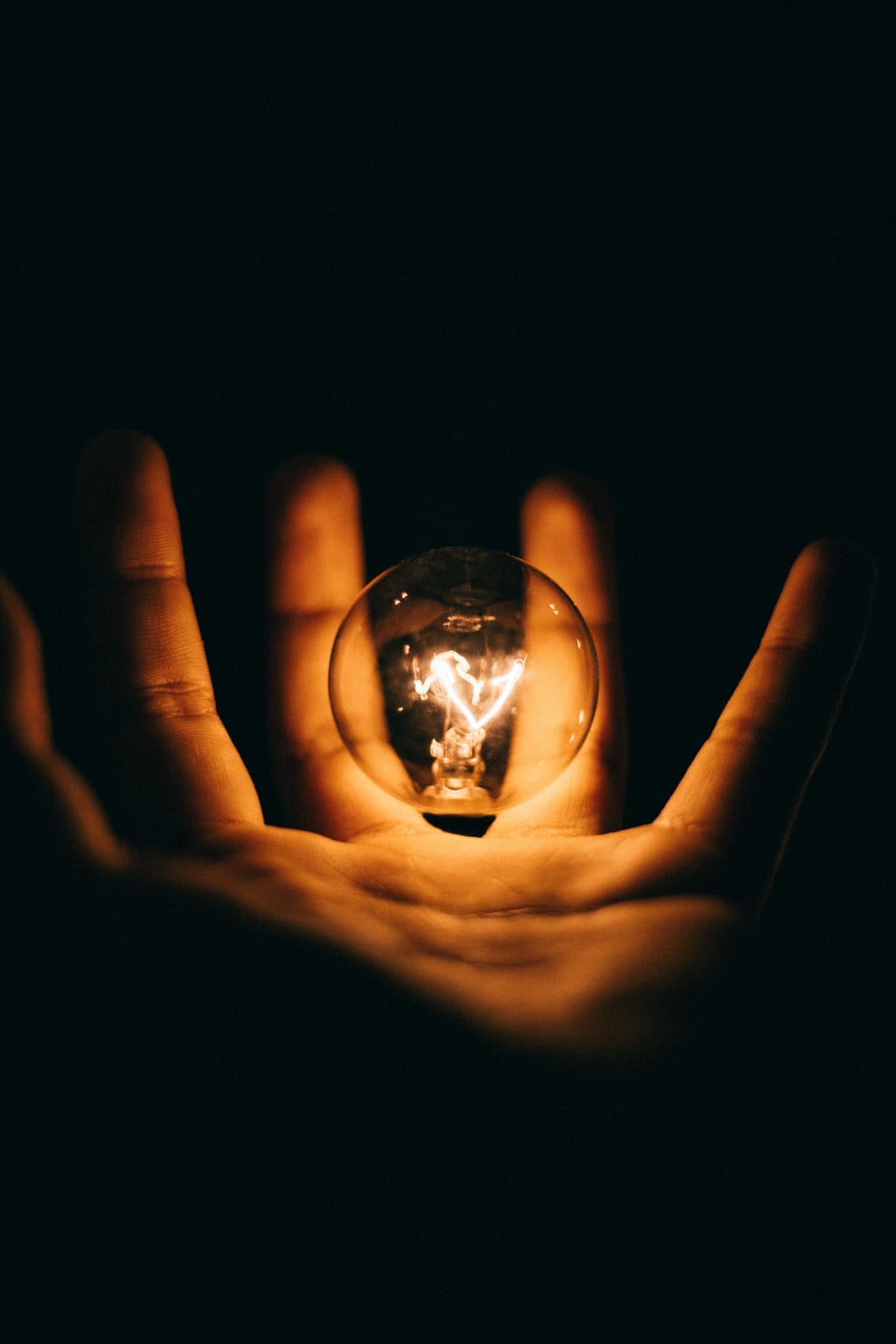
Ava has decided to give her Guardian a hard time.
When she woke up this morning in her bunk to find her stupid Locket glowing red, she immediately felt the urge to run. Of course, running options are limited when you live on an enclosed thirty-three acres with roughly forty thousand other people. There’s the track that runs the perimeter of Campus, but that’s not the kind of running Ava was after. When she looked at the soft red gleam of the heart-shaped interface implanted on the inside of her wrist, she didn’t just have the urge for a quick jog—she had the urge to fully scale one of the towering walls surrounding Campus and to sprint away into the vast, dark wilderness.
Of course, Ava didn’t actually do that. She didn’t even put on her running shoes to do some sprints. Instead, she followed Campus protocol, alerting her workforce manager and making her way down to the command center. But she did stop to eat breakfast in Cafeteria B on the way. And she may have purposefully taken a very long time eating her eggs and toast—a full two hours, chewing every bite with a methodical slowness that was clearly irritating the cafeteria workers—until the dim glow of her Locket had turned into a bright, pulsing red light.
The lingering is a small act of rebellion—an act of microrebellion, as Ava calls it in her head. When she tried to explain this concept to her father, he suggested that the term “purposeful unpleasantness” might be more accurate, or maybe “being difficult for no reason.”
But he’s wrong. There is a reason. Microrebellion has always been a way of life for Ava in a place where people don’t really rebel. And why would they? Everyone on Campus knows that they’re lucky, that what’s inside these walls is way better than the chaos raging outside of them. Despite her microrebellions, Ava knows it, too. She knows she’s lucky—so lucky—to be one of the people who made it on to Z-Tech’s campus that fateful week when the world went dark, lucky that her dad happened to have the forethought to drive them the three hours to the biggest tech company in the world to see if they were taking people in. She’s lucky to live here on Campus, when outside these walls, the fallout from the blackout still rages on, even now, twenty-five years later, with the remnants of the population ravaged by the virus or roving in bands or living in violent, tech-less communities. Thanks to Z-Tech, they have running water and electricity, beds to sleep in and food to eat. They have a life. She should be grateful.
And she is. But living like this comes with a lot of rules, codes and regulations and rations, a list of "have tos'' and “can’ts” and “don’t even think about its” a mile long. And even though Ava’s been living here since she was two, even though she’s known no other life than life on Campus, there’s a tiny part of her that wants to scream when her Locket tells her that she has to finish the soy sausage on her plate before she leaves the Cafeteria in order to meet her caloric intake goal, or when her Locket starts to blink to let her know that she’s not working fast enough at one of her maintenance tasks, or really anytime that her dumb heart-shaped screen glows and she’s forced to flip it open to reveal whatever message the Algorithm has decided to send her way.
But Ava doesn’t scream. There would be no point. Instead, she microrebels. For example: when her Locket glows red to tell her that today’s the day she’s going to be assigned her match—her soulmate, her life partner, her biologically perfect pairing—she doesn’t scream or run for the hills, no matter how much she might want to.
Instead, she takes two hours to eat her eggs, and then she gives her Guardian a hard time.
“Cool shirt.” Ava kicks her legs where they dangle off the side of the table she’s perched on. “Know where I can get one?”
The Guardian peers at his computer screen and frowns. Like all Guardians, he’s clean-shaven and short-haired, dressed in an olive-green shirt embroidered with a large G. His face is sharp and angular, his eyes are dark, and his nametag reads Jai. He hasn’t smiled at Ava once since she arrived.
“These shirts are for Guardians only. No other workforces.”
“Darn.” Ava snaps her fingers in mock disappointment, then rolls her eyes when the Guardian turns around to grab something from the counter. She knows the Algorithm only picks a very specific kind of person to be a Guardian, someone who meets the physical and mental qualifications to keep the peace throughout Campus, to enforce rules and monitor programs, to perform Locket maintenance and solve disputes. After all, the Algorithm only assigns about 3% of eighteen-year-olds to Guardian force during the assignment ceremony every year. They’re also the only force not allowed to go through the matching process. Ava’s not sure of the reasoning behind this, but she guesses that Guardians are just too serious, too important, too essential to the community to be distracted with a small thing like a match. She also guesses that this guy, with his scowl and his nonexistent sense of humor, is probably rolling his eyes internally at her: Ava the lowly maintenance worker, sitting here and kicking her legs on this too-high table like a child, waiting for him to tell her who she’s supposed to spend the rest of her life with. Which annoys Ava to no end.
“So, who are you going to pair me up with?” she asks Jai. She bats her eyelashes at him, faux-lovestruck, adopting a sugary-sweet voice and a fake smile. “I sure hope you choose someone handsome.”
“I’m not pairing you up with anyone. The Algorithm has been collecting biometric data from your Locket since it was implanted, including DNA and bloodwork, in addition to data from your school assignments, work assignments, and peer assessments. Based on this extensive data set, it’s found a match for you.” Jai sounds bored, like he’s reciting a speech he gives every person who walks through his office door to be matched. “This match has been made based both on biological data that might result in the best possible reproductive outcome for the community, as well as personal data that will result in personal satisfaction in your match, which in turn will result in a more productive community. It has notified both you and your match, who you will meet today in a controlled setting. Once I finish my maintenance check, we’ll be able to open your Locket and see who your partner is. And as you know,” Jai finishes, “the Algorithm has never mismatched a pair yet.”
“That we know of,” Ava adds. She thinks of Trevor and Isaiah, two workers on her maintenance force team, both still unmatched and both people she would rather jump off a tower than spend the rest of her life with. If she matches with either of them, she really will scream.
Jai frowns. “The Algorithm continues to track data through Lockets even after matches are made. This data has shown that all matches have been successful.” He presses her Locket, and it flips open, projecting a screen with her daily stats—heart rate, calories, work scores, sleep scores, pod number, work assignment. Today, there’s also a small heart icon with a question mark inside. Just looking at that icon makes Ava’s pulse race, her heart rate steadily climbing before her eyes.
“Unless the Algorithm is keeping negative data from you,” Ava replies absently. She glances out the door behind them, where she can only see a long hallway. Her match—who she’s supposed to spend the rest of her life with, ideally make a baby with to carry on civilization—is probably in this building somewhere. Unless he’s an early type of person, the type of person who scurried down here the moment he woke up and noticed his red Locket. God, a punctual, rule-following match—now there’s a truly disturbing thought.
She doesn’t even notice that she’s annoyed Jai until she turns around to find him staring at her, stony-faced. “That’s a serious accusation,” he tells her.
“Oh, please. I was joking.”
“It’s not funny.”
Ava stares at him. “Are you serious?”
“The Algorithm is an extremely advanced program coded by one of the smartest people that has ever lived. It allows us to live the way we live in here” —he gestures around them— “so we don’t have to live the way people live out there. Or the way people die out there, more accurately.”
“Look, I know that-”
“It processes an unprecedented amount of human data and uses that data to make recommendations for the best possible way that every human being on Campus can contribute to the society we’re trying to build. And it does so in a completely fair way, free of human prejudices. It frees us all from living under a leader with natural human biases, frees us from the threat of tyranny. It makes the hard choices for us, and it makes them in the best way possible. And it doesn’t make mistakes.”
Ava stares at Jai, at his crossed arms, his furrowed brow. His first speech was rote and recycled, but this one was impassioned, fiery. “Look, I wasn’t trying to offend you, or anything. I’m just nervous.” She nods to the screen, to that small question mark.
Jai studies her for a long moment before he exhales, shaking his head and tapping back into his computer. “I’m sorry,” he says without looking at her. “I can be sensitive, sometimes.” He pauses, like he’s considering something, before he continues. “My mom was on the outside when the blackout hit. So...you know. I just feel like we should appreciate what we have here, is all.”
Ava softens at this, forgets her nerves for a moment. “Yeah. My mom was, too.”
Lucky. That’s what she has to tell herself, when she finds herself hating the mandatory bedtime, the tiny bathroom and bunkroom she shares with fifteen other women. Lucky. When she got her job assignment in maintenance force when she turned 18, that green M lighting up her Locket, and she knew she was destined for a lifetime of gardening and cleaning, laundry and fixing. She thinks of her mom, on a business trip halfway across the world when the blackout hit, and she says it to herself, like a mantra: I’m lucky. I’m lucky. I’m lucky.
“Well.” Jai shakes his head, and Ava can practically see him pulling his officious Guardian mask back into place. “Anyway. Your maintenance checks are all clear, your data looks good. Let’s go ahead and find out who your match is.”
Her match. A move out of the bunks and into a two-person pod. Maybe it’ll be a good thing. Ava takes a deep breath and nods.
Jai taps a code into the computer screen in front of him, and the screen of Ava’s Locket goes black for a second. One more keystroke from Jai, and the screen flips back on.
There’s a picture in the heart. A picture of a man.
A picture of Jai.
“Your partner’s name is…” Jai’s voice trails off as he reads his own screen. He shakes his head, squints. Snaps his head up and peers at Ava’s Locket. “That’s...no.”
Ava stares at her Locket screen, frozen.
Jai inhales sharply. “That’s impossible,” he mutters. His face is ashen, his eyes wide. He looks, in Ava's opinion, terrified. “That can’t be...I can’t be.”
Ava snaps her Locket closed so that her screen disappears, leaving Jai staring right at her face.
“The Algorithm never makes mistakes, huh?”
For the first time all day, Ava smiles for real.
About the Creator
Kate Anderson
Fiction (usually romance) based in New York (usually Brooklyn).
Keep reading
More stories from writers in Fiction and other communities.
Shadows and Light
He grew up in the soft hum of stained glass, where sunlight through colored panes made angels dance on the walls. The church was a fortress, its rituals a rhythm that promised safety. Prayer was a language he learned before he could read, and faith was a comfort as sure as his mother’s hand.
By Sound and Spirit3 days ago in Fiction
Wild Card Weekend Recap: What Happens Now?
I think I figured out why I love Wild Card Weekend so much. It's because it's the first playoff anything of the calendar year. The NFL season starts in the fall, and once upon a time, the champion was crowned either on or slightly before New Year's. The evolution of the NFL schedule has resulted in the playoffs starting just into the New Year, and currently, the final week of the season falls on the first weekend of the New Year, with Wild Card Weekend coming a week after that. So yes, chronologically, the NFL's Wild Card Weekend serves as the first playoff anything of the calendar year.
By Clyde E. Dawkins7 days ago in Unbalanced




Comments
There are no comments for this story
Be the first to respond and start the conversation.