
Marsyas Flayed
A myth retold by its victim
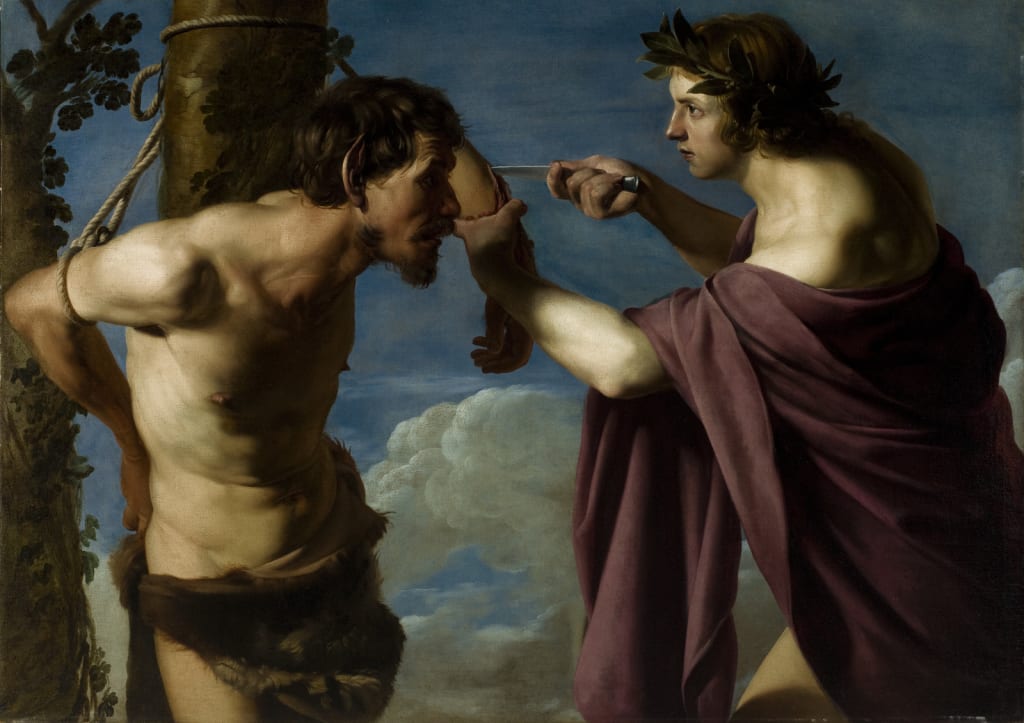
Marsyas Flayed
Our pilgrimage from Phrygia to Mount Nysa is long, the Sun fierce as we move southerly. But anticipation of the god’s presence colors the mood and eases the walk. And what delightful company I have! My priestess Kybele—in fact a goddess, embodiment of the Great Mother—strides beside me. (Only when we pass by settlements does she climb into her chair to be carried, for the sake of appearance.)
The rest of the company is mostly women—some old, many young. No doubt some are my daughters. I’m cautious of that in my cavorting, though I’m not forbidden anything and need only care for pleasure so long as I don’t provoke Kybele’s jealousy. There are few men, but a handful of boys and youths—some are our children and others are vagabonds.
Full satyrs like myself are rare now. We’ve grown like the smooth-skinned people through consort with their fair women. The daughters of men don’t live long, but they’re so delightful!
Even King Midas, friend and protector from my youth, has travelled with us from Phrygia... though he and his retinue keep a dignified distance. No higher company can be had except that of Dionysos himself, whose holy mountain we’ll reach today.
I myself am a kind of king, a lesser god. Silenos is the priesthood title I hold by attachment to my lady. The Silenos has lived through ages, but I’m not so old as people think: Marsyas himself, though magical, is mortal.
I may even die in today’s rites; such things are always possible. The enthusiasm takes many directions and none can stem its tide. We commune in the wild so that there are animals for the hunt, but they’re hard to catch and some one or other of us is often torn in the frenzy. The victim’s own fate decides, and a Silenos carries a heavy fate.
I take up my flutes, blowing the drone note on the left, playing off it with the right. The drummers join in, the company strides in time with them. We dance the rest of the way, singing the names of our god: Zagreus the mighty hunter, Eleutherios who liberates from cares by the fruit of the vine. Rejoicing, we approach the holy mountain by imperceptible degrees.
But wait! A gathering at the foot of the mountain—not native Carians, but a busy work-crew of foreigners. They’re digging, shaping stone, laying slime for a foundation. I doubt my eyes: a white stone door has been erected before the sacred cave, the nursing-grotto of Dionysos.
Kybele’s face burns red. She bellows in the tone that terrifies me:
“Desecrators! Remove your sacrilege from the holy place of Dionysos! Save yourselves from the wrath of the god and his celebrants while you can!”
The men stop to look at Kybele, then at each other. They turn back to their work.
They must not have understood. Even so, how can anyone fail to recognize a goddess, a queen, at least a high priestess in Kybele? Can they be so ignorant or so fearless?
A youth of fine proportion, clothed in the style of those who sail from the West, strides forth from the foreign rabble. He’s not begrimed with work. His voice is a man’s, but young:
“I am Apollo Phoebus, the Sun over these people and god over the Fates, and I claim this mount. Once the temple is complete, those who approach with due reverence may partake in its rites.”
I mostly understand his tricky western dialect—but can he really mean to say that he’s god over Fate?
Kybele responds: “This site is already dedicated to Dionysos. You must withdraw; the gods will defend his claim.”
“There is no discussion here,” the foreigner says. He addresses me, not her. “My priority is above question. Leave, and save yourselves.”
The members of my company murmur, taking clubs in hand—there will be bloodshed. I envision the tree cones on the tips of our thyrsi breaking away, the spikes beneath dark and slick with foreign blood. King Midas peers from his car. His retinue have banded close around him; they won’t aid us in battle.
The foreign god’s eyes are fixed on me, waiting. I look to Kybele.
“Try,” she says. I take a few steps forward. As always when meeting strangers, I wonder what kind of wine they’ve brought… can we make peace over trade, and drink together?
“Is that the instrument of your rites?” I ask by way of an opening, pointing to the object under his arm: a bow of wood, extremely bent, capped with a bar—and strings of varying length running from that bar to the bow. I’ve seen the like before, but not with so many strings.
“It is,” Apollo says, displaying it. “The kithara, the order of sounds incarnate—and I its master.”
(Well!)
“I must hear an instrument and player so great as that!” I say, and hold up my flutes. “Look here: the auloi, the flutes that serve Dionysos and sustain his worshippers. Shall we not hear them both?”
“The greater beside the lesser?” A smile spreads on his face. “They shall be heard in contest. And the lesser shall be ashamed.”
“So be it,” I blurt. Too late now to look for Kybele’s approval; it’s been agreed. “Who shall judge?”
“There are priestesses of song here,” Apollo says. He has them brought forth: nine women in white cloaks, with hair bound up and eyes downcast. They’re a mixed collection of Westerners and Carians, a grim but pretty group. They walk in a line to the place he indicates. Are they captives? Does this god have their loyalty, or might the presence of Kybele and the other women incline them to favor me?
Still, they’re under his thumb—I’d be a fool to accept judgment solely from them.
But good King Midas makes his appearance now, putting up a bold front in purple cloak. Beneath his crown hang the ceremonial ears of our native cult of the wild ass. His guards and servants stay close to him, unhappy that he’s involved himself.
“Midas, King of Phrygia, presents himself as a judge of this contest,” he declares.
Not to be outdone, his rival Tmolus the Mygdonian steps up as well.
Apollo squints at Midas’ ceremonial ass-ears, but accepts both kings as judges.
Midas takes control: “We’ll hear the conditions of the contest.”
“The winner shall treat the loser how he pleases,” Apollo says, then points toward Mount Nysa. “And the disputed site shall be his claim.”
As for the standard part of the wager, some rough play with this lad wouldn’t be so bad, win or lose. The holy site, though, is a heavier forfeit than I’ve ever striven for.
“Agreed,” I say.
Midas nods. “Then begin.”
I realize Apollo has certain advantages: by the nature of the instruments he’ll stand closer to the judges, charming them with his pretty face. I’ll have to stand well back, the auloi being louder—but then I look better from a distance.
Apollo casts his fingers over the strings in a flourish (something I can appreciate about instruments of this kind). Then he plucks out precise phrases in single notes, measuring out the music in equal parts. In places the contrast between notes is interesting—especially when certain strings ring out together—but overall the sound is too disconnected, too clean. The notes don’t roar, don’t blend and leap from each other as they do from my flutes. Apollo’s music is square, like the door he’s built before my god’s cave.
As he finishes I strike off his penultimate note, turning his resolution into a mere embellishment. I take the best parts of his song onto paths he left unexplored. Comfortable now, I build intensity in new directions, rising to a melodic peak. I’ve fully subverted my rival’s tune.
I glance at the judges: Midas smiles but the rest are unreadable, each in their own way… I return my concentration to my own breath. I feel my own people engaged in the music—that and the prickle of energy I feel as I leave off playing are my tokens of success.
The judges have heard it my way: the greater number of the ladies and dear King Midas indicate me with outstretched hand. The first round is mine, and I sneak a glance at my rival. Apollo trembles on the verge of protest and eyes the priestess judges harshly… but he masters himself.
After an initial plucking of the strings, he raises his voice—a sweet, clear voice. I straighten in shock, as do the judges.
“No, I object!” I shout. He breaks off with a glare as I rush forward. “That’s two instruments, not one! The contest is between auloi and kithara; there can be no allowance of voice!”
The judges look to Apollo for his rebuttal.
“Friend,” he says with a cold twist to his lip, “do you not apply your mouth and breath to your instrument? That amounts to the same thing. Further, do you not have two flutes, on which you blow two voices together? How can you claim I take unfair advantage? But if you like, we can make the rule that we may use only our hands, and not our mouths.”
I’m known for my subtlety, but when I try to answer him I stammer. He’s already raised my points and disposed of them.
The judges confer, and Midas rules: “Voice is allowed. Apollo may continue.”
Apollo shoots me a sneer as I withdraw. He starts in bolder than before, outdoing himself with antics: he croons and gapes, turns the kithara upside-down as he plays, even holds it behind his head like a pillow—all the while making seductive looks at the judges.
What have I to put up against this? My instrument can’t be manipulated so shamelessly, I can’t play it backwards or add lying song to it—any more than I can make my old and worldly body appear as a youthful messenger from the Sun.
I’m too distraught to jump in at the end of his song. A strange calm hangs over us, as if he’s cast a dreaming spell. It takes an effort to shake off the torpor, to remember the vibrancy of Dionysos’ music.
I begin slowly, musing over the drone, swaying my body to resonate the god’s presence. Then I strike the call phrases—we shall have Dionysos here, even if I have to wake him, persuade him to come early. My company joins in the call, chanting ‘Euoi, Euoi! Come, O beautiful, O terrifying one!’
Again I warp my rival’s best phrases into the Phrygian mode, alternating them with my own, stretching the melodies and turning them back on themselves by repetitions, by changes in time and emphasis.
I have the inspiration now. My blood had been rising, tightening my face—now I’ve lost awareness of it: I am a reed, simple within—a hot wind roars through me. I rage without thinking, blow without breathing. My hooves stamp time, of their own will.
My eyes turn to the mountain as if to spy Dionysos descending on it as Sky Father, veiled in cloud and lightning. I lash the poor white slabs of the door before the cave with storming sound. Each stone twists and strains against the others, the corners flexing, seams pried apart. I give my last, my all, to pull the door down entirely. My last note, along with the drone, hangs ragged in the air…
But the door stands. It wasn’t damaged, except in my vision.
I’ve surpassed all that I’ve played before. I approach the judges, hopeful.
But Tmolus and the grim ladies all cast their hands toward Apollo. He cackles.
“For my part,” says Midas, my sole supporter, “the song of Marsyas is still greater.”
Apollo jeers at him: “You have taste to match your ears!”
Midas shows admirable restraint, merely saying to him: “The votes have fallen to you, Apollo. Take your forfeit.”
I’ve lost us the mountain. And will Apollo try to take Kybele, too, pressing her into service as a virginal priestess? Will there be a fight to the death, still, as we defend her?
Apollo calls one of his men to him, then points to me. “Flay him,” he orders. The man stares at him, shocked. The god repeats himself, adding: “Alive!”
Apollo’s butcher approaches me in a daze. There is no choice, for him or for me.
He takes me by the wrist and leads me up against a pine tree (they have this right, at least—it’s the tree sacred to Dionysos) and strings my hands up above me. He binds my feet to the trunk. I’m stretched out bowlike, defenseless.
Apollo mocks me: “What would you have made of your skin, beast? A hat? A cloak?”
“A wine sack!” I spit at him, but my defiance is hollow. My eyes meet Kybele’s. Her despair reflects my own. It’s too sudden, too soon. I want to hold her once more—not enacting our roles as god and goddess, but merely as Kybele and Marsyas.
The knife bites in at my wrist and courses down my arm with thunderous heat. I writhe and buck as the butcher works down my side to the waist, where he leans on the knife to pierce the coarse coat of my withers. I cry out, wordless—of course, no one can help me—I’m being peeled now, one wound all over, skin and fat pulled away in rough tugs.
“Why do you tear me from myself?” My voice rattles. “Nothing is worth this!”
Apollo watches me, his face frozen. Over his shoulder I see the square white door framing the nursery-cave of my god. I fix my eyes on that darkness, reciting the god’s names: Zagreus the hunter, Eleutherios the liberator, Bromios the roaring bull torn by the Titans.
Over the gasps between my cries, I hear my company’s wailing. We make terrible music, ecstatic in horror. ‘Euoi, Euoi…’
My god isn’t coming. I weary of crying out; my breath fails.
The outflow of my blood (mixed with the tears of my company) is said to be the source of the river named for me, which joins the river Meander and causes its winding turns. My skin is displayed hanging from a tree on a high promontory of Mount Nysa, where Apollo placed it in memory of his rival.
My skin hangs limp while Western music plays in worship of Apollo. But when the followers of Dionysos visit the mountain by back-paths (being forbidden to approach the holiest place) and the Phrygian flutes are played, the skin of Marsyas dances again.
About the Creator
Trevor Anthony McGregor
I'm a writer and musician living in central North Carolina.
Keep reading
More stories from writers in Fiction and other communities.
An Instruction Manual for Keeping Your Child Alive:
Author’s Note This story contains references to childhood trauma and a parent’s experience supporting a child through recovery, including moments of emotional crisis. The focus is not on graphic detail, but on a family’s survival, vigilance, and the quiet, ongoing work of caregiving.
By Stacey Mataxis Whitlow (SMW)about 6 hours ago in Fiction
The Ritual of Winter Challenge Winners
Welcome to the Winners Announcement for The Ritual of Winter challenge. This prompt focused on winter rituals and the meaning that settles into them over time. The top pieces stay grounded in ordinary acts and repeated routines, letting winter shape the work through pace, attention, and restraint.
By Vocal Curation Team3 days ago in Resources
FPS: The Last Flame Challenge Winners
Welcome to our first Winners Announcement of the year and to the final challenge in the Fall Poetry Series. The Last Flame invited writers to sit with endings, using fire as a central image to consider what remains when something burns out: ash, warmth, memory, silence, or the faint promise of what comes next. The strongest pieces treated endings as gradual rather than sudden, allowing them to flicker, dim, and linger.
By Vocal Curation Team5 days ago in Resources


Comments
There are no comments for this story
Be the first to respond and start the conversation.