

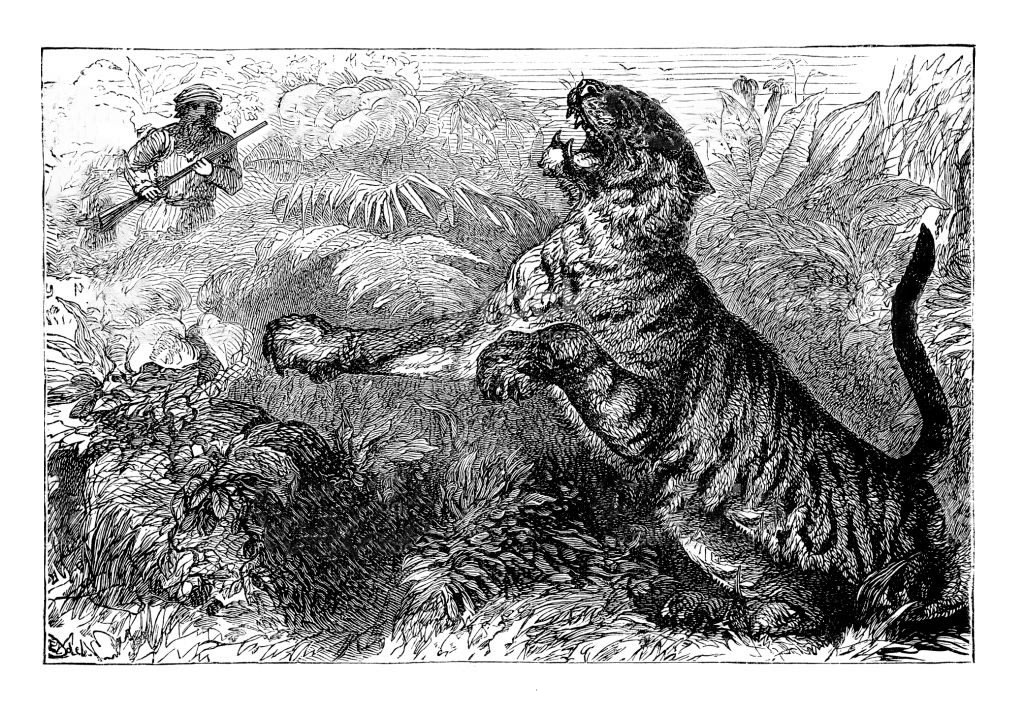
India, is a country perilous to Westerners. When women, and children make their passage there by steamship, they are thoroughly informed of the dangers. Disease, bandits, quicksand and Aghoris, to name just a few. But with a well-informed guide and some preparation, they are avoidable enough, by English standards.
There is a jungle in Tengulu, darker than most Indian jungles. Water pools snakelike in the black earth, and the leaves are thick and heavy. Machete-blows land too loudly for such a quiet, brooding tangle of trees and plants. Vines snag at the ankles like orphaned children, and a flower in bloom is a rare sight. In the Telugu language, the jungle is known as Ceṭṭu Uccu, or "tree trap," in the English language. The natives hunt and forage elsewhere.
Around the year 1899, the name Ceṭṭu Uccu began to spread farther than just the local populace. Tales were being told. Of all the Indian animals, the tiger is one of the most fearsome, and respected. In many places, hunters respect one of their own kind, and refrain from hunting another hunter, especially one so much more adept at the job. "These cats will be the death of us," a famous Wales-born hunter named Thomas Streetsman once remarked in his famous journals, which were printed in England to an eager audience.
Streetsman had an obsession with hunting the wildcats of India. The furs and the prestige were one thing, but after twelve years of skinning the wildlife of India, few creatures posed much of a challenge to the grizzled, white-bearded Welshman anymore. Not even some tigers.
Until Talak.
Talak earned his name after eating the son of a fisherman. The boy's name was Talak, and ever since then, the local villagers took to calling this new man-eater by the name of his first known victim. Talak dwelled in Ceṭṭu Uccu, but no local ever dared to find out where.
Streetsman entered the village closest to Ceṭṭu Uccu during a hot, humid summer, that had the villagers toiling away at their simple work. He asked after a certain man-eater, perhaps going by a name. A blue-turbaned, old Indian man looked at him gravely and said the name, "Talak." This village had lost two of their own to the striped hunter, and children were no longer allowed anywhere near the forest during the day, or even to roam the dusty streets at night.
The first night, Streetsman slept in a local's hut, maps under his pillow. It was on this night that Talak struck again.
The first signs of the attack were a mother's wails, just before the sun had crested the horizon. Several of the elders were trying to console her.
Streetsman reportedly rushed to the scene after being woken by the cries.
"What seems to be the matter?"
The woman wailed something in Telugu to the proud Englishman, then pointed at the forest. The hunter's ice-blue eyes searched the treeline.
"Talak," he said under his breath, with a gleam in his blue eyes.
The bustle in the village became louder and louder as the woman sobbed, shuffling back to her home as her neighbors laid hands on her. Streetsman was still looking at the treeline.
"Aarv!"
An adolescent Indian boy ran up behind Streetsman dutifully, and paused, nervous.
"Clean and ready my pack. I'm going in."
The boy ran off towards Streetsman's hut.
The jungle was thick and black, the sun a mere pinprick in the tangle above. Streetsman's machete chopped left and right, as he tirelessly slashed his way through the undergrowth, panting.
Streetsman made it to a clearing in the forest, where the light poured down like a pillar of grace. He remained at the edge, and leaned against a tree. Hunter's experience. He opened his flask, and began to drink from it. Streetsman was heading for the rocks of a small mountain that rose out of the forest - the tiger might have found a cave there, to call its own.
Streetsman closed his flask, and searched the far edge of the clearing. Movement. Just a leafy branch, but his bones told him, that it wasn't the wind.
The Englishman immediately unslung his rifle from his shoulder and pointed it at the opposite end of the clearing. It was already in stalking mode. Another swaying branch. It wasn't afraid. Had it taken a bullet before? Streetsman's finger moved to the trigger, and rested on it.
Another branch swayed. Then it appeared. A, monkey. A tiny little thing, barely worth the meat. It was holding a banana, and looking at Streetsman. It tilted its head, beady-eyed. Streetsman tilted his head in response, raising it from his rifle.
A clawed paw came down behind Streetsman, raking him across his back. Streetsman screamed in pain - the claws had gone through his hunting jacket like it wasn't there. He immediately rolled on his back and pointed the rifle at the emerging tiger, but it was swatted from his hand by its other striped paw.
"Namaste," the tiger said, in a horrifically deep and growling voice, like a slab of stone on stone.
Streetsman, was petrified. Never in all his years, did he expect a tiger to utter, anything. He assumed he must be dead already.
The tiger roared in Streetsman's face, deafening him. It said something in Telugu, angrily. It then resumed in English, in its landslide voice.
"Old man, look at your enemy. The search was yours, but the prize, is mine."
Streetsman stammered a response. The tiger had him pinned completely.
"Your English, is, quite good."
The tiger roared again, this time with a mighty boom that echoed through the jungle. The birds fluttered away, cawing in fear. Then the tiger spoke.
"I have a message for the Queen. Her jewels lay heavy on this land. Her wish, is not my command. The people are starting to band. Her reign is on a clock of sand. And now, I will take your hand."
About the Creator
Jonathan Lawrence
Haiku writer.
When life gives you ink, make penstrokes.
Keep reading
More stories from Jonathan Lawrence and writers in Fiction and other communities.
Walt the Badger
Every night at midnight, the purple clouds came out to dance with the blushing sky. Walt never cared. Walt is a badger, and a grumpy one at that. None of the other animals of the forest, even talk to Walt. Some, have tried. But too much has happened to Walt, for smiles to come all that easily to Walt anymore. Or nice words. Or even, butterflies.
By Jonathan Lawrence3 years ago in Poets
Miss Persephone's Manual to a Seemingly Ordinary Life
Miss Persephone was found at the dining table, her blue eyes swollen, her tears arriving and retreating like the tides of the ocean. Earlier that day, her family had visited her in the retirement home where she had lived for eight years. It was her eightieth birthday.
By Imola Tótha day ago in Fiction
Instructions for Returning to a Place That No Longer Exists
I. Purpose of This Document These instructions exist because return has been explicitly requested. Please note that they are not an endorsement of the request, nor should their existence be interpreted as confirmation that return is advisable, safe, or even possible in any way commonly understood. This document addresses procedure only.
By Shannon Hilson3 days ago in Fiction


Comments (1)
"Landslide voice" poetry and prose blended beautifully together!