
Making Space
How making space opens the door to what’s possible
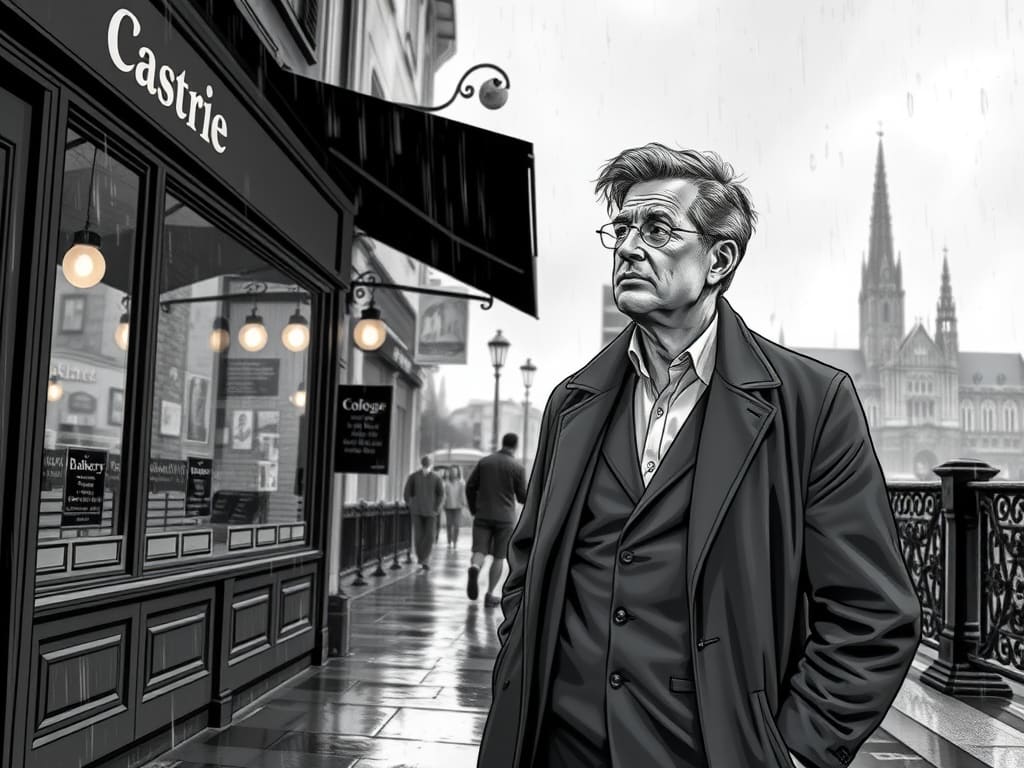
The rain had started just after he left the hotel—fine, persistent, more drizzle than downpour. Dieter didn’t mind. Cities in the rain always felt more honest to him. Cologne hadn’t changed much.
He passed a tram stop where no one waited, a bakery with fogged-up windows, a man balancing coffee and an umbrella with a sort of practiced clumsiness. He didn’t check his watch. He wasn’t late.
A blackbird hopped near the fountain at Ebertplatz, as if it hadn’t noticed the entire city was already soaked. Somewhere behind him, a bell rang. He had planned to walk through Theodor-Heuss Park, maybe watch the lake for a while, but on impulse, he crossed toward the old city gate castle instead.
He continued past the gate, unknowingly following the old Jakobsweg, letting his gaze wander through shop windows. His walk still had traces of the man who once skied black runs before breakfast. Shoulders a bit forward from many years behind a desk, but the frame was still there — built for motion, not meetings.
Then, without warning, he felt déjà vu. He stood in front of the café, and the years lifted—vanished like steam from coffee. Six years ago, his son Kurt had sat just a block or two from here, waiting for his entrance exams at the Cologne Conservatory.
A few years ... and so much had changed. Not only Kurt. Today, his son was graduating—top of his class—and would soon receive a check for 10,000 euros from the Talented Youth Foundation. He could have felt like a proud father.
By chance or fate's quiet choreography, he'd met with Adam here that time— old friend, fellow student at Leibniz University in Hanover. They hadn't seen each other in twenty-five years, but at a reunion in Hanover, they discovered they'd both be in Cologne that spring.
***
"Your boy doesn't chase math?" Adam had asked curiously.
Dieter had long since left math and physics behind. After graduation, he joined Deutsche Telekom in Nuremberg and steadily climbed the corporate ladder, trading equations for spreadsheets and meetings.
"No," Dieter had smiled gently. "I'm not the type to live out my dreams through my children. In fact, I've had enough of that. Now I just make space for them. I guess this is what parents should do."
"I suppose so," Adam replied. "I never had the chance to find out for myself."
"You're still at CERN?"
Adam nodded, and something sparkled in his eyes that Dieter had recognized years ago. An unquenchable thirst, a passion for things he had long since abandoned. People liked to imagine scientists as eccentric or absent-minded — wild hair, lost keys, a fog of genius trailing behind them. That was true maybe once in a hundred. Dieter wasn’t that one. He was sharp, methodical, former league handball player. Precise, but never boring. He brought a kind of play to everything, which made it easier to hide the things he no longer chased.
"We've glimpsed something extraordinary," Adam said, lowering his voice. "If we keep electrons in superposition long enough, they start to influence the entire field around them."
Dieter raised an eyebrow. "Influence how?"
"Think of each one like a candle on a dark grid. Alone, it glows faintly. But together—synchronized—they create something brighter. A pattern. And sometimes, just briefly ... something new appears."
"New?"
“Short bursts of high-energy photons. Not decay byproducts—we verified that. They appear without expected precursors. Just like that.” Adam snapped his fingers. “It’s like the coherence triggers a local resonance in the vacuum field. Not a reaction exactly. More like… the field anticipates structure and responds.”
Dieter sipped his coffee, trying to picture it. "That sounds like virtual particles becoming real."
Adam leaned in, eyes intense. “Could be. And the longer the electrons stay fuzzy, the more ... generous the field becomes. As if we're not just observing reality—but inviting it to fill a gap.”
“So you’re saying,” Dieter summarized, “that by doing nothing, something happens?”
"Exactly. We make space. And something fills it. Wheeler hinted at it, even Feynman circled it. We're not causing particles—we're cultivating conditions where the field offers them. "
"I'm rusty on quantum," Dieter admitted. "But that sounds as if you're violating causality, no? In physics, I remember, you always have to push something into action or existence. But that is not what you said." He thought for a while. "It's like building a sailing ship — and the act of building it causes the wind to rise."
"Then why not open a bank account and wait for riches to appear?" Dieter laughed.
Adam didn't laugh. Instead, his expression grew more serious. "Perhaps you're right. However, there's something else."
He paused for a moment. "Maybe you'll understand."
"During our first successful runs - when the particles began appearing — it felt natural. Almost… graceful. Or even sacred. As when a child is born. Light, stable particles emerged. The more we repeated the experiment, the more particles were emitted. But then later, when our department head tried to replicate the experiment in front of upper management, it went off the rails and straight through the station wall ... The chamber got lit with hard gamma flashes and the field spiked past 10¹⁸ V m⁻¹ — the Schwinger limit. Every dosimeter on the wall squealed at once. Can you imagine? The once gentle equilibrium was now violent — nearly catastrophic."
Dieter raised an eyebrow. "That's … very odd."
"It's happened more than once. At first, we blamed the shielding,” Adam said. “Then synchronization errors. Power supply fluctuations. Later, even thermal drift in the superconducting magnets.”
Dieter nodded slowly. Those were plausible, even familiar terms—although he practically forgot he knew them.
“We combed through the logs, ran simulations. Nothing matched the anomalies. Every diagnostic came back clean. It was maddening.”
Adam looked down at his cup, voice quieter.“Then, one night, around 3 a.m., unable to sleep, I just stopped thinking like a physicist. And I had this… stupid thought.”
He paused.
“What if the instability wasn’t in the system… but in us?”
“Us?” Dieter asked, brows tightening.
Adam met his gaze. “Our mindset. Our presence. You know the principle—observer affects the measurement. Hell, even YouTube gets that part right! I ran a few small trials on night shifts—same parameters, same chamber. But when no one was watching, when the experiment was just… treated as routine—it held. But under pressure, under scrutiny… it became volatile.”
“You’re saying,” Dieter hesitated, “that human presence or intention affects the outcome? Directly?”
“Not directly,” Adam said. “I haven't told anyone, but the more I watched, the more it felt like… our intention is part of the equation. Like the field responds differently when we want something from it—results, recognition, funding. As if the system senses it.”
Dieter leaned forward, not entirely sure if he was amused or disturbed. “So… you’re saying the outcome changes based on why you run the experiment?”
“Yes,” Adam said. “When we act out of curiosity—pure investigation—the field stays stable. But under pressure, with higher stakes… it just becomes unstable. It resists.”
Dieter shook his head slowly. “Your intention impacts the result ... that sounds a bit like… quantum karma.”
Adam smiled—grimly, this time. “Exactly. Instant karma. Cause and effect, but folded into the moment. In daily life, that loop takes years. In the quantum world, it takes seconds.”
A silence settled between them. Dieter sat back, the implications rearranging the room around him. “If that’s true,” he said, “then this research … it isn’t just physics anymore.”
Adam looked away. “It never was.”
"With my results, I nearly managed to persuade my colleagues, and we were continuing with our 'calm' tests only." He stirred his coffee absently. "But as you might guess, our management got involved again.”
Dieter looked up.
“They wanted more. More energy, bigger field, bigger results. If the effect was real, they said, we should amplify it. Push the system harder.”
“And?” Dieter asked.
“We tried our best. And at first, it looked nearly like a success—more emergent particles, higher coherence. But then something shifted.” Adam’s voice dropped.
“We collapsed the fuzzy state… but the particles kept coming.”
Dieter blinked. “After the field collapsed?”
Adam nodded. “Yes. The chamber was already stabilized, observation complete. But the generation didn’t stop - for another 132 seconds! It was as if something had crossed a threshold and no longer needed the initial condition to persist.”
He met Dieter’s eyes.
Dieter exhaled. “So you didn’t just open a space.”
Adam nodded grimly. “We opened a door.”
***
The conversation stayed with Dieter for a while. But then routine prevailed. And besides, his son had been accepted!
And then - just a few weeks later - the news broke. A headline, mid-scroll, between ads for shoes he didn't remember searching for: CERN Facility: Quantum Experiment Ends in Tragedy. Several Dead and Many Injured.
The words didn't land all at once.
But then he stopped.
The screen flickered slightly. His office on Diesselstraße hummed behind him — quiet, clinical. Ozone, dry air, the faint churn of the HVAC. Outside, a DHL van parked exactly where it shouldn’t, like always.
He had to reread them — not because he didn't understand, but because he almost did. Just a paragraph: a containment breach during a high-energy test in one of CERN’s experimental tunnels. Structural collapse in Lab 4. Initial estimates placed the damage well over 30 million euros. Radiation alarms triggered late. Sensors failed to register the initial surge. Some systems didn’t shut down. An internal investigation was underway. Failure of predictive safeguards suspected. Officials declined to comment. Theoretical explanations were described as “inconclusive.” No names listed.
Dieter called Adam, but got straight to voicemail.
He tried again. And again. Same result. Adam's LinkedIn profile was gone.
He imagined Adam seeing it coming — just a second too late. He couldn't unsee the picture for a while. For a few days, he kept checking — refreshing headlines, watching the feed. But the story sank fast.
Then the silence settled in.
Weeks passed. Then years.
***
So now he's back. The café waited patiently. Same crooked sign. Same stubborn, unwashed windows. He hesitated for a moment. But as he reached for the door, something flickered - a feeling like walking into a room where someone had just finished saying your name. Warm familiarity wrapped around him.
The server — young, cheerful — looked up and smiled before he could speak.
"Ah, Herr Baum. This way, please. Your table is ready."
He blinked. "My…?"
But she was already leading him, weaving between tables with the confidence of someone who knew he'd be here.
And there it was. The same table by the window. Reserved. His full name was printed and tucked into a little metal stand.
He sat down slowly, unsure whether to protest or pretend he'd planned this. He chose neither. The coffee appeared swiftly. And then —before he could sip, before the discomfort could settle into his bones — a voice behind him, lightly changed:
"Congratulations, Dieter. Your son is a great talent!"
Reality shifted as he turned.
Adam.
There he was. Older, but smiling happily. He sat down at the table and seemed to be enjoying the moment. Dieter couldn't believe his eyes.
"You're alive …," was all he could say.
“And doing fine, thank you,” grinned Adam.
Dieter folded his hands, locking the tremor inside them.
“I should probably apologize for the joke,” Adam added, “but I couldn’t resist.”
“I think I’ll have something to explain to my cardiologist,” Dieter muttered. “But before that, there are a few things I want to ask.”
“I’m sure. That's why we're here. Go ahead.”
“Start with Kurt. And don’t forget that little accident in Geneva,” Dieter said, still sorting through his thoughts.
"Well, I guess I owe you some explanations. First, you should know — I'm the director of the Talented Youth Foundation."
"A-ha… but that doesn't make things much clearer. And I don't recall seeing your name on any TYF documents…" Dieter said, puzzled.
"Let's skip the boring details. But yes — you need more to understand. Last time we met here, we discussed the research — remember?" Adam asked.
"Yes. Fuzzy electron fields getting unstable…"
Dieter nodded."Right. And our management kept pushing harder for results. More energy was being emitted during the experiments. Saying what I thought would've been scientific suicide. I tried to push back, but you can't stop a machine like CERN." He sighed.
"But it was getting dangerous, no? And no one cared?" Dieter asked.
"It was. But so what? There's no power in the world — not even the UN — that could stop a CERN experiment. Remember the micro black hole experiments back in the 2000s?"
"Sure. But those black holes evaporate instantly."
"Yes. Now we know. But back then, we weren't 100% sure… and still, we tested."
"Fuck…"
"Exactly. I didn't see it then. But I saw it with the fuzzy field. I knew they wouldn't stop until something bad happened. I suggested slowing down, reanalyzing — all ignored. I became the only one concerned. It was like a gold rush. When I realized I couldn't stop it, I resigned. That was just two days before the accident." Adam fell silent for a moment.
"Anyway… you gave me something to think about. Making a space— that was your idea, remember? What if we misunderstand causality? Maybe the goal isn't to uncover its mechanics — but to use it well. And you said that about the bank account…" He sipped his coffee.
"You'll laugh, but I did it. Honestly, I didn't know what to expect. But it worked. Not instantly, like in the lab — but it worked."
"You're kidding!"
"Not at all. In fact, you can see it everywhere: The bakery across the street, for instance — they make bread, and someone always shows up to eat it. Or build a gun. Sooner or later, someone fires it. I bet that’s why the U.S. has such a high rate of shootings," Adam said, and looked sad for a moment.
"Obviously, it didn't work every time. But often enough. Making a space. Or you can see it as planting seeds. Not all of them grow. But with care… some do. So I started planting. But yes, it requires some patience. Lots of patience in fact."
"Trying to follow. But can't you grow something you didn't intend?" Dieter asked.
"Sure. That's probably what happened at CERN. And I remembered that well. See, I didn't open the account for myself ..."
"TYF — now it starts to make some sense," Dieter exclaimed.
"Hope so," Adam smiled.
"Okay ... but how did you know I'd come? I didn’t even know this morning…"
"Not sure you were listening… " Adam teased his friend, "I made the reservation in your name. And honestly, it's pretty unlikely anyone else would sit in a chair labeled with your name. And just to be sure, TYF organizes the concert. We might as well meet here after, too."
"I see," Dieter said at last.
Adam looked across the table. "Perhaps full understanding is not always necessary… You don't want to miss your son's performance, do you?
***
The lights dimmed. Programs rustled once, then stilled. A ripple of applause as the conductor stepped into place. Kurt followed, taking his spot beside her. He gave a small nod, drew a quiet breath—a habit he’d had since schoolboy days—and played. The oboe caught the stage light like a river stone. Oboe Concerto in A minor, by Ralph Vaughan Williams.
A tone, then another. Not loud. Not showy. Just enough to tilt the silence around it.
Dieter closed his eyes.
Music, too, can make space, he thought.
About the Creator
Karel Berkovec
Fiction Stories.
Keep reading
More stories from writers in Fiction and other communities.
The Tango Connection
I suppose I've become a writer so I wouldn't bore everyone to death telling them my stories. Reading them is reading. Not the same. There's rhythm. And timing and, most importantly, drama and suspense. Unless you have tremendous magnetism and an undeniable stage presence, there's no way you can engage an audience the way you can by writing your story. That's my opinion.
By Rene Volpi 5 days ago in Beat




Comments
There are no comments for this story
Be the first to respond and start the conversation.