

By Albert Ainuu
Chapter 1
The ocean spray exploded into a shower of warm, salty rain on Lu’s face as boisterous waves collided with the Alia’s bow. The large ocean sailing double hulled canoe was an impressive sight as it cut through the waves effortlessly under the skilled guidance of Lu’s steady grip of the steering paddle. This 100 foot vessel moved through the water like a dolphin. Efficiently and fast as if it were skimming on top of the waves.
Lu smiled as he watched the mountainous eastern coast of Upolu rise and sink on the horizon with the rolling waves as they made good speed returning home. He was anxious to set foot on land after almost 7 months at sea on an extended folauga. A folauga is a voyage of discovery taken by only the most skilled navigators who inhabited the island kingdoms that populated the Ocean Empire of Tagaloa, God of the Kanaka, the mighty warrior race who had settled the Great Ocean, known to them as the Vasa Loaloa.
Lu had been on many such voyages which had discovered lands that were both inhabited and uninhabited throughout the Vasa. His grandfather had been the master navigator when the Kanaka had discovered the Land of the Long White Cloud, Aotearoa. He still recalled the stories his grandfather told of that voyage. Lu was blessed with a lineage of Navigators on both his father and mother’s side.
When he was of age he had joined his father on the annual Folauga. Lu’s father had taken a fleet that sailed North past any prior voyager’s exploration and they discovered Savaii or as it was now called Havaii. Nearly all major land discoveries were named after the islands where the discovering Tautai or Navigator came from. In that case the island they discovered was named after Savaii, the big island where Lu’s Father was from.
Lu could still recall how they were at sea for longer than any other voyage without seeing land, but his father had pushed forward following his instincts and knowledge of the sea, which he believed indicated there was land somewhere in the area of ocean expanse not familiar to them. He recalled the rewarded anticipation, the exhilaration the crew felt when they finally saw the low lying clouds on the distant horizon that confirmed what they had hoped for from all the signs, that land was near. This was a great discovery, rivaling the Aotearoa find as it was a large island and there were other large islands that had adequate supplies of fresh water, all the familiar food bearing trees and plants as well as well stocked lagoons with abundant varieties of fish. This chain could support alot of people. They explored the different islands in that chain for 3 months before returning home.
These voyages usually included Alias from other island Kingdoms such as Tonga, Tahiti, and Fiji, creating a fleet that provided both security and protection in case of emergency. However, once the Folauga was complete these explorers returned home with news of any major discovery and then voyages of occupation from all over the Empire took off by those seeking a new land. After Havaii was discovered there was a rush of Alia expeditions from all over the empire including some from Upolu to settle Havaii and accompanying islands.
The loud screeching of sea birds circling above the two masts of the Alia brought Lu’s attention back to the present. Each Pe’a or woven fine mat Sail was full as the north easterly winds blew briskly with the rising morning sun powering Lu’s fleet of Alias toward their final destination, the bay of Fagaloa, Lu’s home.
Chapter 2
The Fagaloa Bay is a natural indentation of Upolu’s Eastern coastline which makes it one of the best two harbors in the entire Samoa archipelago but the bay is hidden from the rest of the island by a tall ridge of mountains that encircle the bay creating a natural barrier to intrusion from any invaders on land. As a result entering Fagaloa by boat is the only practical approach. Traversing the mountains from either Falefa to the west or Aleipata from the East would be arduous and difficult.
As the fleet of Alias entered calmer waters the morning sun began to peek over the top of the eastern mountain ridge of Fagaloa, bathing the valley and bay below in golden rays of sunlight as it rose higher in the sky. Low hanging clouds were floating just below the mountain tops that encircled the bay. Emerging from these clouds were numerous waterfalls that lined the walls of the steep ridge like molten silver streams inserted between lush green jungle. Reflecting off the water, the sunlight infused the misty white spray of the waterfalls with color, creating mini-rainbows at the bottom where the waterfalls disappeared into the foliage. The scene was captivating.
The younger children who were too young to do chores were laughing and playing on the sandy shores of the village of Taelefaga which is where the bay ends. The fales or thatched roof houses lined the center malae, a traditional open air meeting place, where all ceremonial events took place.
One young boy of about 8 years was sitting by himself watching the open ocean as his cousins played a game of tag. All of a sudden he stood up and stared intensely at the horizon. He looked away and then rubbed his eyes to look once more. Yes there it was. The shadows moving on the horizon were definitely getting bigger. Toa jumped and yelled.
“Hey, hey, the Alias are coming!!”
The younger children stopped their game and all peered out to the mouth of the bay all eyes focused on the approaching flotilla of Alias. One young girl ran toward the main house where adults were seated.
“The Alias are coming.” She announced with an emphatic tone.
Women scurried out to gather the children while warriors and chiefs gathered in front of the Malae to ascertain whether these were friendly or not. Within minutes the sound of large wooden drums echoed throughout the basin, reverberating from the mountain walls. The outer most villages of Musumusu and Samamea had seen the Alias and relayed the message via drum beat that Lu and his fleet were back from their folauga. It was time to celebrate.
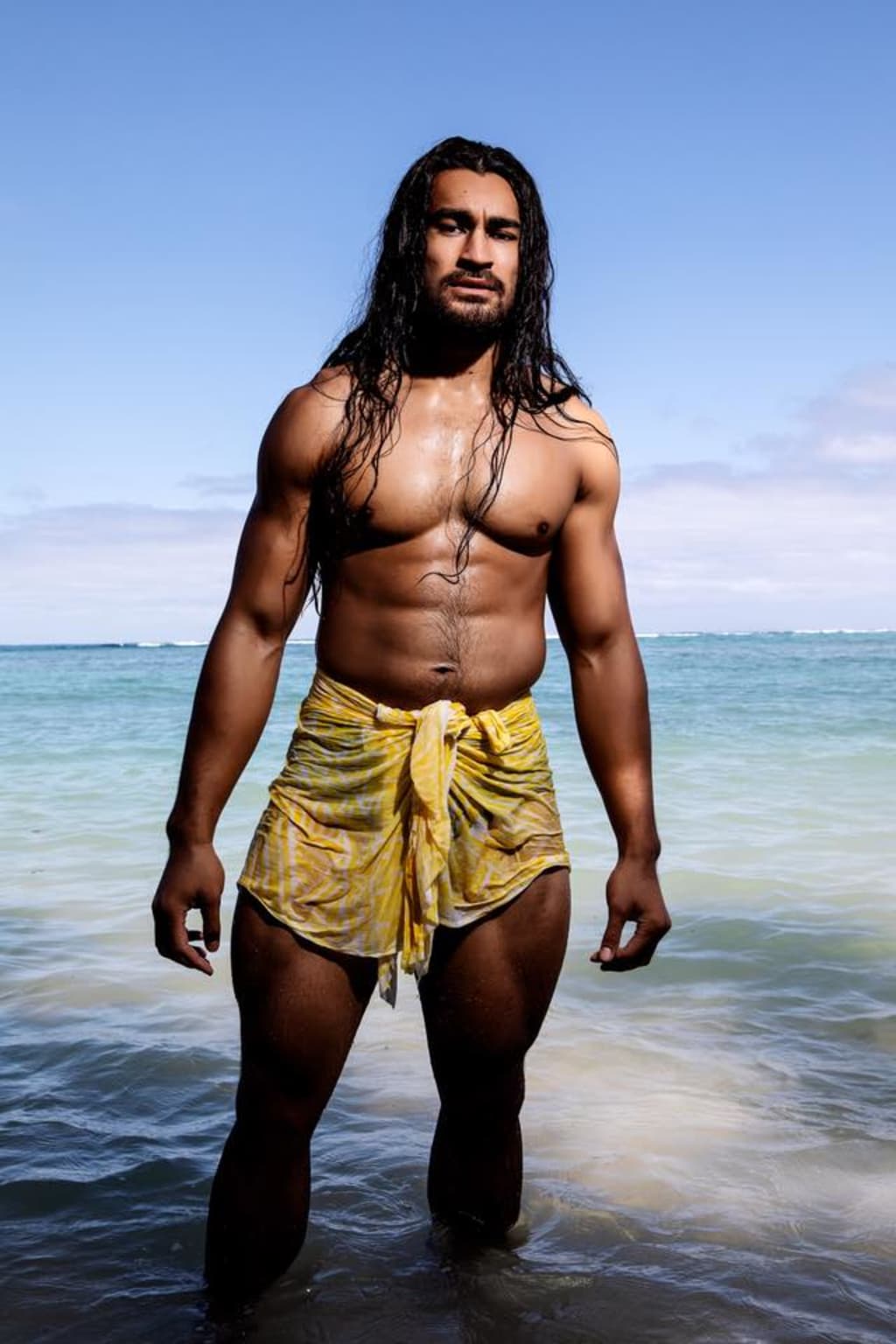
Lu stood on the bow of the first of 40 Alias as they made their way from the mouth of the inlet into the deep canyons of Fagaloa. At 6 foot 4 inches of muscle and tattoo, Lu was an intimidating figure. He was built solid, thick legs, chiseled stomach, wide chest, wide shoulders and powerful arms. His hair was long and braided. He had deep compassionate brown eyes that liked to smile, but were quick to assess his surroundings. His sculptured face was both handsome and intimidating. There were scars on his body from battle and from his work. He was a chief of his mother’s family who resided in Fagaloa. On his shoulders he wore a cape of white fur, the spoils from a raid the folauga had executed in the northern lands. Around his waist he wore a siapo, the traditional mulberry tree bark cloth.
Lu was tattooed from his waist to his knees in the tatau design which he received when he became a warrior. He held a long wooden staff in his right hand planted on the deck of the Alia. He had the ceremonial switch on his right shoulder as he placed his left hand behind his back. This was the way of a chief returning from a successful folauga.
The entire district lined the shores for miles on each side of the bay, men, women and children watching and clapping at the spectacle of 6 large Alias as they glided through the calm waters of the inlet. Each Alia had a crew of 12 to 15 men.
These were the most impressive ocean going vessels found anywhere in the world. They were the best because they were the fastest and most reliable. However the skill of the Kanaka navigators was second to none and among the navigators of Upolu, Lu was acknowledged as the rising star. He had led 5 folauga’s on his own after the death of his father, each of them successful.
“They are out in force today, huh Lu?” was the laughing input of Lu’s most trusted friend, Agavale.
Lu smiled and looked back at his crew all lined up along the sides of their Alia waving proudly at the shore full of people, “The Oti always makes a grand entrance, aye Agavale?”
Agavale was Lu’s cousin from Savaii, from his father’s family and he had been Lu’s closest friend since he had been brought to stay with Lu’s family as a child. Now he was the right hand of Lu in all things concerning the voyages.
“A lii Upu? You gonna get lucky tonight.” Lu jokingly referred to the youngest crew member Upu, who had now returned from his first Folauga at 19 yrs of age. Upu scratched his head and grinned foolishly like any young man insecure with his standing. The crew all laughed, some of the older men slapped Upu playfully on his head.
Tasi, a giant at 6' 10" tall, who was manning the steering paddle, called out, “I hope Upu knows what to do. The last time when we were in Rarotonga he just cried when he saw a naked girl.” More laughter and insistent denials from Upu only brought more positive energy to the Alia named the Oti or Goat, which is the mascot of Fagaloa. The Fagaloa people were known for their unpredictable yet playful persona as is the character of the goat.
The mood among the crew of the Oti and the Alia fleet from Fagaloa was boyant and accomplished as they edged closer to the shoreline of Taelefaga where the crowded beach waited and cheered.
Chapter 3
The crowd on the beach grew larger as the Alias approached. Lu looked over the crowd to see if he recognized anyone. He noticed his son Toa running along the shoreline and waving. He smiled and looked further for his family. He could see his elderly mother coming to the beach with his sister and cousins beside her. It was times like these that made life full, Lu mused as he watched the excitement.
The bow of the Alia struck sand and stopped moving. In a flash Upu was over the side of the Alia. With a splash he landed in the warm water up to his knees. He glanced at Lu who nodded his head before Upu began running to the shore to greet members of his family who had gathered with leis of plumeria flowers to greet their hero.
Lu smiled as he reminisced to a time not so far away when he had returned from the first Folauga and the pride he felt as he was swept up on the shoulders of family members relieved to see him return safe as part of heroic voyage of discovery.
Upu was being mobbed by a large contingent of family and friends. All Lu caught a glimpse of were a sea of arms hugging, hands caressing and cheeks mashed up against young Upu’s face. Lu smiled again as he thought, “This is what its all about, Love.” The words “Family and Love,” echoed in his mind.
The rest of the crew began to disembark and unload the Alia. It would be a long tedious task to unload the treasures and spoils from their folauga. Lu saw the crowd on the beach divide in two to allow the impressive figure of the High Talking Chief walk through toward the Alia. When he had reached the waters edge he planted his staff in the sand, as Lu similarly held his and ceremoniously waved his fue, or switch from shoulder to shoulder as protocol before he began speaking. A hush fell over the crowd.
Lu looked down from the bow of the Alia with sincere respect at the chief who was the highest of the talking chiefs in Fagaloa. He was never comfortable with the cultural protocol but understood the significance of the ways of the Chiefs in the organization of the Kanaka society. It was deeper than just the ceremonial language and actions. The Culture was a manifestation of the living connection or link between a man and his family, between a man and his community,
But even deeper than that this was the force that connected a man and his surroundings, between the living world and the spirit world, between man and the universe. Lu understood that this was the source of the Mana that his people had. In all of his travels he had never seen a more powerful connection to Mana as was present among his people.
It was in moments like these that he sensed the presence of entities not seen, but very real. They too were here to celebrate. They too had contributed to the success of the folauga and his senses were acutely heightened as he awaited the completion of the Tulafale’s protocols.
The voice was deep and strong, “Afio maia Lu,” was his opening salvo, and he then recited the geneology of Lu accentuating the connections between Lu and the highest deities in the history of Upolu.
“Come down from your Alia Lu. You have gone forward into the heavens, you have opened the portals of discovery, you have conquered, and you have returned. Reacquaint yourself with the land of your birth and enrich us with your mana. The Council of Chiefs awaits. Afio maia.”
Lu’s talking chief, Tui, responded while Lu stood silent. “On behalf of Lu and the crew of these six Alias, we thank you for the welcome, it is an honor to be welcomed by the High Talking Chief, and we accept the invitation. We shall be there as you request.”
And with that the High Talking Chief and his entourage turned and walked to the large house in the center of the Malae. As they departed the two groups of people came back together like the return of the tide.
Lu turned and barked out orders to Tasi and the rest of the crew to unload the vessel but not to touch the cages he had put in the hut on the platform of the Alia. These he entrusted to Agavale. “Make sure no one sees these cages or what is in them Agavale. I do not want anyone to know about these birds and they must remain a secret until I say otherwise. Make sure all the crew understand this!” His tone was firm. Agavale looked at Lu and said solemnly, “It is done.”
With that he leaped into the water and walked to the large meeting house where the Council of Chiefs were gathered.
“Lu!” The urgent voice made Lu turn and he saw a rapidly approaching young boy, racing from the crowd toward his father. Lu embraced his son and hugged him for a few minutes. Toa was beaming from ear to ear. At 8 years of age he was already big for his age. “Sole, Toa. You look like you have grown taller since I left.”
Toa’s eyes were wide with excitement. “I caught my first bat!” he exclaimed.
Lu laughed, “A bat? Did you kill it?”
Toa, exclaimed, “No, I just kept it as a pet. It hangs from the top of our cooking house.”
“Well you better make sure it gets fed ripe bananas and papaya.” Lu responded.
“He likes coconut too.” Was Toa’s reply.
And then he was encircled by family. His mother Sina was the first to embrace him. “Lu, I prayed to Tagaloa for your safe return and he has brought you home safe.” Lu was touched. “Sina, I appreciate the prayers. When I see Tagaloa I will thank him myself.”
Sina was a little apprehensive, “You will see Tagaloa? Be careful, he is a God. Only those who are worthy can see him.”
Lu looked into her eyes, “Mother, you always take my words too seriously.”
She was not convinced, “Lu, I know you better than you do. The Jungle is hollow.”
“Ahhhhh you worry too much mother, Tagaloa and his minions have no interest in Fagaloa. We are too difficult of a journey for him.” Lu laughed.
His mother Sina just shook her head. “I fear the Lord Tagaloa and you should too Lu.”
“Ok mother. Tagaloa is Lord. Can we move on to something else? Lets just be happy that your favorite son has returned home and guess what? I brought you some special trinkets from a place called Siam.” Lu countered
This brought a smile to his mother’s face, “ Well why didn’t you say so?”
Lu hugged her again but his mind was concerned.
Tagaloa Lord of the Kanaka was God of the Empire. The Aiga Sa Tagaloa had ruled since the beginning of time. Infact Tagaloa and his family had discovered these islands and led the Kanaka race to settle in the Vasa Loaloa. Tagaloa and his family had designated the people of the Vasa Loaloa as navigators and his authority was unquestioned throughout the Atu Laulau as the empire was known. No one had challenged their authority ever and all bowed down in reverence to him.
But Lu was not as enthusiastic as his forefathers when it came to blind obedience. The millennia since the Aiga Sa Tagaloa had established their dominance was not as important to Lu. Maybe it was because he was the younger generation. Or maybe it was because Fagaloa was somewhat isolated from the rest of Upolu and other areas where the worship of Tagaloa was emphasized. They had not had any visits or demands for tribute from the Sa Tagaloa Clan or their minions for over ten years. There had been whispers that perhaps the Aiga Sa Tagaloa were preoccupied in other parts of the Empire.
Lu gathered himself as he walked toward the Chief’s Council. Tagaloa would have to wait, he needed to focus on the welcome ceremony he was about to be the primary recipient of.
Chapter 4
Excitement permeated the air of Taelefaga. The village had guests to welcome even though some were their own sons. Lu and the crews of the Alias had been gone for over 5 months and the anticipation of the gifts and amazing stories of the voyage created a wave of excitement that spread like a tsunami throughout the Bay of Fagaloa. Chiefs from all the six villages circling Fagaloa Bay were making haste to be present when the Welcome Ceremony began. This was as significant of an event as the entire district would entertain in any given year.
Orders were given by the chiefs to prepare the feast that would be served following the Ava ceremony to welcome Lu. The Aumaga were tasked with the cooking. Meanwhile in the Council House the various Chiefs were assembling and jockeying for position. The most prestigious positions in the house were reserved for the highest chiefs which was established by cultural protocol universally recognized throughout the archipelago.
The Council house was the most impressive structure in the Village. It was elevated above the ground on a platform of stones almost 6 feet in height. The house itself was open with posts around the circumference and the chiefs sat at the posts on pandanus leaf mats. The seating arrangement was according to the titles that were held by the Chiefs and the prestige each title carried.
The house was oblong in shape and large enough to accommodate 100 people. On one end of the house sat the High Chiefs or Alii of Fagaloa. Facing them on the opposite end of the fale talimalo or house would be the guests ior in this case the captains from the six Alias of the Folauga. The front of the house was occupied by the Talking Chiefs representing the various villages of Fagaloa and the talking chiefs of the guests. Facing the collection of Talking Chiefs sat the Taupou or Village Maiden who would prepare the Kava, a Ceremonial drink and her entourage assisting her with the welcoming kava ceremony. Kava is a specially prepared drink from a specific root that is considered to contain spiritual and physical properties. All Polynesian events begin with this ceremony which embody the collective will and unity of the parties participating. This was the most universally accepted ceremony throughout the Empire of the Tagaloa. This was a symbol of trust and honor.
When Lu entered the Council house and sat at the center pole on the side of the house where the guests were a silence came over the house. On each side of him sat Agavale and Tasi and then the Captains from Fiji, Tonga, Tahiti, Aotearoa and Havaiki. Outside on the paepae or stone covered platform sat the rest of the crew members.
The welcome from the Fagaloa Chiefs was issued, and Lu acknowledged the legacy and authority of the Fagaloa District. The ceremony began with earnest as the dried kava stems were gathered and the warrior of Fagaloa spoke with a clear voice, “All of Fagaloa are here. Their Kava have been counted. Let me distribute the kava.” And with that he made gifts to Lu and the Captains of the Folauga of these valuable kava plants. When he completed the gifts he sent the rest of the kava plants to where the Village maiden was seated mixing the Kava mixture of water and powdered kava in a large ceremonial bowl.
The Taupou is the daughter of the high chief and she was dressed in a ceremonial Kuiga or head dress that was like a crown of shooting stars. It was the most impressive piece of clothing found among the Samoan race. It was decorated with glittery shells and anything of value or reflective. The Taupou also wore a decorative outfit and her necklace was of sharp boars teeth that shone white in the diffused light of the interior of the house under the midday sun.
The talking chiefs of Fagaloa were now talking. The Talking chiefs were debating as to would be offering the speech of welcome. This would a prestigious responsibility and in light of the arrival of these guests who had potentially unseen gifts, it was rigorous and heated because the talking chief who gave the speech would receive the lafo or gift from the guests. Usually this was something of value. But even more important was the honor the speech giver would bring to his family for making the speech of welcome on such a momentous occasion. In the end the ranked Talking chief of Fagaloa won the debate and he began to speak.
Lu’s thoughts were mixed as he listened to the recital of the various highlights that were revered by all Samoans on such days as this. Today would be another great day was what the talking chief was leading to because of Lu’s successful voyage and the continuation of the Fagaloa legacy of leading the Folauga that was instrumental in the expansion of the Empire of Tagaloa.
Lu was aware of the respect that he commanded. When his father had died Lu was a young man but the village had placed him in charge of the annual Folauga. His first few voyages had been greeted with lukewarm enthusiasm as he brought home few treasures and there were no new lands left in the Vasa Loaloa to be discovered so in the last few years Lu had decided a different strategy.
Lu had sailed to the western edge of the Vasa Loaloa and found islands and continents that were inhabited by great civilizations that were advanced in areas that few in the empire of Tagaloa had ever witnessed. This interaction had opened up opportunities that other Folauga’s had not seen before. There were things that were used by these peoples and civilizations which were not found anywhere in the Empire. They had shiny trinkets, iron and precious metals such as gold (although they were shiny its value was lost on Lu and his crew), fabric, different foods, weapons and animals. These were things not found in the islands. Realizing the value of these things he knew that taking them to the islands would create a source of value and wealth not available in other parts of the Empire.
Lu had encountered difficulties when he first came to these civilizations and quickly learned that the large cities were not to be trifled with. They were well organized and their defenses were alot more sophisticated than what he was used to in the islands. Plus they had superior weapons. Metal or steel was something the people of the Vasa Loaloa were not able to produce and these people had armies fully armed with steel weapons and clothed in armor. They also had arrows which had caused them many casualties. So they were resigned to attacking at night with the stealth and surprise on their side.
The fleets of Kanaka Alia were viewed warily by the inhabitants of the coastal cities Lu and his flotilla encountered. Most of them were inland and not on the coast. Those cities that were on the coast were inhabited by so many people it was unfathomable to Lu and his crew how so many people could live in these cities. Nothing in the islands rivaled their enormity or their wealth. So Lu decided they would not approach the large cities unless they had reason to believe they would be received as friends. They resigned themselves to raiding the coastal villages and communities which dotted the coasts of these great lands. They were amazed at how large these islands and continents were. They could sail for weeks and months north or south and not see the end of the land. What they had that allowed them to escape any serious conflicts was their swift and superior vakas or Alias.
Their vessels were faster and more maneuverable than those of the inhabitants of these lands. The inhabitants were somewhat afraid of the ocean and had little knowledge of the nature or behavior of the vasa loaloa. Lu knew the safest way to negotiate these people was to be patient and employ surprise whenever they would raid. Their advantage was their speed.
In prior voyages Lu had just sailed as far north as he could and mapped out the geography of the land until it got so cold they had to turn back. The majority of the people they saw were all almond eyed and spoke a dialect of the language they associated with the Saina nation. Lu discovered there were many villages and communities along the coast of this large continent that were unprotected although they were not easy to subdue or raid without a fight. Lu had used both intimidation and stealth to secure prized possessions from these people.
And as he surmised when he returned with these gifts of wealth from the Saina continent the people of Fagaloa were amazed and the word spread far and wide of the voyages of Lu causing more Alias to want to join his flotilla whenever he sailed. Thus the large number of people who had gathered to welcome him back. The chiefs were now lined up in the Council house to participate in the kava ceremony but he knew they were there for more than to drink kava. They had come to receive a portion of the wealth he brought back.
The ceremonial speeches concluded with the synchronized clapping of the chiefs as the kava was about to be distributed. The first cup was announced and Lu was the named recipient. The Taupou who had mixed the kava sat fixed behind the big kava bowl while the men handled the distribution. Something caught her eye as she looked out toward the Alias anchored in the bay.
Lu raised the cup of kava after pouring out some kava onto the ground. This was a tribute to the Gods including Tagaloa, He was about to drink the bitter kava when a sound came from the bay. It was a conch shell blowing deep and long. Shortly after the sound of drums echoed throughout the bay. These were the same drums that had announced the arrival of Lu, now they were announcing the arrival of a new party.
A murmur went through the crowd assembled on the malae watching the kava Ceremony. Something was happening out in the bay. Several warriors including members of the crew of Lu’s Alia moved deliberately toward the ocean. Lu looked at Agavale and nodded. Agavale stood up and went outside. Several more members of the Oti joined him as they grabbed their weapons and moved toward the Alias.
Again the Conch shell sounded and then was followed by a voice chanting from the water. As everyone shifted their attention to the water, they saw a very large Alia sailing in through the opening of the Bay coming toward the village of Taelefaga. Women began ushering the young ones away from the Malae. The crowd was uncertain as the new arrival came closer.
The Alia was a very unique design which was from the eastern edge of the empire where only one entity resided. The emblems and logo on the Sails of the Alia were majestic and recognized immediately by the older generation. It was an Alia from the Aiga Sa Tagaloa. The Alia of the God of the Atu Laulau, Tagaloa Lagi was here in the harbor of Fagaloa. This was not what Lu had envisioned on his return home.
Lu felt a chill permeate the air around him as the spiritual entities Lu patronized manifested an angry attitude toward this new arrival. This arrival was not unforeseen. Lu had felt a strange feeling in his stomach all morning and now he realized what it was. He was angry that he had allowed the excitement of the return home diminish his alertness to the warnings. He had allowed his desire for glory to lower his defenses. He snarled as he drank the kava and then stood up and walked toward the beach. He looked for his son and mother and wanted to make sure they were far away from potential danger.
“Toa!” Lu called out. Toa was not far from him as he left the Council House. He ran toward Lu and Lu told him to leave the malae and take Sina his mother back to their house and stay there until he came home. “Make sure you stay with her.” He called out as Toa ran off to take his grandmother home.
The Council of Chiefs were now making their way to the beach. Warriors were standing on the beach with the crew of the Alias as Lu made his way forward to meet the standard of the God, Tagaloa.
The Tagaloa clan had not been to Fagaloa for 2 years. As he stepped onto the beach an owl flew out of the bush as if startled by something in the brush. This was not a good omen.
The chanter’s voice echoed throughout the bay. His voice sang the words of the chant in a semi-monotone style that was used by the Priests of the religion of Tagaloa. He recited a prayer that was the known throughout the empire, a prayer to the God Tagaloa. Immediately all the people fell to the ground and joined the prayer of the Priest who was on the bow of the Alia of Tagaloa.
Lu knelt down but did not say the words of the prayer. He looked at the Alia which was manned by nearly 20 men. The priest was wearing a white colored cloak that hung over his shoulder and covered his entire body to his feet. He wore a head piece made of ferns. He was about 50 years of age and had a look of cunning calculation as he chanted the words considered by all to be full of mana. The priest looked over the assembled crowd with an arrogance that was imperial in nature.
Lu recognized him. He was a Tongan Kahuna of the Tagaloa priesthood named Tahamanu who was the High priest of the Tagaloa religion in this part of the empire. He had visited Fagaloa alot during the time his father was the chief Navigator.
Tahamanu resided in Palauli, Savaii where the Tongans had built a large stone structure, a temple to the God Tagalaoa in the place called Pulemelei. The Tongans also had built a wall that was known as the Iron Wall to prevent any surprise attacks by anyone who would dare defy the will of Tagaloa. The Tagaloa clan had great warriors who were well trained, discplined in the art of war and able to carry out swift retribution on any who did not succumb to the will of Tagaloa and his Priests.
The nature of the relationship between Tagaloa and his Empire was one that was based on religious fervor. It was blind faith that had been nurtured and developed for centuries. It was a way of life that had begun with the devotion of the ancient ones who came with Tagaloa in the initial settling of the Vasa Loaloa.They had followed Tagaloa and his family from the Eastern continent, the great Turtle into the unknown and had been rewarded with land that was fertile and surrounded by an ocean full of sea life and food. These initial pioneers were loyal to Tagaloa who not only settled the islands of Tonga, Savaii, Upolu, Manu'a, and Tahiti but had established a religion that was universal. All the power of the God Tagaloa was concentrated in the individual who held the title of Tagaloa Lagi.
The current title holder of the Tagaloa title lived in a city situated in the highlands of the central part of the two eastern continents or the Turtle that set the barrier on the eastern edge of the Vasa Loaloa. Lu and his father had sailed on a folauga to the Eastern continent and been welcomed to the capital of the empire of Tagaloa who was the imperial emperor of all the tribes living in that area. On the East continent the people of Tagaloa were not the native inhabitants but because of their skills in war and intrigue they were able to take advantage of the disunity of the people to secure control over the tribes.
These people were the original ancestors to the Kanaka but spoke a different dialect than the inhabitants of the Atu Laulau and they were not ocean dwellers. They were like those living on the Western Continent, strictly land dwellers. They feared the ocean and were reluctant to sail out into the unknown because they had little knowledge of the Ocean or Vasa Loaloa unlike the Kanaka, the people of Lu who knew the ocean like the back of their hand.
The men on the Alia of Tagaloa were all large muscular warriors and they appeared to be Tongan too. They were there to escort Tahamanu and ensure his safety. As the Alia reached the side of the Oti, Lu’s vessel, it stopped and the warriors on the Alia jumped down and carried Tahamanu to shore. Tahamanu was still chanting as he was carried to shore. Once on land the warriors flanked him and began to walk slowly from the beach to the Malae.
The High talking chief of Taelefaga who had welcomed Lu now stood and began to speak to Tahamanu. “You are the Aiga Sa Tagaloa Lagi. You who rule the heavens and the earth, we welcome you to Taelefaga.”
Tahamanu’s Talking Chief responded. “Fagaloa, Tagaloa has not been here for 2 years. He has been compassionate enough to let you gather food and replenish your plantations and animals. You have been blessed by the God Tagaloa’s generosity. The rain and sunshine provide water and energy that allows you to enjoy the lives that you have. Your men are strong and your women give birth. These are because of the generosity of Tagaloa. You have not been asked to return anything to Tagaloa but your prayers. Fagaloa, we have not forgotten you. You have been blessed with the rewards of a master navigator who is known throughout the kingdom for leading expeditions which return with many spoils from the lands of the west.”
Lu’s ears perked up as he heard the mention of his exploits. So Tagaloa was aware of his voyages. Why wouldn’t he? These were collaborative efforts which his father had instigated bringing together Alia fleets from Fiji, Tahiti, Tonga and toher outposts in the empire to join in their voyages and these Alias had their own spoils which they took to their homelands. But he felt something crawling up from his stomach as the focus of the representative of Tagaloa had singled him and the Alias out for examination.
“LU!” the shock of his name being called out by Tahamanu awoke him back to reality.
Lu stood up and looked at Tahamanu squarely in the eyes. He saw a glint of fear which was quickly replaced by a look of superiority. The eyes of the older man were calculating the defiant stature of Lu who was not one to be trifled with. Lu could tell there was more going on behind the eyes of the Kahuna and was tempted to walk forward and behead him on the spot. But a cold chill from the west mountains made him reconsider.
Chapter 5
The warm sunshine that had welcomed Lu back from his folauga was now retreating to the western side of the island even though it was only noon time. The bright light was being replaced by a large dark shadow as a cloud appeared to materialize on its own over the mountains. It grew suddenly blocking the sun and causing a dark shadow to expand over Fagaloa.
A stiff breeze rose up from the Southern part of the island and caused the emblems of Tagaloa to flutter in the breeze like banners emphasizing the importance of the newly arrived Kahuna and his men in Taelefaga. Accompanying this breeze was a wave of humidity that intensified the discomfort of the crowd as the air became heavy with moisture causing many in the crowd to sweat even though it was cloudy.
Lu looked up at the strange dark cloud emerging as if out of thin air. It looked like someone was blowing smoke out of a pipe in the sky then as if on cue a sharp loud thunder clap snapped the silence and reverberated over the mountain range. The people were startled and fear began to show on their faces as they interpreted this as the elements acting on behalf of Tagaloa.
Tahamanu, was standing about twenty feet from Lu and he was holding a staff similar to the one used by the Talking Chiefs and that Lu himself held when he was sailing home earlier. As Lu had stood up slowly, Tahamanu eyed him carefully. He had dealt with his share of potential rebels. He was an expert at sizing up a potential opponent of the Empire and his experience at putting down any rebellion was why he had been placed on Upolu and Savaii.
The islands of Upolu and Savaii were the most contentious and independent thinking of all the island kingdoms in the Tagaloa realm. Tagaloa had been very specific in his selection of Tahamanu. He was not only a cunning administrator, but he was ruthless.
Tahamanu had put down rebellions in Tonga before the Lord Tagaloa had appointed him to these islands. The Tongan people had been subjugated through a vicious campaign that had seen Tagaloa support the Tui-Toga in a series of battles that finally removed all the opponents of the Tui-Toga and placed him at the head of the Tongan islands. The current Tui-Toga Dynasty owed its existence to the Tagaloa family and the assistance he had provided to subjugate all the Tongan people under the rule of the Tui-Toga. The Tongan people had accepted their role in their relationship with their King the Tui-Toga and their God, Tagaloa Lagi.
The Tongans were considered the enforcers of the Aiga Sa Tagaloa throughout the empire. Their warriors were considered among the elite in the empire. But more importantly they were first and foremost very obedient. They did not question or doubt the orders they received. Not like the people of Upolu and Savaii.
These were Samoan people and were known throughout the empire as a people who had too much of an opinion on all things and were too independent to be considered truly loyal under all circumstances. Now this young man who rose without fear and with a sophistication Tahamanu was not familiar with posed a challenge and Tahamanu relished a good challenge. And yet he was cautious because he knew this warrior/navigator was not a mere fisherman or fighter with a grudge. He knew very little about Lu and what he did know intrigued him.
Lu’s father had been the great Navigator/Discoverer Maui. Maui was from the big island of Savaii. The feats of Maui were legendary. He was already elevated to super human status in the eyes of certain parts of the Kingdom. He had discovered the islands of Hawaii and one of the islands in that chain was named after him.
Maui was also a crew member of the great discovery of the land of the Great white cloud when Lu’s grandfather, Loa was the master navigator. Lu had a pedigree that was well defined in the hierarchy of the Kanaka people. He was not someone to be taken lightly. But he was only in his 30s. This was in Tahamanu’s estimation the weak link in Lu’s chain.
There was more to becoming a leader of a rebellion in the realm of Tagaloa than physical prowess and strength on the battlefield. What Tahamanu was confident in was that he had knowledge of the mystical arts and the power of Mana which he felt was superior to anyone in the kingdom except the God Tagaloa himself. This was why he would crush Lu, if this young Navigator were to become a thorn in his side.
Tahamanu smiled cruelly as he thought of the amount of pain he could inflict on this young pup if he were so inclined. But he was in no hurry and as far as he could tell Lu had no such ambitions. But he would see what the extent of Lu’s loyalty to Tagaloa was. He was about to test Lu.
Tahamanu was not comfortable with the defiant stare Lu was looking at him with. It was not just the stare, he felt like there was more than one person staring through Lu’s eyes at him. It felt like Lu was looking right through him. This was not what he had expected. He looked away to break the intensity of the young man’s gaze.
He looked out over the crowd who were still all bowed in respect and then looked back at Lu and spoke with a condescending tone: “Do you look at me with anger Lu? Are you in defiance of the will of Tagaloa?”
Lu was in no hurry to respond as he again looked up at the cloud in the sky and then waved his hand. There was a wooosh sound as rushing air seemed to be unleashed from the Jungle. In a moment the dark cloud above Fagaloa separated and the sunlight broke through. The light blinded Tahamanu as he raised his hand to shield his eyes from the rays of the sun.
“I bear no such feelings for Tagaloa, Tahamanu.” Lu responded with a somewhat mocking tone. “You know me from my days as a sailor on my father’s Alia. I am but a servant of the Lord of the realm. Tagaloa is my God and your God. My family have been loyal to Tagaloa from the time of Maui, Loa and beyond and Tagaloa has blessed us immensely because of our loyalty.”
Tahamanu was defensive when he responded, “Then Lu, why have you not come to Palauli after your voyages to present Tagaloa with a token of your appreciation?”
Lu answered, “Tahamanu, you know very well that the Folauga from Fagaloa have been instructed to present all our gifts to the priest here in Fagaloa since the time of Loa and down to Maui and now myself. Tagaloa’s priest here in Fagaloa, Kafisi has been the recipient of many gifts and tokens of our appreciation at the Heiau where we worship Tagaloa. Our responsibility has been fulfilled with no delay.”
Tahamanu was becoming slightly unnerved. This young man was well aware of the place of his family within the hierarchy of Chiefs within the realm of Tagaloa. But he was not about to look foolish infront of these people and the chiefs of Fagaloa.
“Kafisi!” he called with authority.
The local Priest for the Tagaloa heiau or Temple in Fagaloa stood and presented himself before the High Priest. “I am here.” Kafisi spoke with reverence.
“Do you confirm what Lu has stated here on this malae, this day?” Tahamanu’s voice was becoming more demanding.
Kafisi stood tall and replied, “Yes Tahamanu, Lu and his crews have always presented special gifts to me as the representative of Tagaloa before he presents gifts to anyone in Fagaloa.”
Tahamanu looked at Kafisi with no compassion, “And why were these gifts not sent to me in Palauli?”
Kafisi was unable to reply. He looked down to the ground and then spoke quietly, “I have always accepted the gifts from Fagaloa on behalf of Tagaloa and there was no requirement that I send them to Palauli before.”
Tahamanu exploded, “How dare you abscond the gifts which we all know are of more value than any found in all the islands of the empire. You have seen and heard of the value of these gifts from the lands to the West but you hoarded them to yourself?”
Kafisi was mortified.
Tahamanu looked directly at Kafisi and the darkness of the cloud that had been seen in the sky now covered his face. His eyes were like red coals. Tahamanu then pointed his staff at Kafisi and uttered a few words under his breath. He then spoke loudly to the assembly. “From now on Fagaloa will present their gifts directly to me in Palauli. As the mouth piece of Tagaloa I denounce the priest Kafisi. His life is of no value to Tagaloa.”
As soon as he said that, Kafisi fell to the ground and those around him worked frantically to revive him but to no avail, Kafisi had died there on the spot. Kafisi’s wife shrieked in despair as she watched the demise of her husband.
Lu was dismayed at how quickly the day had changed from celebration to misery. The wrath of Tagaloa was potent and immediate. No wonder the people were intimidated by the power manifested by Tagaloa and his minions. It was deadly indeed. Tahamanu’s mana was impressive and Lu was wary.
Tahamanu now focused his gaze on Lu. Lu was somewhat shaken at the turn of events. “Lu you have seen the power of Tagaloa. The Mana of Tagaloa is all powerful. Without his mana this ocean would dry up. You must never forget this.”
Lu did not realize that during the attempts to revive Kafisi, Tahamanu had sent a few of the Tongan warriors on an errand.
Suddenly Lu heard the voice of his son Toa.
“Lu, Lu help me!”
He became very agitated as he saw the Tongan warriors leading his son toward Tahamanu. He called out to Toa. “Don’t worry, I will save you.”
The warriors of Fagaloa and the crew of the Alias were all standing now, awaiting the command from Lu as to what they must do.
Tahamanu spoke first, “Lu, this is your son Toa. I know this because his mother is from Papa Pulea. This is close to Palauli. It is the village of Maui, your father. I have taken Lea’aoletoa, the boys mother to the Temple in Pulemelei where she is serving Tagaloa. Your son will now join her in serving the God Tagaloa. This is the will of Tagaloa.”
“Lu, don’t let him take me.” Toa implored.
Lu was torn. He was not ready to make war against the God Tagaloa and his minions, although he could easily have defeated Tahamanu’s warriors, but the mana of Tahamanu was another thing and with Toa so exposed to danger he wasn’t willing to risk the life of his son.
He made a decision, “Tahamanu!” he called out with authority. “The boy is under the protection of Tagaloa, am I right?”
Tahamanu smiled and replied, “Yes he will be safe in the service of Tagaloa so long as you present the gifts that are due to Tagaloa. His life will be spared and he will be with his mother.”
Lu looked at the men who were ready to eliminate the High priest of Tagaloa, “Then we must refrain from any action that will be detrimental to the relationship between Fagaloa and Tagaloa.” He smiled at Toa and spoke carefully, “Tahamanu, you are now in charge of my son’s life. I will hold you personally responsible for his well being. If he suffers even so much as a scratch, you will see me in your nightmares.”
Lu then ordered the crew members to bring gifts for Tagaloa to Tahamanu and their Alia. This activity made the mood a little less destructive.
Lu walked up to Tahamanu who held his son, “Toa, take this cape” and he unwrapped the white fur cape from his shoulders and handed it to Toa. Toa was crying.
Lu looked at him and held back his urge to end Tahamanu’s life right there. He made a decision at that moment, “Agavale.” he called His beloved friend stepped forward. “Go with Toa, my brother. Keep him calm until I come for him.” Agavale just nodded and walked to the group of tongan warriors holding Toa.
Lu looked at Toa with his pain starting to emerge in his voice, “Go with Tahamanu and see your mother. She has been missing you and wanted to see you for a long time. Don’t worry, Agavale is coming with you. I will be there to get you when the time soon. Obey the priest and serve Tagaloa with dignity.”
Tahamanu almost seemed disappointed. But he gathered himself and reasserted his control over the situation. “Lu!” he called, “I expect you to bring the gifts worthy of Tagaloa to Palauli. Do not disappoint. Tagaloa is able to see all things and I can see with eyes of the night all things you may try to hide.” Tahamanu then motioned to his crew and they turned toward their Alia and walked back cautiously to board their Alia. Lu saw his son Toa crying and trying to resist but he nodded to Toa to not fight and Toa responded obediently.
“Tahamanu!” Lu’s voice was ominous, “Take care of my son. I will hold you responsible for anything that may happen to him. Tagaloa will not be able to protect you.”
The Tongan warriors were starting to sense a confrontation and began to enclose their space encircling Tahamanu. The High Priest knew he was no longer welcome, but he could not allow the last word be a threat from Lu. “Lu, the God Tagaloa decides the fate of all men, including your son. Be happy that your son will be a part of Tagaloa’s temple. The feast of the Octopus is upon us.”
Lu bowed down and hugged his son as he understood the veiled threat from Tahamanu. The feast of the Fee or Octopus included offering human sacrifice. Usually a male in their teens. Lu focused on staying calm. He stood up from saying farewell to Toa and Agavale and then the priest Tahamanu ordered his crew back on the Alia and began their journey back to Palauli on the island of Savaii. Lu looked out at the Alia as it became smaller on the horizon and he swore at the spirits that had restrained him. The mystical powers of Lu’s spiritual side had fought Lu’s logic, his mind and soul had been in a battle of wills, which as he saw the Alia of Tagaloa disappear over the horizon, he was relieved that he had not acted rashly, but had let the actions of Tahamanu marinate until the time was right to return the favor. And Lu did not lack in the ability to seek revenge.
In fact it was his most prominent weakness.
Chapter 6
His dark side was in full effect as Lu watched intensely at the disappearing Alia. His love for his son coupled with his anger at the Tagaloa Priest, Tahamanu who had kidnapped Toa, was creating evil thoughts and wishes in the heart of Lu. The spirits who he communicated with were in turmoil. There were those that were ready to inflict pain on Tahamanu and there were those that kept Lu from acting irrationally.
Toa was his only son. Only Toa knew how to bring Lu back from the brink of self destruction, which he had not felt for many years. But the sudden removal of his son who was his anchor was wreaking havoc with his psyche. The impressions and the images he was conjuring up in his mind were extremely murderous and bloody. In his heart he had no solace. He wanted revenge like he had never wanted before.
“Lu” the voice of Agavale was not what he was hoping for. The voice of sanity was not welcome at a time like this. All he wanted was Tahamanu within his grasp. He could envision the steel grip of his fingers around Tahamanu’s throat. But he shook his head and took a deep breath as he refocused on his surroundings and realized the men of the Oti were standing ready for battle. He wanted to go after Tahamanu so bad. But he realized that it was foolish and the result would be fatal for his son.
“Yes?” Lu responded.
“We are ready Lu, all we await is your word” Agavale was sincere. The look on his face and the looks of the men of the Oti all reflected the darkness that they shared. They were ready to launch the Oti into the sea and pursue Tagaloa’s priest to the ends of the Earth if it so be, to get their leader’s son back.
Lu knew he had to be cautious and not let his personal grief dictate the safety of his men or the safety of his son. He turned slowly and faced them. He knew what he must do.
“Agavale, we have to complete the unloading of our spoils. Toa will be safe as long as he is under the protection of Tagaloa. We will wait for the sun to rise on an new day. This day is spoken for. We will complete what we began with our people here in Fagaloa. Pray for my son. I believe when he reunite with his mother he will be alright.”
And with that Lu changed his countenance to one of happiness and action.
“Agavale start the unloading of all the Alias.”
Agavale nodded his head and looked at the rest of the crew. “We have our orders, lets get working. Fagaloa wants to see what we have brought for them.” In a heartbeat the mood changed and the people began filing back to the Chiefs Council where the gifts would be distributed.
Lu took one last glance out to sea as he thought of his son and the final glimpse he had of Toa being held by the Tongan warriors as they sailed out of the Fagaloa Bay. The open sea was dark blue against the rich blue sky. Puffy clouds of white floated above the horizon. “Farewell Toa,” Lu thought as he walked away from the beach to the malae.
Meanwhile the six alias were busy as the crews unloaded wrapped treasures and gifts from the Folauga.
This voyage had been a unique one. They had been gone for 5 months and Lu and his fleet of Alias had gone to the Western continent. They had left Fagaloa and travelled to Tonga where the Alias of the King of Tonga joined their 6 Alias. This voyage was short, only 3 days to Tonga. The Alias of Tahiti were already there when they arrived. When they sailed from Tonga there were 16 Alias all together. This was a large fleet. The responsibility for their ability to get spoils were now on Lu’s shoulders. They sailed west and arrived in Fiji in 3 days.
In Fiji, the Tui-Fiti had commissioned 7 Alias to join their fleet. The goal was no longer to discover lands. These were strictly to get spoils. The Tui’s or Kings were spoiled by the success of the previous voyages Lu had taken to the Western Continent. They wanted to enjoy new things not found anywhere in the empire of the Atu Laulau. Lu had been the first to bring back these treasures and it had whetted the appetites of the people, especially the Tuis who were now putting more men and Alias into the service of Lu.
At first Lu had been flattered by the interest of the Tui’s. But now he could see that greed was becoming the primary motivator and that was not what he wanted.
The Folauga had been a collaborative effort when Lu’s father and grandfather had sailed because they needed to be prepared for any eventuality when discovering these new lands. Not all lands were uninhabited. Infact many were inhabited and the crews of these Alia had to fight for survival. The epic voyages were not easy and many lost their lives during the voyages due to dangerous lands where savage inhabitants were not easily subdued. There were tremendous storms which caused the loss of some Alias and their crews. There were illnesses they contracted on their voyages from the inhabitants and there were dangerous encounters with animals they were not familiar with.
But the spoils that Lu had returned with were more amazing to the people than anything they had seen before. There were spices which were used to cook with. They had brought back women. They brought back animals that no one had seen before. They had plants which were used for food and for medicine. Then there were the weapons and tools which they were able to secure. They also brought back fabrics. These generated a lot of interest along with the trinkets and shiny objects that they brought back. The effect that these had on the women throughout the empire was most interesting. Glass was of the most value and anything shiny and glittery made the most impact.
Lu had a specific plan when this Voyage started out. They would sail northeast around the islands that included the large land of Papua. These lands were inhabited by the tribes of the Papuan people who resembled the Fijians but were not Sailors. They would then sail further east along the islands which were inhabited by the Almond eyed people.
These people were so numerous but were not a large people. They were short and light skinned. Lu had noticed that the further north the more light skinned the races became. The west continent was inhabited by mostly these almond eyed people. He found that they had a civilization that was superior to the Atu Laulau communities. The main people were all considered Saiga or some variation of Saiga. Saiga was the largest nation on the West Continent and the richest. But they were very difficult to invade or to raid. Lu had decided on a plan to create an outpost for the Kanaka from which they could launch their raids.
He had sailed north to an island called Tai Wan, which was off the coast of the nation of Saiga. There he had founded a small community. A few members of the Folauga from Aotearoa and Tahiti had stayed and intermarried with local Saiga women. The community would be where the kanaka would come every time they sailed to this area. He had also sailed to the extreme North to an area north of the Nip pon islands.
The people of Nip pon were very smart, quite industrious and rich. They had their own God who was their emporer. This was like Tagaloa for the Kanaka. The only island where Lu was able to secure a foothold was Hokkaido which was the northern most island. There he also left a few members from his folauga there and they had intermarried with local women. These two outposts were the bases from which Lu was prepared to launch his raids and invasions if possible. However he knew that they had a decided disadvantage because the people of the Western Continent had so many more people than they and they also had superior weaponry.
Lu knew that whatever their designs on Saiga, they were not going to conquer this civilization, But they would raid and plunder until they had had their fill or were repulsed or the cost was too expensive for him in terms of human lives lost. But until then he would be reaping this field of dreams.
The Folauga that Lu had just returned from had been very profitable. They had sailed up several rivers in Saiga and along the west continent. They had not raided on their way in, but when they had reached the most inland they wanted to go they turned around and began to raid the villages and cities they had seen and scouted on the way up. The return to the sea was a hit and run affair. They raided and were gone before the villages and cities could muster any resistance.
Lu had decided to take with him a certain bird he saw while he was travelling through the Saiga people’s cities and villages. This bird was similar to certain flightless birds he had seen through out the Atu Laulau but it had been domesticated and it was unique in that it had the most tender flesh and also provided eggs which when cooked were a whole new experience. This bird to Lu would be one of the most important additions for the people of the Atu Laulau because it was easy to care for and had the ability to create more birds in a very short time. Thus it would provide another variety of food for the Kanaka people.
But Lu’s designs for this bird were very specific and he knew it would provide him with a source of power if he were to control its development and distribution. To Lu this bird was going to change the landscape of the Kanaka nation.
He called the bird Moa.
Chapter 7
The crew of the various Alia were all sweating under the noonday sun as they worked hard to unload the hulls of their Alias. These were loaded from front to back on both canoes with plunder and cargo from the Western continent.
Lu tied back his long dark hair which hung to his shoulders and began to issue orders of what was to be taken to the Council house and what was to be sent to the Alia’s house where the crews would divide up their share. He had changed the Siapo he had worn before to his regular ie lavalava. The hot humid air was unforgiving as sweat trickled down his forehead and muscular arms. Just as he was contemplating seeking refuge from the sun the cool breeze from the ocean wafted over his body like a lover's caress and inspired him to keep pushing his crew to complete their task.
Lu was using the activity of the unloading the Oti’s cargo to distract him from the pain which was gnawing at his heart. He bent down to lift the cover which was on the first canoe of the Oti. The cover was a plank of wood, cut to fit the canoe and create a storage space for the folauga’s cargo. Under the cover there were hundreds of packages wrapped in siapo and mats.
Each Alia had 2 canoes connected by a wooden platform. Each canoe was taller than a man’s height. Inside these canoes were where they stored their cargo and food for the voyage. It also had an area where 2-3 people could sleep.
The organizing of each canoe’s contents were done to maintain balance and prevent spoilage from water. Each canoe was organized as follows: The food was placed in the back, separated from the next part of the hull by a space where crew members could sleep. The front area was for the cargo which included plants, tools, weapons, fabrics, pottery, utensils, metals, trinkets, and other valuables. Any live animals were kept in the house built on the platform connecting the two canoes. The crew slept on the platform, in the house, or in the areas available in each canoe.
The Folauga went out usually during the Autumn in the South and returned before the winter in the North when the ocean was most difficult. They also learned from experience that the northern countries winters were extremely difficult for sailing. On Lu’s second folauga to the Western continent he decided to sail as far north as he could but he and his fleet were quick to realize the extreme North was no place for an Alia in the winter. That was why they had established a community in Hokkaido.
“Lu, we have emptied the hulls of both canoes, all that remains is what is in the house.” Tasi was referring to the Alia’s house which sits on the platform between the 2 canoes.
Lu looked carefully around the busy activity as the rest of the Alia’s were completing their unloading. He spoke with careful emphasis, “Agavale, take those 3 cages into my house, keep the covers over them so no one will see what is inside.” Agavale motioned to 2 other crew members to join him.
As soon as the cages were lifted, the chickens began squawking. The majority of the people who were gathered around the unloading operation were family members of the crew. They were unsure of what they had heard, but they knew there were live animals in the cages. The curiosity was the last thing Lu needed.
“Agavale, go now. As fast as you can.” Lu was adamant,
He looked over to one of his crew members, “Sisifo” he called, “Go with Agavale and stay there at the house to watch these cages. Don’t let anyone see what is under the covers.”
Sisifo left his post and went immediately with Agavale and the men who were carrying the cages.
Some little children were already following the men and trying to sneak a peek at what the cages held. But Sisifo quickly discouraged that attempt with a couple of slaps on the most curious child’s head. Scurrying away and crying the little children found something more interesting to observe that was also less painful.
The sound of voices was loudest around the Council House. The chiefs had all returned from their encounter with Tahamanu and were making plans for the burial of Kafisi. Kafisi had been a good man, even though he was Sa Tagaloa’s priest in Fagaloa, but he had been liked by the people of Fagaloa and respected by all. Now with Kafisi’s death they would have to wait and see who would be the new priest for Fagaloa.
Fagaloa had become accustomed to the Folauga’s of Lu. These were considered a time of great festivities. The last one had taken about 7 days before they were all satiated and people finally left the malae at Taelefaga to go to their homes. This was the highlight of the year for the people of Fagaloa. But this year the celebration was marred by the visit of Tahamanu, the death of Kafisi and the taking of Toa, Lu’s son.
There would be a solemn burial for Kafisi. His wife and children were inconsolable as they took their father’s body to the Temple grounds where they lived. The women of Fagaloa were quick to render their help as an organized body of women to help Kafisi’s wife prepare for the difficult ceremony for her husband.
The chiefs put Kafisi’s funeral as the priority and the distribution of gifts would have to wait until the days of mourning were complete. It was usually up to the family of the deceased as to how long the mourning would be, but the consensus was Kafisi’s wife should not keep it too long, because they were all dying to see what had been brought home by the Folauga.
It was tragic to see the conflict caused by the euphoric arrival of the Folauga and the unfortunate turn of events caused by Tahamanu. Lu felt a rising sense of anger at the injustice of the actions of the High priest of Tagaloa. He had looked forward for so long to this day, when he would see his family and enjoy the celebration with all of Fagaloa. He reveled in the sharing of the spoils of the Folauga with those who had stayed behind. It was the prayers and well wishes of those who remained behind that were the reason his efforts and those of his fleet of Alia’s were successful.
He never doubted this truth which had been taught to him by his father and his grandfather. He also was able to see into the spirit realm at times, and he confirmed the value of this concept. An adventurer was only as successful as his moral support. Those who sent prayers and thoughts into the cosmos for the success of the Adventurer definitely contributed to its success. Those were the tools of success that he had been taught to rely on. It was as important as the strength and the skill of the Adventurer and his crew. “E le sili le ta’i i lo’o le tapua’i.”
Lu was standing by the Alia looking up to the mountains which circled his home. He counted 5 waterfalls cascading water down the mountain side. The Alia had been unloaded now it was time for him to relax. But he was still unsettled. The darkness he was fighting now began to creep back into his psyche. Doubt about the decision he made to allow Toa to be taken by Tahamanu was seeping into his thoughts.
Lu shook his head.
He had been a navigator for over 10 years. Never once did he doubt himself or his ability to make decisions that were for the crew’s of his Alia’s best interests. He had the will of a lion, (which he had seen in Saiga) but now he was as fragile as he had ever been since his days of adolescence.
He looked out to sea one more time and then resolutely pulled himself together and walked slowly but defiantly back to his home.
The walk from the beach to his house was about ten minutes. He saw men carrying bundles of goods from the 6 Alias passing him and smiling as they walked briskly to the Alia collection house. There were also women and girls who came up to him and kissed him on the cheek as he made his way to the collection. The adoration of the people lifted his downed spirits with each kiss and hug. Little children were laughing and walking beside him.
This made him sad when he saw young boys the age of Toa laughing and joking as they imitated his walk. One of the boys asked if he could carry his weapon. Lu smiled and gently told them no.
“This weapon is too dangerous for you. You might cut off your hand.” He joked.
It was a sword he had been given in Siam. The blade was sharper than any of the obsidian blades available throughout the Atu Laulau. Although he had seen these in the Atu Laulau, but they never lasted long because of rust. This sword he had received from a Chieftain of one of the communities they had sailed past, but the people had come out to wave and welcome them ashore. This didn’t happen too often so it had intrigued Lu who ordered the fleet to anchor and they came ashore. They were wary of surprise attacks which happened but not very often.
This community were part of the Siam empire. They lived in houses which were on stilts above the water. The people were familiar with the ocean and even though they did not understand the language they were able to receive their hospitality. The people of the Siam community were in awe at the size of the men aboard the Alias. All of Lu’s men were warriors who were ready for war and yet they welcomed hospitality with as much enthusiasm as a war. It was refreshing to be welcomed and not feared as was the case with most communities. This was one of those rare times.
The Siam people had never seen Kanaka or Alias before. This was a different design of vessel from what was seen on their waters. It intrigued them to see such large vessels maneuver so easily in small spaces and move so fast on the open sea.
When they walked onto the shore crowds of people came to the shoreline. They wore their most impressive siapo and ula lei or ula nifo. Lu had put on his head piece and carried the Nifo oti as he led the contingent of men from the Alia. The rest of the Alias were anchored with men standing by if this were to become an ambush.
Lu was greeted by a slender man who stood about 5 foot ten inches, tall for his people. Like the people in this region he had slanted eyes. He wore a headpiece too that was pointy at the center and was about 2 feet tall. This chieftain also wore a suit of armor that was elegant as well as impressive. When they met Lu had held his Nifo oti out in front of him in a position known to be peaceful. The chieftain also brought out his sword and held it in a similar fashion. This was the beginning of the friendship between Lu and the chieftain from Siam.
Lu and his fleet had stayed with the people of this community for 2 weeks as they replenished their supplies and repaired the Alias. It was during this time that Lu had noticed the Moa.
During their stay at the request of the Chieftain and his people, Lu had noticed these birds which were all around the compound and it seemed each family kept a flock of their own. When they were served with the local food, the flavors were delicious and enticing, but the meat was new to Lu and his men. They had never eaten anything so tender and yet tasty when prepared with the various herbs and spices.
Lu was trying to learn the language. He was able to ask “what is this?” in Siamese as he pointed to the meat which they had been served. The chieftain then told him the name of the bird in Siamese but Lu shook his head to indicate he didn’t understand. The Chieftain then sent someone outside and in ten minutes they brought back a chicken. The chieftain pointed to the bird which Lu had seen roaming all over this community.
“This is the meat you have just enjoyed.” He said with a smile.
Lu’s mind was already contemplating the possibilities. There were few things that really caught the attention of the people of the Atu Laulau and food was one of them. They had domesticated pigs in the islands but birds were not known to be able to be domesticated.
The closest meat comparable in texture to this Moa was the pigeon of Upolu and Savaii. The pigeon was considered a delicacy that only the highest chiefs in the islands enjoyed because of the difficulty in catching or snaring them. Only they could enjoy the tasty texture of its flesh.
But here was a bird that was being consumed by everyone in Siam, including the poor. And it had more meat. Just the looks on the satisfied faces of his crew confirmed what he suspected.
This bird was valuable.
When they departed Lu requested that he take a few of these chickens with him. The chieftain had no problem with this request and had presented Lu with 3 cages of chickens totaling 10 birds. Lu in return presented the Chieftain with his Nifo Oti and a fine mat. The chieftain then presented Lu with his sword. This was a valuable gift indeed because there was no iron in the islands. He embraced the chieftain and waved to the family and community of Siamese people as he walked to the Alia.
There was a somewhat lengthy farewell for some of the crew members who had grown rather fond of some of the girls of the community. These were quite beautiful women and a couple wanted to go with the crew but Lu was hesitant because of the dangers of their voyage. He told the Chieftain that he would come back and then they would see if the love birds still felt that way about their love. This was sensible and the Chieftain agreed.
Now Lu stood in front of the cages from Siam. He had told Sisifo to clear out any curious people. He uncovered the first cage and there were 4 birds, the other two cages had 3 birds. The chieftain had given him 7 female chickens and 3 males. As Lu looked at these quirky birds he realized he had to keep his birds a secret. He covered the cages again and told Sisifo to follow him. They headed toward the mountains to the east of Fagaloa Bay. He knew exactly where he would begin raising these birds. His Moa must not be exposed too soon. They would become the new currency of exchange in the Atu Laulau.
Chapter 8
The path leading into the forest was well marked. It had been used by Lu and his family for generations to go to their plantations. Lu and his brothers and cousins had all grown taro, bananas, yams and kumara as staples for the family meals. Their farms were on the side of the mountain and had expanded over the mountain ranges where there was more level terrain.
The sounds of the village were muffled as soon as they entered the jungle and within seconds of entering the undergrowth of green foliage all that was heard was the native sounds of birds, crickets and the clucking of the chickens within the cages.
Lu’s pet dog, Mu had joined them and barked as he led the procession up the narrow path further inland. Lu was followed by Sisifo who had the one cage and the rear was brought up by Lu’s big black cat Fasa. The cat followed Lu wherever he went, even on voyages, he would go. Lu felt the power of his cat, which was a fierce fighter indeed. He had seen Fasa whip all the dogs in the village. Mu and Fasa were buddies but Fasa believed he was the dominant one. Lu never ceased to be impressed with Fasa’s capacity for compassion for small animals or the animals Lu cared for. It was an uncanny trait for a cat. But in Lu’s eyes Fasa was more than just a cat. Fasa was his spiritual mascot. A protector.
“So where are we taking these birds Lu?” Sisifo was uncomfortable with the non-verbal silence.
Lu reflected for a bit as they kept a steady pace moving in a more vertical angle as they moved further from the ocean, “Well, I think there is a spot that they will be safe from any potential thieves or destroyers but we must go through some difficult terrain to get there.” Lu answered.
Sisifo was curious now, “Why are these birds so important Lu?”
Lu was careful not to divulge any plans for the birds, but responded, “Sisifo, Im not sure, but I feel like they will be very important for people everywhere in the Atu Laulau. Don’t you think?”
Sisifo was blissfully ignorant of anything more sophisticated than the execution of a voyage and the accompanying celebrations. “Yeah I agree, they taste really delicious. I thought you were going to cook them for the fiafia tonight.”
Lu turned around and looked at Sisifo, “In time our people will enjoy their meat. But until I tell you otherwise keep these bird’s existence and location a secret that you must guard with your life. Do you understand?”
Sisifo was taken aback by the severity of Lu’s tone and the magnitude of the responsibility he was now saddled with. Sisifo was a veteran of 4 voyages. Although he was in his late 20s, he was thick and built low to the ground. He had a funny unsophisticated disposition which made everyone enjoy his presence, but in battle or on the Alia he was all action. Sisifo responded, “Sure. I can do that. But don’t make me stay out here to guard these birds please, I just got back and I need to see my woman tonight.”
Lu laughed. It was the first laugh he had had since they arrived, “No Sisifo, we will be back home before it gets too late tonight. Your woman will be done shaving her mustache by then.”
Sisifo laughed as they resumed their journey inland, “Ohhhhhh Lu, why you got to remind me of that girl. I moved up to a whole new level now. Yeah, she is fine and she has long brown hair and she smells like flowers when she is close. I think Im inlove. Which makes me think Lu, when are you gonna start seeing someone? You need some help with some words…”
Lu and Sisifo went back and forth as they went further inland. Meanwhile, the jungle was becoming quieter.
Mu stopped going forward and turned around to wait for his master Lu with tail wagging as if awaiting instructions as to which path to take. Sisifo noticed the change in the dog’s attitude from being exuberant to being almost a little afraid. He then looked around and noticed that they had reached a very dark and ominous part of the jungle. The trees overhead were thick with vines which weaved a mat of leaves over the path and there was little sunlight coming through. There were parts of the bush that everyone was told not to go through and thus avoided. The path that went to Lu’s family plots was veering to the right.
As Lu got to where Mu was standing and he turned left toward the path less travelled. It was a faint path and headed straight into thick vegetation. The air around them became uncertain. Sisifo was clearly hesitant. Mu wasn’t that enthusiastic either. But Fasa who just caught up with their procession kept his pace and assumed the lead position.
Instead of just walking the path like Mu, Fasa was skirting along the side of the path, walking under the vegetation, over tree logs and rock formations, but always scouting for potential danger. The black cat of Lu had a thick set of shoulders unlike most cats, he was like a miniature black panther with an attitude to match.
Sisifo spoke up, “Are we on the right path Lu? Im not sure I have ever been to this part of the vao before.”
“This is the way to the Lagi tua iva.” Lu said carefully.
“Wait,” Sisifo blurted out, “We aren’t going there it’s a sacred place for only the Aiga Sa Tagaloa.”
Lu was not slowing down as called back, “Well Sa Tagaloa and Lu have an agreement and they owe me right now.” Lu’s anger was rising as he spoke.
Sisifo was aware that Lu had increased the pace and he did not want to be left behind so he pushed forward as they began to climb a steeper path to the top of the mountain that was reserved only for the God Tagaloa.
The path emerged onto the side of the mountain and from what Sisifo could see the route was suicidal at best. It was a path of less than 3 feet wide clinging to the edge of the mountain side. From where they were standing the narrow path ended at the other side where more vegetation was growing and that was about 400 meters away. To step off the side of the path was sure death caused by a fall to the bottom of the mountain which was about 500 feet straight down to trees and green jungle. The view from this vantage point was magnificient and Sisifo looked out thinking, “This is a great last view of Fagaloa Bay before I die.”
Lu seemed to read Sisifo’s mind. “Don’t worry Sisifo, I know a safe way to get to the other side.”
Sisifo’s sarcastic side came out naturally in situations like this, “I never knew you could fly, Lu”
Lu had to laugh, Sisifo had made their most dire situations during their folauga bearable with his sarcasm. “No Sisifo, we wont be flying with wings, but there are vines we will swing from.” And he pointed to the extended vines which hung from the top of the mountain which was actually about 50 feet up. They were attached to the large trees located near the edge of the mountain top. Lu gave Sisifo his extra cage and then he tied the remaining cage around his neck and grabbed a hold of the vines which he yanked to make sure they would hold. He then wrapped the vines around his body and the cage on his back. With that he ran out to the opening and leaped out to the open sky. A gust of wind rose up suddenly and seemed to push Lu’s flying body out further away from the mountain side. He began to swing from the vines across the face of the mountain. The chickens were squawking as they sensed the weightlessness, the bumpy landings and the mist of water from the spray of one of the waterfalls that poured down the mountain side entering the cage. Lu kept jumping and rappelling along the side of the mountain side til he reached his destination on the other side.
Mu was barking at the spectacle while Fasa began to run down the path toward where his master now stood unloading the first cage.
“Its your turn now,” Lu called out to Sisifo. “Just grab a pair of vines, test it out first and then do what I did.”
Sisifo gulped a few times as he looked down at the depth of the valley below. The vines were not providing him with much confidence even though he had seen Lu who weighed as much of not more than he, fly across the mountain face in about 20 seconds. But he was even more afraid to disappoint Lu.
Lu was like their leader, elder brother, almost like a spiritual guardian. Each member of the crew would gladly give up his life for Lu and they were ready to do so this morning when the Tongan High Priest of Tagalaoa had taken Toa. Thankfully Lu had other plans. But this was crazy.
Sisifo knew Lu was suicidal at times but this was …..he closed his eyes and ran out to the open sky and leaped with fear and determination, heart beating at a million beats per minute as he held tightly to the vines he had chosen, tested wrapped around himself and the cage he had carried up the mountain side. They seemed to be firmly attached to the trees up above.
As soon as his feet left the solid foundation of the earth, all he felt was the wooosh of air as he soared out into open space hundreds of feet above ground. He peeked and saw he was about 50 feet out from the side of the mountain over open expanse. He was afraid to look down. His mind was torn between exhilaration and pure fear. Everything looked small and distant from his position. he felt the vines reach their limit and then he began the return toward the mountain side. Lu was laughing heartily and then they both heard something that made Sisifo's heart drop.
A snap.
He looked up and saw the end of one of the vines come falling down towards him. The broken vine made his body fall a bit but he still had two vines intact. He was scared now and he saw Lu, face serious, furiously scrambling to try and meet him in the middle of the open path where he would land. He called to Lu, “Don’t worry, I still have two more vines to support me. Im ok.”
But Lu was already swinging out with his own vines to meet him in mid air. Sisifo landed on his first jump and Lu was there to guide him to safety. As they both fell after untangling the vines and the cage Sisifo immediately looked to the East and gave a prayer of thanks to Tagaloa.
Lu watched him and smiled when he was done. “Tagaloa still owes me.” He said dryly.
They secured the last cage and Lu and Sisifo made their way up to the top of the mountain. Mu had resumed his position at the head of the group, Fasa was bringing up the end of the procession. From where they had “swung” out into open air it was a nice hike of 20 minutes to the top of the mountain which was full of pleasant bird sightings and songs.
They emerged from the jungle into a clearing that was about 1 acre wide by 2 acres long. They were at the top of the sacred mountain reserved for Tagaloa, but which no one had been to except Lu, who had discovered this site about 15 years ago. This had been his sanctuary and where he was able to plant his own food and which he had experimented with some of the special instruments, plants and other artifacts they had collected on their folauga’s.
The view from the clearing was amazing as it opened up the entire landscape of Fagaloa, and the Atua District from Falefa to Aana on the west side. He could see Savaii even in the far distance. Aleipata and then Falealili opened to his view on the East. He was also able to see the island of Salaia which was east of Aleipata and was under the rule of the Tui-Manu’a.
The land had been developed with a variety of bananas, papaya, guava and other fruits. Where they had emerged were several huts already built with adequate thatches to handle the weather, mats were rolled and stored in the interior. It was a small compound usually like those that families would set up at their plantation where the men could come do work and then prepare food if needed before heading home for the day.
Noone stayed out in the bush after dark. That was only for Shaman or those with added spiritual talents. Sisifo called them lunatics because the jungle at night is the scariest place on the planet and he could feel the approach of the demons or unclean spirits as soon as the shadows of the day cast their first silhouettes. Sisifo would make sure he was not late exiting the jungle if he were by himself.
Sisifo was awestruck at the view and the exclusive opportunity he had to witness Lu’s private laboratory. This was where he made certain items and conducted experiments with the spoils they brought back with them. It opened his eyes to a whole new understanding what Lu was trying to accomplish. This site reminded him of one of the Temples guarded by monks in Saiga and Nip pon. It was also a reminder of the homeland they came from in the East. The land of Sa Tagaloa where the inhabitants lived inland and at the tops of the everlasting mountain ranges, where few cities were found on the shores.
As Sisifo turned back Lu was already opening the cages. The first cage had four females and they were large with eggs. They were colored brown, grey and various shades of black and yellow. The feathers were ruffled as they shook off the long trip. They had been fed well with coconut shreddings.
Lu prepared their cages inside one of the huts. The chickens stretched out their legs and began to scratch for insects which were plentiful in this place. Sisifo went to the other cage and opened it and out walked 2 males and a female. The males immediately started to crow.
This annoying sound took Sisifo back to Siam when they had first arrived there and this sound was heard at night causing him and the crew to nervously look around at what kind of dangerous animal would make such a cocky and challenging sound. Imagine their laughter when they saw the culprit. But unfortunately, as it turned out these birds were trained to fight also. For such small birds they were fierce and quite arrogant. He remembered the first Cock fight he attended they were mesmerized by the unflinching bravery of these birds that fought without fear. They immediately named the male roosters “Toa”, which is Samoan for warrior. This was an attribute the Samoans revered in any species and this rooster had captured the unbridled intensity of uncompromising fury that was an attribute any warrior would gladly embrace. But it was one of the most deadly sports they had witnessed in the West continent. Sisfo was thinking when they had enough birds or Moa he would start a Cock fighting tournament like he had witnessed in the West Continent.
Lu laughed, “Hey they all made it. My Moa have made it to their new home of Fagaloa.” he announced as the chickens looked out over the wide expanse of the bay below. In time you will be the most valuable of all our possessions. He cuddled one female. The bird made sounds of contentment and satisfaction as if it approved of their new home.
They went through the compound and made sure everything was in order. Sisifo could see other trees that were growing in one area to the back of the plantation. He assumed these were Lu’s private stash. Plants he was growing for his personal pleasure and eventually to be distributed like the kumara and the mango. He had brought the first mangoes and after they grew well he had sent them to various High Chiefs as gifts. This would be the fate of the Moa’s also, Sisifo thought as he looked at the birds which were becoming familiar with the plot of land. They were very happy it seemed with the climate and the natural surroundings. Lu scraped some coconuts for them which they ate voraciously and then he placed water in a wooden tanoa before he called Mu and Fasa who were lounging in the main house.
“I think our work is done here Sisifo, unless you want to stay here and guard my Moa.” Lu joked.
Sisifo’s face was a look of horror as he thought of how spooky and scary this very spot might be at night. He shook his head and smiled, “no maybe not this time.”
Lu laughed…”Oh that’s right the girl is waiting. Just make sure it’s a real girl not a faafafine.”
“Sole Lu, you know I don’t play that game. Im a real man.” Sisifo responded in feigned indignation.
“Well judging from the swing you took today at the mountain you got a ways to go.” Lu countered in good humor. With that they set off back toward the jungle.
Chapter 9
The night had descended onto the malae where the events of the day had taken place. The village houses circled the malae and each house had its own light coming from within from dried coconut lamps. The houses were open so light spilled out onto the malae where children and adults were still milling about and discussing the events of the day. Lu walked back to his house through the malae. Sisifo had seen his group of friends and had made his move to enjoy the gathering of people who were about to start festivities called the Ai ava, where the guests were entertained with dancing and singing from the villages. These festivities were usually how couples were determined. A large fire was set on the edge of the malae and a crwod was gathering.
Lu walked into his house and saw his mother Sina still crying. Toa was her favorite and his kidnaping by Tahamanu was not taken lightly. She looked up at Lu as he entered the house and stood up, secured her sarong and walked toward him. Lu towered over his mother Sina. She was not frail or weak by any imagination, but her sorrow was palpable. He saw the members of he family all gathered in the house, it was if someone had died.
Lu embraced his mother and she cried softly. As she disengaged herself she spoke carefully. “I appreciate that you did not act as you are known to have acted in the past.” Lu looked at her and realized the devastation he and his family had avoided today. Although he may have won the fight but he knew he, his crews and Fagaloa would have lost the battle. Tagaloa would have sent a flotilla of a hundred Alias to avenge Tahamanu should Lu have done what he was known to do. Lu was known for swift vengence.
But on this day he had been cautious. He was now becoming more aware of the spirits that were in his employ. He was becoming more alert to their whisperings and this was what had tempered his response today.
Now as he looked at all his family members seated safe he realized he had made the right choice. “It was not easy mother.” he said tenderly. “I will go get him in a few days.”
His mother looked at him with smiling eyes through tears, “Yes my son, you must go get Toa. I miss him so much.”
Then as if awaking from a dream she stood up straight and with a commanding voice spoke to the young adults sitting in the house…”Hey, dont sit there like fools, get the food, we havent eaten all day!” The house erupted in a swirl of activity. The mood of sorrow was replaced with a feeling of warmth and purpose as the youths and women went to get the food that had been prepared as Lu and Sisifo had been securing his Moa.
Baskets of food from the Umu were brought into the house and taro, palusami, fish, pig and the delicacies of kafolo and faausi were laid infront of the adults. The feast was eaten with laughter and good conversation as the family listened with rapture to Lu as he recounted the stories of the 6 month Folauga.
This was always the best part of the folauga, the telling of stories and the looks of the children and the youth as they tried to envision lands and people they had never seen before. Lu had secured a special container in the house earlier which he had told those in the house to not touch until he came back from the jungle with Sisfo. Lu now brought this container down from the rafters of the house and began to present gifts to all the members of the family.
Lu and other members of their folauga had in times past brought home captives as well as gifts so they were aware of the Saiga or almond eyed people. Several of the Saiga women were wives of some of the chiefs in Fagaloa. They had children who were almond eyed and had straight black hair also. It was a phenomenon that was known throughout the Empire, adding new characteristics to the genetic makeup of the Kanaka made them more adaptable. They were able to adapt to different climates because they had been to these places and were aware of the various cultures and peoples.
Slaves were not a part of the Samoan culture. They had seen these in other parts of the Empire but Samoans were not participants in slavery. The captives they brought back were assimilated into the culture and the people and within a few generations were considered Samoans. Lu had brought back a number of captives. They were living with his sisters and were part of his family. He protected them and had been offered dowries by certain chiefs who wanted to marry one of his foreign women. Chiefs from all over Samoa had come to secure a wife of one of these foreign women who were known for their skills and various talents. But it was also a symbol of prestige to have a wife from the folauga.
Lu was always the entrepreneur.
The night was starting to get more entertaining as the Captains and crew of the Folauga were entertained and they in turn entertained the Fagaloa people with dances and interesting items from the folauga including people from these foreign lands. Some wore their outfits from their own cultures including something called the kimono. They danced in a certain way especially those from Siam. Graceful movements that were not familiar in Samoa. The Samoan women were intrigued with these new fashion styles but had no materials to make similar outfits. The closest thing Samoan women could create were ie toga made of fine lau ‘ie. These were highly prized for their finely weaved strands that took months to weave one mat which would cover a girl’s body.
The only other material they had in the islands was the Siapo which was made from the bark of the mulberry tree. The process for creating this fiber material which was painted with designs which were painted on the processed bark with a board called the upeti which was carved to portray certain designs and stenciled onto the siapo or tapa cloth. The siapo was worn by the taupou or village maiden when preparing the kava at a ceremonial gathering of chiefs as was done earlier in the day. The village maiden who prepared the kava at the welcome ceremony was the daughter of the High Chief of Fagaloa. Her name was Sina.
Lu had seen the village maiden many times in the past. Her father was the high chief Ulualofaiga’s daughter but she was now a young woman of 18. He was impressed with her beauty and grace. She seemed a quiet and thoughtful girl. Not prone to loud laughter and ambitious actions. She was well mannered and very polite. Her family had raised her well and she understood her role in the village setting. But she had been protected by her brothers and cousins. It was not an easy task to get close to her. Lu was not in any rush and he having been in many a relationship was not anxious to complicate his life with a wife. He wanted to retrieve his son from the clutches of Tahamanu. But he caught a glimpse of her at the entertainment as she and her cousins were laughing at the comedy of the faaluma who was leading the singing of the village choir. The flickering light from the flames of the fires seemed to accentuate the contours of her face and the shape of her mouth. He had to look away and focus on the entertainment. But when he did look back where she was she was looking at him, and then she smiled. He caught himself looking at her long black hair that framed the plumeria flower on her ear...and then she was gone.
Lu was not sure what had just happened but the night seemed promising at that point….until he heard the voice of Tasi. “Lu.” Lu turned and saw Tasi and a group of his crew approaching. The light of the fires had a different effect on the muscular torsos of these warriors all of whom were tattooed in the pe’a from waist to thigh.
“Tasi, why are you not enjoying the festivities?” Lu asked.
“Lu, we are not here to enjoy. We are here on behalf of the crews of all the Alia who went forth with you on this folauga. If you want we will chase Tahamanu this night and return Toa to you by tomorrow evening. All we await is your command.” Tasi’s voice was firm but lined with venom.
Lu was brought back to the cold reality of what had transpired and the loss of his son was still burning like an inconsolable ember on his heart. “I am ready to go, but I do not want to endanger the life of my son. As long as Agavale is with him he will be safe. I will wait to go to Tahamanu and we will appease the Tagaloa priest and properly return my son.”
Lu arose and embraced the torso of the giant. Tasi, returned the embrace but his voice remained serious. “Lu, we are ready to die for you. Our lives have been full from your influence. We will stand down tonight but we wont allow this injustice forever. I know you are grieving. Your grief is our grief. Yes Agavale will not allow anything to happen to the boy. We are ready.”
Lu acknowledged the band of warriors who stood in the darkness, weapons at their side. To an outsider it would seem as if a raiding party was being assembled. Tasi turned and nodded his head and the men melted into the dark shadows as if they had not been there. Lu contemplated what had just happened. He knew there was a brotherhood that had formed between him and those of the Folauga. Even the captains from Tonga, Fiji and the other islands were ready to go. But the calm thinking Lu had inherited from his father had prevented him from making the obvious move to avenge his son. He knew there would be more opportunities and as long as the boy was alive and safe in Agavale’s care, and he already foresaw the intent of Tahamanu to use the boy as a negotiating piece in the deadly game of power that was developing between Lu and the Priest of Tagaloa, that was when he knew the boy’s life would be spared.
Besides it was obvious, Tahamanu wanted a gift. Lu smiled, “I have a gift for him.”
Chapter 10
As dawn broke the people of Fagaloa heard a different sound. It came from the top of the mountain range where Lu and Sisifo had taken the cages. The first ever crowing of the rooster to greet the morning sun alerted the slumbering villages of Fagaloa below that it was indeed a new day. The crowing reverberated through the valley. The festivities of the night before had made many too tired to wake up and begin the daily chores of the day. But it was Lu who awoke suddenly when he heard the sound and he realized this was not something Samoans were used to. He laughed when he realized how this sound was new to Samoa….and he was the one responsible.
He looked around the guest house and saw bodies strewn and sleeping in a number of different places. These included his men and those from the other Alias. He stood up and looked out onto the malae. The embers of the bonfire from the night before were smoking but no longer alive. The cool breeze from the ocean had stirred up those who were trying to find their way home. A few fires from cooking huts began and the smell of food began to fill the air.
Lu walked down to the pool. This was a community pool of fresh water that was encircled by a rock wall and the village bathed in the ocean side, while drinking water was drawn from the side where the spring bubbled up from the coastal rocks. Lu sat down in the shallow side and began to wash his body with coconut husk strands. The pool was empty and he dove under the water which refreshed him. When he emerged he saw a face looking down from the edge of the pool. The Village maiden was there with her younger siblings to fetch water. Saisului’s natural beauty was accentuated by her tall frame. For a woman she was tall. This was perhaps her Tongan side because her father was part Tongan from the Tongan royalty.
Lu swam up to them and smiled. “Talofa Sai” he said in greeting. She turned to him and smiled back. “Malo Lu.” Her voice was strong, not at all timid. With water dripping down his torso he emerged from the water. “I saw you last night at the malae. What did you think of the comedian from Tahiti?”
Saisului was filling her water jugs. She paused and responded, “He was not funny.”
Lu laughed..”Well I saw you laughing. You sure you werent amused?”
Sai looked at Lu and laughed. “Oh he tried too hard. I was laughing at that not his jokes.” she paused and then said “But I notice you didnt bring back any women from the West this folauga.”
Lu was a bit taken back, but didnt skip a beat. “I did but they are hidden on the top of that mountain,” and he pointed to where the crowing was coming from.
Saisului laughed again, “Ohhhhh so thats what that horrible noise was?”
Lu splashed her with water and Saisului and her siblings scurried away laughing. Lu was definitely interested.
The captains of the Alias from Fiji and Tonga were now arriving to bath in the pool. “Lu. You alright? The morning does look good for sailing.” Lu understood they were encouraging him to go after Toa and Tahamanu. “Yes my brothers,” he responded laughingly, “Its a great day for you and your crews to sail to Tonga and Fiji.”
The captain of the Tongan Alias came close to Lu. “I know this Tahamanu. He is a dangerous man. In Tonga he killed many people using the name of Tagaloa. If you go to get your son he will require the best spoils of what you have brought from the Folauga. He is a greedy man.”
Lu looked him, “Niutupuivaha, I understand. But my son’s life is worth everything to me.”
Niu looked at the sea and lowered himself into the water of the pool. “My brother,” he began, “We are only a few days journey from here. Do not go to war without us. This Tahamanu owes my family alot. I will be very angry if you go without me when you seek revenge.”
Lu responded, “If they want a war, then I will give it to them, and you will be by my side Toko”
They clasped hands in the waters of the pool.
As the crews began to head to their Alia’s the captains each came to Lu who was standing in his siapo lavalava and necklace of chiefs, the Ula fala, around his neck, to say their final farewells. Many of the crews and the captains were emotional. The may never see each other again. Life in the island groups where they lived was not all peaceful and safe. There were intertribal wars, there were invasions from rogue chiefs. They all knew tomorrow was not given, but they had made this folauga a success and the rewards for them were now in their hulls and ready for the trip home. They all gave Lu the credit and he gracefully accepted. Some cried and embraced Lu. In Polynesia it was not shameful for a man to cry. They wore their emotions proudly. It was why they were so passionate.
When they had all boarded their vessels a chant rose up from the women. They recited the chronicles of the first voyage of Tagaloa who came to Samoa and from here went forth to people all the islands of the Vasa Loaloa. As this chant was going forth the people on the shoreline came forward and placed flowers in the ocean as a token of love. The crews from the Aotearoa vessels began to return the chant with a Haka, then the crews of all the vessels began their traditional dances on their respective vessels to show their respect and appreciation for the hospitality of Fagaloa.
The Alias of the Folauga began to weigh anchor as they first vakas slid effortlessly out of the safe harbor of Fagaloa Bay and into the Vasa Loaloa. The crowds that were gathered along the shorelines as the magnificent vessels from Tonga, Fiji, Tahiti, Aotearoa and Havaiki sailed toward the open sea waved and shouted encouragement.
Lu stood with his white wolf’s fur over his shoulders, spear in hand and the flowers which he held for when the last of the Alias would be on their way. His would be the last offering as part of a prayer of peace and safe travels after the last vessel withdrew its anchor. As it would so happen, Tonga’s Vaka would be the last to weigh anchor and Niutupuivaha was there on the helm as the sail billowed open. He shouted loudly “Lu do not forget. We fight this tyrant together. That is what brothers do.”
Lu waved and spread his flowers onto the ocean surface. As he did this the crews of the Samoan Alia began a dance of farewell in the waters of the bay. The crowd sang and all joined in the song. Some spectators spontaneously started to dance on the shore. Children were laughing and running along the sand until the vessels were travelling faster and faster with the favorable winds. It was a magnificent spectacle as the flotilla of over 30 Vaka with Sails billowing sailed toward their homelands to the chorus of thousands of spectators singing in unison. “Falaulae. Falaulae o mai ia...O mai a. Omai tatou o, se’i tatou, Se’i tatou faalogo, i upu, i upu ole Malo, oloo ua tau faaloooogo Falaulae!” As they reached the mouth of the Bay of Fagaloa the vakas all split up with those going to Tonga, Fiji and Aotearoa making a right turn to go South. Tahiti Alias went east while Havaiki’s alias went straight ahead into the North.
Chapter 11
Lu was careful to visit the birds he called moa religiously. When he built bedding for them the females laid eggs almost immediately. Lu was pleased. Within a week he had little moa running around and following the mother hens. Lu was amazed at how sturdy they were and they amused him with their busy personas. They never seemed to lose focus, always investigating something.
As he sat on the side of the mountain Lagituaiva and looked out into the vast ocean blue and turquoise as it stretched out to where it touched the sky he felt an emotion of longing as if he were drawn to the water. Even though he was safely on the land, his body missed the rolling of the Alia as it negotiated the swells of the Vasa Loaloa. White wave tops speckled the deep blue and enhanced the mystery of the ocean. Lu looked out at this blue carpet of water as a wide road. One that he could take to any place he so desired. Such was the confidence he had when the ocean was laid out like a magnificent tapestry. Lu looked down onto this expanse of water and realized how much he missed Toa. If his son were here he would be chasing the Moa and the little moa around. He had brought Toa here several times and Toa knew the hiding places of those treasures Lu wanted to preserve. Toa was Lu’s reason for sailing and discovering. He wanted to find a place Toa could call his own.
Lu knew the Ocean was his domain, it was the one thing that put him in a class of persons not common even among the Kanaka. Navigators were revered in Samoan culture because they knew the secrets of traveling from one place to another in the vast ocean without getting lost. This was not a talent that was readily learned. As in many cases among the Kanaka, certain families were blessed with this skill and elevated it to an art. But what also was unique to Lu and his forefathers was the Mana that they had.
Mana is the manifestation of supernatural power that is present in all humans but which is less restricted in certain individuals because they are more in tune with nature and the forces of the universe, which are many and more varied than what is perceived by human senses. The effect of mana for Lu was like having direct connection to the collective wisdom of the navigators who came before, their experiences and analysis naturally came instinctively to his mind, but more so he sensed things before others could which usually allowed him to find the solution to a difficult problem. Lu had seen it happen too many times to question its existence. He felt impressions and these were familiar to him, but not only did he get impressions but he saw signs in the sky, in the various lifeforms, and he even felt a connection with the elements and the life forms so that he was able to understand things on a personal level as if they had personalities, this included the weather. He saw what others were not able to see. This gave him respect from his crew and other chiefs as a man with a deeper understanding of the universe. He didnt feel special but those around him were religiously inclined and knew Lu had a special gift.
Lu first became aware he had access to this power while he was a young boy. He saw spirits and other entities in the twilight and in the dark that others around him were not aware of. He felt the presence of the spirits both good and bad with a heightened sensitivity that seemed to be dormant at times but then under certain circumstances he was empowered by the presence of certain spirits, some were family, like his Grandfather, others were warriors and guardians that were his constant companions. Lu was able to access these spirits with a variety of methods. Chanting in a particular place and time opened the portal, he also knew of a blend of plant leaves and bark, juices and flowers which were potent indeed, and they had a different effect on him. These concoctions opened him up to a world of both powerful entities and vengeful spirits. These “visions” were not for the timid or weak. The “real world” was insulated against these entities but they found entry into the real world through a variety of portals that could be opened by Lu. But he only approached them as a last resort.
There were times when he would see visions of ancestors and other entities, not all of which were pleasant or mere impressions. He had met and fough an entity or two. He was well aware of the powers that existed just beneath the thin film of reality that humans sought comfort from by denial or were blissfully ignorant of because they were only aware of the superficial realm of reality which was the realm of the 5 senses. This was the limit that most humans were able to access. The supernatural was real in Lu’s existence and he neither enjoyed nor denied it. To Lu it was a part of who he was and he had accepted it as a youth. His spiritual side was described in the Samoan culture as a second persona. They called it “itu lua” or that he was a dual being. These powers he found out were why his forefathers were such excellent Navigators sailing forth into unknown, uncharted waters without fear. They had the help of the spirits and this brought Lu comfort as he looked out to sea, but then suddenly he felt the stabbing loss of his son Toa.
Lu’s eyes began to wet with tears. The young face of Toa seemed to hover over the horizon and he heard his voice drifting in the winds. Lu shook his body and stood up abruptly. Mu and Fasa were startled and Fasa was alertly looking for any sign of danger his tail wagging in anticipation. Lu began
Voyaging or Folaugas kept the Kanaka of the Vasa Loaloa unified. The secrets of the navigator were passed down from Father to Son, and in some instances to nephews and other trusted members. Lu’s father Maui had fine tuned the artform of navigating to where he could tell from the waves rocking the Vaka, what land was nearest to the vessel and set a course for that land. These subtle motions of the waves in Lu’s mind were the ocean talking to him. His father had told Maui of the various varieties of waves, there were 37 different waves in the ocean and each had its own velocity and direction. How to interpret their messages of where they came from and what was out there not seen yet, but definitely out there, was separated the navigator from the sailor and the others.
The voyaging of the people of the Vasa Loaloa made life among these islands exciting. The range of emotions from joy at the arrival of the voyagers to the sadness of seeing the voyagers leave, were the metronome that kept the rhythm of the Kanaka in sync with nature. By virtue of their voyages they were able to dictate the highs and lows of life on these isolated islands separated from each other by this velvet silk road, the ocean. The Voyaging strengthened the culture and the values of the Kanaka with each discovery and settlement. They were not able to grow large populations but they were able to live in comfort and with absolute freedom knowing there was no barrier that could stop them from leaving their island group and move to another island. Having that immediate access to move about was a freedom that was a rare occurrence in human interaction. It was unique to the Kanaka because in the Vasa Loaloa, they were not restricted by anything. And as they spread out the voyaging legends grew.
The stories that were passed down from one generation to the next evolved from stories told among men to legends told by elders at the fireside at night to wide eyed children. And they always gave the most respect to the voyagers and their discoveries. In most instances the legend spoke of great mana that was exhibited by the Tautai or Navigator. This mana was a spiritual connection that only those with the gift were able to use. It was as if he were one with the elements, the sea, the wind, the stars, the birds and the fish. A Tautai was truly able to sense what other men could not. The heightened sensitivity was interpreted as supernatural but it was a very real part of the Tautai. It was not something available in pride, but with humility it manifested itself with power and accuracy. Changes in the air, the variance of the waves slapping against the hull of the Alia, the direction of the birds flying, even the taste of the water...all of these spoke to the Tautai and it revealed the path they should take. This was mana.
Chapter 12
The months passed and Lu’s flock of chickens were becoming more and more numerous. The people of Fagaloa knew there was something happening on the top of the mountain where Lu had his refuge, but they were respectful of his ownership and would not interfere. They knew Lu had access to spirits in the jungle and were wary of trying to go to where he alone was allowed. The jungle spirits were quite fierce and destructive and the people from the village were superstitious and unwilling to invite the evil spirits that resided in the jungle to their homes.
Lu had used this time to plan his next move. He was not happy that this priest, Taahumanu, who had invaded his realm and with arrogance taken his son hostage. He was burning silently within every day he awoke and realized his son was no longer there. But Lu was not one to move carelessly. His most prominent personality trait was to plan carefully all of his actions. This trait served him well as the Folauga’s results testified. There were minimal casualties and maximum rewards. It was why the Folauga of Lu was well respected and attracted voyagers from all over the realm of the Atu Laulau.
And so he came to his refuge and thought and planned the rescue of his son while he also fed and cared for his growing flock of Moa. He called these chickens moa. The moa were a breed of wingless bird that was found in Aotearoa and which grew to extraordinary sizes. They were thus unfit for transporting to other islands because they were vicious and not suited to tropical weather. But these chickens were small in comparison and from a tropical location themselves so they were suited to Fagaloa.
Lu looked at the flock of over 50 chickens and smiled at the prospect of having the sole source of chickens in the Atu Laulau. He already knew how tasty these birds were. He decided that tonite he would cook a couple of chickens for his mother and family. This would be the first meal of Moa in the Fagaloa bay. He smiled as he thought of how his mother would enjoy this new meat. Then his thoughts went to his son Toa and his countenance darkened. He began to run through his mind the plan for returning Toa to him.
His plan was to avoid the violence that he knew Taahumanu was prepared for, even expecting. There were those who he talked to from Havaiki, the Big Island of Salafai, where Taahaumanu had taken Toa who reported to him how the city of Palauli’s defenses was growing in strength as more Tongan warriors were brought in by Taahumanu in preparation for any revolt from Lu or any others. They had started to build what was called le Pa Toga or the wall of Tonga, which meant they were building stone fortresses.
Palauli was a city fashioned after the cities in Havaiki Mamao where Tagaloa resided. The city was occupied by over 200,000 people. This was a city with a well organized infrastructure and laid out with temples and houses organized to encircle the temple of Pulemelei. The temple of Pulemelei was where the High priest Taahumanu presided in his role as the religious head of all the Tagaloa churches in the islands. He was the supreme priest over the islands which meant he decided the fate of many. This was something he had instituted when he was brought by the current Tagaloa to be the highest authority of the realm in these islands. These islands were known for their fierce independence and love of free thought.
Unlike all other island groups in the Atu Laulau, this island was not ruled by a royal family. Except for their respect for Tagaloa and their submission to the religious authority of Tagaloa, this island group were quite independent. Tagaloa had viewed this with concern. He did not want to lose the power he held over the Atu Laulau. But he was engaged in wars for control in the land of Havaiki Mamao, the Turtle, where the mountain ranges stretched forever. There were many races and powers in that land. It required his entire attention. Thus he needed the authoritative control of Taahumanu to keep these islanders under control.
Lu’s fathers family were from Papa Puleia on the big island. He also had strong ties to the island of Manono and the district of Safotulafai on the big island. These were fierce warrior clans. They would stand with him if there was going to be any kind of fight but Lu wanted to avoid a full war because he was not ready for such an encounter and he knew that his son’s life would be forfeited if he went to war with Tagaloa’s High priest.
He had decided to appease Taahumanu with gifts that would allow him to return with his son. These gifts would be from his stash of foreign gifts he had acquired on the various voyages. Many of these gifts were not yet revealed to the people because he had stored them at his place of refuge. No one had yet been able to enter this place unless Lu had led them there. So there were only perhaps 2 other people who knew of this place and they were totally loyal to him.
Lu went into the fale and brought down a basket of weaved pandanus leaves from the rafters of the house. He opened it up and selected a gold necklace and a red jewel. These he knew would be highly valued by Taahumanu. These were not found anywhere. Lu had taken these from a raid they had made in the land of the black people.
There were many black races, and some inhabited the Atu Laulau also, but these who he had taken these gifts from lived on a very large land which Lu and his Folauga were only able to sail around the Eastern side of the land, they had not sailed up the western side because they had to return home. It had taken them 2 months to sail down the East side of this large continent. This large land was called Aferika. There were many peoples living there and some had magnificent cities and wealth like where the Tagaloa resided in Havaiki Mamao, but there were also small villages and communities on the coast that the Folauga either raided or made friends with their people.
As Lu held these gifts up to shine in the sunlight he thought to himself, “If Taahumanu does not take these in exchange for my son I will kill him with my own bare hands.” As he placed them in his tapa cloth pouch he walked purposely to the edge of the cliff where he would descend to the jungle and village below. He held a basket of cooked chickens as he left his refuge. The smell of the two cooked chickens permeated the air as he descended and flies were attracted to the meat. He landed carefully and sprinted for the village.
Chapter 13
The Tagaloa was the God Supreme of the Atu Laulau. All of the Kanaka were descendants of Tagaloa. The Tagaloa family were elevated to God status because they were of the old family, they were remnants of the old ones. The Kanaka Maoli. When the Continent of Mu covered most of the South Pacific, before the flood, Tagaloa were rulers of the people. This is why when asked where they came from, the people of these islands always say they came from the islands of Upolu, Savaii, Tutuila, and Manu’a which were what remained of the sunken continent Mu. Many generations had passed since the Tagaloa family and those who populated the islands had established dominance.
Tagaloa was also a title that was passed from one generation to the next of the Leaders of this clan who were revered throughout the Atu Laulau. They had spread their influence and established their empire using their religion. Tagaloa had powerful mana. In the creation of the world Tagaloa rebuilt the empire that had been demolished during the flood. The center of the world were the islands of Upolu and Savaii for many generations. The Tagaloa Clan were the original Navigators and had come from the Turtle, the continent that lay to the east. Their capital was located in what is now the highlands of Central America. The name of this place was the Lagituaiva or 9th heaven.
The Tagaloa empire was divided into 9 levels or heavens. The heavens were compatible with the stars under which each region saw at night. The Empire stretched from West to East. The Eastern most part of the Empire was the 9th Heaven. The Islands of Samoa, Tonga, Tahiti and Fiji were the 1st heaven because this was where the center of the Empire was located. Aotearoa was the 2nd heaven, Hawaii was the 3rd heaven, the 4th heaven was where the South continent east of Aotearoa was located, North of the South Continent were the islands of the dark people, this was the 5th heaven, East of those islands was the large land mass where slant eyed people lived where Lu had received his chickens. This was the 6th heaven. North of this was where the people of Tai Wan, Saiga and Nip pon lived. This was the 7th heaven. East of center was the west coast of the Turtle. This was the 8th Heaven. Inland of the coast of the turtle was the interior of the Turtle where Tagaloa’s capital was located. This was the 9th heaven.
The 9th Heaven was located in an area of the Northern Continent that was in the highlands. The Tagaloa Dynasty were amazing builders and had constructed stone pyramids that were unrivaled anywhere in the Western Hemisphere in their size. They used a technology that cut and wedged these huge stone blocks to fit with such precision it was not possible to put a blade in the joint. They had used stone building technology from Mu. The way of the builder was traced back to the knowledge that Tagaloa brought with him from the Heavens. Now on this planet he and his descendants were the children of the Gods and they alone held the power over the Atu Laulau or the people of the Center. Tagaloa had held this power for over 20 generations. The religious fervor for the Tagaloa and his priests was still intact but there were small changes that had begun and these had been the result of the Folauga’s that allowed the Kanaka to travel to other nations and see the way that these people were living and the nature of their politics. The knowledge that was brought back by the Navigators contradicted some of the Tagaloa doctrines. But more importantly the people of Upolu and Savaii were quite independent and free thinking. They were not easily subdued.
Lu was thinking of these pieces of information as he tried to sort out the storm in his mind and heart. He walked from the edge of the jungle out into the Malae as the Sun above was oppressive in its brightness and intensity. But for the constant sea breeze, the heat and humidity of the sun would have destroyed all life on the land. But with the breeze came the promise of rain and the ocean invited Lu to swim or fish.
As he looked out over the Malae or field he saw that in some of the houses encircling the field were elderly men rolling sinet rope from coconut husk strands or women who were weaving mats. Not many people were outdoors due to the heat. He walked to his neighbor Faalafua’s house.
Faalafua was a tall muscular man with a brilliant mind and eloquent delivery when he spoke. Faalafua was a veteran of the voyaging. He had been on about 8 Folauga’s with Lu or Lu’s father. He was a powerful individual who enjoyed physical activity. As Lu approached Faalafua was in the cooking hut with his two sons opening their Umu where they had cooked taro, fish and a pig.
“Lu!” Faalafua called, it was a loud exclamation whenever he called Lu, “Good day and perfect timing. The food is ready, lets go to the main house and get ready the boys will be bringing in the food soon.” That was an invite and command.
Lu was hungry and he had no intention of missing this meal. “Faalafua? What is the occasion? I see you have the pig roasted to perfection.” Lu inquired.
“Im celebrating the feast of Tagaloa prior to the new moon, so we can benefit from his blessing for a good fishing trip.” Faalafua explained as he walked to the large main building or fale tele where his Mother and Father were seated. His wife began to lay mats down for Lu and Faalafua to sit on.
“Amia,” Lu implored to Faalafua’s wife, “Dont go to all that trouble, its just me. I can sit on the stones.
Amia looked at Lu smirking as she laid down the nice mats, “Im sure you can but I need to try out my new mats, they could use a little flattening.”
Lu laughed, “Oh I see...Im only good for flattening out the mats. The old man stood up and shook Lu’s hand. Then Lu sat down with Faalafua. The old man Limutau began to welcome Lu with a short speech. Lu was very respectful when he replied the cultural formality acknowledging the old man’s chief title and its value in the setting of Fagaloa chiefs. After that they began to converse.
There has always been a free thinking attitude in Samoa. Samoan people love their independence and have fought in many wars to assert their freedom to decide for themselves. It maybe a result of living beside the largest open road, the Pacific Ocean, which allowed Polynesians to leave at will when the circumstances so desired. The topic of Tagaloa and the control he claimed to deserve led those in Upolu, Savaii and Manu’a to begin to resent the authority of the Tagaloa Dynasty which was imperialistic as well as an interference to local politics.
The distance between Tagaloa and the subjects of the Atu Laulau was another contributing factor to the loss of respect between Tagaloa and his empire, at least in this area which was isolated due to the largest body of water in the world. Dealing with the oppressive control of the Tagaloa’s priests had been wearing thin on the native populations especially in Lu’s part of the world, since his father’s generation. Kahamanu had maintained a balance of religious respect and imperialistic control using the cruelty of the Tongan guards and those who were under the Tagaloa priesthood, coupled with the fear the people had of Tagaloa and his supernatural power. But the people were not subjects of Tagaloa by fear alone. It was by respect, consent and convenience. Tagaloa had history with the people of the South Pacific. It was here that he originally had claimed his throne. This was the First Heaven. But he and his empire had moved from here conquering and dominating the lands from the Center, Samoa, to peoples throughout the Pacific and into the large Continents of Asia and the Americas.
The Kanaka race were not a weak nor were they easily intimidated. They were the intimidators in most encounters with other races because of their large stature, courage and strength. They had an attitude of warriors and a confidence which was borne of the success they were accustomed to in war, discovery and navigation.
By virtue of their isolation from other races the Kanaka were protected from the interference and control usually associated with smaller races because of their numbers. The Kanaka had the advantage of developing their culture in a secure and protected state. But there was a change coming and Lu felt it in his bones. Kahamanu had stepped over the line which separated religion and politics. Now Tagaloa was a kidnapper of children, a situation that had not been allowed in the past. But with the taking of Toa, Lu and the rest of Fagaloa knew the tabu had been breached. Kahamanu was now in violation of the code of the Kanaka Maoli. The loss of a child was a penalty of ultimate injury. Losing a child brought interruption of the family line and this was of ultimate importance in the Kanaka Culture. Taking a child was unforgiveable in the realm of Tagaloa.
Limutau didnt waste any time when he began the informal conversation, “Lu, congratulations on your patience and your intelligence in the face of a very trying experience. By avoiding conflict when Kahamanu took your son you have shown wisdom beyond your years. But Kahamanu’s actions broke the Tabu. It violates the natural way and it changes the state of our people’s affairs if we allow this to go unpunished. To take your son was a serious matter. I know he thought he could lure you into open defiance of Tagaloa, which would have given him the right to penalize you. His cunning ploy was deceitful and below the position of a priest of Tagaloa. He thought you would act as a normal person, a father, with emotions. But you exposed him as a snake and saved your son’s life because he cannot harm him after what we and the entire Fagaloa Bay witnessed him taking your son without your permission and under threat of death. As painful as it must have been, you acted wisely. A leader must, when given the choice to protect his family and avoid a trap, be as cunning as the trapper. You brought pride to Fagaloa with your restraint. It was like a fish, the flesh is soft but full of sharp bones.”
Faalafua entered with his opinion, “Limutau, Lu was thinking of all of Fagaloa when he restrained himself, especially since he had his Auvaa from the Folauga there.” The auvaa were the crews of each Alia. Lu had a small army awaiting his orders and would not have hesitated to attack the Priest and his Guards. But had they executed Kahamanu then the wrath of Tagaloa would have been unleashed. But that was the dilemma Lu was keenly aware of. To contend with Kahamanu and his fighting guard of Tongan warriors was justified but the final result would have been sacrificing not only his family but the entire Fagaloa Bay. Tagaloa was a ruthless emperor who had used both priests and armies to cement the Tagaloa family’s strangle hold on the affairs of the Atu Laulau.
For the most part the control was respect driven. The people living in the ocean were not easily controlled because they enjoyed too much freedom as part of their environment. It would be difficult to patrol the ocean to control travel where there is no path or road. The Tagaloa Clan had moved to the Land of the Turtle for this reason. It was easier to rule over land masses than to rule over water.
The history of Tagaloa was celebrated in the islands as part of their folklore and traditional obedience to the original being the first “God” who was known to people the islands and conquer this immense body of water. This feat alone was cause for deep respect. The myths of Tagaloa were shrouded in mists of legend and spiritual power. In days gone by Tagaloa was loved by the followers of the religion and were obedient to Tagaloa because he was the Diety responsible for the empire. But as generations passed and the discoveries of the Folauga’s undertaken by other skilled Navigators, including Lu’s father and now Lu, himself, it became less burdensome and the grip of Tagaloa was loosening. Coupled with the Tagaloa clan moving their headquarters to lagi tuaiva or the 9th heaven, the impact of Tagaloa as a ruler was less and less serious. The High Priests of each heaven were the administrators of the realm and reported to Tagaloa. It had been a long time since Tagaloa had personally taken offense and punished a rebellious group. In fact it had been mostly the High priest, in this case Kahamanu, who executed punishment, which was executed by the Elite Guard on their behalf if there was need to subdue any rebellious parties. The most recent crushing of any resistance had happened on the islands of Rotuma. The Tagaloa Navy came in and destroyed the entire village of rebels in one day. The story of this attack was heard by many throughout the Atu laulau and many feared the wrath of Tagaloa.
Lu knew the capacity of Kahamanu to be ruthless and the swift reprisals he and Fagaloa could expect if they were not careful. If he had taken up arms to rescue his son the result would have been the wrath of Tagaloa. What form would that wrath take? Lu was not willing to use his son as an experiment to find out the answer to that question.
Lu looked up at the ceiling of the large Fale and then focused on the old man Limutau, “Limutau, I appreciate your concern. Faalafua is right. I believe Kahamanu was trying to incite a confrontation with me. I believe this because there has been some rebellion in the Empire. We were told in Papua of how the soldiers of Tagaloa and the Priest had massacred a village of rebels. I suspect Kahamanu wants to make an example for the rest of Upolu not to question their authority. They knew we would be here at that time and they violated the tabu. This concerns me alot.”
Limutau then leaned forward and softly spoke so that only Lu and Faalafua were able to hear his voice. “There was an army of Tongan warriors hidden in the jungle that day. My sons were returning home from the plantation when they noticed a large body of men moving toward Fagaloa from Falefa. They were hidden so the men who were trying to reach Fagaloa did not see them but my sons recognized them as Tongans and they heard the plans which were if Lu were to resist or attack Kaahumanu they were to emerge from the cover of the jungle and attack the villagers killing as many as they could. Apparently there was another flotilla of Alia hidden in a bay not far from us where they could sail in to Fagaloa and rescue Kaahumanu and those who were with him should there be any violence. But you were not fooled and this is why we look to you as the leader of this people. You have the ability to peer into the future and to see the deep and dark intentions of men. It is a God given ability that very few possess Lu. I sense you have a plan. I wait for your timing and then we will mobilize our people to rescue Toa.
Lu looked steadily at Limutau but was looking right through him. “Toa is safe at the moment. But Kaahumanu is not satisfied with the status quo. He wants to destroy any challenge to his authority. I think he will return to create more anxiety and disturb the peace. In my estimation we have maybe 2 weeks before he makes the return voyage.” His serious gaze refocused and he smiled at Limutau. “I think we need to send Faatoga to Palauli. She is a daughter of Lealaimanu’a in Palauli. I believe she is pregnant with your son Moasope’s child.”
Limutau was instantly aware of the implications of such a trip by his daughter in law. The Samoan culture was that a woman who was pregnant with the couple’s first child would always go home to give birth. The family of the husband would go to escort her home and then return to their home to await the delivery of the child and she would be returned to him with child by the wife’s family. There were gifts and speeches and much to do when these events took place. But Limutau also saw the need from a strategic point of view.
“She is not that pregnant”, he volunteered. “But we can always say she misses her Mama…” And they laughed.
The plan was laid out. Moasope and his brothers would take Faatoga home to Palauli to give birth. They would be there as spies to see what Kaahumanu was doing and as soon as they knew if he was returning to Fagaloa to come back and warn them. In the meantime Lu would be preparing to intercept the Tongan Priest before he left Palauli and intercede with gifts for his son. In the meantime Limutau, Talamaivao, and the chiefs of Fagaloa would be preparing their Alias and their men for a battle. This going to be strictly a Fagaloa affair. No other district would be invited or recruited for this battle. The risk of the word getting out and warning Kaahumanu was too high. The surprise of such an uprising was paramount to its success.
The people of Fagaloa and the crews of the Folauga were surprised that Lu was so passive. But little did they know, Lu had thought all of these possibilities out. He was about to fulfil a wish his father had revealed to him before he passed away, to extinguish the control of Tagaloa with his arrogant Priest and free the Samoan people from what had become a tyranny. The time had come for a new dawn and this was going to be the time of free choices by the Kanaka.
Chapter 14
Lu stood up in the fale where the plans were being put together. He needed to get outside and clear his mind. Lu looked at Faalafua who had been talking with earnest to the other warriors in the fale. As soon as he got his attention nodded to the outside and stepped outside of the fale.
He was troubled by the report of Tongans hiding in the jungles above Fagaloa. This was a well thought out plan. He had not anticipated the ruthlessness of the Kahamanu and the warriors of Tagaloa. This only made him more determined not to take the intentions of the Tongan High priest lightly. He knew there were other reasons for the interest of the Tagaloa on the voyages of the Folauga. The Folauga were able to reach the most inaccessible parts of the empire. Tagaloa had stretched his empire too far. It had become impractical to manage with any impunity. This was why the religion of the Kahunas was created. Through sorcery and spiritual manifestations coupled with strict religious protocols was Tagaloa was able to maintain the control over this wide expanse of water which had all these people living on islands thousands of miles apart, yet they basically spoke the same language and rehearsed the same culture. The majority of the islands were controlled by Tagaloa through their strict adherence to the religion of Tagaloa which the tagata maoli submitted voluntarily to, as infants submit to their Father. But Samoa was different.
Samoa had a certain air about it. Whether it came from the land or the lineage of the people who lived in Samoa, they were a different breed. There were too many ambitious individuals who emerged from this group of islands. The Samoans were less compliant and as a result less religious than their compatriots throughout the oceanic empire. They questioned authority and cherished their freedom from rulers. Lu could tell they were becoming less enchanted by the magic of Tagaloa’s priests and being able to voyage to many lands with impressive cultures to the East and the West, by the Samoan voyagers didnt help. These navigators brought back many tales of civilizations that were quite advanced and more impressive than what they had seen though out the 9 heavens of Tagaloa. Samoans have this one characteristic, a short attention span. They are known for losing interested which coined the phrase: Fiafia puupuu. So the Samoans were prone to be more difficult to impress and thus more difficult to control. The Tagaloa clan knew if there was to be a break in the empire’s control, it would begin in Samoa.
Lu had heard many reports of people throughout the Atu Laulau suffering at the hands of the High priests of Tagaloa. On the island of Rapa Nui, Tagaloa had denuded the entire island of forests to allow the building of stone statues which were being transported to the turtle and other locations to build up the religious affiliations of natives to Tagaloa’s religion. As a result the island of Rapa Nui was becoming a hell hole where people could not find wood and the result was starvation, cannibalism and enslavement to other islands.
This was an oppressive regime whose influence that was now moving across the Tagaloa empire like a dark cloud of locusts from the East. The Atu Laulau was becoming infected by this corrupt sickness and because Lu was one of the few who had access to the broad reaches of the Atu Laulau because his Vaka crews and the flotilla of Vakas that were included in the Folauga came from all reaches of the Atu Laulau and they brought with them the news of all the island groups. The news was disturbing. The main enforcer of the Tagaloa family was Kaahumanu. He was feared by all island groups because of his ruthless guard of Tongan warriors and he also had powers of the spiritual realm. That was widely feared by the kanaka throughout the Empire because the High Priest had used this power to condemn violators of the code of the Atu Laulau’s respect for Tagaloa to death. SImilar to what had happened to Kafisi. But something bothered Lu about the death of Kafisi. It just did not feel right.
As he played the scene back in his mind he was trying to expand his view of what he remembers the day Kafisi was struck down like bolt of lightning. He was looking directly at Kafisi and Kaahumanu when the exchange had occurred. He tried to recall the weather and the surrounding the circumstances if he could see anything that was unusual or out of place. As he played it back in his mind he tried to look at all the faces that were in the close proximity to the two main actors of that day. Kaahumanu was standing in front of his Tongan guard. The Tongans were all at least 6’4” tall and muscular. They had facial and body tattoos that emphasized their extremely fearsome visage. Lu who was not a short man himself, was reminded of how he was impressed by the Tongans who were lined in a military formation, fully armed. There were probably 50 standing with Kaahumanu and another 100 warriors on the fleet of Vakas that the High priest had brought with him.
Lu shook his head as he saw in his mind that there was nothing out of the ordinary with the Tongan Guard. So what was he missing? He recalled the position of Kaahumanu as he faced Kafisi. He was about 10 feet away from Kaahumanu, facing him with a scowl on his face that was evil and menacing. Lu remembers how much he wanted to slap that scowl off the arrogant High priest’s face with his left hand. He would use the left because if he used his right hand Kaahumanu would not awake. That was it…!!
Kaahumanu had two priests standing on each side. These two men were not as physically impressive as the Tongan warriors. Infact they were shorter and more slender than Kanaka Maoli.
Faalafua had emerged from the fale and the voices of the warriors and chiefs were still humming with emergency. As he approached Lu they began walking toward the water. He looked seriously at Faalafua and lowered his voice and said, “I do not think Kafisi died as the result of a curse from Kaahumanu.”
Faalafua, eyes widened as he asked in a serious tone, “How did he die then?”
Lu asked him, “Was there anything strange that happened to Kafisi before he died?”
Faalafua responded carefully, “He fell and the two priests of Kaahumanu ran to him and were the first to hold him. His wife then began wailing and crying as she tried to remove the priests from her dying husband.”
Lu looked at him as he asked, “What do you know about the two prests, where are they from?”
Faalafua replied, “I am not sure where they come from. I have heard they are priests from the Turtle, the land mass to the east. They are actually natives from that land. They smoke the tapa’a and they also smoke other weeds which makes them inebriated. That is why they have those tubes they carry around.”
“I have heard about these men. They are from the land where Tagaloa and his armies have occupied in the East. They are not like us. I heard from some of our Folauga who have had contact with these natives, that they have weapons we do not have. They are experts in the use of poisons,” Lu spoke in a low and deliberate tone. Lu looked at Faalafua and asked, “When are they burying Kafisi?”
Faalafua was brought back to reality with that question, “They will bury him tomorrow.” He looked toward the part of the village where Kafisi’s family resided. “His body will begin to smell if they wait another day.”
Lu responded calculatingly, “We will take a si’i alofa for Kafisi on behalf of our family. Please tell the women to prepare fine mats and also get the young men to start cooking a pig for the sii. I will meet you here before we go to take the Sii tonite.” With that Lu turned and strode purposely into the jungle toward his fortress.
Chapter 15
Lu knew he had to set a trap. If he were to remove the control of Tagaloa from the Atu Laulau he would have to create a change in the perception of the people. The Kanaka Maoli must be convinced that Tagaloa was not a God, but a man. If he were able to remove the fear and respect that the people held for Tagaloa, the religion and the clan, he would be able to remove them from the position of power and respect the Kanaka maoli had given them. The way for him to achieve this was to expose the Tagaloa as not having the kind of power that was feared by the people. He would have to show the people that Kaahumanu, Tagaloa’s High Priest had no such power over life or death.
The power of Tagaloa was overwhelming as the people of the Atu Laulau had never known another ruler since the world changed and Mu was submerged. There had been many generations since that catastrophic event. The legends were clear that Tagaloa was the God of the Universe. He had caused the catastrophe that sank Mu. The legends say Tagaloa was in a battle with the race of Papa Lagi. The ones who burst from the heavens and that they had beaten them and chased from the Atu Laulau. But in their final act to escape the wrath of the Kanaka Maoli, the Papa Lagi had brought down the power of the heavens and the rain, storms, volcanoes and earthquakes which resulted in the sinking of Mu leaving only the tips of mountains where the survivors lived and the Tagaloa clan continued their rule over the Kanaka Maoli.
But the move from the Vasa Loaloa to the lands to the East had diluted the Tagaloa’s power and the clan was now more concerned with maintaining and consolidating their power on land. They seem to have forgotten where they came from and how they had successfully become the new power on the Land mass to the East. It was due to the fighting prowess of the Kanaka Maoli warriors. But wealth and power over larger land masses and more gold and rare stones was more valuable to the Tagaloa clan now than maintaining the Vasa Loaloa. For many generations Tagaloa was only a voice, a threat, a religion that the people worshipped at the altar.
Although the Kanaka Maoli were living on islands throughout the Vasa Loaloa they were keen practitioners of battle and warfare was an artform to them. The culture was infused with the movements of war. The dances they performed at large gatherings were military movements coordinated to the music or singing. The original Kanaka Maoli were warriors and had developed a mind set that was tactical and strategic. They realized that in order for them to be successful as a race they would need to be superior in all fighting techniques. They had incorporated these techniques, mental attitudes and strategic concepts in their culture so that it became second nature to them.
As they began to move from one place to the next they were recognized as a fighting force of exceptional effectiveness and brutality. About 800 years before Lu, the Tagaloa clan had become the most powerful clan in the Vasa loaloa and had set their empire up to cover all the island peoples east of the darker peoples. This was the beginning of the Tagaloa Empire and the elevation of Tagaloa to the status of a God was a result of their ability to subdue and control the Kanaka Maoli using threat of war and religion. Their prowess as warriors was key to this control but the religion of Tagaloa and the Kapu system they imposed made the islands united under a system of government that had operated for nearly a thousand years.
When it came to warfare, the Kanaka Maoli and specifically the warriors of Samoa, Tonga and Aotearoa seemed to be especially skilled at executing ambush and destroy tactics. It was this quick strike capacity of the initial warriors of Tagaloa that allowed the Tagaloa clan to take control of the Vasa Loaloa and eventually enter the realm of the Turtle. This land mass was larger than anything the Kanaka Maoli had ever seen or witnessed in the Vasa Loaloa. The ambitious Tagaloa Ulualofaiga, the one who was the first to have the desire to establish an empire that expanded into the land of the Turtle, set out to establish a foothold on the coast of the massive land.
The invasion army of Tagaloa were able to subdue the tribes of the coast and establish an alliance with them. This increased their numbers significantly and there were already rulers of the land but the tribes of the coast were not very friendly nor were they compliant with these rulers attempts to subdue them. By joining Tagaloa Ulualofaiga’s military force they now were able to challenge the existing rulers and this was something these coastal tribes had wanted to do but lacked the ability due to their lack of warfare skills.
Now with the leadership of Tagaloa Ulualofaiga and his Kanaka maoli warriors, the coastal tribes became a force to be reckoned with. And that was the beginning of the end of the rulers of the land. Tagaloa went from fortress to fortress and slaughtered those who resisted while allowing the others to join his army. Within 3 years of arriving at the coast of the land the Tagaloa clan had become the rulers of the land between the coast which they call the Pa’a or crab and the highlands where the majority of the tribes were located.
Tagaloa Ulualofaiga also had the builders or Menehune at his disposal. The builders were a race who came from the inner earth. They were endowed with supernatural powers that allowed them to move elements and shape structures with their magical powers. These Menehune were the original priests of the Kahuna religion which was instituted by Tagaloa throughout the Atu Laulau.
The Menehune were both priests and also the magical builders of the large structures on the planet since ancient times. Once Tagaloa reached the highlands he named it the 9th heaven. Ole Lagi Tua Iva. This was the capital of his empire and he set out to expand his rule over the entire realm of the turtle. But what he soon realized was that this land was larger than anything he and the kanaka maoli had ever seen. In time the Kanaka maoli warriors who had made the initial entry into the turtle became homesick. They missed their island homes and their lives with the freedom that was theirs while sailing. There was a falling out between the Kanaka Maoli warriors and the son of Tagaloa Ulualofaiga who took the throne from his father after he passed away.
Tagaloa Moketuma was the son of a woman from the Turtle tribes. His mother was the daughter of the paramount chief of the tribe from the coast. This son felt little affiliation with the ocean and he became less connected to the Atu Laulau and the Vasa Loaloa part of the kingdom. There were many distractions and wealth to be harvested on this continent that Tagaloa was now a intricate part in the power structure. But Tagaloa was not the only power in this part of the world.
To the south of the Lagi Tua Iva was a very strong kingdom of the Maea which stretched into the narrow lands that connected the North continent with the Southern continent. The southern continent had many powerful kingdoms and empires. The Kanaka Maoli warriors who came with Tagaloa Ulualofaiga became discontented when Tagaloa Moketuma seemed to take more advice from the people who had lived on the land before the invasion of Tagaloa. Because he was half Turtle his loyalties were split. This combined with the weariness of the Kanaka Maoli of the ways of the land dwellers, they decided it was time to let Tagaloa manage the affairs on the continent and they returned to the Vasa Loaloa.
Not long after they left there was a war between Sa Tagaloa and the Maean Empire. Word came to the Atu laulau that Tagaloa was in a war of survival. The Kanaka Maoli were not about to allow their God to be defeated so they sent their armies to assist the Tagaloa Clan and they were able to repel the advances of the Mayan empire. Infact they were instrumental in defeating this empire and it subsequently fell into ruin. But the Tagaloa could not convince the Kanaka Maoli to stay. And they left for their homes in the Vasa Loaloa.
After this episode the Tagaloa knew these were his most trusted warriors and would preserve his empire if they were not recruited and engaged continually. Thus he sent envoys and priests to strengthen the ties between the two parts of the empire, the land and the sea. He had the religion of the Kahunas firmly entrenched in the islands to maintain their loyalty to Sa Tagaloa. The empire was divided into 9 heavens or districts and the leadership became meshed with the priests of the kahuna religion. In time whoever was the High Priest over the Vasa Loaloa held the most power in the region and was honored and feared by the Kanaka Maoli. The current High Priest Kaahumanu was the High priest of the Kahuna religion at this time for the Vasa Loaloa. He had achieved this status through a treacherous act. His Tongan roots made him strong and ruthless and his warriors from Tonga were well known for being fierce and indomitable.
Kaahumanu was the force which Tagaloa used to enforce his will and maintain his power. Kaahumanu had unlimited power in the Vasa Loaloa. From the land in the East to the lands in the West, Tagaloa was the ultimate power. Everything was well coordinated between the religion and the control of the political power, Tagaloa was the King of Kings, the Emperor of this vast empire. But Lu was not happy with what he could see happening.
The people were very compliant and that was what bothered Lu. They were being manipulated by someone who they thought was superior, a God, but the more he thought about the Vasa Loaloa and his travels to the West he realized that Tagaloa was like those who thought they were all powerful in the lands to the West. They held the power only because the people gave it to them. He felt compassion to the people of the West as he thought of the many different power struggles they seemed to face especially when the ones who claimed said power were using tricks and threats to maintain their power., He saw the same situation with Kaahumanu and Tagaloa. They were no different.
He felt an anger well up inside of him as he remembered the tears of Kafisi’s wife and his children sobbing as their father was left lifeless on the ground. It was one thing if the death was the will of God which was what the Priests of Tagaloa wanted to convince the people was what happened. If it was the will of the Gods, then there would be no resistance. The people would bow obediently and accept the situation because they believed it was the will of the God Tagaloa. But what if it was not from God? His suspicious nature, born of his experience in his travels, was instrumental in making him less susceptible and naive.
If the death was not the will of God then Kaahumanu was murdering people under the guise of religion and this was not acceptable. In accordance to the teachings of the true God, there was love and there was compassion. That was what the God who came down from heaven had brought. Tagaloa had usurped this religion as his own and the trouble was starting to brew. Lu was suspecting that there was more to these deaths than the power of Tagaloa, there was something else.
By the time Lu had sorted through his thoughts he was at the fortress. He called his moa with a call that sounded like “ku ku ku” and they flocked toward his voice, they were happy to see him. He had grated fresh coconut which he threw into the gathering of moa. There were almost 30 birds of varying sizes now. The mothers with their little baby moa were the most busy as they ate and shared with the baby moa the coconut. Lu felt a sense of warmth and pride as he saw that his little flock of moa were growing and flourishing on his mountain fortress. He felt confident that they would be protected here because there were no natural predators in this area. Below in the villages there were rats that had caught a ride on a Vaka many years ago. They were countered by the cats that his father had brought from one of the folauga which had gone to the Western lands. The other animals that were not native to these islands were dogs. They had made the voyage when the first Folauga had returned with gifts and new people.
As he looked at the now satisfied moa he felt sad that he would have to sacrifice one, but he was going to make a gift tonight to Kafisi’s widow and children. A gift that would set the trap.
Lu had decided that the best way to snare the oppressive Kaahumanu was to threaten his authority. Tagaloa was considered the God of the Universe but there were other Gods and Ku was the God of war. When Lu was calling his moa he used the word Ku for a reason and the fact that the Moa responded was a conditioned response because the call was followed with the receiving of food. But the Ku ku ku call made it clear these were the benefits of Ku, the God of war and war was the real religion that Lu and many Samoans practiced.
Lu’s thoughts were beginning to coagulate and come together as he rounded up the moa and put them in their places of sleep. The war God Ku was the manifestation of the red planet seen on the horizon on certain times of the month. This God was a fierce entity that would strike swiftly and decisively in battle which was why Lu felt this God was the perfect contender for the throne of God for the Samoan and people of the Atu Laulau. No longer would they worship Tagaloa. His time was over. It was the time for Ku.
Lu grabbed a young male Moa and strangled it with his bare hands as he concluded his thoughts. The bird died quietly but not without a struggle. Lu found himself stroking the limp body of the bird….and without warning he looked over the horizon and saw a shooting star cross the deepening hues of the sunset. The sign was clear, his path was set and the next step was almost ready.
He had a few more pieces of the plan that he needed to put together to satisfy him that there would be success but the death of the moa seemed to energize him with both a fire to make right the wrongs that were evident in his circumstances, as well as cause him to mourn the life of the bird which was symbolic of the death of the power structure Lu was determined to bring down and change the future for his son and his people.
Chapter 16
Lu was deep in thought as he walked through the Jungle returning to his home after taking care of his chickens and planting a large plot of taro roots in the hills. He was carrying two baskets made of coconut fronds full of taro, papaya, breadfruit and coconuts which were hanging from a long stick or amo, that he carried on his neck. The sweat was dripping from his forehead and massive shoulders as he walked briskly toward the village. He heard the various birds calling out in the jungle. In the distance he heard laughing, some youth were working in their plantation and probably telling jokes. The path through the dense foliage was well worn. The tracks of wild pigs crossed every so often as Lu kept up the pace. The sooner he got home the sooner he could relax.
As he emerged from the jungle behind his family’s complex, he was surprised to see a gathering of people infront of their houses. He set down his load and grabbed a coconut cup and dipped it in the wooden container which held drinking water for the family. He drank deeply
while keeping one eye on the crowd gathered out on the malae infront of their home.
Someone noticed him and loudly proclaimed “There is Lu!” Everyone turned and looked at him as if to say…”Come here...you have guests.” A young man separated from the group and ran toward Lu.
“Lu,” he exclaimed, “There are some men here from Falefa and Lotofaga, even some from Lufilufi. They want to buy your Moa.”
Lu was intrigued. He had only shared the moa with those at Kafisi’s funeral. It was not widely known that he had these birds and yet word of mouth was most effective in these parts. He approached the small gathering where about 10 people were standing and they seemed to be men who were either chiefs or important members of their villages. He knew a few men in the group who were from Fagaloa and Falefa which was a village about 20 miles over the mountain pass and was closest to Fagaloa, but the others were not familiar.
“Malo” he hailed as he approached. The men moved closer to him with outstretched hands which he shook as he smiled. They all reacted with respect but very cordial at the same time.
“Have the family of Lu offended anyone to cause your visit?” Lu asked with a humorous but strong tone.
“No no,” they all responded and were put at ease with his attitude of reciprocation. Then one of the visitors spoke, “We have heard of your Moa. We are from Lufi Lufi, Lotofaga and Falefa and our Paramount Chiefs are quite curious about this bird that tastes so delicious and we have been sent to inquire about it and ask you for your permission to acquire some of them.”
Lu had not thought of the Moa as a commodity. He had only wanted to raise them for his family and the local villagers, when needed. But he was quick to understand that this was an opportunity.
Lu spoke, “Why dont we come into my house. We can be more comfortable and discuss this more.” The visitors all laughed and agreed as they followed Lu to the big guest house.
As the women of Lu’s family set mats for the visitors Lu went to the back and instructed the young men to cook food and the chicken he had brought back to be cleaned and prepared for the guests.
Lu returned to the guest house and sat down. He sat facing the visitors who he acknowledged were from 3 highly respected villages of the island of Upolu. Lufilufi was the seat of the Paramount Chief TuiAtua, Lotofaga was where the Sa’o Faapito: Fiame resided and Falefa was the residence of the Prince. Lu’s head was full of scenarios as he resumed the conversation with his guests. The High Talking Chief of Lotofaga, Sitagata was speaking.
“Lu, we have long heard of your exploration voyages. The news is always a source of wonder and interest to our Paramount Chief Fiame. He only wishes he could join you as you explore the lands of the East. But this time he has heard of a fowl that you brought back which is very unique and larger than our pigeon. As you know, catching pigeons is an art form that only the highest chiefs are able to perform. The pigeon is a delicious bird, but it is not abundant and we are going further and further inland to locate them. If the stories of your moa are true, this may be a valuable bird that can be domesticated, which we cannot do with the pigeon, and it will become a source of food for us when the fish are not biting.”
The currency of Samoa and the Atu Laulau was not money, it was influence. Cultural prestige is what lies at the core of the society and rising in status was achieved by marriage and genealogy, and when available through valiant action in battle. Lu had status within the Fagaloa Bay, but among the highest chiefs of Samoa he was not. But Lu did not aspire for that as he was satisfied with his rank in his family and among those chiefs in Fagaloa. He had not sought for influence outside of Fagaloa except when it related to his voyages. Those were the only times he was in need of help from others and those who joined his folauga were second and third generation navigators from various islands within the Atu Laulau.
Contemplating the long term benefits of the transaction he was about to engage, Lu decided he would make gamble on the value of his Moa. He sent for his family chiefs to assemble and present kava for the visitors, as they were of high rank. As the kava ceremony ended the food was then ready and served.
The laulau of food was presented to the guests and there among the taro and the palusami and fish was presented to each guest a piece of the chicken which Lu had brought down that morning and instructed his family to cook. The guests were quick to observe this strange mat that they had not seen before. It was larger than a pigeon and more meatier. As they ate looks of surprise and pleasure came to their faces.
After the meal the Chiefs were motivated to negotiate. Lu was aware he had made a good impression. He spoke emphatically, “I hope you have enjoyed your meal. That is the Moa which I brought back from my last voyage. This is not found anywhere in the Atu laulau. The ones who have this bird will enjoy honor and love from their people as these birds can multiply and flourish in our lands with not much work from it’s owner. But this is a sacred bird. We are only allowed to keep it by the generosity of the Gods. This is a Moa Sa. Noone can have it unless they are related to the heavenly family. ”
The chief from Lotofaga spoke, “Then we qualify. Our paramount chiefs are all part of heavenly families that came from the sun as you know. These genealogies are well known and recited in every gathering of importance in our islands. How can we acquire these birds, preferably a male and female?”
Lu smiled. “I will bring to Fiame, Tui Atua and Le Aloalii a pair of Moa each. I will come in a month with these sacred birds.” The chiefs were happy at this response and after talking among themselves they made a final speech. Sitagata was the talking chief who addressed Lu.
“Lu, we are honored with your generosity. You have fed us and we have tasted the flesh of this moa sa. It is very enjoyable and we can see this addition to our paramount chiefs, as prestigious for them as providers and leaders of our districts. Such respect will be remembered and our Paramount chiefs will not forget your generosity.” After the speech the chiefs and their party stood and departed in good spirits.
Lu and his family chiefs sat looking at each other after the departure of their guests. This was a very crucial point in the status of Lu and their family. When the top chiefs of their region made a trip to request such a favor it indicated that Lu had a commodity that could elevate their family within Samoa’s hierarchy of chiefs. At the minimum, they would owe Lu if he ever needed help. Lu was aware of the value of this transaction. His mind began to consider the possibilities.
“Lu.” the voice of Talamaivao woke Lu up from his thoughts. “What should we do to prepare for the promise you have made?”
Lu realized the honor of the family was at stake if he should fail to deliver on his promise. He made quick mental calculations and spoke methodically. “We need to bring moa to our complex and build cages where we can raise them and make sure they are healthy when it is time to take them as promised, to our benefactors.”
Talamaivao spoke again, “Lu, we see that your Moa will be valued throughout our islands. I believe we will see more visitors such as these in the near future. This is a good thing but we must be ready and protect these Moa.They will bring prestige and wealth to our family!”
The entire family all nodded in agreement.
Chapter 17
Lu and his family started to bring many of Lu’s flock down to the village and put them in cages where they were protected by the Chiefs of Fagaloa’s decree that these were sacred birds. By identifying them as sacred, no one in the villages dared touch them. These were the fowl of the Gods and nobody wanted to challenge the power of the Gods. The appearance of the highest chiefs of these islands in Fagaloa to acquire these fowl was evidence that they were not to be touched unless permission granted. These also became the pride of the district as the fame and prestige of Fagaloa became associated with this unique bird that was bringing more and more purchasers and highly respected chiefs to Lu.
Lu had not anticipated this level of notoriety spreading to villages near and far so quickly. He was quick to assess the value both in terms of prestige and strategic positioning within the entire archipelago due to the value of these birds.
Food is a major part of the culture in these islands. The preparation, who prepares it and who is served all comprise a systematic hierarchy of value within a family and village setting. In a family the men do the cooking as the role of women in the culture is one of prize and value as the females of the family are considered the Feagaiga or “covenant” of each family. The female in a family especially the adolescents are protected and carry with them the honor of the family. It is through them that the family can ascend into the higher levels of the community when they marry or have children with a member of a higher chief’s family. As a result the brothers and male clan place their sister or daughters on a pedestal. Thus the men do the cooking. However the girls do serve the chiefs of the family and elders first and then the children and the rest of the family eat after the elders are done eating.
The value of the Moa was both commercial and spiritual. In the eyes of the elders, this bird had a quality in the nature of this bird that was domesticated and had many uses from the meat, to the eggs, to the feathers which became the decorations that could enhance the ceremonial dress of the Taupou and other participants in the Kava Ceremony and subsequent events. This bird was recognized by the elders as a gift from the Gods which was attributed to Lu who had brought these birds to the islands. As a result Lu became known as the bringer of the Moa, and all the subsequent respect that was attached to the event became subject of conversations and eventually songs were sung about this arrival to the islands where birds were hunted but were not numerous enough to satisfy the appetite of the people. However, this bird could multiply at a rapid rate that a family with a pair of Moa could within a few months have a flock and this was a source of great prestige within the islands as those chiefs with such a flock were considered rich and blessed. The sacred value of the Moa was accepted by the highest chiefs of the nation.
The entire development came to a peak on a day when the Blue sails of Alia were seen entering Fagaloa Bay. A hush fell over the Bay as these 4 Alia sailed in silently and came to the shores of Lu’s village. Although there had been many visitors to Fagaloa since the popularity of the Moa had been spread out through the word of mouth these Alia were different. They were the Alia of the Tui Manu’a.
Manu’a is considered the most sacred islands of the Archipeligo and the Tui Manu’a has been recognized for generations as the ancient ruler of the Atu Laulau. This family are connected to the wounded one. Thus the name Manu’a which is the word for wounded. The wounded one is the God of the Universe and his wounds are his offering for the inhabitants of the universe. This being is not as well known as Tagaloa, but his power is obvious as the Tui Manu’a was and still is the most honored of all chiefs in the vast Atu Laulau and the Tui Manu’a’s power both spiritual and political was derived from this God.
The Tui Manu’a clan had established the first empire of the Atu Laulau in the earliest of times. They had conquered all the islands of the Ocean from the Turtle to the Western islands which were scattered from North to South. The Tui Manu’a was the first monarch to unite all these nations and island groups under one authority. Tui Manu’a’s warriors were feared all over the Atu Laulau. Their discipline and ability to conduct combat were recognized from one end of the empire to the other. The warriors of Tui Manu’a were skilled in special martial arts that were not well known through the other islands. But the Tui Manu’a was not an authoritarian ruler. His rule was based on free will and was quite benevolent which was a luxury he could afford as his armies were considered the elite thus Tui Manu’a gave all the major islands of the Atu Laulau a title of “Tui” which indicated they were part of the Tui Manu’a Heirarchy. The islands of Fiji and Tonga were given the Tui title to their rulers, thus the highest titles in these islands are Tui Fiti and Tui Toga. There were other island groups who were given this designation and thus they were recognized throughout the Atu Laulau as the highest chiefs of their regions and it was because they received that designation from the Tui Manu’a and were now part of the Manu’a Empire.
As these Alias sailed into the bay the uneasy silence was felt by all who watched from their villages and thatched roof homes, the procession of Alias making their way to the end of the Bay. Upon their arrival the welcoming party had already been assembled as the people of Fagaloa especially the Chiefs understood the importance of these guests. The majestic Alia of the Tui Manu’a slid onto the sand beach and the warriors of the Tui Manu’a jumped into the water and assembled themselves on the beach in front of the main Alia. There were about 20 warriors all muscular and tattooed. They looked serious and were not carrying weapons however, these warriors were well known for their skill in hand to hand combat with or without weapons. One of the chiefs on the Alia began a chant. The chant was an ancient one of the connection between the Tui Manu’a and the people of Fagaloa.
As the assembled welcoming party heard the words of the chant they all became very somber and serious. The words of the chant were deep and indicated the importance of the connection between Manu’a and Fagaloa. This was a chant of friendship and warm relations. The end of the chant was met with a High Talking Chief of Fagaloa stepping forward and with his full regalia of staff and ula fala around his neck, he addressed the Chiefs on the Alia with words of respect and honor to be visited by the great Tui Manu’a’s entourage. Although he was not there, the Tui Manu’a’s high talking chief was there and he accepted the invitation to step down off the Alia and join the chiefs of Fagaloa in a Kava Ceremony welcoming them to Fagaloa.
The people had gathered to witness this unusual event as the Tui Manu’a and his representatives rarely came to any place, and had not been to Fagaloa for over 10 years.
Lu walked with the welcoming chiefs to the Alia and they all welcomed the chiefs of Manu’a with the Sogi or kiss of the people of the Atu Laulau, which is to touch noses and then breathe in each other’s air. Lu felt the powerful grip of the High Talking Chief of Tui Manu’a pulling him close to him as they “kissed” welcome.
“The Tui Manu’a has heard much about your voyages and is proud of all of your accomplishments.” The High Talking Chief said in a determined voice. “You are carrying out the continuation of the Tui Manu’a’s mandate which comes from our islands and is spread out to the rest of the Atu Laulau. Tagaloa is awaking to your power. Beware.”
Lu was surprised with the final warning from the High Talking Chief. Coming from one who speaks for the Tui Manu’a was as if the Tui Manu’a himself were speaking to him. Lu’s facial expression of concern, was not lost on the High Talking Chief, who did not avoid the look from Lu, but rather looked back with a level of mutual respect and love for this adventourer which reflected the feelings coming from the highest levels of the existing powers that be in these parts of the Atu Laulau.
Although Tagaloa is recognized as the overall ruler and God of the Atu Laulau, but the Tui Manu’a is considered the most powerful chief and holds a sacred place in the hierarchy of chiefs and leaders of the Atu Laulau. Tui Manu’a is a unique entity and has power which is considered as powerful as Tagaloa, but Tui Manu’a is not considered a threat to Tagaloa. This is the mysterious balance of power that existed between the Diety known as Tagaloa and the Ruler of the Manu’a Empire, Tui Manu’a.
While Tagaloa was acknowledged as the God of the Universe, Tui Manu’a was the ruler of the
Atu Laulau in terms of force or military. However, Tagaloa also was powerful in his own right using the power of the Kahuna Religion and priests such as Kaahumanu, to control the populace. The difference was the management of the two realms.
While Tui Manu’a succeeded in acquiring the respect and alliance of the various island nations, either by valor and battle or through treaty, Tui Manu’a was a diplomat and statesman and his descendants were all educated to manage the Empire of Manu’a in this manner. The Tui Manu’a did not place forces in those subdued lands to exercise control. His was a policy of fierce warriors and compassion followed by free choice which based on the respect for what Tui Manu’a and his forces could do when provoked, the people were less inclined to resist such a benevolent ruler. Because of this style of management Tui Manu’a’s Kingdom rarely had any conflicts as he chose not to interfere in the affairs of those who were allied to his empire.
Tagaloa however was becoming more flagrant in the use of force to subdue and control the people scattered throughout the Atu Laulau. The Tagaloa Clan were becoming more active and more demanding. The rise of the War Priests such as Kaahumanu had started in the previous generation, which grew in authority to the point where the establishment of Priests as the enforcers of Tagaloa’s will and power was accepted and feared throughout the Atu Laulau. Combining spiritual and military power was an effective tool in the management of a scattered group of people as inhabited the Atu Laulau.
While Tui Manu’a was quite nonchalant in his management of the Empire, the people were well aware how powerful this Chief was and how effective they were in battle. They had proven themselves throughout the prior many generations that the warriors of Manu’a were perhaps the most violent and effective fighters in the realm. They were very disciplined and maintained the same humble attitude as the Tui Manu’a, who seemed reluctant to flaunt his power. This was why there were no revolts or actions against the Tui Manu’a and his realm from those who were subdued. The level of respect and compliance was achieved without continued force and intimidation by the ruling party. Rather the Tui Manu’a held control because the people he subdued were not living in fear and were allowed to maintain their own cultures and power hierarchy within their own communities. All that changed was their allegiance, which was now to the beneficent Tui Manu’a.
However, the rise of Tagaloa as the power in the Atu Laulau was no longer hidden. Rather it was becoming more and more prevalent and the use of force through the warrior/priests and forces they commanded was becoming a matter of concern for the various island nations who had been satisfied with the reign of Tui Manu’a. For Lu to hear these words of encouragement and a warning from Tui Manu’a’s High Talking Chief caused him to ponder. There was a power struggle brewing and for whatever reason he was caught in the middle.
But Fagaloa and the chiefs welcoming the warriors and chiefs aboard the Alia of Tui Manu’a were not the only ones who saw the entry of the four Alia into Fagaloa Bay. A top the eastern ridge of mountains which overlooked the coastal villages of Fagaloa Kaahumanu had set up a team of Tongan warriors who were to observe and report on the happenings in Fagaloa. For whatever reason, Kaahumanu felt a foreboding within his core. The man he knew as Lu, was not someone he felt would comply with the wishes of Tagaloa. The magic and the religious overtones of Tagaloa as God of the Universe did not seem to affect Lu, as it did the rest of the populace. Lu’s defiance was not overt, but Kaahumanu could sense that Lu was not intimidated by him or the Tongan warriors he had at his side. This was serious cause for concern. Lu was to be watched and then put down publicly so that there would not be any resistance from the people when Tagaloa’s Empire was implemented.
The warriors of Tonga sitting on the ridge witnessed the arrival of the 4 Alias. They immediately understood who the Alia represented. Kaahumanu must be warned, that Tui Manu’a was now aligning himself with Lu.
The order was given and two warriors separated themselves from the group of spies and set out for the coast where an Alia was hidden ready for the journey to Palauli where the High Priest, Kaahumanu was holding Lu’s son captive.
Palauli is located on the south side of the Big Island of Savaii. Throughout the Pacific the name Savaii or Hawaii or Havaiki, are well known as the original place where the people of the Atu Laulau came from. Located in the lush valley where the river of Palauli and it 8 waterfalls provide water, the land gently slopes into the deep center of the island. In the city of Palauli the complex community was populated with over 200,000 people. The temples and Heiau dedicated to Tagaloa were central to the layout of the community.
About the Creator
Albert Ainuu
A new writer from Samoa, the independent nation in the South Pacific. I write of the historical and fictional legends that originate in our part of the world. Sharing the perspective of our people and our stories.
Keep reading
More stories from Albert Ainuu and writers in Fiction and other communities.
Lu Fasiaitu, the God Slayer
Chapter 1 The ocean spray exploded into a shower of warm, salty rain on Lu’s face as boisterous waves collided with the Alia’s bow. The large ocean sailing double hulled canoe was an impressive sight as it cut through the waves effortlessly under the skilled guidance of Lu’s steady grip of the steering paddle. This 100 foot vessel moved through the water like a dolphin, efficient and fast, as if it were skimming on top of the waves.
By Albert Ainuu4 years ago in Fiction
One Unchecked Box
"Republished" because it was the only way to add the embed for the newly recorded audio version of this story due to the Top Story badge. Plus it serves as a nice, informal announcement of the podcast's revival for another season (go subscribe!):
By Stephen A. Roddewig3 days ago in Fiction



Comments
There are no comments for this story
Be the first to respond and start the conversation.