
Like Drinking Salt Water
What if you could change history with a stroke of a pen?
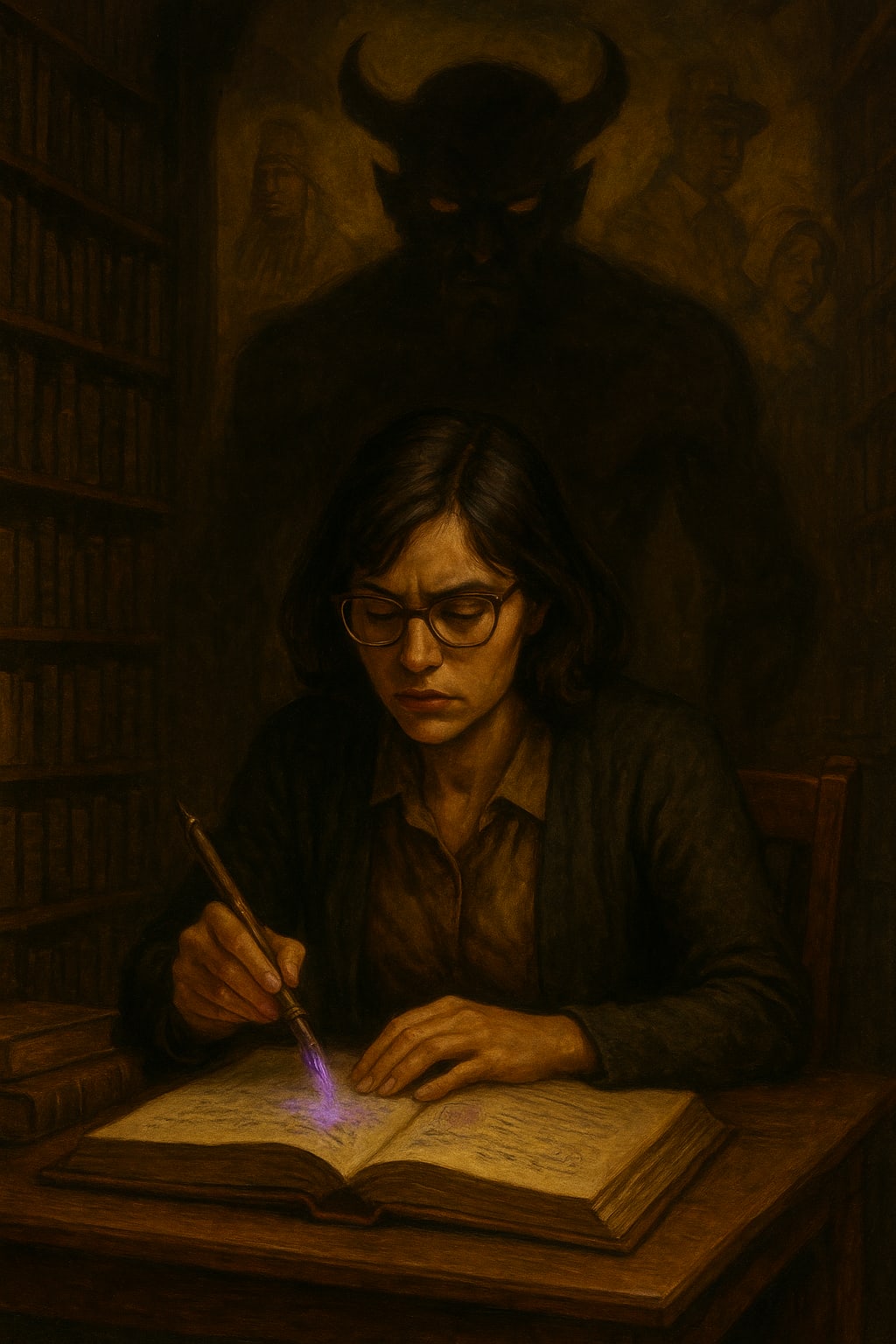
The fluorescent lights cast their ghostly light as always, their buzzing undercurrent a lullaby that had accompanied Elena through countless solitary hours in Special Collections. She pushed her glasses up her nose, a gesture as habitual as breathing, and squinted at the faded brown ink of a marginal note. The Hartwell estate collection had arrived three weeks ago in seventeen banker's boxes, each one a small archaeological dig waiting to happen, and she was nowhere near finished cataloging it.
Seventeen of them, she thought, and I'm still on box three. At this rate, I'll be here until Christmas.
Elena had been alone in Special Collections for the best part of four hours already, a solitude that had become her natural state. Her cardigan hung loose around her shoulders, the same gray wool cardigan she'd worn to the office for the past three years. Coffee stains marked the front of her blouse – one from this morning's hurried breakfast, another from yesterday's lunch she’d eaten at her desk. She was forty-two, and she looked every minute of it, and then some, she thought each time she looked in the mirror, worn down by vicious academic politics and years of thankless, barely-paid work.
Her career had stalled somewhere between her dissertation defense and the gradual realization that tenure was a fairy tale told to naive graduate students. Her dissertation on women's role in the leadership of the early labor movement in New England had been groundbreaking, or so her advisor had claimed. But groundbreaking didn't pay bills or secure permanent positions. It sat on a shelf in the university library, gathering dust and the odd glance from an occasional grad student. She’d been so excited to be offered a lectureship at Brown, adjunct, of course, but now, all these years later, she was a small fish still, indeed.
She opened a slim volume titled "Industrial Relations in the Connecticut Valley, 1890-1900" and, to her surprise, saw that someone had been making notations in the margins. That probably long-dead scholar had corrected a few dates in faded brown ink, and in one place, changed the name of a local organizer. The handwritten name sounded familiar – Elena had run across it in her research, but there was little about this woman in the sources, and so she had abandoned that line of inquiry. Elena smiled gently to herself: the scholar clearly had been a kindred spirit.
At least someone cared enough to argue with this book, she mused. More than most people do these days.
Elena read more carefully, comparing the marginal notes to the main text. The anonymous corrector had good instincts – several of the challenges were spot-on. The book claimed that Thomas Burke had organized the 1898 textile workers' strike in Millfield, but Elena knew this to be wrong. She had written her master's thesis on regional labor movements before taking up her broader dissertation topic. Sarah Kellerman had been the real organizer, though her contributions had been systematically minimized in contemporary accounts. Burke wasn't even present in the state at the time of the strike.
Same old story, Elena thought, her jaw tightening. Man gets the credit, woman gets forgotten.
Without thinking, Elena uncapped her fountain pen. The pen had been her father's gift when she received her PhD, back when he still believed academic life would treat his daughter better than it had treated him. He'd been a lecturer at Amherst, watching his brilliant daughter earn degree after degree, convinced that her obvious talent would ensure a bright future in his beloved academia. While he lived, Elena did her best to make him think she was on her way to one, but she left every visit with a bad taste in her mouth, hating herself for deceiving the old man.
"Leni," he'd said when he gave her the pen, "this pen is for signing your tenure agreement. I always knew that you would be someone important." She tried not to think about that.
The purple ink she favored flowed smoothly across the margin as she inscribed her note. "Sarah Kellerman organized this strike, not Thomas Burke." She paused, her pen hovering over the page. Should she add more? Mention Kellerman's innovative tactics, her ability to unite workers across ethnic lines? The woman had been remarkable. Elena had spent months researching her story, only to watch it disappear into the footnotes of academic papers that focused on male union leaders.
No, she decided. Keep it simple. Just the correction.
She capped the pen and made a note in her catalog about the existing marginalia, then moved on to the next volume. The Hartwell collection was proving to be a treasure trove of Connecticut Valley history, though most of it would probably never see the light of day. Who read regional industrial history anymore? Who cared about the forgotten strikes and failed negotiations of a century ago?
I do, she answered herself. Someone has to.
* * *
Three days later, Elena returned to the same section of the collection, drawn by a nagging feeling that she'd missed something. She'd been having trouble sleeping, her mind churning over the Kellerman correction. She was sure of her facts, but they had been derived from secondary evidence, not primary sources. Maybe she should amend her note to reflect it.
Tucked between the industrial relations texts deeper in the box, a tantalizing corner of a manila folder was just visible, its yellowed edge suggesting considerable age. Elena frowned, checking her filing system. She was always meticulous about cataloging since her student days. Her advisors have always insisted on the importance of clean record-keeping, and she’d gone through the box twice already. The folder wasn't in her records. Maybe it fell out of one of the other boxes, she wondered, though that didn't seem too likely.
Inside the folder, she discovered newspaper clippings from 1898, yellowed with age but remarkably well-preserved. "Local Woman Leads Textile Strike," read one headline from the Willimantic Journal. The accompanying photograph showed Sarah Kellerman addressing a crowd of workers, most of them women. She looked so sure of herself, so authoritative, and clearly respected.
Elena carefully examined the image. This was the woman she'd spent months researching, but she'd never seen her face. The woman in the picture looked exactly as Elena had imagined her: fierce, determined, uncompromising.
Under the clippings, she found a handwritten letter from Kellerman to her sister, dated three weeks into the strike. The cursive was elegant, cultured:
"Dearest Margaret, The New York leadership keeps trying to take over our little efforts here, though they cannot argue with our results. We have gained more ground in three weeks than they managed in three months of doing things their way. I sometimes wonder if they would rather lose than win under feminine direction. You should see the looks I get when I stand up to speak. But our weavers are forced to work each day in such unsafe conditions, and for starvation wages, and I will not let pride stand in the way of justice."
Elena's hands trembled slightly as she read. The letter was exactly what she would have expected from Kellerman – pragmatic, frustrated, but utterly committed to the cause. But how had it ended up in the Hartwell collection?
She checked the adjacent boxes, searching for any sign of where the folder might have come from. Box four held industrial records, box five – personal correspondence from mill owners. Nothing about Kellerman or any other union leaders.
This is impossible, she thought, wrinkling her nose. Documents don't just pop up out of nowhere. Then another thought struck her – If only I had run across this sooner. Maybe the field would have taken notice of me. Maybe I would have tenure now.
But there it was, tangible evidence of the woman she'd spent so long researching. Elena took pictures of the clippings and letter, then carefully filed the folder in its proper place. She'd need to update the catalog, cross-reference the materials with her existing Kellerman research.
Moving to another volume after lunch, she was unsurprised to find another error. The book claimed that suffragette Mary Torrington had been born in 1867, but Elena remembered reading that she was actually born in 1872. The five-year discrepancy might seem minor, but it placed Torrington's political awakening during the 1892 labor riots rather than before them – a significant difference in understanding her motivations.
Details matter, Elena thought. Each and every one.
She carefully wrote her correction, her handwriting joining the anonymous scholar's brown marginalia in a conversation across time. As she wrote, she found herself thinking about Torrington's story. The woman had been radicalized by watching clashes of police and Pinkertons with striking workers, had channeled her outrage into the suffrage movement. Born in 1867, she would have been twenty-five during the riots—old enough to be politically aware but perhaps not as emotionally affected. Born in 1872, she would have been only twenty, likely less experienced but more emotionally vulnerable to the trauma of seeing her neighbors beaten by police.
The later date makes more sense, Elena decided. It best explains her special brand of radicality.
* * *
That evening, Elena sat in her small apartment, chewing a stale takeout Caesar, her mind returning to the day's discoveries. She'd poured herself a glass of Malbec but hardly touched it. The coincidence was impossible to ignore, and no less impossible to believe.
How could I have missed that folder? she was thinking. It's really not like me.
The first thing she came across the next morning left her stunned. As she carried her next volume to her desk, a faded photograph fell out, landing on the floor face-up. Having stooped to pick it up, Elena could not believe her eyes – it was a copy of Mary Torrington's baptismal record, from 1872, as she had been so sure. This was starting to feel a little weird.
Elena looked up at her reflection in the window. It was dark out, and the New England winter offered no comfort to her troubled soul. Her face stared back, graying hair in an untidy bun, owlish glasses she had worn since high school. Was this how she would end her days, forever the forgotten frump, and now losing touch with the one thing that gave her life any kind of meaning?
At least I can give Kellerman her due, now that I have the documents, she thought. Maybe it wasn't all for nothing. If this is going to be my legacy, then maybe it wouldn’t be such a bad one.
* * *
It was already dark, and Elena was starting to think about quitting for the day when her phone buzzed with a reminder about tomorrow's faculty meeting. Idly, she checked her email. There was a message from Alastair, as she still thought of him, or Dr. Whitcomb, as had always instead on being titled. Not addressed to her, of course, it was a departmental memo. “Colleagues, do not forget to attend my talk tomorrow at the Regional History Conference. I will be presenting my paper on the Sacco and Vanzetti case. Your support will, of course, be enormously appreciated.” She could almost hear him intone this in the plummiest of Oxbridge accents.
Her stomach lurched a little. Even now, fifteen years after their affair, Whitcomb's arrogance could still make her skin crawl. She remembered being twenty-seven, naive, flattered by the attentions of the suave professor newly arrived from Cambridge. He had seemed so sophisticated, worldly, with his old-world manners and his tales of Oxford tutorials and Cambridge libraries. He'd made her feel special, chosen, until she realized she was just another conquest in his long line of grad students and junior faculty.
He brought her on as his teaching assistant for a single course, but she wound up doing a great deal of research also, all unpaid, of course, for his book on transatlantic labor movements. The affair had lasted a few months, conducted in his office after hours, in hotel rooms during conferences, and, rarely, in the rather swish apartment he'd kept on College Hill. He'd promised her nothing and delivered it. When the course ended, he headed back to England without so much as a by-your-leave, leaving only a brief note thanking her for her "research assistance."
The worst part was that she still felt something for him. Not love, exactly, but a pathetic flutter of… something, whenever she saw his name in her inbox or heard he was attending a conference. She hated herself for it, this weakness that persisted despite knowing exactly what kind of man he was.
Pushing her thoughts of him aside, Elena turned back to her research. She had work to do, real work. Sarah Kellerman deserved better than to be forgotten while men like Thomas Burke received uncalled-for credit. Elena uncapped her fountain pen and began writing in the margin of the book, detailing Kellerman's leadership role, her innovative organizing methods, the speeches that had united workers across ethnic and gender lines.
The purple ink flowed steadily as she wrote, note after note of corrections and additions. Kellerman's story emerged in Elena's careful handwriting: her background as a mill worker's daughter, her self-education, her ability to speak both English and French to the diverse workforce. Elena wrote about the innovative strike tactics, the way Kellerman had organized childcare cooperatives so mothers could participate in picket lines, her negotiations with mill owners that secured better working conditions.
She worked until nearly midnight, her hand cramping from the writing. When she finally capped her pen, she felt a strange satisfaction, as if she'd accomplished something important. Something necessary.
The next morning, she found an entire folder of Kellerman materials waiting for her: photographs, union meeting minutes, personal correspondence. It was right there on her desk, without explanation. The documentation was thorough, authentic-looking, and compelling. Elena stared at the materials, her hands shaking slightly as she paged through them.
This is impossible, she thought, but there it was, in front of her. And, no one had seen or heard anyone carrying the file or even entering the room.
* * *
Before she even opened her computer, Whitcomb stormed into her basement lair wild-eyed, his usual pompous demeanor gone, replaced by panic barely contained. He still cut an impressive figure at fifty-five, handsome in that delicate, aristocratic way that had once made Elena's heart flutter. His graying hair was perfection, his tweeds direct from Savile Row, but his hands shook as he began rifling through some boxes more or less at random.
"Elena, someone's been tampering with our labor movement collection. I just logged in to double-check my notes for the conference, and half my sources appear to have vanished! And this is what I really fail to understand – the sources of my citations are now showing opposite information than I know them to contain. I am about to take my leave of sanity!"
Elena watched him search through the boxes, growing more and more frantic. The bronze nameplate on his office door revealed him to be a Pemberton Visiting Professor, but he'd been visiting for three years now, his permanent return to Cambridge mysteriously delayed.
"What are you looking for, exactly?" she asked, though her stomach was already knotting with suspicion.
"My documentation on the Sacco and Vanzetti case. I had irrefutable evidence of their guilt – witness testimonies, ballistics reports, correspondence from the FBI. Now I can't find most of it, and what I can find contradicts everything I know to be true." He pulled out a folder, his face flushing red. "This, for example! This witness statement I've been citing for months now says the complete opposite of what I remember!"
Troubled, Elena offered to help search. This was at least as weird as finding previously unknown documents that had so conveniently supported her positions. As they scoured the archive through the afternoon, Whitcomb's desperation grew. More and more of the documents that he'd been certain of had vanished or been altered. His carefully constructed argument was in tatters.
"This must be sabotage," he muttered, sweat beading on his forehead despite the cool temperature of the basement. "Someone must be trying to destroy my reputation. They have always been jealous of me, I know, but this is a new low!"
She finished her workday in a daze, going through the motions of cataloging while her thoughts churned. At the organic store that evening, picking up her usual meal of salad, chicken, and a bottle of red wine, the suspicion finally crystallized into something approaching certainty.
What if it wasn't a coincidence? What if her corrections had somehow… No. That was impossible. Insane. She was a historian, not a witch. But the thought wouldn't leave her alone.
That evening, Elena sat in the back row of the lecture hall, watching Whitcomb's presentation with a mixture of fascination and horror. He stood at the podium, his notes scattered before him, trying to salvage what remained of his thesis.
"The evidence against Sacco and Vanzetti was… compelling," he attempted to remain authoritative. "The ballistics reports clearly showed that the guard had been killed by a bullet fired from a gun that was later found in Sacco’s possession. The eyewitness testimony was incontrovertible, and the evidence of Sacco’s cap found on the scene had correctly sealed their fate.”
The audience grew restless. Elena recognized several prominent historians in the crowd, people whose opinions mattered in their small academic world. They exchanged glances, whispered among themselves. A hand went up in the front row.
“You refer to statements and evidence that had been either recanted or found less than conclusive, Professor Whitcomb,” pointed out Mary Chan, who had once been another one in the long line of Whitcomb’s conquests. “I trust that you have the documentation to support your conclusions. It does not appear to be listed on your handout or in your pre-print.”
Whitcomb's face went pale. He shuffled through his papers, looking dazed. "The evidence is… the documentation clearly… I'm afraid there seems to be some confusion with my sources…”
With mixed feelings, Elena watched him fumble through the rest of his presentation, a shadow of his usual assured self, managing only the most basic summary of the case before fleeing the stage and out of the room. Walking home through the February cold, she was surprised to find herself pleased with his discomfiture, but also deeply troubled. Whitcomb's humiliation was complete; his reputation likely damaged beyond repair. But the timing was a little too convenient, too perfect.
She'd always believed in justice, in the importance of historical truth. If he was wrong, then it was only proper that his thesis be rejected, but then there was the human cost. Whitcomb was a self-regarding, pompous shit, but still it wasn’t very pleasant to watch him self-destruct, and in such a public way. Still, she could not shake a nagging feeling that there was more to what she’d witnessed than maybe met the eye.
* * *
Elena woke in the silence of the night with the absolute certainty that she was not alone in her apartment. She lay still, listening to the familiar sounds of the old building settling, the hum of the refrigerator, the distant whoosh of Route 95 traffic. There was nothing unusual, but the feeling persisted. She slipped out of bed, padding barefoot through her small apartment, checking the locks on her door, peering through the blinds at the empty parking lot below. Everything was exactly as it should be, but she couldn't shake the sensation of being watched.
She made herself a cup of tea and opened up her laptop, thinking she might as well get some work done since sleep seemed impossible now. As she updated her notes on the Kellerman materials, the thought struck her with sudden clarity: what if it really had been her marginalia that somehow manifested the newly found documents?
The idea was absurd, impossible. But the more she thought about it, the more the pieces seemed to fit. The timing, the specificity of the materials, the way they perfectly corroborated her corrections. And then there was the Whitcomb business. That was really weird.
Elena tried to dismiss the thought, but it clung to her like smoke. At the library the next morning, she made a decision. If she was going to lose her mind, at least she could do it scientifically.
She selected three different books, three different possible inaccuracies. She made sure that she wasn’t writing down facts she knew to be incontrovertible – they had to have been open to debate. She pulled out her fountain pen and changed a date in a volume on colonial treaties. In a demographics text, she fixed a population figure. In a third book, she was about to change an attribution of a quote when her pen dribbled and ran dry. She borrowed a ballpoint from the circulation desk and made her changes using that.
After lunch, she returned to find that the first two corrections had produced supporting documentation. A folder containing the correct treaty, filed exactly where it should be. A census report confirming the population figure, tucked between related materials. But the third correction, made in ballpoint, had generated nothing.
This really was insane, Elena thought. She had a magic pen? A pen that could alter the historic record? She saw an image of her father, his age-spotted hands still steady as he handed her the long black box, its Mont Blanc decal staring at her through the years.
* * *
"You look awful," Ilona said, cutting into her parmigiana with far more force than necessary. "When's the last time that you slept?"
They were sitting in their usual spot at Rossini's, the little Italian place near campus where they'd been meeting for dinner once a month since Ilona started grad school. Elena had been Ilona's undergraduate advisor, then mentor, then her friend. Now, at twenty-six, Ilona was finishing up her dissertation while Elena remained trapped in adjunct purgatory.
"Strange things have been happening at work," Elena began, then stopped herself. How could she talk about this without sounding insane? "Just so much stress… You know how it is."
Ilona nodded, but Elena could see the concern in her dark eyes. Dr. Martinez, soon to be, if all went well. First generation in the States, first in her family to go to college, carrying the hopes and dreams of parents who'd sacrificed everything for their daughter's education.
"Speaking of strange happenings," Ilona said, lowering her voice, "something happened at the university. With Mornay."
Elena knew the name, of course. Professor Claude Mornay, department head at Harvard, an undisputed expert in all things American from the New Deal and through the war years. His bio of FDR’s advisor Harry Hopkins had been praised to the skies, called magisterial. It even sold some copies to the public, surprisingly for such an obscure topic. “The New Deal's Right Hand,” he’d called it. “Harry Hopkins and American Democracy.” Like most historians, Elena had a copy.
"I was helping organize his research files," Ilona continued, "getting ready for his sabbatical. You know how he is about documentation."
Elena nodded. Mornay's reputation for meticulousness was legendary.
"I found some cables. Among the State Department, Harry Hopkins, and a Naval officer in 1943. The officer was reporting on a lend-lease shipment to the Soviet Union, routine inspection. He’d found documents stamped Top Secret, technical specifications for aircraft and munitions. One mentioned something called the Manhattan Project."
Elena's fork stopped halfway to her mouth. "Manhattan Project in 1943? That's…"
"Two hours later, there's a cable from Hopkins himself. Personal authorization, telling the officer to reseal the containers and expedite the shipment." Ilona's voice dropped to a whisper. "I photographed everything with my phone before I showed Mornay."
"What did he say?"
"He went ballistic. Snatched the documents, told me to delete the photos. Said that if I ever mentioned this to anyone, he'd ruin my career. He was furious, Elena. Scary furious."
Elena, stunned, sat back. She’d read the book – Hopkins was FDR’s closest advisor. He lived in the White House, saw the President every day, and was trusted more with foreign policy than the cabinet or the State Department. He’d advised on FDR’s Japan policy, negotiated Lend-Lease with Stalin, supported Churchill’s overtures to draw the country into war. He was the second most powerful person in the country until stomach cancer laid him low. Even when so ill he could not eat, he still came with FDR to Yalta.
“I don’t know if you remember, but Hopkins had been fingered later, during the McCarthy era, and even rumored to be ‘Agent 19’ from the Venona intercepts. You know how Mornay had treated all these allegations. He called it paranoia and did his best to impugn everyone who’d made them.” Ilona’s eyes were shining. "This could rewrite the history of American involvement in World War II," Ilona said. "If Hopkins was working for the Soviets…"
"You kept the photos?"
"Of course. But what good are they if I can't publish without destroying my career? My defense is scheduled for December. My parents are planning to fly up from Texas. If Mornay blacklists me…"
Elena reached across the table, covering Ilona's hand with her own. "Are you prepared to take risks for the truth? I don’t know what I would do in your place, to be honest… She frowned. “Sometimes justice requires courage, but I don’t know if I would have enough."
"Yeah… It’s easy to be passionate about Truth when speaking in the abstract. But it’s my whole future! And, as you know, I still have to help save for my parents' retirement, and on a graduate student stipend…"
They finished dinner in troubled silence. What was this thing called truth when it comes to history, really? What happened, or what we believe had happened, because someone had written it? Truth is what matters, she told herself. But even as she thought it, she wondered if she was only trying to convince herself.
* * *
Elena was alone again in Special Collections the next afternoon, cataloging a new batch of materials, when she came across another all-too-familiar error. The book claimed that Chief Joseph Blackwater's 1876 peace negotiations had been conducted by a white missionary named Samuel Harrison. Elena knew better. She'd come across references to this in her broader research, enough to know that Blackwater had conducted his own negotiations, speaking fluent English and displaying a sophisticated understanding of federal law that had impressed even his opponents.
Same old story, she thought. A powerful indigenous leader is subsumed by the white savior narrative.
She uncapped her fountain pen, then hesitated. The purple ink seemed to pulse with possibility. After what had happened with Whitcomb, with the Kellerman materials, she understood the power she seemed to wield. Was she brave enough to use it?
Her phone buzzed with a text from Rachel: "Lunch Monday? I need to talk to someone sane about this insane profession."
Elena typed back: "Of course. 12:30 at the Faculty Club?"
She turned back to the book, her pen still poised over the margin. The correction felt righteous, necessary. Chief Joseph Blackwater deserved recognition for his own diplomatic skills, his own intelligence. Elena wrote carefully, detailing his education, his legal acumen, his successful negotiations that had prevented a massacre.
As she wrote, she felt that strange sensation again, the feeling of approval, of rightness. The purple ink flowed smoothly across the page, and for a moment, she could have sworn she felt someone else's presence in the silent room.
* * *
"I'm losing my mind," Rachel said, absently picking at her salad. "I swear to God, Elena, I'm losing my mind."
Tenured at thirty-eight, Rachel had two well-received books on women's suffrage, a comfortable office with her name in gold lettering on the door. Chan-Zuckerberg Associate Professor R. Friedman, how proud she had been then. But today she looked haggard, her usually perfect hair pulled back in a messy ponytail, her eyes rimmed with red.
"What's wrong?" Elena asked, though she suspected she already knew.
"My book proposal. The one on transcendentalist women? I've been working on it for eighteen months, and now suddenly nothing makes sense. I go to verify a quote from Margaret Fuller, and it says something completely different from what I have in my notes. Not similar, Elena. Completely different. Opposite, in fact."
Elena's stomach clenched. "Could it have been from a different note?"
"That's what I thought at first. But it's not just one quote. It's dozens. Sources I've been citing for months now say things they never said before. Or they did say them, but in completely different contexts that completely change the meaning."
Rachel pulled out her phone, scrolling through notes. "Look at this. I have Margaret Fuller quoted as saying, 'A woman's highest achievement is in supporting the intellectual endeavors of her husband.' But every source I check now has her saying, 'A woman's highest achievement is in pursuing her own intellectual endeavors, with or without a husband.' How could I have gotten that so wrong?"
Elena knew exactly how. She'd heard from Rachel two days ago, right before she'd made her notations about Blackwater. Her blood ran cold. Not only was her power to amend the record like some kind of cosmic balance sheet – one colleague harmed for every set of facts restored – but it looked like the person whose work would suffer would be the one whose name she had seen last. This was really just too much power to wield.
"The dean is breathing down my neck," Rachel continued. "My book proposal doesn't make sense anymore. The argument I've been building for months has collapsed. What am I going to do?"
Elena stared at her friend across the table, feeling the weight of her pain, fear, her bewilderment. Rachel had worked hard for her success. She had earned it. And now Elena's zeal to expose the truth was destroying it, unpicking years of painstaking research.
"Maybe," Elena said carefully, "we're all just constructing narratives. What if there is no objective truth? What if every correction we make just creates a different distortion? I mean, when we write history, do we reveal what actually happened, or do we invent a narrative by choosing what sources to follow and what facts to include?"
Rachel looked up sharply. "You sound like those postmodern theorists who think everything is relative. I thought you believed in historical accuracy."
"I do. I want to." Elena chose her words carefully. "But if pursuing justice means destroying other people's work, is it still justice?"
"What are you talking about? Justice doesn't destroy truth. Justice reveals truth."
Still, Elena wasn't so sure anymore. “Look, here is one example. One of my friends came across a document that suggests that Harry Hopkins – you know, the FDR advisor – was possibly a Soviet spy. Today, Hopkins is a hero, but if she publishes, then tomorrow will he be a villain? And what of all the work by researchers who’d praised his contributions? Does it all vanish, along with their careers?”
“I am surprised at you, Elena.” Rachel was suddenly very serious. “You of all people know that careers aren’t as important as the truth. If they were, then what would it make us? Historians, or self-serving propagandists?”
Truth or otherwise, Elena felt responsible for this calamity her friend was facing. Yet, the lure of this unique ability to let the light of truth shine was very strong. She just wasn’t sure that she could handle the responsibility that came with it.
* * *
She trudged back to her cave in Special Collections with a heavy heart. The books awaited her, patient, silent, holding their secrets and their errors. She found another mistake, a small one, the kind of thing that probably mattered to no one but her.
She hesitated before making the correction, her pen hovering over the page. Was this justice or selfishness? Truth or power? She didn’t know.
Finally deciding, Elena put the book back on its pile untouched, but as soon as she turned to walk away, she felt strangely compelled to pick it up again. The error stared back at her, a small historical injustice that she could fix with a stroke of her pen. She struggled against the feeling, standing up and walking to the window overlooking the quad.
Students hurried across the brown February grass, bundled in coats and scarves, their breath billowing in the cold air. They looked so young, so hopeful. Did they know how the world would disappoint them? How their dreams would shrink to fit the confines of circumstance, of their limitations?
Elena turned back to the book, then away again. She felt restless, agitated, as if something was pulling at her from inside. The quiet of Special Collections, usually so comforting, now felt oppressive. She was aware of every small sound: the hum of the fluorescent lights, the whisper of forced air through the vents, the distant murmur of voices from the main library.
And something else. The sense that she was not alone.
"This is ridiculous," she said aloud, her voice unnaturally loud in the silence. "I'm talking to myself in an empty room."
But was it empty? Elena looked around the stacks, scanning the narrow aisles between the shelves. Nothing. No one. Just books and dust and the faint smell of old paper.
She needed coffee. That was all. It must have been the lack of sleep that was making her so paranoid. She ordered a double latte at the library café and sat at one of the small tables surrounded by students reading and typing on their laptops.
Normal people, she thought. Living normal lives. Not wondering if they're losing their minds in a basement full of musty books.
But even as she tried to convince herself, she felt the pull. The book on her desk, waiting for her correction. The small historical injustice that she could fix, so easily. Her fingers tingled with the need to hold her pen, to write, to set the record straight.
She drank up her coffee in three quick gulps and hurried to the basement. The book was exactly where she'd left it, open to the same page. Elena snatched it up and uncapped her pen, her hand moving almost without conscious volition. The purple ink flowed across the margin, making the correction that she'd been resisting.
Immediately, she felt a peaceful sensation spreading through her, a sense of completion, of approval. The restlessness disappeared, replaced by a calm satisfaction. She picked up her phone to check the time and saw a text message from Professor Pansky, timestamped thirty minutes earlier.
"Elena, would you like to join me for dinner tonight? We are overdue."
* * *
Dr. Pansky's house sat on a quiet street not far from campus, a small colonial with a well-tended garden and even a white picket fence. Elena had been here many times, first as his student, then as his colleague, finally as something approaching a friend. Pansky had been her father's friend first, had known Karl Messer from their student days, before each departed to their own school to begin teaching.
Inside, it was the same as always: dark wood furniture, Persian rugs, bookshelves lining every wall. But something felt different tonight. The usually immaculate space was cluttered with boxes, papers scattered across every surface. The painting of the god Ilmarinen, a relic of the professor’s old enthusiasm for the Kalevala, which usually hung above his desk, was propped against a wall. The photo of erupting Mount Etna that Elena had so loved was altogether missing.
"Elena, it is good to see you." Pansky looked older than his seventy-two years, his white hair disheveled, his usually neat appearance rumpled. "I'm afraid I'm not very good company these days."
"Cyril, what's wrong? You look…"
"Confused? Lost? That's because I am." He gestured at the chaos around them. "I've been trying to make sense of my research notes, prepare for my last semester before retirement. But I can no longer make any sense of it."
Elena, pale with foreboding, followed him into his study, where more boxes waited. She could see manila folders overflowing with papers, notebooks with pages marked by dozens of sticky notes. She knew what he was going to tell her.
“It’s my first book that is the problem. You remember, the one on colonial indigenous relations,” said Pansky, his voice hollow. “It’d made my reputation then, but now… Now, none of it adds up. My documents, my sources, none of them say what’s in my notes. Sources I've built entire arguments around now say completely different things."
Elena's heart sank. It was exactly as he had feared. "What do you mean, specifically?"
"Treaties I've quoted extensively, land negotiations I've written about, the correspondence. It's all… wrong. Not wrong, exactly, but different. As if the historical record has been rewritten while I wasn't looking."
He pulled out a folder, his hands shaking slightly. "This is my research on the 1871 Treaty of Fort Laramie. I’d studied it for a dozen years, published two articles on the negotiation process. According to my notes, the treaty was negotiated primarily by Indian Agent Samuel Morrison, a typical example of federal bureaucratic heavy-handedness."
Elena felt sick. She knew what was coming.
"But when I went to verify my sources last week, everything had changed. The documents now show that the negotiations were conducted by the tribal leaders themselves, particularly Chief Standing Bear, who apparently spoke fluent English and had studied federal law extensively. Morrison was barely involved."
"Could it be your memory…" She felt dirty, like a liar.
"My memory is fine!" The outburst seemed to surprise Pansky as much as it did Elena. He sat heavily in his chair, suddenly looking every one of his seventy-two years. "I'm sorry. I know how this sounds. But I've been meticulous about documentation for my entire career. Meticulous. These are not lapses in my memory."
Elena said nothing, but her mind raced. She remembered making corrections about indigenous leaders, about their intelligence and agency being overlooked in favor of white intermediaries. She'd been thinking about justice, about setting the record straight. She hadn’t even known that Pansky had messaged her – perhaps she would have stopped if she had seen it.
"I went to my doctor," Pansky continued. "Asked about early dementia, Alzheimer's. The tests came back normal. Cognitively, I'm fine. But professionally, I'm finished. How can I teach when I can't trust my own research? How can I publish when my sources contradict my arguments?"
He looked at Elena with desperate eyes. "Did I imagine it all? Forty years of scholarship, and none of it was real? Was history as I wrote it actually real?" Struck by a thought, he stared. “Written history depends on what we put in and what we leave out, does it not? Do we create history then? Is written history the same as History, with the capital? What is it? Is it what happened or what people believe happened?”
“Cyril, please don’t make more of this than it deserves,” Elena tried to soothe him. “I understand how you must be feeling, but really, it is only your first book, your juvenilia. Your most important work was always on diplomatic history, wasn’t it? Your book on American diplomacy of the first half of the Twentieth Century is a standard reference. That’s still intact, right? Even if there is a minor scandal, your real reputation is not really affected.”
“I hope that you are right, my girl.” Pansky stopped pacing. “Maybe not all is lost. Besides, I will have my whole retirement to return to this work and repair what can be repaired.”
Elena let her breath out in relief. She hadn’t realized that she was holding it. Now she wouldn't have to tell him that she was rewriting history somehow, that her corrections were unraveling the decades of his scholarship.
"Your work has always been excellent," she said at last. "You taught me to be rigorous, to question sources, to look for the human stories behind the official accounts. That hasn't changed."
But even as she said it, she wondered if she was telling the truth. Pansky’s final words, particularly, stuck with her. Was she correcting history or changing it? What if she were a tool of some shadowy demiurge of history, who used her for its own obscure ends, regardless of the cost? She had to stop, and stop right now. This was too much. The pursuit of truth, however laudable, should not destroy the lives of people, people who have done nothing to deserve it.
* * *
Elena’s blood ran cold. There, in the margin of a book she'd been cataloging yesterday, was fresh purple ink. Her handwriting. A correction she didn't remember making. She double-checked, went back over her notes, but there it was. She didn’t even have to be there now for written history to change, but who, or what, was changing it, and why? She’d vowed to stop doing this, but now… And that persistent feeling of a presence in the room… She felt her mind begin to slip.
The phone rang. Still reeling, Elena snatched it up without looking and answered it on her way out of the quiet room. Ilona's voice was thick with tears. "Elena, I need to see you. Something terrible has happened."
They met at a coffee shop off campus, away from the watchful eyes of the academic rumor mill. Ilona looked exhausted, her dark hair pulled back in a messy bun, her eyes red from crying. She'd always been so composed, so determined. Seeing her like this broke Elena's heart.
"I went ahead with it," Ilona said without preamble. "The Hopkins documents. I reached out to Professor Williams at Columbia, the one who wrote that exposé on State Department corruption in the forties. He was excited, said the materials could be groundbreaking."
Elena felt a chill. "What happened?"
"He promised to protect me. Said he had enough clout to keep Mornay from retaliating. We co-authored a paper, submitted it to the Journal of American History. It was accepted for publication."
"That's wonderful news."
"No, it's not." Ilona's voice cracked. "Mornay found out before it hit the presses. He called an emergency meeting with the graduate committee. My dissertation defense, scheduled for December, has been cancelled. My research grant has been terminated. Professor Williams… he couldn't protect me after all. Said Harvard applied pressure to Columbia, threatened to end all collaborations."
Elena reached across the table, taking Ilona's hands in hers. They were cold, trembling.
"I don't know how I'm going to tell my parents," Ilona continued. "They've given everything for my education. Worked double shifts, sent me every dollar they could spare. My mother cleans office buildings at night so I could afford graduate school. My father hasn't taken a vacation in ten years."
"There are other programs, other advisors…" Elena knew that this was a hollow hope.
"Who's going to take me now? Mornay has connections everywhere. He's already started making calls, letting people know I'm 'unreliable,' 'prone to conspiracy theories.' I'm Ahasuerus now, condemned to wander the wilderness for my transgression… History has always been my calling… And now, it’s up in smoke. What am I going to do?"
Elena squeezed her hands tighter. The reference to the Wandering Jew stung; Ilona rarely talked about her struggles with faith, but Elena knew she'd been raised Catholic and still carried the weight of that tradition.
"Send me copies of the documents," Elena said. "All of them."
"What are you going to do?"
"I don't know yet. But truth matters, Ilona. It has to matter more than one man's reputation."
That evening, Elena sat in her apartment staring at her laptop screen. Ilona's email had arrived an hour ago, containing scanned copies of the Hopkins cables, clear photographs that showed every detail of the damning correspondence. The evidence was undeniable: Harry Hopkins, FDR's most trusted advisor, had been working for the Soviet Union.
Mornay's biography of Hopkins, "The New Deal's Right Hand," sat on Elena's bookshelf. She'd read it when it was published five years ago, impressed by its scholarship and its passionate defense of Hopkins against Cold War accusations. The book had won the Bancroft Prize, established Mornay as the definitive authority on New Deal personalities.
She knew that could fix this. She knew exactly which corrections to make, which sources to adjust. A few purple strokes of her pen, and the historical record would shift. Hopkins would be exposed as the traitor he so obviously was. Mornay's reputation would be destroyed, his career ended. Ilona would be vindicated.
* * *
At the crack of dawn, Elena was already at her desk at Special Materials, filled with purpose, printouts stuffed in folders clutched tightly in her hand. She had the Hopkins documents, a copy of the Mornay book. All she had to do was make her notations with her magic pen, and justice would be served. Ilona would be vindicated, Mornay exposed, truth made triumphant.
"The 1943 Atlantic Charter negotiations included secret protocols regarding post-war intelligence sharing," she was preparing to write. "See Hopkins-Stalin correspondence, classified file 247-A."
She shut her eyes, envisioning the future. It had to work. She could already picture it, an email from Ilona: "Elena, something incredible has happened. A folder of Hopkins documents just appeared in the university archives. They corroborate everything I found. The head librarian is calling it the discovery of the decade. Mornay is in emergency meetings with the administration. I think they're going to have to reinstate my defense!"
With firm purpose, she took up the pen, uncapped it, feeling its portentous weight. Her father's gift, given in hope and love, and now an instrument of something she no longer understood. Of justice, maybe. The purple ink seemed to pulse with possibility, with power. And yet, she hesitated.
What am I becoming? she wondered. What is this power doing to me?
She looked at the documents spread across her desk, at the pen in her hand, at the book waiting for her corrections. Fluorescent lights hummed above, their buzzing lullaby unchanged. But Elena heard something else now, a whisper at the edge of perception, urging her forward. The pen called out to her, pulled her with its promise, the promise of justice, the promise that truth would finally prevail. And yet, another thing called out, also, the cold fear that she was no longer in control of what she did.
All she had to do was write.
She thought about Sarah Kellerman, finally receiving the recognition she deserved. She thought about Chief Joseph Blackwater and Standing Bear, their intelligence and agency finally acknowledged. She thought about all the forgotten women, the dismissed indigenous leaders, the marginalized voices that history had overlooked.
The documents lay before her, damning and clear. Hopkins, the architect of Lend-Lease, the man who had helped win World War II, revealed to be a traitor. Mornay, the distinguished scholar, exposed as a fraud. Ilona, the brilliant young historian, vindicated and triumphant.
All it would take was a few lines of purple ink.
Resolved now, she touched the paper with the nib, and right at that moment, her phone buzzed beside her on the desk. She glanced at it and froze. It was a text. From Pansky.
Undisclosed location, 2025
About the Creator
The Myth of Sysiphus
Sisyphus prefers to remain anonymous as he explores the vicissitudes of the human condition through speculative fiction.
Keep reading
More stories from The Myth of Sysiphus and writers in Fiction and other communities.
In the Garden of Eden, Baby
Moodily, Darius was contemplating his latest acquisition, a mahogany writing desk that had belonged to Charles Dickens. The desk was perfect: authenticated provenance, immaculate restoration by his master craftsmen, displayed in a room where morning light struck it at precisely the angle that best revealed the wood's natural grain. It also had no meaning. He turned away toward the sunset. The ocean was a mirror, the dying sun casting a long red reflection.
By The Myth of Sysiphus7 months ago in Fiction
Pandora’s Burden
“My brother warned me to not accept gifts from the one who commissioned you,” said Epimetheus to the woman clad in silvery raiments standing at the entrance to the temple. Her silver tiara and the silver rings on her fingers and toes glinted in the firelight cast by torches set on either side of the doorway. Lingering in the shadows, beyond the reach of the flames as she was, he could not tell what she held in her hands. At first what appeared to be a box was perhaps a funerary urn, or maybe merely an apple.
By J. Otis Haas2 days ago in Fiction
A System That Isn’t Working Challenge Winners
Systems promise order. They organize behavior, distribute opportunity, and suggest that if everyone follows the rules, things will work. The entries in A System That Isn’t Working look closely at what happens when that promise begins to slip.
By Vocal Curation Team4 days ago in Resources


Comments
There are no comments for this story
Be the first to respond and start the conversation.