
I awoke into my nightmare. My cold and unyielding body refused to obey my commands. I couldn't move. My eyes scanned the room with frantic urgency, darting from shadow to shadow. I was a prisoner in my own skin, unable even to blink. There was no respite, no escape. My heart drummed a steady rhythm, each beat amplifying the dread that pulsed through me. I was back. Again.
The room was familiar, yet every detail seemed charged with malevolence. My gaze flickered to the furthest point of the room, where a dark figure stood near the wardrobe, barely discernible in the dim light. What does it want? The figure shifted, slipping in and out of my peripheral vision like a phantom, never fully coming into focus. It flickered like a broken TV, constantly distorted and jumping, its presence unsettling in its intangibility.
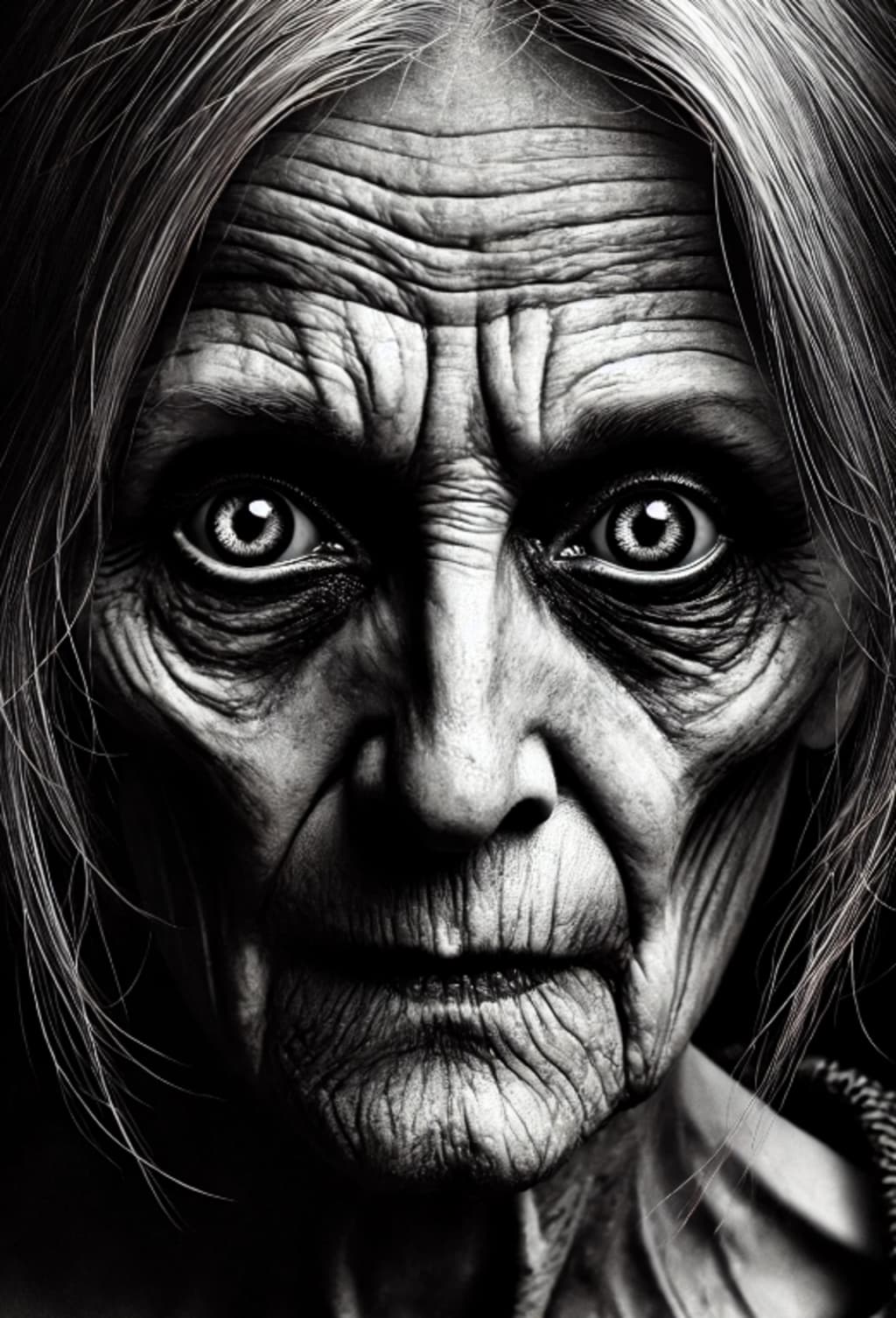
And then, it was close—too close. An old woman was hunched and snarling with a hatred radiating from her like heat from a flame. Her face, contorted with disgust, hovered inches from mine. Vulnerability washed over me, deeper and more primal than I had ever known. I could feel her breath on my neck, a cold, moist whisper of air that made every hair on my body stand erect. Why can I sense every hair so vividly if I'm still asleep? My mind screamed for action, but my body remained rooted, a powerless vessel at her mercy. Yet she did not strike. Instead, she leaned in and whispered, her voice muffled and unintelligible, the tone chilling enough to send shivers down my spine. I retreated so much into myself from the fear I created a contorted and compressed body, breathing became a suffocating effort.
You might assume this is just sleep paralysis—a state where the body is trapped in sleep while the mind awakens. It's a simple explanation, but it falls short. If my body is truly paralyzed, then how can I move my eyes? How, with concentrated effort, can I wiggle my index finger, even if only slightly? These anomalies defy the conventional understanding of this phenomenon.
For years, I sought answers, diving into research and numbing my fears with prescriptions meant to dull the terror. But now, I understand that pain is not something to be avoided but something to be confronted. The truth lies in experience, not in the deadening of sensation. Avoiding danger by numbing myself is no safer than facing it head-on. In fact, it may be worse, a cowardly postponement of an inevitable duel.
But perhaps I've been approaching this all wrong. The actual confrontation isn't with the old woman in my nightmare but with the passive existence I've accepted in my waking life. Every day, I am a passive observer, a vessel that accepts whatever fate society decides to pour into it. I've tried to overcome these nightmares from within the dream, trying to wrestle control from the old woman, but to no avail. The paralysis extends much beyond the night.
I began to question why I was being punished in these nightmares. What do they want to reveal to me? The truth became clearer: this state of paralysis is a mirror, reflecting my reluctance to see the truth in my daily life. The nightmare forces me to stay in the moment, eyes wide open, as I do nothing. The passivity that defines my interactions with others—the nonsense I tolerate, the annoyances I endure without complaint—has seeped into my soul. Is it out of fear of conflict or a desire to be liked? No, it's something more profound. I realized I don't care if a stranger dislikes me or if a confrontation leads to an argument. The real issue is my desire for an easy life, a path of least resistance. But even this justification crumbles under scrutiny. My laziness has become my default mode, a habit hard to break. The nightmare shows me this truth: I cannot expect others to value me when I do not value myself. If I put a low price on myself, be sure the world will not raise my worth.
Determined to break this cycle, I desperately attempted to reclaim myself. That night, something felt different. The usual sickly dread was lighter as if a burden had been lifted. Let me rest, I thought. But as the dream began, following its usual script, I found myself staring back at the old woman. I must be cautious about staring into the abyss and not let it stare back into me. But for the first time, I realized you cannot hurt me. I can only hurt myself. I control you.
She paused. The room seemed to shift, the oppressive weight on my chest easing just slightly. The old woman's form began to blur, her features melting into a shapeless shadow. Her voice, now faint, echoed in my mind: "Confront your fears or be consumed by them."
With a surge of defiance, I focused on my breathing, each inhale and exhale grounding me in the present moment. My heartbeat became a steady drumbeat of resolve. I willed my body to move, and this time, it obeyed—not just my finger but my entire hand, arm, and torso. The paralysis yielded, and I sat up, gasping for air.
The room was still, and the figure was gone. But her words lingered, etched into my consciousness. I am no longer merely a passive observer of my own existence. The nightmare, though terrifying, has given me a gift: clarity.
I rose from my bed, my body quivering but alive with a new sense of purpose. I know now that to live is to engage fully with the world, to confront its absurdities, and to challenge its impositions. The true terror lies not in the spectral visitations of the night but in the unexamined acceptance of a half-lived life.
With each step from my bed, I felt as though I was stepping into a reality I could no longer ignore or passively endure. The nightmares may continue, but they will no longer define me. Instead, they will serve as the crucible in which my resolve is forged.
I opened the window and let the cool night air wash over me—a small gesture, yet it signified enormous intent. I was awake, in every sense of the word, ready to face whatever came, eyes wide open.
I took something from the fact if your dreams do not scare you, they are not big enough. These dreams scared me, alright. I used to believe this as a testament to ambition. But now I see that the thoughts we pretend not to have—the fears we bury—are the ones we must face. The true nightmare is not in our dreams but in a life unlived.
About the Creator
Oliver Millward
Hi I have just completed a MSc in psychology and feel I want to write psychological novals that centre around existential dread. I read a lot of philosophy particularly the Greeks. Please recommended me some reads and have a read on mine.
Keep reading
More stories from Oliver Millward and writers in Fiction and other communities.
Fading Memories
A chilling realization washed over me: the scars were old, the message carved in a desperate bid for truth. I had been here before, trapped in this endless loop of confusion and deceit. It does not matter for how long. All that matters is that with each day, I gain more memories. Presumably, I had asked for a pen and paper in the past, and they either denied my access for cruelty or witnessed me trying to recall my memories. All I had left was my skin. I know asking for a pen now would trigger a treat from me to them. They know my path. They know my responses. I must recognize what they think I will do and differ my response to that of the unknowing lump of flesh they wish to remain captured.
By Oliver Millward2 years ago in Fiction
This Is What I Do When People Throw Rocks At Me
Rocks have been thrown at me for a greater part of my life. Some have been small and missed hitting me. When people don't get a reaction from me, they throw bigger rocks with a better aim. Many have been hurled at me with precision over the years. For a long time, I thought my only options were to dodge them or be crushed by them.
By Margaret Minnicks5 days ago in Confessions


Comments (4)
' I am no longer merely a passive observer of my own existence. ' What a great line. Your description is frightening while at the same time a mystery of sorts. Well done
...where the nightmares symbolize the author's broader issues with self-assertion and acceptance...
Well written
So horrific