

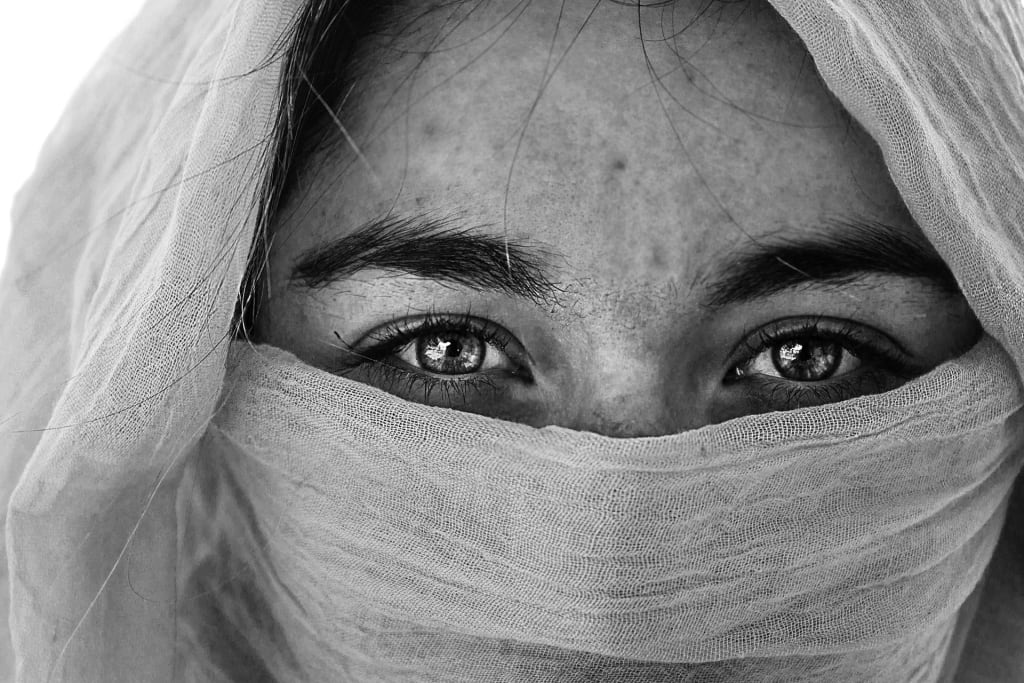
I remember my mother’s braid touching the road, and her eyes.
Her father made bricks in Amritsar, the city of the Golden Temple, he was a Muslim but did not have the Koran in his heart. He was called Mohammed and married Ruttie. On the first night after the wedding, five twins were conceived. My grandmother gave birth to them, one after the other, but all the males were born dead. Only two girls survived, my mother and my aunt.
They were two thin girls, who wept softly but suckled the milk with tenacity. Mohammed said that it was the girls who had sucked the life out of the boys and mourned the deaths of his three children. “If my children are dead,” he complained, then I don’t even have daughters.
He snatched the girls from their mother and wandered with them through the mud and bamboo shacks of the poor neighborhoods. At dawn, he handed them over to a Hindu family. “Here is some money,” he exclaimed, “raise these little girls as if they were yours, because I don’t have the courage to drown them.”
One morning thirteen years later, Mohammed passed through the neighborhood where his daughters lived. Sitting on the doorstep of a house, there was a girl who was kneading chapati. She had a black braid that brushed the ground, a straight, delicate nose, peach cheeks. She was absorbed in her work and she sang a hymn to the goddess Sita under her breath. Mohammed asked a neighbor who that girl was. He discovered that it was one of the daughters he had repudiated, and that the Hindus had called her Suyeda. At that moment another girl also appeared on the threshold. From the similarity, Mohammed understood that she was the other twin, but grew shorter, stockier and darker.
Many years had passed, and Mohammed no longer felt any blood connection with those two girls. Daughter or not, he wanted Suyeda for himself. His wife Ruttie had aged, deformed from too many pregnancies where all the children had died. If Mohammed had been afraid of Allah, he would have understood that those losses were the punishment for having abandoned his daughters, but he did not have the Koran in his heart and that evening he did not return to his wife.
He bought food and entered Suyeda’s house.
- Here is some food — he exclaimed — give me back my daughters because from this moment they are my property again.
He crouched on the charpoi, between the twins, but all evening he had eyes only for Suyeda. He played with her braid, told her funny stories and chose the best bites for her. At the end of the dinner, he threw a handful of rupees between the bowls of fruit and rice. He spoke into the master’s ear and immediately the whole family decided to sleep on the street. — It’s too hot inside, they said.
Suyeda and Haria also took their mat. — No — ordered who they thought to be their father — you two sleep inside tonight.
They obeyed, lying on the charpoi they shared every evening.
When Mohammed joined them, they were already sleeping, embraced. The man quickly took off his robe and lifted Suyeda’s sari. The girl opened her sleepy eyes. She saw above her that imposing man, with a thick beard, foggy eyes. He was naked, with a huge red phallus pointed at her. — Don’t shout, Suyeda, or you’ll wake up your sister — he told her — I’m your real father and I can do whatever I want with you.
Beside, Haria was curled up and did not move. Mohammed lowered on top of Suyeda and with one of his hands blocked her shoulders against the ground. With the other he spread her legs, then thrust her member inside her. Suyeda blew her nostrils, like an animal, but she didn’t scream. Haria remained turned on her back, motionless.
The man’s weight was immense and crushed Suyeda against the floor. Inside her belly she felt a hard club shaking and rubbing, skin to skin. Then, suddenly, Mohammed complained and Suyeda believed that the goddess Sita had killed him, to avenge her. But he wasn’t dead. He stood up and left the house.
Suyeda heard Haria sigh loudly, as if she had been holding her breath all that time. She lay flat against her twin’s back and didn’t say a word. She didn’t move her legs until morning and let her blood, and that other sticky thing, congeal on her thighs. She was all battered, like when she was beaten for burning chapati. She still felt that bristly beard on her breasts, and she relived the agony of being impaled between her legs by a man who had said to be her father.
Neither she nor Haria spoke of that man anymore.
Suyeda did not know she was pregnant. The women in her house told her, beating her with a stick on the swollen belly. “You will have a child,” they screamed, “and this shame will fall on all of us.”
They called an astrologer and paid him to read the baby’s sex in the stars. — He will be a male — predicted the astrologer. “A boy is fine,” the women said and left Suyeda alone for the rest of her pregnancy.
She didn’t have a boy but a girl and that girl is me.
I came into the world at night, after the monsoon had blown all day. The streets were swamps and my mother was restless as a tiger as gusts of rain hit her house and filtered through the roof.
She had never loved that hovel, nor the people who lived there. She only loved Haria, her twin.
While she reflected, kneeling to guard the masala that she roasted in the tawa, with her belly reaching almost under her throat, she felt a pain so strong and sudden that she thought she had burned herself with the embers. She looked down, with the quick breath of a frightened mare. She was too far from the embers to have burned herself and between her legs there was no fire but water that bathed the sari.
She moved, but it was as if a hand held her nailed by the fire. She slid back onto her back, suffocating from another pain and, as she gasped for help, she smelled the charred spices in the tawa. They will beat me, she thought, like the other time I burned the chapati. But even if they had beaten her with all the sticks in the world, she couldn’t have felt more sick than that.
It was only the first pains, the lightest, of a labor that had to last all night. Many hours later, Suyeda had also stopped screaming, as a circle of women bustled around her.
The astrologer was called again and the circle opened, reverent, on her arrival. In exchange for three handfuls of rice, the astrologer read the future on the palm of Suyeda’s sweaty hand. — It’s not okay — he grumbled -tonight the stars are against.
The stars were now pale when Suyeda had the last contraction. She clung to Haria’s arms and screamed. My head appeared and an old woman grabbed it and pulled. I was torn in this life by her dirty hands.
- But it’s not a boy! The women of the house exclaimed indignantly. They took turns looking at my sex. — It is only a female — they disapproved — a useless and expensive female. Let’s get rid of her!
Haria intruded, shielded me with her body. — Leave her to me, I’ll take care of her!
She took me in her arms and, with my own blood, marked a tika on my forehead. “Here is your third eye, niece,” she said, “I’ll call you Mandala, circle of life.”
And even when I became Fatima for everyone, for Hariamasi I always remained Mandala.
Suyeda struggled to recover from childbirth. She spent many days lying on the charpoi. Her fever made her see things that were not: a bearded monster, taller than the sun, swallowing her; a red spear piercing her from side to side; a glass of milk turning into blood.
Aunt Haria leaned me close to the body of her sleeping sister, she brought my mouth to her breast until I found her nipple by myself and latched on to it.
Slowly, my mother regained her strength but she never recovered from the fever. She began to smell my body and to taste the drops of milk that escaped from my lips. She held my hands and feet in her mouth and warmed them with her breath.
She sat down on the doorstep. She didn’t care what people thought. She was no longer a good Hindu girl and she would never get married. She had copulated with her father, she had become a pariah among pariahs and even the untouchables called her impure and avoided walking in her shadow. Therefore she gave up all restraint. She pulled aside her sari and exposed her thirteen-year-old breasts to nurse me among the people, shamelessly.
Four years passed, one after the other. I grew up healthy and strong, in spite of myself, in that house where I was invisible to everyone except the twins. I looked more like Haria than Suyeda. Like her, I had strong features, strong bones.
Fever and breastfeeding had thinned Suyeda, making her transparent and beautiful. She had that rumpled flower look that ignites men’s imaginations.
Charim spotted her, the worst womanizer in all of Amritsar. He was twenty years old, had a rich wife much older than him and two young children. He belonged to the merchant caste but it was his wife who worked, while he ran after all the girls in the city. He was the terror of fathers and husbands. He took his pleasure with Muslims, Buddhists and Hindus, with virgins and with married women, with courtesans and even with women banished from their caste.
He saw my mother and planted his bold eyes in her face. As he passed and passed in front of her house, he smoothed his mustache, rattled his ornaments, bit his lip.
Suyeda was seventeen. Her only knowledge of men and of love was the old nightmare of a demon who claimed to be her father and took her by force. Charim began a delicate dance with her. He wrote the name Suyeda on the ground with a twig. He was kind to me, he handed me areca nuts and betel leaves with his own tongue. — One day, little Mandala — he told me — you will be like your mom who shines more than a star.
He would join us when he knew we were alone, and he would bring my mother fruit and flower necklaces as gifts. He showed respect for her, as if she, instead of an outcast, was a virgin he intended to marry. One day he sent her an old procuress who gave my mother nuts, perfumes, rings, saffron, and talked to her about the love she had aroused in Charim’s heart. In a tearful voice, she explained how much he would suffer from a rejection. She told her that Charim’s wife was an ugly and bad woman, that she mistreated her husband and did not love him an iota.
Suyeda regained modesty. She stopped sitting in the doorway, except when she hoped to see Charim pass. If he was close, she never looked him in the face, but she lowered her head and half-mouthed her questions. Her love made her shy as a doe.
She began to daydream. Certainly, she thought, Charim’s wife will die someday. She is very old, there are those who say that she is even thirty years old. That day, I will become the first bride and, after, I will fill the
house of flowers, I will make the floor shine and I will always be beautiful and fragrant for him. My sister Haria and my daughter Mandala will live with us.
They were beautiful dreams, during which Suyeda forgot that she was an outcast, one to which her own people did not speak.
One evening, Charim brought with him a beautiful necklace. It was pure silver filigree, with a pendant that fell on the chest. — For you, Suyeda — he told her — as a token of my love. The silver bears the marks of my nails and teeth.
- Shukria — Suyeda replied — thank you, I’ll keep it forever.
When she abandoned herself in his arms that same evening, she wanted to think she was the only one for him: Charim had no wife and all the other women no longer existed.
I was only four years old, but I remember standing in a corner, picking the papaya fruit that Charim had given me, and looking at my mother and him lying on the charpoi. She had the sari up. He was on top of her.
He kissed her on her throat, on her shoulders, on her arms, on her face. They moved together and their motion was reminiscent of the wave, the wheel, the cobra coming out of the basket to the sound of the fakir. In their midst, the necklace shone in the shadows.
I was afraid of the noises they made, but the papaya was sweet. I filled my mouth and covered my ears so as not to hear.
A few months passed. Charim came to us regularly. Each time there were mangoes for me, or betel leaves, or nuts. Each time the two of them stretched out on the charpoi, or stood against the wall, and made those movements and noises.
Then Charim stopped coming. Every day Suyeda sat in her doorway and looked down the street.
With each day that passed without him arriving, my mother lost color from her face and burned a little more. If I approached her, she chased me away in irritation.
And then came the day of the Baisakhi festival. On the streets there were magicians, fortune-tellers, and yogis who walked on hot coals or pierced their cheeks with wire. There were jugglers, dancers and snake charmers. There was, I remember, even a harnessed elephant.
In the midst of the crowd, next to a gypsy who had a cobra wrapped around his neck, we saw Charim. He looked at the jugglers and seemed to be having a lot of fun. He was with a veiled girl, who wore large enamel earrings and wax bracelets with sparkling pebbles. At times, Charim bent down to whisper something in her ear. The girl laughed, with large eyes of luminous pitch, and she pretended to cover her ears so as not to hear.
All the while, my mother stood there staring at them, not saying a single word. When the crowd dispersed, she followed them, pulling me with her.
She searched all the alleys, behind every wall, every bin, every tree. Her instinct led her over the threshold of a courtyard. Charim and the girl were entwined in the darkness of the old entrance and kissed. The girl no longer had her veil and she barely looked fourteen.
Suyeda remained crouched in the shadows watching them. I was close to her and didn’t even dare breathe.
Eventually, Charim walked out of the courtyard with a satisfied air. My mother stepped in front of him. — Charim! — she called him — Charim …
He barely looked at us. — Get out of my shadow, outcast.
My mother groaned, covered her mouth with her hand. She took one step back, then two, then she started running.
Over the next few days she didn’t say a single word. Her fever returned and she stopped eating. She refused the leaves full of rice that Haria offered her and for a long time she ate only milk mixed with water.
She sat on the charpoi all day, with the necklace clutched between her thinner, feverish fingers. She had become so transparent that they noticed that she was pregnant again only when the birth was near.
As soon as the pains began, Suyeda told her sister that she was going to die. She called me and put Charim’s necklace in my hand. “It’s yours now, Mandala,” she said, and she clenched my fist so hard that her pendant pierced her palm. — Always keep it! This necklace bears the marks of Charim’s fingernails and teeth.
After two days of labor, my mother had another child, my brother Kartar. Immediately after giving birth, she died of hemorrhagic fever, as she had predicted.
I was only five years old, but that day I swore that I would no longer allow a woman to lose her life to give birth to a child.
Since then I have changed city, name and religion, but, to this day, I have always kept my promise.
After Suyeda died, my life changed. It was our aunt Haria who raised me and Kartar. We grew up in the home of our adoptive relatives, who treated us like pariahs. For them we were impure, children of incest and adultery. Nobody spoke to us, nobody tolerated our sight. Only the humblest jobs were reserved for us.
Kartar, my half-brother, was a shy teenager, withdrawn, lazy and neglected. True to my promise, I became a midwife, even more unclean in the eyes of my family. The women I helped, however, were grateful to me.
One day I was called out of town. I walked all the way and came sweaty and tired to a mud hut, where a man of about fifty showed me his cow bellowing in despair.
“I’m a midwife, not a vet,” I protested. I started to leave, but when I saw the calf’s head protruding between the beast’s legs, my indignation faded and I got busy. The calf was born healthy and the cow happily licked it.
- I have no money to pay you — the man confessed. — But I am grateful to you. That cow is all my wealth and, even if I’m not Hindu, it’s sacred to me. Now, thanks to you, I will be able to sell the veal. Come to my field and take what you want!
He said his name was Kalim Hussein and explained that his family came from Arabia.
A week later, I saw him appear, with a bouquet of wildflowers and a humble smile on his face. — I am Muslim — he stated — and I am poor. I only have the field and the cow but I ask you to be my wife.
I accepted. Together with Haria and Kartar, I left the house where I was not loved and went to live with Kalim Hussein. We repaired the roof of the hut with my money and bought a donkey. To marry Kalim Hussein, I had to convert to his religion. I did it out of duty but also out of gratitude. I learned to perform ablutions, to get on my knees, always knowing where Mecca was. I learned to rest my forehead on the carpet and to pray to Allah for mercy.
Before the wedding, a mullah arrived who made me repeat some verses of the Koran in front of two witnesses. -There is no other God but Allah and Muhammad is his prophet.
With these words, I entered the light of Islam, with the name of Fatima.
We got married without a dowry, without a party and without guests. After the ceremony, Kalim Hussein returned to the field, Haria to the kitchen, me to my work and Kartar to doze in the sun in the ditch.
I discovered that my husband was a compassionate and kind man. He never forced me to eat beef and in the evening, when he came home from work, he always brought me a flower.
Gradually, thanks to him, I came to know the true faith. The law of the Prophet became iman within me, spirit and light in my heart. Of my own volition, I chose to wear the veil as a sign of respect for my husband.
For two years we lived off our work, getting by as best we could. For every baby and every calf born alive, I was paid. If a son was born, they also paid me double. Haria took care of the house. Kartar lent a hand to Kalim Hussein in the fields, when he felt like it. My husband never complained about my brother’s laziness. — He is young — he said — blessed is youth!
Kartar was fond of Kalim Hussein, in his eyes everything he did was well done, so much so that he too wanted to convert and put all the fervor of his age into the new faith.
Hariamasi did not convert, because religion had no meaning for her. “I believe in what I see,” she said. She was a solid and generous woman who never complained.
I was young then, and I didn’t love Kalim Hussein with that love of which songs or stories speak, but I considered him a pious and just man. When we joined, in the nocturnal rustle of our hut, he was thoughtful and also attentive to my pleasure.
In 1947, the year India became independent, I was pregnant too. August 15th was a day of joy for many, but not for us.
A horde of Sikhs spilled over in our village, west of Amritsar. They came by bicycle, on foot, in waves, like furious grasshoppers, brandishing kirpans, sticks and clubs. They fell upon the men, surrounded them, massacred them.
Kalim Hussein was in his camp. He tried to escape, they told me, but they jumped on him and slaughtered him among the pumpkins, with the donkey running mad and the cow bellowing in terror.
That morning, I was in the home of a woman in childbirth, accompanied by my brother and Haria. A group of screaming men surrounded the house. Kartar barred the door, while I yelled at him to run away, to hide. — Long live the light of Islam! he shouted instead. — Long live the true and only faith!
They tore him apart in front of my eyes.
He was seventeen, my brother. The voice was not enough to scream when they cut off his head and legs.
Five of them broke into the house. They beat us with the flat of their daggers and tore off our robes. They raped me, my aunt and all the women in the house. A man threw me on the ground, across the door, and climbed on top of me.
The neck flooded with his fetid beard, my head thrown back, I could see the sky and the courtyard and the dogs fighting around Kartar’s body. I could hear the cries of the woman giving birth. A man was forcibly pushing her member into her, knocking back the baby’s head.
I did not feel the bites, the cuts, the burning and the weight of the man on me. I was deafened by the rales of the woman in labor and of a girl to whom they were snatching a newborn from her hands.
I lost consciousness for a minute, maybe two, three. When I opened my eyes, the man was no longer on top of me, but on a little girl who was screaming and struggling. I lay in the doorway, unable to move, pounding and burning. The child was taken, she was no more than eight years old, and nailed. I could hear crying with mangled sobs, in a corner of the house.
The young mother crawled on all fours on the floor towards something small, inert.
Eventually they dragged us out. One by one they pushed us, staggering, half naked, covered in blood, scratched and bruised, shredded by daggers.
First came Haria. I realized that all along I hadn’t heard a single cry from her mouth. I came out too, then the little girl, who came out crying, with her hand between her legs, and blood dripping down her slender calves. The young mother appeared last. She had recovered the baby’s body and was holding it tightly to her chest. She swayed, looking away, her eyes blank, fixed, frightening.
Then no one came out and the house remained silent.
The sun burned, the vultures and crows screeched and lowered themselves almost touching us, the dogs roared and growled. The sobs of the women died away, then flared up again.
They forced us to parade through all of Amritsar, together with the other women, to the Golden Temple. We dazedly crossed the marble walkway, blinded by the reflection of the water and the copper domes heated by the sun.
And, inside, it really was the end.
I remember screaming, that the temple floor was red with blood, that women screamed and slammed into the walls like trapped moths. They were slaughtered and fell on top of each other. I remember that the blood splashed on the walls and that the echo doubled the violence of the screams.
It can’t happen, I thought, it can’t. Haria was beside me, petrified. Together we ran, seeking escape towards the back of the temple. We stumbled over bodies, our bare feet slipped on the blood, agonizing hands gripped our ankles. We kicked to free ourselves, mercilessly. The only instinct was to escape, to get out of there.
A man grabbed my aunt by her hair, pinned her down. Haria was naked, her body shaken by a violent tremor, the gaze of a hunted animal. I clung to her, tried to drag her away, to snatch her from the man’s hands, but I slipped and fell face down in blood.
The man cut Haria’s throat. Her veins gushed, flooded her chest, flooded me. I lay on the ground next to my aunt’s limp body, paralyzed, awaiting her death. I had no more will.
It was chance that saved me. A woman ran by, she bumped into the man who had already raised the kirpan against me. With a scream of rage, he turned his fury against her. He tore open her chest. The woman fell on Haria and I rolled away. I crawled on her belly, curled up motionless, hidden among the corpses.
Around me, the slaughter continued. I heard inhuman cries, saw women running in circles, mad with terror. I felt that even my reason was wavering, it was abandoning me. My eyes were clouded, my skin slimy, I was suffocated by the smell of blood and fear. I don’t know how long I remained there, still and curled up, while the screams around me died away and only the moans of the dying remained.
Then the men went home, to their wives, their sisters and their daughters.
I no longer looked for my aunt’s body. At that moment I couldn’t pray, neither for her nor for anyone else. At that moment there was nothing left for me. The important thing was to be able to move my legs, take one step after another, send the air down into my lungs and let it out again. I was a beast, a hunted dog who wanted to survive.
The pain came later, and together with the pain, hatred.
I found my husband in a ditch. The dogs had devoured his liver and genitals. His body was black with flies. I dragged him out. It seemed light to me, or maybe it was the fury that gave me the strength. I buried him behind our house.
I recovered the donkey and I went to look for my brother. The torso was still in the yard, in front of the house. I found the legs, what was left of the arms, but I couldn’t find the head. I buried what I had found.
In the hut there were two other corpses. One belonged to an old woman. The other was of the woman in childbirth. Between her wide open, battered legs, the baby’s head could still be seen. That was the only time I hadn’t been able to do my job to the end.
The remorse for leaving Haria suddenly hit me. I fell to my knees in the middle of the courtyard and cried. I cried for her, I cried for Kalim Hussein and for Kartar. I prayed to Allah to welcome their souls to heaven.
It was dark when I loaded the donkey. I took a blanket, a sack of rice, the Koran, my mother’s necklace.
By then, I no longer had anyone in Amritsar. I left Punjab and went down to Benares, where I gave birth to Ahmed. The only thing I thanked Allah for the day Ahmed was born is that he was the son of Kalim Hussein and not of the black-hearted men who had destroyed my life.
About the Creator
Patrizia Poli
Patrizia Poli was born in Livorno in 1961. Writer of fiction and blogger, she published seven novels.
Keep reading
More stories from Patrizia Poli and writers in Fiction and other communities.
The Sucker Punch
While the weather grew miserable and the city turned sullen, a lone lightpost oscillated under the weight of the incessant rain. Kine stood in the downpour, her polycarbonate skin slick and cold, watching as his shadow inched closer with a hollow step.
By Caitlin Charlton3 days ago in Fiction
Ludacris and Nelly draw backlash over bookings at MAGA-coded music festival
Ludacris and Nelly headlining a mostly right-wing event is good for them. It’s also great for the genre of hip hop. The two rap veterans have showcased their talents on other stages. Why can’t they perform for mostly MAGA folks and grab that bag?
By Skyler Saundersa day ago in Beat


Comments
There are no comments for this story
Be the first to respond and start the conversation.