
KINGDOM
Kingdom is Japanese manga series written and illustrated by Yasuhisa Hara. Serialized since 2006 in Weekly Young Jump, it has gained immense popularity for its compelling narrative, intricate characters, and detailed depiction of historical warfare. The series is set in the Warring States period of ancient China, following the journey of a young war orphan named Xin (Shin in Japanese) as he aspires to become the "Greatest General Under the Heavens."
1) Plot and Story:
The story begins with Xin and his friend Piao, who dream of becoming great generals. However, tragedy strikes as Piao is chosen to serve the Qin army, leading to a sequence of events that thrust Xin into the heart of political intrigue and war. The overarching narrative revolves around Xin's rise from a lowly servant to a formidable general, against the backdrop of the unification of China.
The plot is richly layered, blending elements of political strategy, warfare, and personal growth. The strategic maneuvering of different states, power struggles, and alliances contribute to the complexity of the story. The relentless pursuit of the unification of China creates a tense atmosphere, where characters face challenges that test their limits and reshape the destiny of nations.
2) Art:
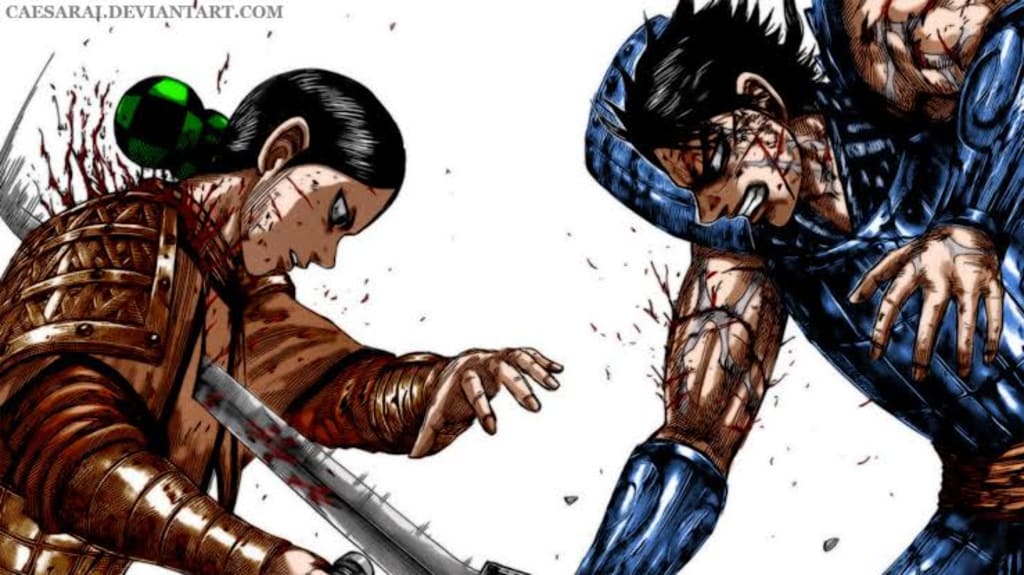
Yasuhisa Hara's art is a standout feature of "Kingdom." The detailed character designs, intricate battle scenes, and well-rendered landscapes contribute to the immersive experience. Hara's ability to capture the intensity of battles, the emotions of characters, and the grandeur of the historical setting elevates the manga's visual appeal.
The art evolves throughout the series, with an evident improvement in character designs, panel layouts, and action sequences. Hara's dedication to historical accuracy, particularly in depicting weaponry, armor, and architectural elements, adds a layer of authenticity to the visuals.
3) Arcs:
"Kingdom" is structured into multiple arcs, each contributing to the overall narrative. Key arcs include the Sei Kyou Rebellion Arc, Coalition Invasion Arc, Sanyou Campaign Arc, Coalition Army Arc, and more. These arcs showcase different aspects of warfare, politics, and character development. The narrative seamlessly transitions between grand battles and intimate character moments, providing a well-rounded reading experience.
The Coalition Invasion Arc, for instance, stands out for its scale and complexity, involving multiple states uniting against the Qin. The Sanyou Campaign Arc highlights strategic brilliance and showcases Xin's growth as a military commander. Each arc builds upon the previous one, creating a cohesive and engaging storyline.
4) World Building:
"Kingdom" features a diverse cast of characters, each hailing from different states and backgrounds. As the story progresses, characters form alliances, rivalries, and friendships, contributing to the intricate web of relationships. The Qin royal family, including the young King Ei Sei, plays a central role in the narrative, shaping the political landscape.
The world-building in "Kingdom" is expansive, providing insights into the diverse cultures, traditions, and military strategies of the Warring States period. The different states, such as Qin, Zhao, Wei, Chu, and others, are distinct in their governance, military doctrines, and societal norms. The meticulous attention to historical details enhances the authenticity of the setting.
5) Theme and Symbolism:
At its core, "Kingdom" explores themes of ambition, leadership, sacrifice, and the pursuit of a greater purpose. The manga delves into the ethical dilemmas of war, the consequences of political decisions, and the impact of individual actions on a larger scale. The unification of China serves as a powerful metaphor for the characters' personal journeys and the collective destiny of the states.
Symbolism is prevalent throughout the series, with motifs such as swords representing power, leadership, and the weight of responsibility. The manga skillfully weaves these symbols into the narrative, adding depth to the characters and their motivations.
6) Characters:
The characters in "Kingdom" are diverse and well-developed, each with their unique strengths, flaws, and motivations. Xin's journey from an impulsive and hot-headed youth to a seasoned general is a testament to the series' focus on character growth. Other notable characters include the strategist Qiang Lei (Ei Sei), the enigmatic general Ren Pa, and the fierce warrior Kyou Kai.
The relationships between characters, whether built on camaraderie or rivalry, contribute to the emotional resonance of the story. Complex characters with nuanced personalities make "Kingdom" a character-driven narrative, adding depth to the overarching plot.
7) Impact:
"Kingdom" has had a significant impact on both the manga industry and its readership. Its success lies in the fusion of historical drama, intense battles, and character-driven storytelling. The manga's popularity has led to various adaptations, including an anime series and a live-action film.
The fanbase, both in Japan and internationally, has grown steadily over the years. "Kingdom" has inspired discussions and analyses within the manga community, fostering a dedicated following that eagerly awaits each new chapter release. Its impact extends beyond entertainment, sparking interest in Chinese history and culture among readers.
8) Real History:
While "Kingdom" is a work of fiction, it draws inspiration from real historical events and figures of ancient China. The Warring States period (475–221 BCE) serves as the backdrop, with characters like Ei Sei being based on historical figures such as Qin Shi Huang, the first emperor of China.
The manga incorporates historical battles, political intrigues, and cultural elements, offering a unique blend of fiction and historical realism. While liberties are taken for dramatic effect, "Kingdom" provides a gateway for readers to explore the rich history of China.
9) Conclusion:
"Kingdom" stands as a testament to the power of storytelling, seamlessly blending historical elements, compelling characters, and intense battles. Yasuhisa Hara's meticulous attention to detail, both in the narrative and the art, elevates the manga to a level of excellence. As readers follow Xin's journey and witness the unfolding of ancient China's tumultuous history, "Kingdom" remains a captivating and immersive experience that transcends the boundaries of its genre. With its impact on the manga industry and its ability to resonate with a global audience, "Kingdom" cements its place as a modern classic in the world of manga.
About the Creator
Murali
Hi guys


Comments
There are no comments for this story
Be the first to respond and start the conversation.