
Jenny Got Her Gun
"To know and love one other human being is the root of all wisdom.”

Early September is bittersweet. Summer’s games and romance are consigned to memory. Washing machines have dissolved salt-tinged stains and leached away the coconut sweetness of suntan lotion. Bathing suits and beach towels are packed away. Kayaks and paddles, coolers and racquets are stored at the back of garages or in garden sheds. Crisp tan lines begin to blur. And school starts again.
Back at their studies and socializing, the beautiful young things swap exaggerated tales of passion shared with dangerously good-looking partners under the influence of forbidden substances. But while Jenny listened, she hid her summer secret. And never told her friends about Giancarlo. The young man she had met when she had knocked over his bicycle.
At seventeen and new to driving, she had backed her convertible runaround out of its parking slot in front of Mueller’s Bakery and was easing forward. Cranking the wheel and checking for traffic, she clipped a bicycle with her bumper and heard the clatter as it fell off its kickstand. Horrified, she stopped and ran to the front of her car and saw the machine lying defeated on the tarmac. She was wrestling to get it off the ground when he showed up. He took it from her and smoothly righted it. She was flustered and flushed under her tan.
Eyeing the bicycle, he pronounced, “no harm, no foul.”
“Are you sure,” Jenny said while looking doubtfully at a front wheel that was no longer perpendicular to the handlebars.
“Absolutely,” he replied as he put the wheel between his knees and with an effortless twist, restored the 90º angle recommended for best handling.
Relieved at this result, having feared calamity, Jenny turned her attention to the young man in front of her. Unusually, for a denizen of a beach town in the middle of July, he was wearing jeans and a long-sleeved shirt. And he was unencumbered by any beach paraphernalia. Jenny deduced he must not be a ‘Benny’ as the locals called the summer-only residents - the big-money crowd down from the City and points north.
She saw that he was startlingly good-looking, even beautiful. Slim and of medium height, he was strong without bulk. Even motionless, he radiated athleticism. He seemed in no hurry to leave, but he didn’t say anything. Jenny was not sure what the protocol was in these situations. But as a young woman raised to take responsibility, she offered him her cell number in case any hidden damage should show up. He assured her everything was fine but he would take her number just in case.
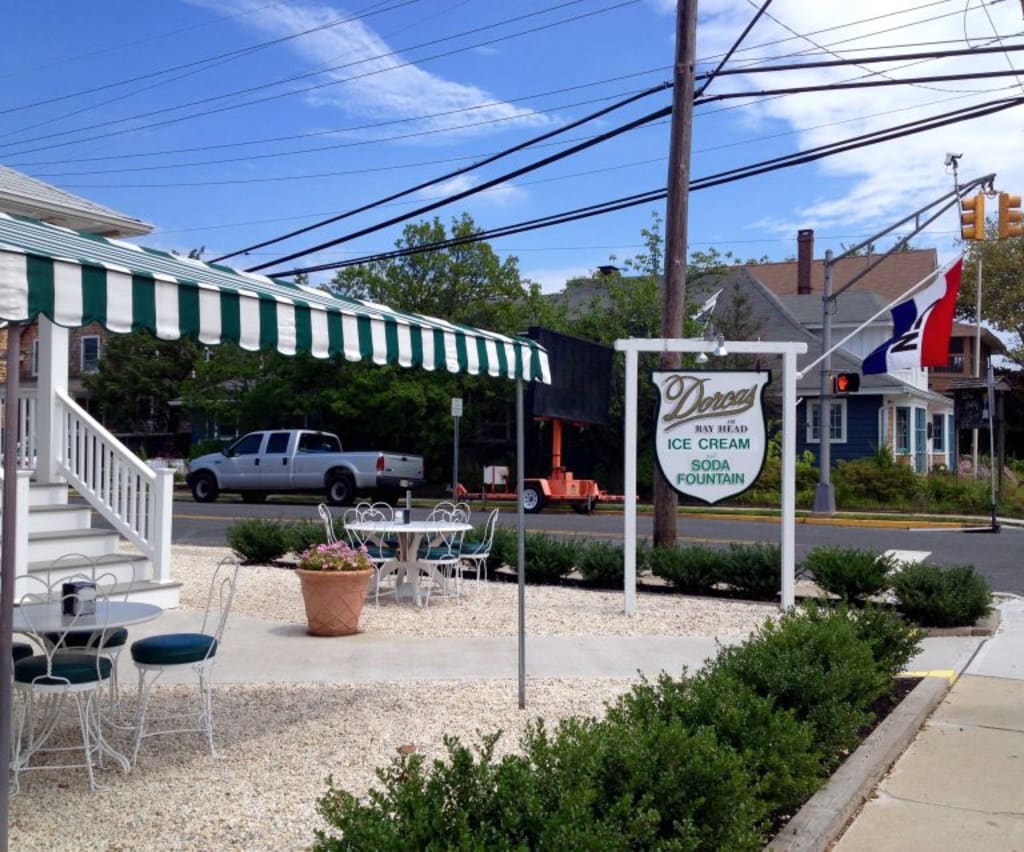
And then Jenny offered to buy him an ice cream cone at Dorcas’s, the town’s long-established cafe two doors down. She had never done the like before and was not sure where the words had come from. He looked surprised but accepted her offer. And that started the summer that changed her.
They are two sides to an American coin. And Giancarlo, he had told her his name, was not on hers. He had been born in Copenhagen as the son of an Italian carpenter from Naples and an African-American nightclub singer from Alabama. He lived in Virginia but was up at the shore for the summer, helping out at his Uncle Ernesto’s seafood restaurant - the one which everyone acknowledged had ‘fish to die for’. His job was to drive to the Bronx’s New Fulton fish market in the predawn to buy the fish for that day’s service. In the early morning, it was a quick run into town. And his workday was done by eleven unless Ernesto needed him to sub for a missing busboy.
He spoke with a lyricism alien to her braying crowd. He was well-read, with a love of Russian fatalism, English whimsey, and the endless self-analysis of the French. He told her stories of a world foreign to her experience. He was not of her caste - the gin-soaked, pink trousered, cashmere twinset, pearl-draped WASPs who jealously guarded generations-old piles of money they had been smart enough to be born into. At nineteen, he had already traveled widely through Europe with his mother, as she sang at the jazz clubs embraced by Parisiennes and the newly hip Eastern Europeans.
Jenny - or Jennifer Bainbridge Winant-Barlow to give her full credit - had visited Paris. But there, she stayed at the George V and ate at only Michelin-starred restaurants. She had never been to the 10th arrondissement or the music basements on the rue des Lombards. And as for Eastern Europe, she had no idea Estonia was the only ‘Baltic’ worth visiting and the Czech Republic was where you had to be.
The two of them spent hours together. Jenny would pack a picnic basket her parents thought she was taking to the beach. But they steered clear of the sanded crowds of strutters and lookers and drove to a small, spring-fed lake that lazed next to an orchard. There they would swim in the indolent water and eat and doze in the shade of a venerable pear tree. A tree that by the end of August was weighted with ripening fruit.
And then summer ended.
For the first time since she was eight, when the gardener had run over her dog Piddles, she felt the sting of unrecoverable loss. She was going home. And Giancarlo, grateful to the country he loved and wanting to give back to it, had enlisted in the Marines. He was the first significant love of her life. She had had girlish infatuations, but Giancarlo was the first man with whom she had shared intimacy. And his departure left an ineffable void.
Their affair had been a thing too precious to be sullied by the cheap jibes and braggadocio the others used to describe their summers. It was hers to treasure and nurture. To contemplate privately, far from the maddening crowd of her dearest friends.
They FaceTimed and texted, but there is no substitute for holding a hand or feeling a caress. And even that was put on hold when Giancarlo went to boot camp. His last phone call informed her that he had arrived safely at Parris Island SC, and for the next thirteen weeks would be incommunicado. To become a marine you must first be stripped of your civilian individuality and learn to think as part of a group of equals. And no love, either new or longstanding, deters the Marine Corps from their mission of turning the youth in their charge into efficient, order-obeying, killing machines.
After boot camp, Giancarlo had ten days of leave. The first five he spent over Christmas in Virginia with his family. The second five he spent with Jenny. He had taken a room in a bed-and-breakfast a few miles from her home. Even though Jenny had turned eighteen, she was still her parents’ little girl, and they would not have welcomed a young man of the best family to share their daughter’s bed, let alone one from such a colorful background as Giancarlo.
The time they spent together was private, passionate, and too brief. And after it ended, Jenny never saw Giancarlo again. If she could have foreseen the future, she would have implored him to stay. Instead, she watched with a wounded heart as he disappeared in an Uber. For two months he sweated through his battlefield infantry training. Then he was assigned to the 3rd Battalion, 7th Marine Division, and deployed to Al Taqaddum, Iraq. In the fourth week of his tour, he was killed by a suicide bomber.
Jenny was not listed as kin and would not have known what happened if Master Sergeant Calvin Williams, Giancarlo’s squad leader, hadn’t called her. The sergeant was gruff. He told Jenny tales of both Giancarlo’s exemplary if nascent service and of his high regard for her. Despite his staccato military delivery, Jenny could feel the sergeant’s grief as he explained that Pvt. Esposito was a credit to his country, and he was deeply sorry for her loss.
She had told no one of Giancarlo and now had to bear his loss alone. She had never met his family and didn’t know if they knew of her existence. She assured her friends, worried at her despondent monosyllabism, that all was all right. And if her parents noticed anything wrong, they assumed she was worried about her college applications.
Jenny was a ship unmoored. Her anticipated career in a socially appropriate line of work seemed pointless. And she had no interest in spending time with the self-confident but ultimately vacuous young men of her social set. Her parents were glad when the letters of acceptance arrived from Swarthmore and Vassar. They wondered which she would pick. They hoped for Vassar because, while they knew Swarthmore to be a good school, they were unsure if Philadelphia was as suitable as it used to be.
But Jenny had other plans. She submitted a late application to the University of Virginia and was accepted. It pleased her to think that she would be close to where Giancarlo had lived. Not that she was mawkish or believed in cosmic connections. But Virginia has a military tradition. And once there, she enrolled in the Naval Reserve Officer Training Corps, the first step to becoming a Marine Corps officer.
For her first 18 years, Jenny had followed the tracks laid down for her. She had been favored, academically successful, prepped for a comfortable and rewarding adulthood, with a lifelong set of friends who spoke the same language she did. Jenny knew their rituals, their customs, their habits. She was at ease on tennis courts and golf courses. She knew who they liked politically and who was a comer, who would be successful, and who was a poseur. She knew the deal makers and drug takers. She was protected, safe, secure from risk.
She was well-educated - and yet she knew nothing of the world. Until a dumb accident introduced her to a man who had never been safe or protected. She had learned that you don’t live life to its uncertain extent until you risk it. To truly live, you have to be alive. And to be alive, you have to be conscious of death. No matter what might happen to her as a Marine she knew the uniform would free her from her predestined conformity.
Women in the Corps are no longer unusual, but they are still rare. And none was as rare as an entitled descendent of a family that had lost touch with America. A family that, along with the others boasting of ancient bloodlines, had cleaved itself from unprivileged Americans. Americans who lived beyond the walls of connections, lawyers, and wealth managers who shielded the sepulchered rich from life’s vicissitudes.
Her parents had no idea what to make of this unexpected course correction. At first, they were incredulous, but they came to appreciate her iron determination. She was hard-bodied and focused. She was capable and now fully her own woman. At her graduation from UVA, her father watched with pride as her mother allowed herself a wry smile as if to wonder at life’s caprice. They embraced her with satisfaction and congratulated themselves on raising such a fine young woman.
After a weekend of drinks and goodbyes, she boarded a military bus to The Basic School, the Marine Corps officer’s first step in her military career. On the way, she opened a locket - a family knickknack handed down from some Victorian great-great-grandmother - and stared at the picture of the man who had made her. And thanked him.
About the Creator
Pitt Griffin
Once upon a midnight dreary, while I pondered, weak and weary, it occurred to me I should write things down. It allows you to live wherever you want - at least for awhile.
Keep reading
More stories from Pitt Griffin and writers in Fiction and other communities.
Achieving Greatness
May 1, 1986 Sitting in a tent, swaddled in a blanket, Ann stared out over a white wasteland of ice. The wind whipped across a monochrome landscape, where signs of humanity were few, fragile and temporary. She was cold, but she had been cold much of her life, and it invigorated her. It cleansed her soul and stripped her psyche of the detritus of daily life. It sharpened her focus and fired her ambition.
By Pitt Griffin4 years ago in Fiction
If You Love Me, You'll Do It
I met Jason when I was five years old. I could say that I loved him from the moment I saw him. He was so handsome to me and I felt in awe by his presence. When they introduced him as the new kid in school, I wanted to be his friend right away. I remember it like it was yesterday. I remember his smile and how he didn't seem shy. He appeared confident and ready to learn. I waved at him and said "hello," before anyone else could even say a word. He sat next to me, and I asked him if he wanted to be friends. He looked so happy as he said, "Yes!"
By Sidney Smith (Sid Smith)7 days ago in Fiction
A Love Letter to Charlie
Dear Charlie, I don’t want to say goodbye to you but after you were flipped on your side by Mardi Gras revelers two weeks ago, the insurance company considers you totaled. Breaks my heart that one stupid prank ended our run. Note: my father-in-law is delighted by the news as he considers you a widow-maker and insists we find a safer vehicle for his future progeny. (Shoot, we’re not ready for kids… just got married a few months ago. Can’t we have a little time before the honeymoon ends?)
By Cathy Schieffelin5 days ago in Fiction



Comments
There are no comments for this story
Be the first to respond and start the conversation.