


CHAPTER 8
The ride out to the Lightninged Tree—as Richard preferred to call it—took a little more than fifteen minutes from Bedloe Manor. The road was ragged, rough in places where the potholes were deep. Most of the potholes were off on the sides of the road, enabling Sonia to make better time than Nigel would’ve thought possible in an automobile. He could see her smile when she caught him looking at the speedometer.
It’s the type of road, he thought, made for a motorcycle.
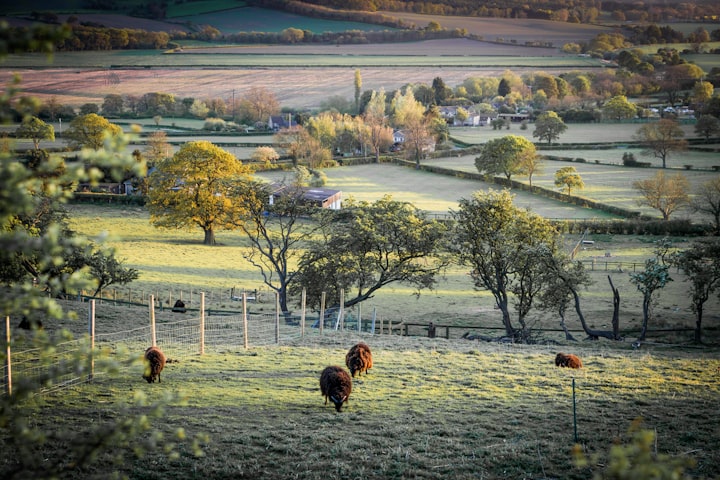
The smooth, rolling hills of the Devon countryside were a palette of vibrant colours, with the morning sun sitting bright over the hills. There was a muted haze hanging low in the distance. Endless acres of farmland rolled out as far as the horizon, each separated by a hodgepodge of hedgerows—looking almost as if ribbons of green bunting had been randomly tossed into the distance—while a small stream—a rill, Nigel smiled to himself, remembering the word from some obscure poem he’d read as a child—passed through and around the trees, following the lay of the land. He looked up at tall aspens swaying in the gentle rhythm of a breeze coming up from the south, pushing the few clouds in the sky, northward.
It’s beautiful countryside, he had to admit.
As much as he told himself he wanted to get back to Chumley Grove, there were times it seemed when the countryside called out to him when he was on his motorcycle. That was when he’d pull over to the side of the road and simply look about as he drank cold tea from a thermos and enjoyed a bowl of his pipe. Willows grew wild, their tentacled branches scraping the ground with the frenzied trauma of a wounded animal.
He was grateful that it was still warm enough to have the top down, and wondered how Richard was faring in the backseat, baring the brunt of the wind and the spray of the larger puddles she hit. The smaller tributaries and streams had flooded with all the rain over the last few days, and he could see large, open ponds in the distance, winking in the morning light.
“It rides nice,” Nigel said over the roar of the engine and the splash of the puddles. He’d wondered if she’d heard him when Richard spoke up.
“And you say your Daddy bought you this car?”
“He did. It was a gift, so to speak,” she said, turning her head and talking over her shoulder.
“What does that mean? ‘So to speak’?” Nigel asked.
“He’s a doctor. Having a nurse—slash—daughter was a dream come true, for him. But then the War came, and by the time it ended, I’d had enough of nursing. I served on the Front at the Battle of the Somme my first week there. It didn't get much better after that.”
“His Lordship’s son died at the Somme,” Richard said with a trace of sadness.
A respectful moment of silence passed, unannounced, but not unnoticed.
“That doesn’t answer my question,” Nigel smiled.
“What was it again?” she teased.
“Ha!” he mocked. “A fine detective you’ll make, when you can’t even remember a simple conversation.”
“Touché,” she laughed. “But no. I was sick of it all. I think he understood—my father, I mean. When I came home, I stayed in my room for five days. I never came out--not for anything. I had to sort things out in my mind. I saw horrific injuries, but I could deal with that. I could see a man come in holding his guts in his hands, but I couldn’t handle sitting at their bedside and holding their hands while they called out for their mothers before they died. That was hard.”
“I can see how that might be,” Nigel nodded.
“Can you?” She looked at him for a long moment before turning her attention back to the road. “After I came out of my room, I told my father I was done with nursing. He seemed disappointed, but, like I said, he’s an understanding man. He asked me if I was thinking of going into teaching. I thought he meant being a school teacher, but, no, he meant Nursing. He thought I could find a position teach Nursing.”
“But that’s not getting out, is it?”
“That’s what I told him—”
“Take this trail up here, Mum,” Richard said, sitting forward in the backseat and eagerly pointing to the right. Sonia veered off the road following what looked to be little more than an animal trail.
“The trail seems smoother than whatever that is they call a road,” Nigel laughed, and Richard sat back in his seat, saying, “Won’t be far now.”
And it wasn’t.
They topped the hill and Nigel could see the tree nestled in a small lea, sitting behind a lowlaying hillock where a narrow hedgerow bisected it. The tree was well weathered where the lightning had struck it all those years ago. It appeared ancient with its gnarly, twisted branches, and split trunk. It had started out as an oak he could see, but now resembled something he’d call a Gothic nightmare.
Somehow seems to suit the house, he thought; well, that’s what Charlie would say.
The tree had been struck by lightning before Richard was born, he said—probably even before his father’s time. What leaves that were left on the tree were brilliant with colours, vibrant Nigel saw, and he watched the topmost branches rippling in the light breeze. The tree has to be centuries old for it to have survived a strike like that, he thought. The ground was covered in dead leaves that seemed to lay peacefully at ease in the leeward shadows of the hills around them.
“Stop here,” Nigel said, holding his hand out, and Sonia hit the brakes. Richard pitched forward, banging his head against the back of Nigel’s seat.
“Are you all right?” Nigel asked, turning to look at him.
“I’ve had worse, lad,” he laughed, rubbing his scalp hard. “I don’t know how many times I’ve been kicked by a horse—none in the head, thank Christ—so something like this is nothing to concern ourselves with.”
“I’m sorry,” Sonia said, trying to suppress her laughter. “I didn’t mean to. I forgot you were back there. I just reacted.”
“It’s quite all right, Mum,” Richard smiled.
“Just stand there a moment and tell me what you notice,” Nigel said, looking at Sonia as he stuffed his pipe and lit the bowl.
She looked up. “I can see a bird.”
“Very funny. And the tree? Do you see the tree?”
“Yes. I can see it.”
“And what, exactly, do you see?”
“Nothing out of the ordinary.”
“That’s exactly what I mean,” sucking the pipe to life.
“What’s that you say there, lad?” Richard asked.
“That man. The man who came riding in on the horse? What was his name?”
He looked directly at Sonia.
“Artemus Spencer.”
“You remembered that, did you?”
“He was a fine looking gentleman,” she laughed. “I make a point of remembering all the fine looking gentlemen I come across.”
“You make a point of it, do you?” Nigel laughed, turning to look at her.
It was almost as if he was seeing her for the first time, standing where she was on the running board. Or perhaps he was no longer seeing her as Special Constable Nazar? It was plain to see, and not just by anyone’s standards, that she was an attractive woman. He'd noticed that the moment he first saw her. She seemed even more attractive now, the way the light seemed to hold her. Her blonde hair had fallen out of its bun, hanging over half of her face, and she tucked it back under her hat. It was an alluring pose, he thought--one hand on the windscreen and the other holding the door--and he even allowed himself a moment to envy her husband. Nigel thought a man has to be very understanding to allow his wife the opportunity to pursue her dreams.
“I doubt Mr. Nazar will appreciate the competition,” he smiled.
“Believe me, if he were still alive, no man would turn my head,” she laughed.
“Oh. I’m sorry. I didn’t know—I mean, of course I didn’t know. How could I? We’ve just met. I mean, I mean, what I mean is—”
“Oh, leave off, lad!” Richard said with a shake of his head. “Or should I get you a shovel, so you can dig yourself a deeper hole?”
“I did rather botch that up, didn’t I?” he said, dropping his head and shaking it as if he was replaying the conversation over and over again in his mind.
“It’s fine,” Sonia said, pushing the door aside and looking at the ground before stepping out. “It’s been eight years.”
“Stay on the running board.”
“What for?”
“Eight years?” Nigel asked, opening his door and standing on the running board as well. Richard made to stand up and Nigel turned to look at him. “You’ll have to stay here. I’m sorry, Richard. This is a Constabulary matter."
“Don’t you need me to look at the hoof prints?”
“That, my dear man, is exactly the point I'm trying to make about Mr. Artemus Spencer.”
“What’s that?” Richard asked.
“He lied to us,” Sonia said, shading her eyes and looking at the tree.
“I’m sorry?” Richard said, looking at her.
“There are no hoof prints,” Nigel laughed. “He was never here.”
“Then how did he get the horse?”
“We have to go and look just the same,” Sonia said, stepping off the running board and walking toward the tree. The ground was sodden. There were large puddles under the leaves, and she cried out when her foot sank down over her ankle.
Nigel turned to look at Richard.
“Stay here,” and he jumped off the running board to join her.
“I’m sorry about what I said earlier. It was insensitive,” he said as he joined her.
“What? No, you had no way of knowing. I’ll be fine. I’m not some heroine in a novel about to run off and weep in the corner because someone happens to mention the fact that she’s a widow.”
“Wow,” Nigel said awkwardly. “You’re not the least bit shy about what you say, are you?”
“I can’t afford to be any less sensitive than the next person—or is that more?” she asked. “Makes no never mind, I’m—”
She stumbled.
When she turned to see what she’d tripped on, Nigel was all ready on his knees, digging at the dirt with his hands.
“Do you by any chance happen to have a spade in the boot?” he asked, looking up at her.
“No,” she said with a slow shake of her head, and crouched down beside him to help brush the dead leaves aside.
“They didn’t bother to go very deep,” Sonia pointed out.
“Can you hazard a guess as to how long you think he’s been here?”
“A week. At the most, I’d say a week.”
“Well, whoever he is, we can be certain Mr. Spencer didn’t put him here. But that doesn’t rule him out as a suspect—at worst, a person of interest…at the very least, as a person of interest.”
“Oye, I know him,” Richard said, standing above them and looking down at the body.
“You do?” Nigel asked, looking up.
“He’s that agitator been running about trying to get support for the local Communists in Chumley Grove. They’ve been touting him about town like St. John calling for the Messiah.”
“Not sure what that’s supposed to mean, but are you sure you want to be saying something like that in these parts?” Nigel grinned.
“You said he’s been running about? Running about where?” Sonia asked.
“He’s been talking with the staff at all the major Houses, here about. He was always with someone else—safety in numbers one would think—except that she was a woman.”
"I don't see another body laying about."
“People don’t want to listen to that sort of talk,” Sonia said, brushing the last of the leaves away and looking down at the body. “Not now. The War’s still too fresh in their minds, and the last thing they want is getting back into it with the Reds.”
“You seem to know a lot about it,” Richard pointed out.
“I do. I can tell you something elase,” she said, looking at Nigel directly across from her.
“And what would that be?”
“He’s been beaten.”
“You mean someone beat him to death?” Richard asked.
“One would almost think that—except for the bullet hole in his forehead,” she added, pointing to her own forehead and tapping it with her index finger. Nigel looked at the body as she bent down, trying to turn the body, even partially, looking for the exit wound. In the end, she settled for reaching her hand underneath the skull and feeling about.
“I’d say it was a large calibre weapon,” she said at last.
“Why?”
“The size of the hole—the exit wound,” she corrected herself.
“Well, that’s just great,” Nigel concluded, wiping his hands on a small handkerchief he pulled out of his back pocket. He held it out and offered it to Sonia.
“What do you mean?”
“They’ll send someone out to investigate this now then, won’t they?”
“I suppose that would be the next step,” she agreed.
“But why dump him out here? It doesn’t make any sense,” he asked, looking about.
“They didn’t,” Richard said with a slow shake of his head.
“Do you know something we don’t, Richard?” Sonia smiled.
“It’s the rain we've had these past weeks. The streams around these parts have been known to flood over the years. I’ve seen this spot under three or four feet of water more times than I can count. I’d say the body was dumped somewhere upstream and washed down here when the river crested its banks. This is basically downstream from everywhere. This little stream here leads to a tributary that drains into the Exe.”
*
“Tell me about—what did you say his name was? O’Dowd!” Nigel laughed, suddenly remembering the name. “Tell me about O’Dowd,” he asked Richard.
They were in the Bentley again. Sonia had pulled the top up and Nigel was grateful, feeling the cold seeping through his wet trousers, reminding him of what the cold could be. He’d heard that some automobiles now came equipped with gas heaters, just for such occasions, he told himself, trying to suppress a shiver, but of course the Bentley didn’t.
It doesn’t matter how much you spend, you always forget something. But who forgets the heater?
“Yes, Reggie,” Richard replied. “Nice enough, fella, but Reggie O’Dowd’s an outsider. He showed up here after the War, claiming to be a nephew of one of the two previous owners—or something like that—at any rate, he said he’d inherited the place with their passing.”
“But you don’t think it’s true?”
“No one thought to question it,” Richard said with a slow shake of his head.
But Nigel could see that Richard had.
“Everything seemed to be in order, from what I’ve heard.”
“In order?” Nigel echoed. “And what year was that? When the previous owners passed, I mean?”
“The Urquharts? That would’ve been Ray and Heather…so it would’ve been before the Great War…I’d say maybe…1912? 1913? The farm never made enough money for them. Like everyone else around here, they were deep in debt. A lot of them quickly fall to weed around here, but they always managed to make it through.”
“The land here isn’t owned by Lord--I've forgotten his name?” Sonja said, quickly flipping through the pages of her notebook.
“Baron Geurnsy. The third Earl of Aylesbury,” Richard replied.
"That's the name. Sorry I forgot it, won't happen again."
“This is the edge of his land. This tree's alway served as sort of a marker for the people here about. But it’s only a matter of time before he buys everything here, isn’t it? He would’ve owned the Urquhart place already, but for the War.”
“Do you mean O'Dowd's property sat empty for two or three years?” Sonia asked.
“The entire length of the War,” Richard smiled, nodding his head at the irony. “Five years at least. He’s not much of a farmer, your Mr. O’Dowd, not from what I know about farming, which isn’t very much,” he added with a chortling laugh. “But even so, it’s more than what he knows.”
“Why do you say that?”
“Why?”
He turned to look at Nigel again.
“He’s one of those Londoners come here after the war to try and make a go of it. Something he obviously had no idea of how to do in the first place. Don’t know much more about him, really. Nice enough bloke all the same. Easy to talk to. He never brought his wares to market when he got his first crop, because he didn’t have enough to spare. His was a life of subsistence farming, at best. He’s learned over the last five years, I’ll give him that. He was selling to some of the Manor houses instead of taking it to the market once he figured out how to do it.”
“When did you say he first got here?”
“I didn’t.”
“But it was after the War?” Sonia pointed out.
“Aye, that it was.”
They were headed in the opposite direction, toward the O’Dowd farm, with Nigel hoping he’d feel the automobile’s natural heat coming through the carriage from the large engine. It was a half hour of tortuous track, and there were several times when Nigel thought they’d have to get out and push, but Sonia was able to sort things out thanks to the weight of the Bentley.
The sun was well over the hills, the glare winking against the larger puddles and making it almost unbearable Nigel thought, wishing he’d had his riding jacket so he’d at least have his sunglasses.
He smiled when Sonia reached for her purse and began sorting through it, looking for her own sunglasses.
He smiled and she looked at him, looking up from the mess of her purse on the seat.
“What?”
“Nothing. You just never see women like you, do you?”
“What’s that supposed to mean?”
“Women don’t drive. And they certainly don’t drive Bentleys”
“I told you, my father bought it.”
“Your father the doctor?”
“You don’t believe me?”
“I didn’t say that.”
“Well you don’t sound convinced. He doesn’t sound convinced, does he Richard?”
“No, Mum, he doesn’t.”
“Well, if you’re going to take her side, at least give me some warning,” Nigel said.
“I’m going to take her side,” Richard said, leaning forward and smiling.
“Why?”
“Why? Because we should’ve been out pushing at least three times that I’ve seen, and we haven’t. She’s not like other women,” he said, settling back into the comfort of the seat.
“Thank you, Richard. I think,” she added, putting her sunglasses on and turning her head with a haughty shake as she concentrated on the lane ahead of her.
Nigel sat back and sighed, smiling. He closed his eyes against the sun as she gave a sidelong glance at him, smiling to herself as she brushed the hair out of her eyes.
The O’Dowd farm sat off to the left of a small dirt track well-worn with wagon tracks. Sonia had to park the Bentley in front, and they went the rest of the way on foot. There was a haze of morning mist clinging to the last of the weeds and grass, the tree-line in the distance a dark silhouette against a clear sky. There was a steady line of smoke as thin as a pencil sketch scratching against the clear sky; the windows of the farmhouse appeared large and clean, the floral curtains tied up with lace; the farmhouse itself made of local ragstone, pianted white with a thatched roof.
Richard was quick to spot Isobel’s familiar horseshoe in the mud. As well, there were three other sets of footprints—one of them a woman’s—after which Nigel told Richard he'd have to wait in the Bentley. As they approached the farmhouse, Nigel wondered if O’Dowd was the sort of man who dealt well with authorities? Richard said he’d come from London, but that no one knew anything about him. If he served in the War and came out here after, it was likely he didn't have a good time of it, Nigel told himself. In his own experience, he’d learned that volunteers from London used the War as an excuse to escape the poverty back home. At least here, he has a home, he told himself. If his life was a struggle, it was an honest struggle—something a man might learn to accept—as long as he didn’t let it beat him down. He wondered if O’Dowd had let the circumstances of his first years weigh him down? Had he been one to give up? He doubted it, not if the man had a woman.
“Do you have a pistol?” he asked.
“Why would I need a pistol?”
“In case he has one?”
Claire met them at the door with a happy smile, asking them if they’d like to come in and take a cup of tea with her?
“Sonia Nazar and Nigel Bannister, Chumley Grove Constabulary,” Nigel introduced themselves. “If we could just have a few words with you? Mrs. O’Dowd, is it?”
“All but in name,” she smiled. “Do come in, please."
“I don’t think that we—”
“Nonsense,” Nigel replied, pushing his way past Sonia and making his way into the farmhouse.
The house smelled of fresh baked bread and reminded Nigel of childhood. His mother used to bake bread in the morning, and he’d wake up to the smell of it as he readied himself for the day’s work. At fifteen, he was no longer in school, but working at the shoe factory with his father and uncles, and had been since he was fourteen.
He looked at the large stove, holding his hands out towards it and feeling the warmth penetrating his frozen fingers. He could smell herbs and spices cooking in a pot on the back plate beside the kettle Claire picked up, as she started filling it with the hand pump beside the sink. A part of him was tempted to lift the lid and look inside the pot. Instead, he looked at the various baskets of fruits and vegetables on the small cluttered counter top, then pulled a chair out from under the table and sat as close to the stove as he might. He could feel the warmth seeping into him as quickly as it had leaked out, and felt grateful. He would’ve liked to take his shoes off and dry them properly, but that was taking it a bit too far, he told himself. He’d simply sit as close to the stove as he could—for as long as he could—and hope his trousers dried.
“We don’t get much company out this way,” Claire was saying over her shoulder as she filled the kettle. “I don’t remember the local Constabulary ever coming out to visit.”
“Don’t you ever get visitors, Mrs. O’Dowd?” Sonia smiled, looking for a place to sit.
“Oh no, no one’s likely to get visitors out here, Miss. People have a hard enough time trying to scratch out a living—you have to be a constant gardener—so there’s no real time for visiting, is there—unless it’s going to market, or perhaps the Fair.”
“Did you go?” Nigel asked. “To the Fair?”
“To the Fair? When am I going to find the time for that?” she laughed, turning around and folding her arms as she leaned back against the sink. “No, I sent Reg and Artie out with a cartload of pies to sell. It’s almost an hour’s ride, so they got an early start of it and come home late. I was already sleeping by the time they got home. Is it Reg you’re looking for? Is he in trouble? Or Artie? He strikes me as the type.”
“Why would you think he’d be in trouble?” Nigel laughed.
“I don’t know; you tell me.”
“Were they alone?”
“Alone? What do you mean were they alone? I just said it was him and Artie. He couldn’t very well be alone if he had Artie with him. I told him, you can’t be out on the lanes alone at night.”
“Why not?” Sonia asked, looking up from her notebook. “What’s there to worry about out here?”
“The Lords and ladies of the area, they have their own set of rules. They like to go out for a midnight ride, from time to time, if you know what I mean?”
“Midnight rides?” Nigel asked, looking up from the stove. “What’s that supposed to mean?”
“Honestly, Constable Bannister,” Sonia said, dropping her notebook down to her side and looking at him with a slow shake of her head. “Do you seriously have no idea of what she means when she says ‘midnight rides’?”
“Absolutely none.”
“None?” she laughed.
“Why would I? I don’t live here.”
“And you’ve never shagged anyone before, is that it?” Claire asked.
“Have I ever—” Nigel was embarrassed.
“Please,” Sonia laughed. “He was in the War, Mrs. O’Dowd. That’s all they ever did when they were ‘Over There’. Remember, they weren’t coming back ’til it was over, ‘Over There’? What did you think they meant when they said that?”
“Right you are then, Miss,” Claire said with a smile.
“Are you two quite finished laughing at my expense?”
“That quite depends on what you say next. Now,” Sonia said, looking at her notes again. “Artie?”
“Yes. He’s a friend of Reggie’s from ‘Over There,’ ” Claire laughed. “He was a sergeant, or something like that. I don’t really pay that much attention to him. They knew each other is all I can say, for sure. Reg owes him is all I ever hear.”
“You don’t pay any attention to him? Why not?”
“I’m busy enough as is, Miss. If I don’t have time enough to see to Reg's needs, how do you think I’d have time for two men? I feed them two meals a day, send them out to deliver my pies to the neighbouring farms, pick up supplies when I need them, and for the most part leave them to their own devices.”
“And you say Reggie owes him?” Sonia asked, looking down at her notes.
“Yes. Something about saving his life, I think; I don’t know. I don’t sit with them when they start drinking for the night, either. I’ve plenty enough to do without having to sit with two drunks lost in their drinks talking about how great a time they had during the War, whoring and thieving—”
“Thieving?” Sonia asked. “That’s a strange way to spend your time.”
“Why’s he here?” Nigel asked, looking at Sonia and shaking his head slowly.
“He said he needed to get away from London. I don’t think he was enjoying his time there; I don’t suppose there’s a lot of work for soldiers coming back.”
“It’s been five years,” Nigel pointed out.
“From what I understand, Artie’s not like us. He’s gentry.”
“Gentry?” Nigel asked.
“He’s a gentleman, born and bred—or so he says.”
“I understand what gentry means,” he smiled.
Sonia was looking out of the window, at the small pen behind the house.
“Do you believe him?”
“There’s some things you can’t hide when it comes to being a gentleman,” she said, almost looking thoughtful as she considered the question. She nodded. “I never doubted he was raised like that.”
“Is that where you keep your horse and wagon? Or are we beyond that now? Do you have a truck?”
Claire didn’t even bother to turn and look.
“Yes. Except it’s gone now.”
“Out making deliveries?”
“No. It takes two days to make the pies. No. Reg’s off to London for business.”
“Business?” Nigel asked.
“He wants me to open a place in Chumley Grove and make a right proper stab at it,” she smiled. “Artie says he’ll help as much as he can. Are you hungry? Have you had a bite to eat? Would you like a meat pie?”
“I doubt if that would be appropriate,” Sonia said with a slow shake of her head.
“Nonsense,” Nigel laughed. “I’m starving. If you want to give me one of your amazing pies, I won’t say no.”
“You can’t have a slice of pie when you’re on duty.”
“A slice? You can’t expect me to just have a slice,” Nigel laughed.
“You’ve had my pies before?”
“Charlie always picks one up whenever he can,” Nigel laughed.
“You said Artie planned to help. How can he help if he doesn’t have a job?” Sonia asked.
“I never said he didn’t have a job,” Claire replied, pouring the boiling water into a ceramic teapot. She spooned tea leaves into an infuser and dropped it into the water. “I don’t know what it is he did when he lived in London, but he says he has a rich uncle.”
“How long is he planning to stay?” she asked, looking at the small living area and what she assumed was a single bedroom. “You don’t have a lot of room. Can’t be too comfortable with the three of you here? Is that his room?” she asked, pointing at a small curtained off area.
“Yes, once upon a time it served as a larder. That’s why it’s so cluttered here now.”
“Well, that certainly proved inconvenient for you, didn’t it?”
“One learns to get by,” she laughed, pointing at where she’d placed the different fruits, vegetables and various baskets scattered around the crowded kitchen.
“Are you expecting Mr. O’Dowd back for the evening?”
“I couldn’t say. He says he knows a banker from back in the day who might be able to help him—whatever that’s supposed to mean.”
“Another comrade in arms?” Nigel grinned, staring up and feeling his trouser legs.
They felt dry, and he stood up, just as Claire put a piece of pie in front of him.
“You can’t leave yet; I’ve just plated it.”
About the Creator
ben woestenburg
A blue-collar writer, I write stories to entertain myself. I have varied interests, and have a variety of stories. From dragons and dragonslayers, to saints, sinners and everything in between. But for now, I'm trying to build an audience...
Keep reading
More stories from ben woestenburg and writers in Fiction and other communities.
JACK OF DIAMONDS
Artie woke up before the dawn. His muscles ached from the climb up the wall last night, but he fell to the floor and did forty quick push-ups regardless. He wasn’t getting any younger, he told himself as soon as he finished. Still, it had been an exhilarating climb, even if he felt as if he’d been beaten with a cricket bat. He remembered how the first time he’d tried climbing he nearly fell; since then, he carried a rope in case he ran into any obstacles. So far, that only happened the one time, in London; and he’d broken a finger that time.
By ben woestenburg4 years ago in Fiction
Bomb Scare
It was 2027, and the world never thought it would happen. A missle hit the United States, but it wasn't where they had anticipated. A little town in the northeast was hit by a missile strike, they didn't know why, and they didn't know exactly where it hit, but they did know it was a coastal community, somewhere between Maine and Delaware.
By Gregory Payton6 days ago in Fiction
Serve and Protect
Serve and protect, serve and protect. Uphold the law, for the good of law-abiding citizens. I wear my badge with pride. I wear my badge with honour. Protect and serve. That's what I signed up for. I stalk these streets, keeping the peace. Ensuring that the good people are safe from the riffraff that is becoming more of a problem with every day that passes.
By Paul Stewart6 days ago in Fiction
Worth the Wait: Puerto Viejo, Costa Rica
Beach bumming in a small Caribbean beach town sounded like a perfect way to end our 6-month trip through Mexico and Central America. Or so we thought. The foul, fishy stench of rotten seaweed hit our nostrils as we stepped from the cramped bus and looked out at a rather depressing, empty, and underwhelming black sand beach. It was pouring with rain, and we had to quickly fish out our ponchos. We thought, this couldn’t be it, could it?
By Sh*t Happens - Lost Girl Travel6 days ago in Wander



Comments
There are no comments for this story
Be the first to respond and start the conversation.