
It Happened in Queens
A cab driver, a dragon, and a forgotten past

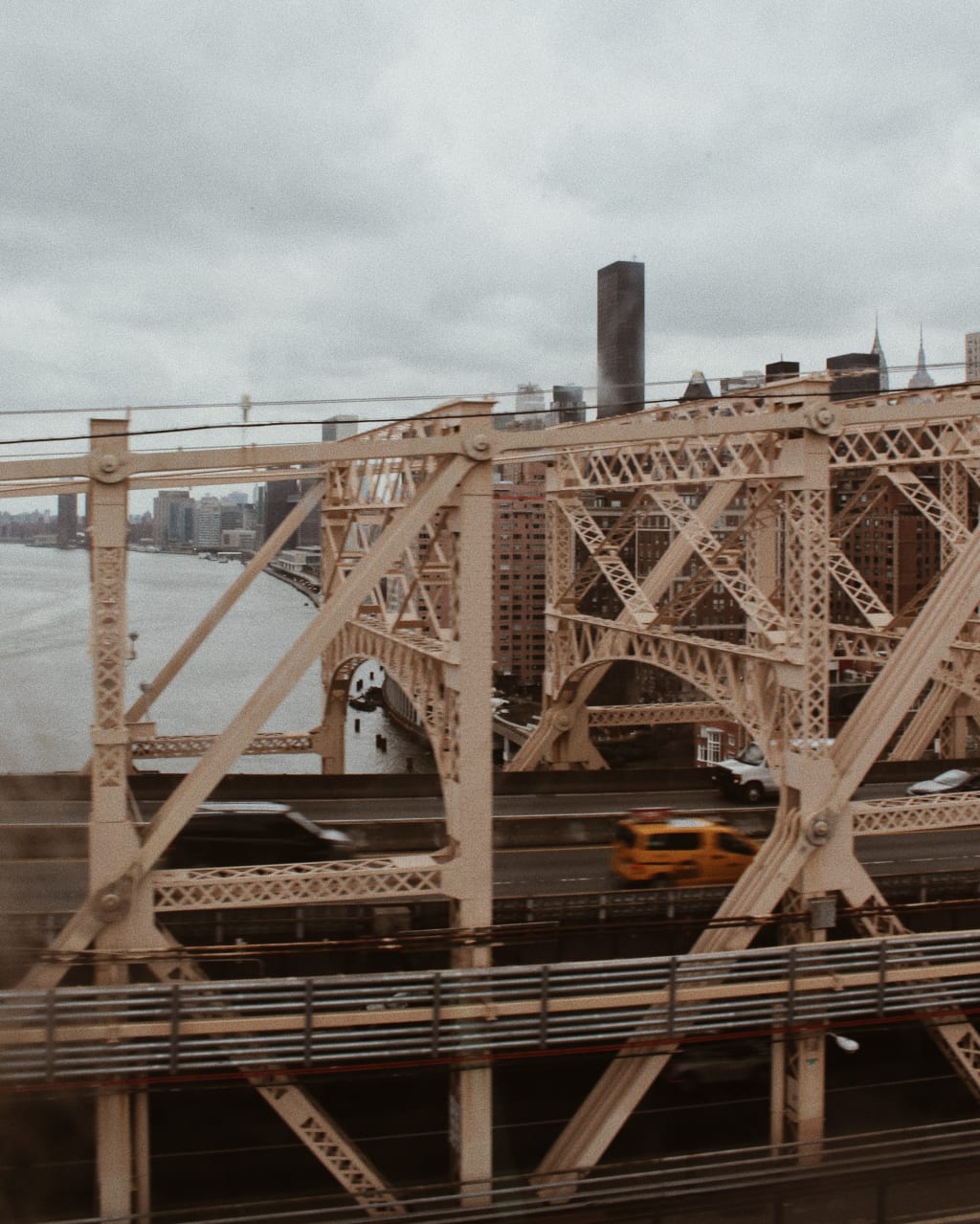
There weren’t always dragons in the Valley—at least not for Mike, but thank heavens Mike could see them now. Otherwise, he would still be running that lousy cab route from Queens to Manhattan.
The first time Mike saw a dragon, a scaled green thing with wide glass blue eyes and a pupil like the “L” piece from a Tetris game, he was running a family of tourists from the airport to the Upper East Side. He was willing his banged-up cab through two swanky town cars, half hoping he’d scrape up their polished sides, when he saw it, perched like a gargoyle in front of a gaudy furniture store with bedazzled lamps lining the shop windows.
Mike blinked. Blinked again. Rubbed his eyes. Snapped them closed. Snapped them open. Thrust them closed. Pushed them open. The horns blared; expletives rippled down the line of cars piling up behind.
The cab’s passengers grew anxious.
“Sir? Can we go?”
“Mr. cab driver, sir, are you okay?”
The creature blinked slowly and surveyed the scene, its ears pushed back from the storm of shrill honks. It was no bigger than a mid-size dog, say a husky or a lab. Its skin was scaled in narrow ovals that overlapped, one atop another like lime green shingles on a roof. The eyes had a slight light blue glow, and the tail had a patch of fur on the end reminiscent of a mangy coyote stalking Central Park.
Its gaze met Mike’s, and its eyes widened in bewilderment. It looked behind both shoulders, hoping a spectacle was playing out behind it and attracting Mike’s dumb, awestruck expression. Satisfied there was no spectacle and that his stare was firmly settled on it, the dragon let out a little shriek and scampered down a nearby alley.
Clunk
The driver behind had taken matters into her own hands, too frustrated to continue letting out her rage through the blaring of a horn, she had plowed into the back of Mike’s cab. The lurch returned Mike to the present, and he accelerated with a hard push of the pedal, much to the relief of the family who were on the verge of great disappointment that their voyage into the big city was to be ruined by a doldrum cab driver with fried nerves.
Michael Frigelio, or big loafers Mikey as his friends called him in homage to his strange proclivity for buying shoes two sizes too big, saw his first dragon on October 10th, just as the city was starting to forget about summer. Mike had driven a cab in New York City for 21 years, ever since he graduated high school. He lived in a little neighborhood in the corner of Queens ironically called the Valley after some wise-cracking fellow thought it the height of hilarity to call a neighborhood of steel and cement "the Valley.” In the Valley, graffiti sprayed in white and red obscured street signs and colored the big black dumpsters that lined the streets. Piles of trash bags laid in heaps blocking parking lanes, rats scampering in and out of these plastic palaces with little goodies, a scrap of pizza, a fried cheese ball, a wilted fry. The pigeons sat in close-knit lines along the side of fire escapes, electric wires, and window frames, smooshed so closely together that one might assume they had gathered to gossip about the gross habits of the humans below and their perverse obsession with Macy’s.
Mike had long been tired, a deep weariness that had settled in his bones and left him on the couch each night with a row of beers lined up in front of him, the TV flickering blue light across the otherwise dark room. He lived in the same apartment his parents had and their parents had and their parents had, on and on from the very first Frigelio in New York City in 1860. He lived there with his sister Marley, a nurse who worked late nights and early mornings and more often than not passed him coming and going.
He came home to this empty little apartment to find his sister eating a granola bar on the couch—it was rare indeed to find her home at any hour of the evening.
“Good day?” Marley asked.
Mike garbled a response, the image of the green scaled thing perched in front of the furniture store heavy on his mind.
“Mike?”
“Super day,” he said loud and clearly to discourage further questioning. “I’ve got to go out, actually, I forgot to do that stuff I had wanted to do.” He hurriedly replaced the baseball cap and coat he had shed only moments before.
“But I thought we could have dinner together.”
“Maybe later,” he called back, already out the door.
He rambled about the streets, peeking into alleyways, flashing pictures into dark corners, hurriedly reviewing the captured image for any sign of a scaly creature, any inkling of a tail tipped with a sporadic puff of hair. Nothing.
Neighbors waved, hailing him over for a drink.
He repeated the same line about an early morning and dinner with his sister before turning the corner rapidly and peering up a fire escape or hunching onto his knees to look under a parked car.
He was poised in such a compromising position when a clear, bell-like voice sounded from behind him.
“Looking for something?”
In an attempt to snap back onto his feet, Mike awkwardly rolled onto his side.
“Need some help?”
An olive-skinned hand extended downward, with an old, poorly made beaded bracelet of lime green beads fraying at the tie dangling from the wrist.
Mike looked up. The figure before him was dressed in a loose white dress with a neckline embroidered in a green lancet. She had thick black hair that grew in loose waves from the crown of her head to her shoulders. She had light blue eyes that seemed, on first glance, to glow.
Mike hoisted himself from the ground with much huffing and puffing.
“Thanks,” Mike mumbled.
“Why thank me? You wouldn’t even let me help you up.”
He nodded and walked forward, passing the young woman.
She followed.
“You didn’t tell me what you were looking for.”
“I wasn’t looking for anything,” he glanced down an alleyway.
“What do you think is in that alley?”
“Nothing.”
His eyes wandered up a fire escape, grasping his phone tightly in his hand.
“And that fire escape – what’s up there that you want to photograph?”
“Please stop following me.” Mike wasn’t one for confrontation, a trait that surprised many who heard his heavy New York accent, saw his stained Yankee’s cap pushed down low on his head, and assumed him to be the gruffest of the gruff New York stereotypes.
“Hey Mikey! Why is your sister here and you’re not?” Carlos called from across the street, beckoning Mike inside of Torelli’s, the local bar. “Just started a game of darts. You want a rematch from last week?”
Mike snapped his head to the side and looked behind him. There the woman stood, smiling at Carlos, the bar, and the people inside.
Mike wrinkled his brow.
“Buddy, why are you staring behind you? You being followed or something?”
Mike stared at the woman behind him, surveying her up and down. He looked back at Carlos, then back at the woman, feeling as though he’d entered a cheesy slap stick comedy where everyone was in on the joke but him.
“Don’t you see her?” He called across the street, motioning toward the woman, clear as day, standing before him.
“See who?” Carlos asked.
Mike pushed his finger out in an attempt to touch the woman before him. She took a step back.
“What are you doing, buddy? Come over here and get a drink. You look punch tired.”
“I got to go home,” Mike called back, a siren blaring in the distance, “get my mind sorted.”
Without waiting for a reply, Mike turned quickly on his heels, rounded the corner of 75th, walked hurriedly by store fronts with rusted grating secured to the windows. The smell of gasoline dripping from a nearby truck saturated the air.
Mike stopped with a sudden jolt and swiveled around—the woman wasn’t there.
“Looking for me?”
He looked up to see her sitting above him on a fire escape, her legs dangling over the edge.
“Why couldn’t he see you? I must be going plum crazy.”
“Not crazy,” she swung herself to the pavement below and sat on the edge of sidewalk, “or, maybe you are. I couldn’t say.” Mike sat down beside her, keeping a good five feet of distance in case she twisted her body and began walking down the street like a possessed Exorcist character.
“Why couldn’t he see you and, better yet, who are you?”
“Which do you want answered first? It’s such an annoying thing to ask two questions at once and leave the other to sort through which you want answered first.”
“Who are you?”
“Selia.”
“That’s all I get?”
“Selia Pertuccio.”
Concluding this line of questioning was going nowhere fast, Mike returned to his first question, “why couldn’t Carlos see you?”
“I don’t know.” Selia responded.
Letting out a frustrated grunt, “why can I see you?”
“I suppose you’ve been rallied.”
“Rallied?”
Selia nodded her head, rubbing her frayed bracelet in an anxious set of strokes, up and back, up and back.
“Meaning what?”
“As far as I know, someone is rallied to you when they have touched an object you held dear in life.”
Mike rubbed his forehead, his callused fingers digging into his scalp, “you’ve got to give me more than that.”
Selia stood up and paced back and forth, braiding and unbraiding strands of her hair. “Here’s what I know,” she quickened the pace of her voice, words piling atop each other and pressing down on Mike as she spoke, “when a person touches an item someone who is stuck between life and death valued dearly in life, they are rallied to them. After being rallied, you are drawn to the person whose item you touched, able to see them in their human and sembalmic form. It's an unbreakable bond, or so they say. Long story short—you must have touched something I loved and, well, here we are.”
Mike closed his eyes and settled his head between his knees, only managing to say, muffled through his jeans, “Sembalmic form?”
“You would call it a dragon, I believe.”
“And that is supposed to be what?”
“The externalization of my soul,” Selia reported with a matter-of-fact air that made the concept of an externalized soul seem as natural as asking for cream in coffee.
Mike repeated the words slowly.
“Yes, after you die you may appear as a human,” Selia motioned to her current form, “or as the manifestation of your soul, which humans who were rallied saw, wrote about, and passed on to future generations until the sembalmic form became myth and fantasy and, for whatever reason, became referred to as a dragon, which is such a silly word if you ask me.”
“Sembalm is better, then?” Mike, unsure of what point to settle his mind on, decided to focus on lexicon.
“Isn’t it?”
“Not sure, really.”
Silence hung in the air, a strange reality for New York. Minutes ticked by, or, if you asked Mike, weeks went by before he broke the silence, “I am bound to you, you say? What’s that supposed to mean?”
“I can’t say.”
“Well, if you can’t say, who can? A shaman? A wizard? Some sort of—what’s that Greek thing? An orvis?”
“It’s all theoretical for me,” Selia snapped, “things I’ve heard others talk about. Things I’ve read about. I never assumed I’d be rallied to—it just doesn’t happen for people who lived like I did. Our things are forgotten in the back of apartment buildings, burned in fires, placed in museums behind glass and only handled with fine white gloves to preserve their historical significance.” She scoffed.
“People who lived like you did?”
Selia fell quiet and nodded. Her words burrowed into Mike’s brain. Mike had often heard his grandmother say something similar when describing her childhood in fits of anger, emphasizing that people who lived like her and her family were looked on with scorn and venom by those who wouldn’t deign to set foot in the Valley, infested with those rats and Italians.
“What exactly,” Mike fumbled for the words, “who exactly . . . when exactly did you live?
“It doesn’t matter.”
Mike found his words, “Doesn’t it, though? If I’ve been rumbled,”
“Rallied,” Selia corrected.
“Rallied, I mean, won’t I need to know these things?”
“I suppose.”
“Unless,” Mike sprung to his feet. An idea had struck him, an idea that rather pleased him. “What if we just parted ways? You wouldn’t need to tell me what you clearly don’t want to, and I could just get back to it.”
Selia pursed her lips and clutched her elbows, assuming an awkward position that was sure to attract attention despite her clear efforts to divert it.
“Selia?”
“I don’t know if it’s true.”
“If what’s true?”
“From what I’ve heard, if you, the one who has been rallied, decides to neglect the task you’ve been called to do, you’ll join me here in the in-between space. ”
Mike let the words sink in, the ones, at least, he could understand. “So, I die?”
“Theoretically.”
“How do you theoretically die?”
“You know what I mean.”
“Obviously not.” Mike snapped. The frustration and confusion started to pull Mike downwards into a space he reproached. He didn’t like to lash out, to burst his buttons, as his grandmother would have put it. He didn’t like to let things consume him. He didn’t like to feel angry, to feel scared, to feel anything too much. So, he relied on a trusted technique he had used since his boyhood. He left Selia where she stood and started home. As he turned the corner, he caught a glimpse of green-scaled wings disappear in the other direction.
About the Creator
Amy Fredrickson
Amy has been writing in genres ranging from poetry to fiction to creative non-fiction since graduating from university in 2015. She currently works as an editor and technical writer.
Keep reading
More stories from Amy Fredrickson and writers in Fiction and other communities.
The Metal Bees
My gran was the last of our family to see a honeybee. She said they were beautiful, little fluffy beams of sun always busy, their hums the soundtrack of an April afternoon in the blueberry fields. When the honeybees had all died, their visage laid to rest on a long list of extinct specimens of the 21st century, the government didn’t miss a beat in launching a solution – BeeX1. The project was lauded as an amazing feat of technology, a victory of human ingenuity – millions of little diamond-shaped titanium drones swarmed the acres of Washington cherry tree orchards, the swaths of Texas broccoli fields, and the stretches of apple tree land in Michigan. My gran had a potent distaste for the metal bees, as she called them, but she had little choice when a man in a suit dictated renewed terms of her contract for leasing the land. No metal bees, no more Kellington Family Farms.
By Amy Fredrickson3 years ago in Fiction
Miss Persephone's Manual to a Seemingly Ordinary Life
Miss Persephone was found at the dining table, her blue eyes swollen, her tears arriving and retreating like the tides of the ocean. Earlier that day, her family had visited her in the retirement home where she had lived for eight years. It was her eightieth birthday.
By Imola Tóth5 days ago in Fiction
G.I. Joe's Last Stand, Saturday, December 25th, 2010
This was Toby’s best Christmas ever!! He woke up to a mountain of presents, even ones he hadn’t dared ask Santa for. A brand new Playstation 2 sat amid the chaos along with two amazing new games: an adventurous SpongeBob game and Spyro the Dragon. There was also a football, a blue and orange frisbee, a fresh pair of shoes, a stack of new clothes, and not one but two big stockings overflowing with sweetness and joy.
By Anton Mathias Heft a day ago in Fiction
Center Stage with Paul Stewart
*** I'm keen to republish the interviews I did for my series with Vocal creators. It's been a few years and I thought it might be nice to revisit these wonderful conversations. I'll be releasing them one at a time for a few weeks/months.
By Heather Hubler5 days ago in Interview



Comments
There are no comments for this story
Be the first to respond and start the conversation.