
Our world was done. There were only a few of us left, whereas I remembered billions.
I remembered the color green being representative of vitality, whereas now it represented mold and decay.
I remembered the wars, and the single flash that killed billions.
I remembered the water wars, and the last rain to fall.
About a month ago, there ceased to be night.
Worldwide, we were surrounded by a harsh light. The sun no longer appeared to rise and set.
The moon and stars, as we knew them, had vanished, as had weather and any weather patterns.
It wasn’t the warm, inviting light that was prophesied in our scriptures. It was far brighter, almost blinding, but cold. The heat of the sun became a distant dream while most shade, as a respite against the heat of the sun, became non-existent, too. The few places that had shade weren’t cooler than the surrounding area. They were all the same, base temperature, everywhere, under the light and not.
Yet the air temperature wasn’t cold, nor was it hot.
Actually, the air temperature was exactly where we always wanted it to be, but now it seemed sinister rather than a desired goal.
Our scientists, those who remained, failed to provide explanations, at first. It wasn’t until much later, after our eyes adapted to the light, that a few of us noticed the gigantic eye. We were all able to see the eye after a while. It appeared directly above us, even on the far side of the earth. None of us were able to escape its all-seeing perception.
Accept when it went away, which it did, for weeks at a time. The pervasive light would dim at those times, but it would still be everywhere.
It was during those times, of the dimness, that we started to perceive shapes in the sky.
We perceived a much more brightly lit lab environment, filled with giants, taller than the sky, hustling about among bubbling Erlenmeyer and circular flasks. We saw micropipettes and their discarded tips, each tip bigger than our biggest mountains. We saw one tip take up an entire ocean, and all the life that swam in it, in one pull. The ocean floor was laid bare and the mystery of what lay at the bottom was apparent to us all.
We saw who was pulling the strings, and who, for all we know, always had been.
We were an experiment, nothing more, conducted in a lab. Our world now sat on a lab table, and we were being studied through a microscope, at least 100 times larger than our world.
It was then we saw, and heard, the locket, and became aware of the b-flat and our crystal captivity.
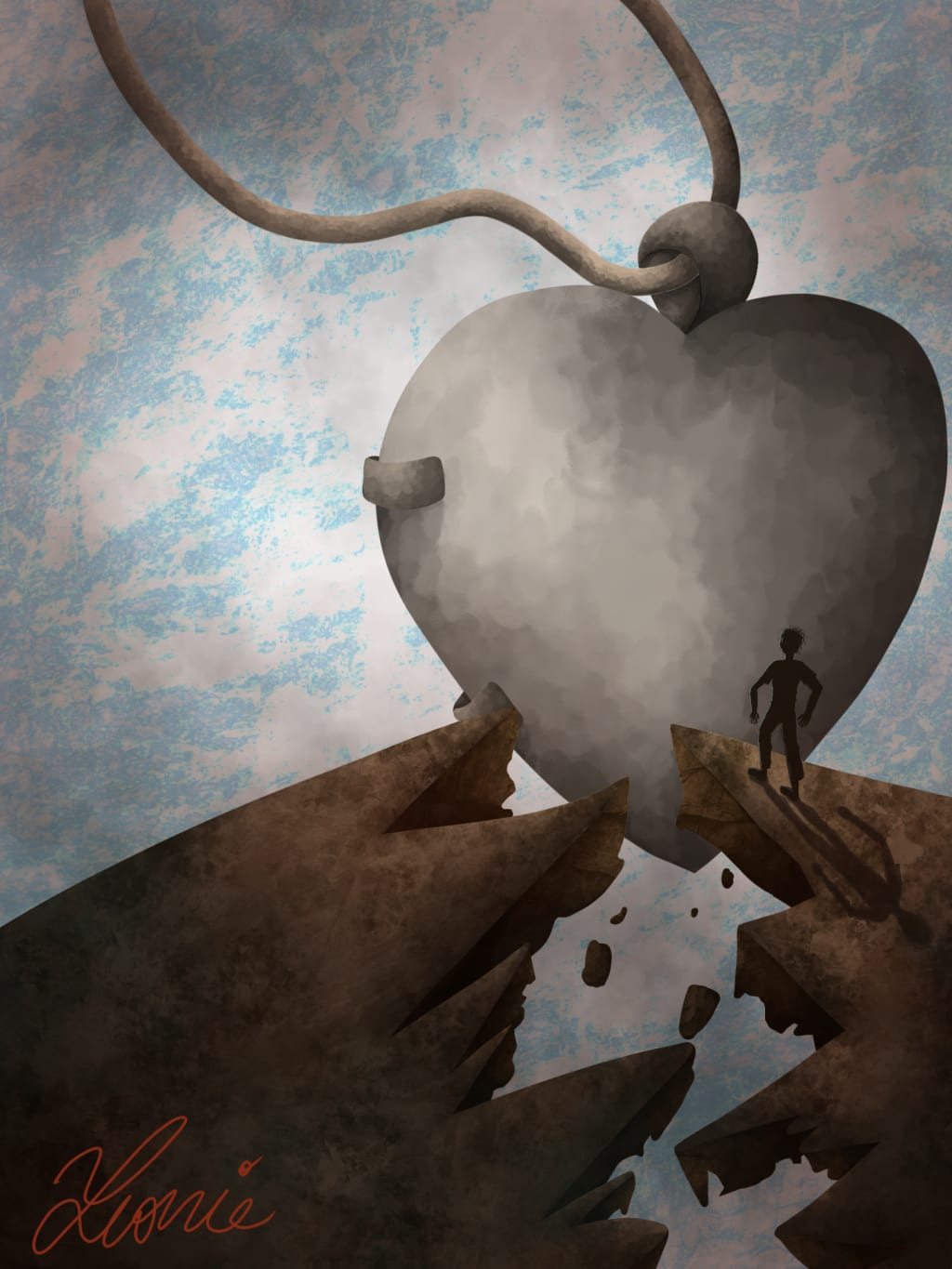
The heart-shaped locket banged against the crystal, intensifying the b-flat that resonated through everything. I held my ears against the volume, waiting for it to abate to a dull permanence within this purgatory.
“What went wrong?” the voice boomed, even louder than the b-flat, but more tolerable to me, as it was feminine.
I felt the ground shake beneath me, not like an earthquake, as it followed a distinct rhythm, not unlike walking.
“Oh, it’s your fault,” I heard a deep masculine voice scold as the earthquake stopped. “You forgot to sequester the carbon dioxide in the atmosphere last week.”
“My fault?” feminine voice retorted. “But it was Wednesday. That’s your day.”
The warm feminine tones of the one named Artemis, the cold masculinity of the one named Apollo, dominated our world. We didn’t need scientists anymore, as we finally perceived the truth of our world. The eye of the one called Artemis peered down at our world, taking up most of our sky.
A few ophthalmologists remarked that her retina looked remarkably healthy.
“No, if you’re going to call it Wednesday, then it’s Odin’s day. How is your boyfriend anyway?” Apollo shot back.
An enormous, yet distinctly feminine, hand appeared in a section of the sky and slammed itself down against what we could only assume was the lab table. A concussive shockwave ripped through our world, flattening what few structures we had left and levelling mountains.
“He’s NOT my boyfriend.”
“Oh yeah?” followed by a deep, masculine, derisive snort. “Why’d he give you that locket then?”
“What locket?” Artemis shrunk back, as the eye was gone. The light dimmed immediately after.
“The one hanging off your neck that says ‘To my beautiful Artemis. Love, Odin’.”
We saw the one called Artemis shrink back away from us, covering the locket with her hand.
“How did you know what it says? I haven’t even shown it to you. You snooping through my stuff when I’m not around? Is that what you were doing instead of sequestering the excess carbon dioxide from the atmosphere last Wednesday?” she demanded.
“Why should it bother you if he’s not your boyfriend?” we observed Apollo smirking as he said it.
“Why are you deflecting the fact that you hosed this experiment by forgetting to sequester the carbon dioxide from the atmosphere on Wednesday? This is the third time you messed it up, Apollo. Dad’s not going to let us keep doing this forever,” Artemis stood up from her lab chair.
“But mom will. She likes me more,” Apollo waved off the remark with a dismissive gesture that, a few of our meteorologists remarked, likely started hurricanes in the past, back in the days when we had water on our planet.
If we actually were a planet.
If nothing else, having all these explanations for what were previously unexplained phenomena was tremendously fulfilling.
“Hera’s not actually our mom, but you never paid attention to any of that anyway,” Artemis crossed her arms in front of her. “The only maternal instinct I’ve ever seen from Hera is when it comes to vegetables and forcing children to eat them.”
“Hey, I eat my vegetables,” Apollo puffed his chest forward.
“I always dumped mine on your plate when you weren’t looking,” Artemis gave a smile that was bigger than the moon.
Apollo looked stricken. Then puffed his chest forward again.
“At least I’m encouraging a sustaining environmental practice whereby the participants establish communal growth and compassion towards a more grandiose, all-encompassing civilization.”
“You sound like Demeter. But it was still your job to sequester the carbon dioxide, idiot,” Artemis came back to the table and prepared to use the microscope.
The one called Apollo grunted, followed by a second grunt acknowledging respect.
As I looked out on what was left of our world, the cold masculinity took on a whiny undertone.
“Well if I’m so bad as to encourage civilization, what do you do?”
“I encourage natural selection by ferreting out the old, the weak, and the sick, allowing a more robust gene pool for what will ultimately be the betterment of all, provided the sequestering of carbon dioxide occurs on a regular basis,” Artemis stated, adding with a slight smile. “It pays to be the goddess of the hunt.”
“Hmph. Dad should have released his lightning bolt on that Darwin guy the day he stepped on the HMS Beagle.”
“It’s just applying Adam Smith’s principles to a biological structure. As I recall, Darwin had 20 years to stew about it before he bothered to publish. And besides that, isn’t natural selection what actually happens in any sustainable society?”
What I remembered as once having a thousand hues of green as far as the eye could see had been dried to a dull sulfuric ochre. I found it momentarily hard to breathe, but it passed.
Directly above us, the eye again appeared, bright like the moon but a hundred times bigger, peering down while off in the horizon we saw her elegantly rendered female hand taking notes with a pen.
The eye was above us once more, then it left. As it left, we again saw the heart-shaped locket swinging towards us and stopping, followed by the same reverberating b-flat reminder as before.
“He ate his father, you know,” Apollo stated.
“Who?” Artemis asked.
“Odin, your boyfriend.”
“Would you stop? Or shall I tease you about Freya?”
“That didn’t work out well,” he acknowledged, sounding sulky. “Too many cats.”
“Cats are great hunters.”
“Not everything is about hunting, you know.”
“It didn’t work out well with Odin, either,” Artemis sighed. “He couldn’t accept the idea that I didn’t want to play in his tree house, and that I’d rather work in the lab.”
“Then why’d he give you that locket?”
“It was kind of a last minute bit of desperation on his part to make me reconsider his tree house. After he gave it to me, I asked if we could just be friends. That didn’t go well. He ended up chopping down the tree. Last I heard he was growing a new one and hitting on Athena.”
The eye appeared above us once again, followed by a sensation of being raised and lowered slightly. When we were raised, it felt like gravity had become a lot more intense and when we were lowered, everything seemed to float. These sensations had become a great deal more frequent in the last few days.
“It’s so hard to bring these little guys into focus with this microscope, what few of them are left,” she said, as the heart-shaped locket gonged once again, this time ending with a sound like a colossal crack as the world split in two.
“You might want to take off that locket while you’re looking through the microscope,” he said. “I can see where it’s banging against the experiment.”
“What? Oh fiddlesticks, you’re right,” she sighed again. “The slide cracked. Now we have to start all over again.”
“You can’t make an omelet without cracking some eggs,” Apollo said as he placed a hand on her shoulder in a consoling gesture.
“That’s a horrible analogy,” I heard her say, as we were thrown into eternal darkness.
About the Creator
Anton Crane
St. Paul hack trying to find his own F. Scott Fitzgerald moment, but without the booze. Lives with wife, daughter, dog, and an unending passion for the written word.
Keep reading
More stories from Anton Crane and writers in Fiction and other communities.
The Man Who Survived 76 Days Lost at Sea: A True Story of Survival
The Man Who Survived 76 Days Lost at Sea: A True Story of Survival The ocean can be beautiful, peaceful, and endless. But when you are lost in it—completely alone—it becomes something else entirely.
By Baseer Shaheen a day ago in Fiction
Guard Your Battery
Why are some people so attractive just by standing there? It’s not because they are "likable," but because they don’t need everyone to like them. I realized later that truly charismatic people allow themselves to be criticized, but they never criticize themselves. They never try to please the world; instead, the world stops to watch them.
By Emily Chan - Life and love sharing7 days ago in Poets


Comments
There are no comments for this story
Be the first to respond and start the conversation.