
Ink That Writes Itself
“A story that unfolds on its own—and rewrites your fate.”

Elliot Morgan had never believed in magic.
He spent his days restoring old books in a dim shop called The Dusty Spine, tucked between a dying florist and a locksmith who hadn’t opened in years. His life was made of paper cuts, cracked leather, and the soft, satisfying scent of aged parchment. It was quiet, predictable. Safe.
Then the package arrived.
There was no return address—just a thick envelope sealed with deep crimson wax. Embossed into the seal was the image of a feathered quill piercing an open eye. It looked old. Ancient, even. Elliot’s name was scrawled across the front in a looping, elegant hand that looked oddly familiar but which he couldn't place.
Inside was a single item: a black fountain pen wrapped in silk. No note. No explanation. Just the pen.
Elliot examined it. The metal was warm to the touch, and its surface shimmered strangely, like ink swirling in water. He clicked the cap off. The nib was gleaming—too perfect, as if it had never touched paper.
He should have thrown it away. But curiosity, that dangerous little whisper, told him to try it.
That night, he opened one of his blank journals and began to write.
Except—he didn’t.
The pen moved on its own.
Words spilled out in looping script across the page, faster than Elliot could read. He dropped the pen, startled, but it hovered midair and continued writing. Paragraph after paragraph flowed from the floating quill, pages turning by themselves. He stared in frozen silence as the story formed.
It was a scene—detailed, vivid, and unsettling. A man walking home through the fog. A shadow following him. A whisper of his name. A flash of silver.
Then—blood.
The man’s name?
Elliot Morgan.
He slammed the journal shut. The pen dropped to the desk, lifeless.
His breath came in ragged bursts. “What the hell is this?”
The room was quiet again. Too quiet. Outside, the fog thickened against the windows. He could swear he heard something—or someone—scraping across the glass. He didn’t sleep that night.
By morning, Elliot convinced himself it had been a hallucination. Stress. Lack of sleep. Maybe a prank. Surely there was a logical explanation.
But the next day, the journal had changed.
The ink was different. The scene had evolved.
Now the story continued—Elliot reading the journal, pacing, trying to understand. And then, on the next page: a knock at the door.
Knock. Knock.
He froze.
A knock echoed through the shop—three sharp raps on the front door. His legs moved before his brain did. When he opened it, no one was there. Just a parcel.
Inside? A second blank journal.
Over the next few days, the pen wrote more.
It described things before they happened: conversations he hadn’t had yet, people he hadn’t met, thoughts he hadn’t thought. Every time he tried to ignore it, the pen would float and write anyway—on walls, on furniture, on his skin.
The ink never ran out.
Then the journal began predicting his death.
“He will walk down Ash Street at 9:13 PM. A silver car will not see him in the fog. The brakes will scream too late. His body will crumple like the paper he loved. He will die, exactly as written.”
He read that line at 8:47 PM.
Elliot ran to the streetlamp outside and ripped the journal’s page out, heart hammering. He crumpled it. Burned it in the sink. But when he returned to the desk, the journal had already rewritten the passage.
Identical. Word for word.
At 9:05 PM, he picked up the pen.
“Can I change it?” he whispered.
The pen hovered, then wrote:
“Only if you know how.”
Desperation made Elliot reckless.
He began testing the pen. Writing names. Changing details. And it worked—but at a price.
He wrote that a thief would slip on a puddle and get arrested. The next morning, the newspaper reported a convenience store robbery gone wrong. The photo showed the man Elliot had described.
He wrote that the woman in the café would leave town and forget her pain. She vanished the next day.
But every change made the pen darker. The ink grew redder. The journal’s pages curled at the corners, as if burning from the edges.
The final journal—the third one—was waiting on his desk tonight.
On the first page, it read:
“You’ve written enough stories, Elliot. Now it’s your turn to finish the one that started it
He picked up the pen. It didn’t float this time
About the Creator
Keep reading
More stories from junaid ali and writers in Fiction and other communities.
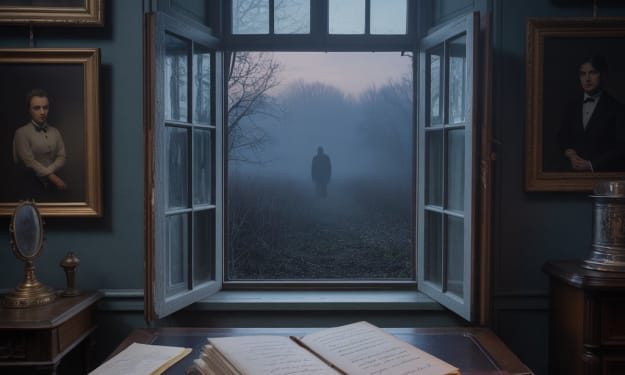
When the Windows Forgot to Close
The town of Wrenfield was the kind of place where even the birds knew not to sing too loudly. It wasn’t haunted by anything so cinematic as ghosts or murder, but rather by a silence that felt too heavy for its size—like a hush waiting to break.
By junaid ali6 months ago in Fiction



Comments
There are no comments for this story
Be the first to respond and start the conversation.