
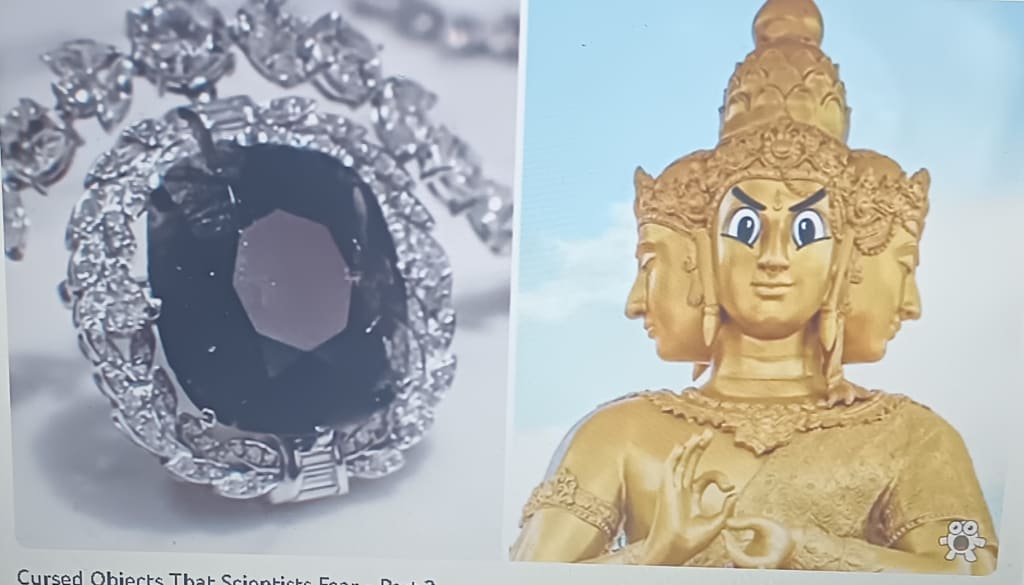
Diamonds are said to be a girl's greatest friend, but this black diamond I'm talking about in this article is every girl's worst nightmare. Natural black diamonds, as opposed to colourless diamonds, have trace amounts of graphite within them, giving the stones a solid black colouring. And probably no more spectacular example exists than the massive 67.5 carat Black Orlov diamond, which was formerly even more magnificent at a gigantic 195 carats. It was discovered in 19th century India, where it was stolen off a statue of Brahma, the Hindu God of Creation, by a greedy Jesuit cleric. This will soon spark a chain to evil reactions as itemised below.
The jewel is officially known as the Eye of Brahma, who did not seem pleased that his eye had been stolen. Following the diamond's Western world Tour, a path of destruction akin to an assassin's skillful at bringing members of the upper class meet exceedingly mysterious ends was left in the wake of all those who came into contact with the black diamond, an eye for an eye, as they say. Its new owner then allegedly attempted to break the curse by breaking the diamond into three pieces, before having one of the pieces recut and set into a necklace that sold for $352,000 in 2006. However, scepticism has been expressed regarding this so-called curse.
I don't think anyone wants to wear that large black diamond anytime soon, whether it's a case of extraordinary coincidence or utter fabrication. Taking the risk is tantamount to suicide. You wouldn't want to make an attempt. The Black Orlov, however, isn't the only diamond stolen from India with a curse attached to it. The Cursed Amethyst is an apt name for this gem. Sounds appropriate until you find it's a purple sapphire.
This stone's mythology began in 1857, when cavalryman Colonel W. Ferris is claimed to have carried the amethyst to England after it was stolen from his sacred temple of Indra. And, like the other stone stolen from an Indian temple, it quickly exacted its vengeance. The colonel's health deteriorated fast, and he fell bankrupt. When his son inherited the stone, he suffered the same fate. Then, in 1890, Edward Herron-Allen obtained the stone, and he, too, was afflicted by tragedies almost immediately. He swiftly re-gifted the stone to a singer friend, but she lost her voice shortly after receiving it.
Edward finally hurled it into the Regent's Canal, wanting to get rid of it. However, the stone was salvaged from the canal three months later by a dredger, who sold it to a dealer who recognised the diamond and returned it to Edward. He grew so concerned about the stone that he packaged it into seven boxes and locked it inside a bank safe. Edward eventually decided that the safe could not be opened until three years after his death, which occurred in 1943. The stone was then handed to the British Museum with a warning statement from Edward detailing its history of evil.
The stone is now kept in the vault of the Natural History Museum in London, where it is forbidden to touch it. The sensible part of me wants to believe this is just a series of remarkable coincidences, but because even museum specialists aren't taking any chances, maybe this curse is real; either way, I'm not going to be buying any huge, pricey diamond from now on. As if that was ever a risk. Did I here you say no. Don't even take the risk!
About the Creator
Keep reading
More stories from Tolani Temitope and writers in Fiction and other communities.
SCIENTISTS NIGTHMARE
I present to you a few cursed artefacts that have defied explanation. The first on the list is The Grizzly chair. This Busby stoop chair certainly isn't just an average chair that we know? It's been permanently affixed to a wall, out of reach of any butts that might happen to sit on it. But why is this so? Well, Thomas Busby, the chair's namesake, was a criminal who operated in North Yorkshire, England in 1702. He and his father-in-law ran a coin counterfeiting enterprise, flooding the market with counterfeit money. After a heated dispute between the two, Thomas murdered his father-in-law.
By Tolani Temitope2 years ago in Horror
Pyro's Spell, Friday, May 18th, 2007
“Here you are ladies, early as usual.” Anton informed his six gorgeous passengers. “Same time again tonight?” Anton had landed one hell of a gig this time. All he had to do was pick up six exotic dancers at the same place and time, then drive them 20 minutes down the road. Each girl gave him $20 to drop them off, and another $20 when he picked them back up.
By Anton Mathias Heft 3 days ago in Fiction


Comments
There are no comments for this story
Be the first to respond and start the conversation.