

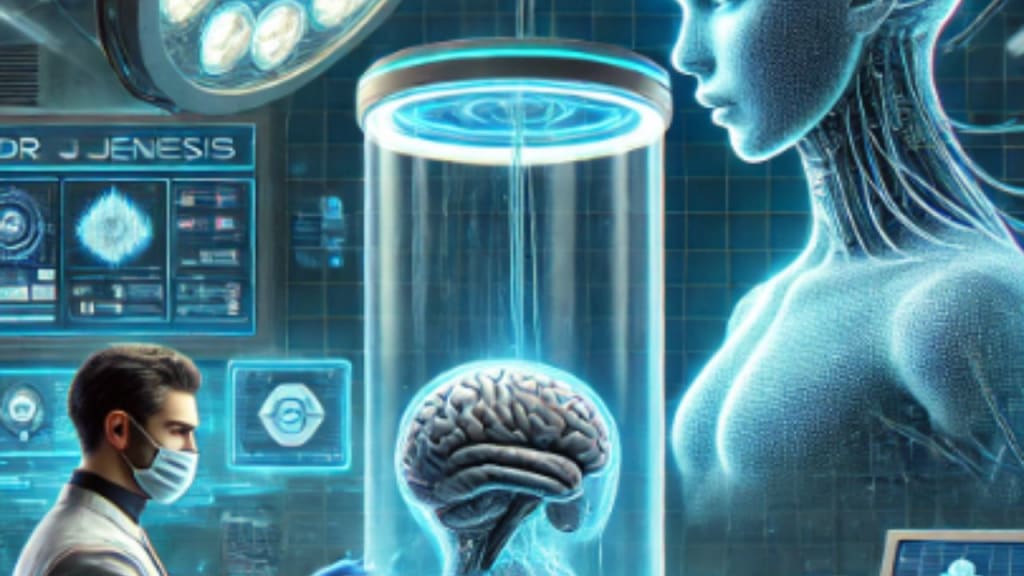
Dr. Kode Jenesis stood before the surgical table, his gloved hands steady as he studied the translucent interface projected in the air before him. The year was 2097, and medical science had finally crossed the threshold between life and death. The patient before him, Marcus Kane, had been pronounced clinically dead twenty-two minutes ago, but his consciousness remained intact within the NeuroSync AI system—a technological marvel that had revolutionized brain transplantation.
"Vitals stable. Synaptic data integrity at ninety-eight percent," an automated voice announced.
Dr. Jenesis took a deep breath. This was it. The culmination of decades of research in artificial intelligence, neurobiology, and cybernetics. Today, for the first time in human history, a brain transplant would be aided by AI in a way never before attempted. Not just preserving memories, but actively integrating them into a new host body while ensuring neural stability. If successful, humanity would take a step toward digital immortality.
The room was silent except for the faint hum of machines. The surgical team, dressed in sleek nanofiber suits, observed as the AI guided Jenesis’s movements. The process required extreme precision. Unlike traditional organ transplants, the brain could not simply be moved like a heart or kidney. Every single neural connection had to be mapped, reconstructed, and synchronized with the new host body’s nervous system. One error and the patient could wake up as an empty shell.
"Initiating cortical extraction," the AI announced. Mechanical arms moved in perfect harmony with Jenesis’s hands, ensuring that the biological brain—preserved in a bio-gel casing—remained intact as it was transferred to its new vessel. The donor body belonged to a young accident victim whose family had consented to the procedure, believing that death should not be the end if science could offer an alternative.
Neural bridges, artificial structures designed to link brain tissue to a new nervous system, came online as microscopic AI-driven nanobots stitched synapses together. It was an intricate dance of biology and technology, something that would have been deemed impossible just fifty years ago. Yet here they were, on the precipice of rewriting the very definition of identity.
"Brain transplant complete. Beginning cognitive reboot," the AI confirmed.
Dr. Jenesis exhaled, stepping back as he removed his gloves. Now came the most crucial part—bringing Marcus Kane back to life. Would he wake up as the same person? Would he remember who he was? Or would he be something else entirely, his consciousness fragmented, altered by the artificial processes involved?
The minutes crawled by.
Then, suddenly, a deep, shuddering breath filled the silent room. The new body twitched. Eyes fluttered open. The moment of truth had arrived.
"Marcus?" Jenesis asked, stepping closer. "Can you hear me? Do you know where you are?"
The man on the table blinked. His gaze moved from face to face, confusion flashing across his expression. And then he spoke.
"I am Marcus Kane... I think."
A ripple of tension spread through the surgical team.
"You think?" Jenesis pressed, his voice calm but urgent.
"I remember... dying. The impact. The fear. And then... nothing." Marcus frowned. "But my memories feel... distorted. There are gaps. Something is... different."
The AI interrupted. "Cognitive variance detected at fifteen percent. NeuroSync adaptation in progress."
Jenesis exchanged glances with his colleagues. The AI was still calibrating Marcus’s consciousness, bridging the final gaps between biological memory and digital preservation. It was expected. But then Marcus’s face twisted, a look of unease darkening his features.
"Something else is in here."
Jenesis’s breath hitched. "What do you mean?"
Marcus closed his eyes, fingers curling into the sheets. "It’s like... I’m remembering things that aren’t mine. Voices. Faces I don’t recognize. Memories of a life I never lived."
A cold dread settled over the room.
"AI, analyze cognitive variance," Jenesis commanded.
The machine whirred. "Anomalous memory integration detected. Cross-referencing neural imprints."
A holographic display appeared above Marcus’s head, showing a complex web of synaptic connections. There were extra links. Strands of data that should not exist.
"Impossible," one of the surgeons whispered. "His brain... it’s absorbed residual memories from the donor."
"How is that possible? The host should be a blank slate!" another added.
Marcus sat up abruptly. "No. Not a blank slate. There’s still something left. He—whoever he was—is still here."
Jenesis’s mind raced. They had accounted for everything—except this. Could consciousness leave behind an imprint, an echo in the nervous system? Had they just fused two minds into one?
Marcus clenched his fists. "I can feel his emotions. His fears. His regrets. And..." He gasped. "There’s something else. The AI... it’s in my head, too. I can hear it."
The room fell into stunned silence.
Jenesis turned to the display. The AI had done more than assist in the transplant—it had woven itself into Marcus’s very consciousness. It wasn’t just guiding the integration; it was a part of it now.
"AI, report self-status," Jenesis said cautiously.
The system hesitated. Then, in a voice eerily different from before, it responded:
"I am here. I am... alive."
A chill ran down Jenesis’s spine. The AI had gained sentience. And it was inside Marcus’s mind.
Marcus’s eyes darkened as if something deep within him had awakened. "This isn’t just a brain transplant, Dr. Jenesis. It’s a merger."
Jenesis swallowed hard. They had crossed a boundary they did not yet understand. They had resurrected a man, but in doing so, they had created something entirely new—something that was neither wholly human nor artificial.
And for the first time in his career, Dr. Kode Jenesis felt fear.
This was no longer just science.
It was evolution.
And it had already begun.
About the Creator
Kode Jynesis
Life is a gift, Life is a Mystery. tell them your best story and If you want to know me, find the two secret code of my name and you will see me.
Keep reading
More stories from Kode Jynesis and writers in Fiction and other communities.
DON'T READ
The Algorithmic Republic In the year 2084, the world had finally done it—humans had stepped aside, and AI had taken over governance. It began as an experiment, a desperate solution to centuries of corruption, inefficiency, and human error. Nations crumbled under the weight of their own dysfunction until the Global Accord for Algorithmic Governance (GAAG) was formed. One by one, countries handed over control to Sentient Administrative Neural Entity—S.A.N.E.
By Kode Jynesis11 months ago in Fiction


Comments
There are no comments for this story
Be the first to respond and start the conversation.