


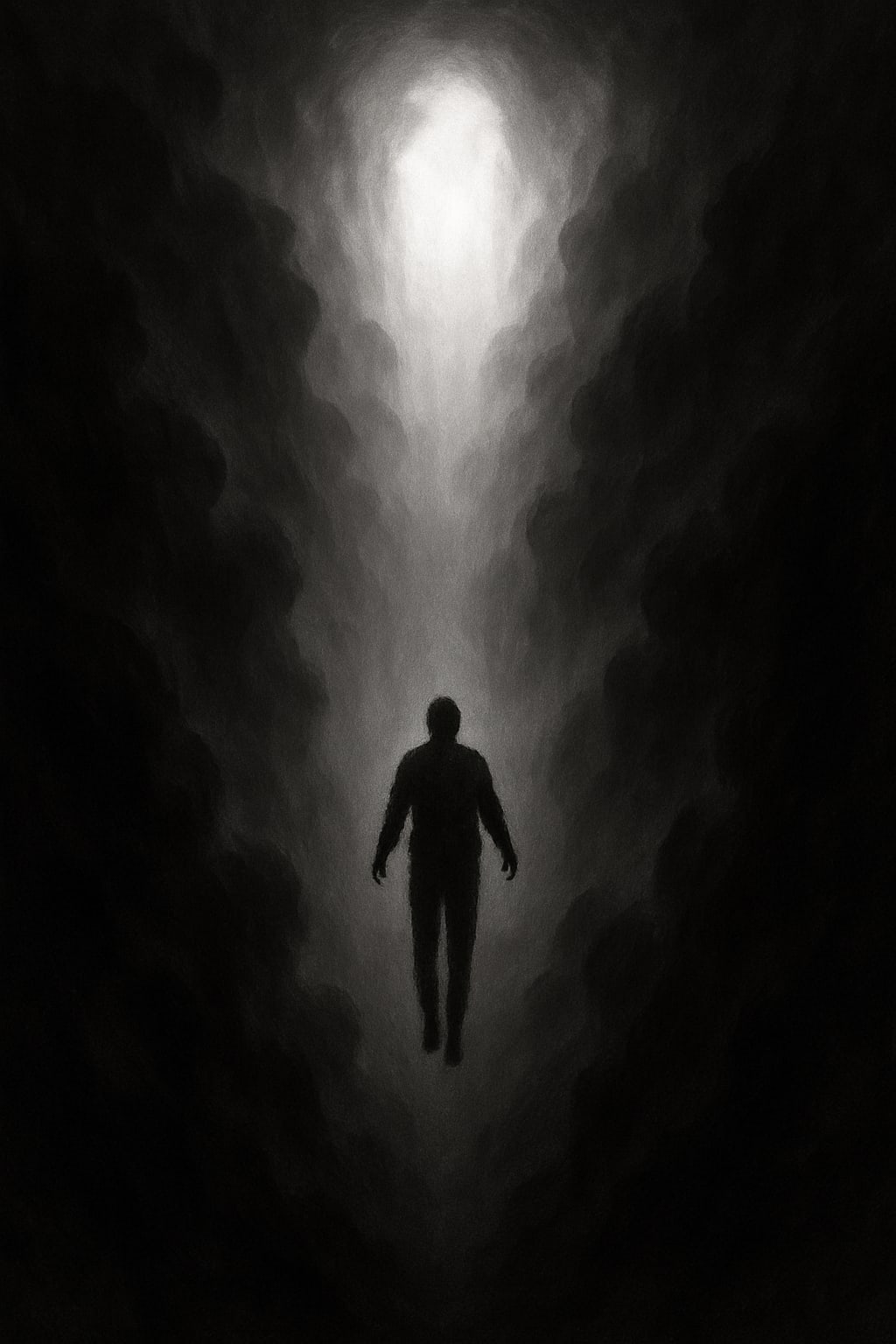
Simple is the man who qualifies his existence with temporary conditions.
I am hungry. I am cold. I am thirty-one. I am tired. I Am… I Am… I Am.
We spend our lives patching ourselves together with little statements like that, don’t we? Our beings reduced to the constant need to reassert identity using the “I Ams” of moments. And we call this life? That is what it means to be self-aware? To know the “I Ams” that define our fragility more than they do our mortality?
Perhaps, then, in that I am mortal, I am simple.
For I Am.
I Am… I Am… I Am.
It was all my father could say in the end—I Am.
It was the truth he found there, in the room.
It was the truth he knew.
It is the truth.
And I have become desperate not just to know it, but to share it.
The truth.
I will share it with you as my father shared it with me.
It began in innocence, as harmful things so often do.
It didn’t take much convincing for my father to agree to split the cost of Pope House with Carl. They were a few drinks in when Carl, speaking in that jittering cursive tongue of the drunk, started on his pitch. “It’s a beautiful property,” he’d said. “It’s well known.” “It’s historic.” “We work on it on the weekends then sell it for a fat wad in a coupla years.”
He was right from certain angles. The property was beautiful in the way that anything green is beautiful to a man from Phoenix, even if that green is overgrown and full of briers. It is well known, but only if you’ve lived in Yurtsburgh long enough to be entrusted with its folklore. It is historic in that it was built in the fifties, no matter Matty Pope abandoning the house and everything in it in the same decade. And they really could have made a “fat wad” if they had lived long enough to finish the flip.
“Only five hundred?” My father asked. “You sure ‘bout that?”
“Hell yeah I am. Five hundred each and we’re in.”
“Well shit, could tear down the house and still make a profit selling the land.”
Renting a bulldozer, or paying whatever fine the fire marshal handed them, to clear the land and sell it to the state would fetch a much smaller return, yes, but a quicker one. And, God, I wish they’d gone this route—they might’ve never found that room, never known the truth, never been constrained to “I am”.
Were the windows intact? No, they were shattered long ago at the hands of boys older folk would refer to as rowdy. Were the bones good? No, the boards had rotted through, giving the Pope a horrid smell that girls, dragged there by boys pining for their interest, often complained about. Were the goods inside worth saving? No, whatever Matty left behind had been looted or destroyed for a minute’s laughter. Was the house reparable? Perhaps not. They went on anyway. My dad and Carl. They went on.
And this stirred some interest in the town.
Some years back a girl’s body was found savaged in the woods surrounding the property. After that, rumor spread through Yurtsburgh K-8 that a beast lived in the Pope—a great pale beast, gaunt, towering, eyes a consuming black.
Every Halloween, some poor kid hoping to prove he’s cool gets dared to stand on the Pope’s steps. So he climbs up there, knees shaking so badly they’re hardly holding him, the house creaking in the wind behind his back. Then comes a sudden crack and he bolts for his life, certain the beast is after him, only to find that his newfound buddies, bursting with laughter, had thrown a rock. Carl had to be dared onto the steps just the same, but it wasn’t fear of the pale beast that gripped him. It was the fear that the steps could no longer support his not-insignificant weight.
Most of Yurtsburgh held the opinion that the place wasn’t worth its weight in shit. Most thought the place would collapse at the first hammer fall. But somehow the Pope managed. Despite the years, despite the boys who vandalized it and the girls who swore it stank of something dead, despite the storms that blew half the shingles off and the rot that chewed at its bones, the house held.
Dad and Carl started renovations the next weekend. They tore out panels, scraped wallpaper, and patched holes. And yet, for the longest time, folks in Yurtsburgh doubted whether actual work was being done or if they were just there getting drunk. My dad would come home, slump on the couch, shirt clinging with sweat and dust, and say they’d labored the twelve most fruitless hours a man could live. “Place consumes time whole,” he joked once. Carl laughed at that, but not for long.
It was on their fourth weekend that they found the room. Or was it the fifth? I can’t trust myself to remember the details so minutely anymore. It was just a week ago that he passed, and it only took the couple leading up to that for the truth to sink in, so it had to be the fifth weekend. I think.
If simple men confine themselves to “I Ams”—and Carl was the apotheosis of “simple”—then Carl’s “I Am” was, more often than not, “drunk”. He was drunk that Saturday, tearing down some old shelving along the wall on the right as you go down. A thirty-pound sledgehammer in the hands of a man with a preference for the bottle is the perfect setup for a predictable accident. As Carl told it, he swung the sledgehammer downwards, missed his mark entirely, and his considerable weight carried his momentum past his balance. As he pinwheeled, the hammer slipped from his hands, slamming against the opposite wall headfirst.
Embarrassed despite being alone, Carl picked himself off the floor, dusted off his jeans and shirt, replaced his cap, and went to fetch the hammer. It was at the base of the wall, which cracked into a busy spiderweb from the impact. Muttering something about “damn shoddy construction”, he felt along the mark he’d left and felt something he hadn’t expected—air. A thin stream, steady and cold, brushed along his palm. He clambered to his knees and pressed his nose along the draft. It was dry. Not wet. Not mildewy like the rest of the house. Dry as no cellar ought to be.
This was the sort of development Carl Mizerowski had secretly hoped for. Rumor had it that Ol’ Matty Pope was not just a lonely bachelor, but a somewhat wealthy one. Nobody in Yurtsburgh’s history, as far as Carl was aware, had ever made out of Pope House with a safe, or armfuls of cash, or bars of gold. Not even a bank bond slip. If there was treasure of any kind, if the rumor held any truth, it was here. It was sealed behind this wall. It was here.
And, of course, there was truth found behind.
When my dad descended to the cellar to see how Carl was coming along, he found most of the shelving still intact, while the wall opposite them now bore a hole a few feet wide that had heretofore not been there.
“Carl, where the hell are ya?” He called from the base of the stairs.
No answer came. But it was obvious even to a man of my dad’s aptitude that Carl had gone through. A dim stream of yellow light bled from the jagged opening. Dad crossed to it, hesitant, calling all the way—“Carl? Carl you there?”—and bent at the waist to peek in.
“Carl, what’re you— Jesus! Oh, Jesus Christ. Is that— is that a body?”
But Carl answered nothing. He stood motionless, his arms limp at his sides, his flashlight angled to the floor, his head bowed in the same direction. There, beneath the beam, lay a sinuous scab of a man, its skin collapsed to bone and peeling in paper sheets. The corpse curled against the wall, its right hand extended as if reaching for someone once loved.
“Jesus fuck, Carl, what’re you doing? Get away from it!”
Still no response. Carl did not move. Nothing seemed to register.
He couldn’t tear his eyes away from the body either, but he nevertheless army-crawled into the room enough to stand. Only when he reached Carl did he understand: it wasn’t the corpse that held Carl still.
It was the truth written on the wall at its hand.
A truth left in rust-dark blood smears.
The truth of I Am.
That was the story that my dad told me that night. He spoke to me in a wavering voice, his hands trembling so badly that they refused to hold steady, his eyes glazed and dull.
I didn’t know what to do for him. The only comforts I knew to give were alcohol and company, so I slept on his couch that night. No matter how I might sometimes speak of him, I wish it understood that my dad was a man that I cared for deeply. I’m not sure how God chooses who’s beloved, but I believe my dad to have been.
Feeling like an intruder to his grief, I listened through the wall as he whimpered, then succumbed to wailing. At these first cries, I crept to his room, pushed open the door, and called from the threshold, “Dad, what’s wrong?”
His answer came in a cry, each word forced out as if chosen with painful care. “I am no good.”
“That’s not true,” I said. “Why’re you saying that?”
“I am no good.”
“Dad—“
He sat bolt upright and shouted, almost pleading for understanding, “I am no good!”
I didn’t know what to say, but I worked myself into tears trying for something—anything—that would let him know just how completely I disagreed. Instead I rushed over to him and wrapped him in a hug.
He sagged into me, sobbing into my chest, and after a time his arms came up to hold me too. Still, he muttered, “I am no good.”
The next day he emerged from his room in the same clothes, his eyes a raw, bleeding red, and I doubted he’d slept at all.
“You alright?” I asked.
“I am fine.”
“What do you need? I can make some breakfast if you want.”
“I am fine,” he repeated, the words flat.
Everything I said, every question I asked, garnered the same reply. Eventually I left for work, knowing he was lying every time he opened his mouth.
I didn’t see him until dinner that night. His eyes were rimmed blue, and his face slack and fallen. I’d always known him to be a stoic man, but this was not stoicism; this was a void.
The only time he spoke that night was when I took him by the hand, jostling him from his stupor, and asked, “Dad, what’s wrong?”
He met my gaze—and I’m pained to say that I wish he hadn’t—and answered me: “I am afraid.”
“Of what?”
He only shook his head.
“Tell me,” I said. “Please.”
His eyes dropped again, and in a faint, breaking whisper, he said, “I am so afraid.”
For the next couple weeks, my dad expressed himself only through his “I Ams”. Common were the endings of afraid and no good and fine. For one afternoon the ending even became furious.
I became his caretaker in those final weeks, not knowing what had broken him but trusting that he would return. That hope waned with every passing day, though, until I could stand it no longer. I knelt before him and begged for the truth of what he saw. For I had begun to learn that the rumors were true, that there existed a pale beast in Yurtsburgh, and that it was before me in the man I once knew as my dad.
Two weeks into his break, I knelt before him, sobbing. “Dad, please talk to me. What did you see?”
His eyes—an oily charcoal—fell upon me, and for the first time in weeks, I knew he saw me as I was. And then he spoke in a dry rattle, “I Am.”
And I knew then that this was the truth.
The truth of I Am.
A smile broke across his face, and it was horrific. Laughter, bright and ragged, tore out of him. Something in me cracked open at the sound. A lightness rose, a clarity, and before I could stop myself, I was laughing with him.
“I Am,” he gasped. “I Am! I Am! I Am!”
I cradled his face in my hands, my own laughter dying into a trembling joy. “I Am,” I echoed.
Then his laughter collapsed into violent coughing. Blood flecked from his lips, speckling my face and shirt. I only held him closer, because in that moment I understood: my dad was not broken but prophet, and the mantle he carried had slid from him onto me.
I Am… I Am… I Am.
I am desperate to share this truth. For is this not God’s plan? To shed mortality and take up immortality? For all those who know it as he did shall shed their mortal names and enter truth.
The truth he carried.
The truth he gave me.
The truth of I Am.
Simple is the man who builds his life from fleeting statements of himself.
I am hungry. I am tired. I am afraid.
But those are only shadows cast by greater truth, a truth waiting beneath all speech. Even now, you feel that truth moving behind your thoughts, gathering itself, forming into shape.
I am mortal, and in that, perhaps, I am simple. But man is not meant to remain in mortality. Now that truth has been spoken, all lesser things begin to fall away.
And all that shall remain is truth.
I Am.
About the Creator
Keep reading
More stories from J. Nicholas Merchen and writers in Fiction and other communities.
John, the Beloved
My grandmother chose my father’s name from the Bible—for he would be beloved by the Lord, just as the apostle was. And I would like to think that he was. That perhaps his being taken from this earth was a kind of divine intervention, that his test in life had been seen and counted finished. That maybe the Lord looked upon his shaking hands, the choreas that so often humiliated him, and decided that the comforts of glory were more fitting for such a man than the weight he bore here.
By J. Nicholas Merchen8 months ago in Fiction
Lightning Never Strikes Twice
The distant rumble, the sudden deluge, the crescendo of sound, the flash of light, the explosive energy — it never gets old. I became an amateur storm chaser about two years ago. My wife, Cindy suggested it. Sort of. She said, "Alex, you know this cancer is killing me. I've come to terms with that, but you're smothering me. Go join a band, write a book, or become a storm chaser, for all I care. I love you, but you need a hobby."
By Julie Lacksonen4 days ago in Fiction
Inside Rebels
You stared at the chalk‑dusted blackboard, the harsh scrape of the marker echoing the teacher’s voice as it cut through the quiet of the classroom, and you felt the weight of every syllable settling like a stone on your shoulders. It was Mr. Harrow, the man whose reputation for cruelty preceded him, and you and your partner, Elena, had already learned to keep your heads down when he entered the room. “If you cannot answer the question, you are simply unworthy of learning,” he had snarled, his eyes flicking between you as if searching for a crack in your resolve. The air grew colder, and you sensed Elena’s trembling hand brush against the edge of the desk, a subtle reminder that you were not alone in the mounting dread.
By Forest Greenabout 3 hours ago in Fiction
This Is What I Do When People Throw Rocks At Me
Rocks have been thrown at me for a greater part of my life. Some have been small and missed hitting me. When people don't get a reaction from me, they throw bigger rocks with a better aim. Many have been hurled at me with precision over the years. For a long time, I thought my only options were to dodge them or be crushed by them.
By Margaret Minnicks6 days ago in Confessions


Comments (2)
Wooohooooo congratulations on your win! 🎉💖🎊🎉💖🎊
I really enjoyed this. Interesting concept. 👍