

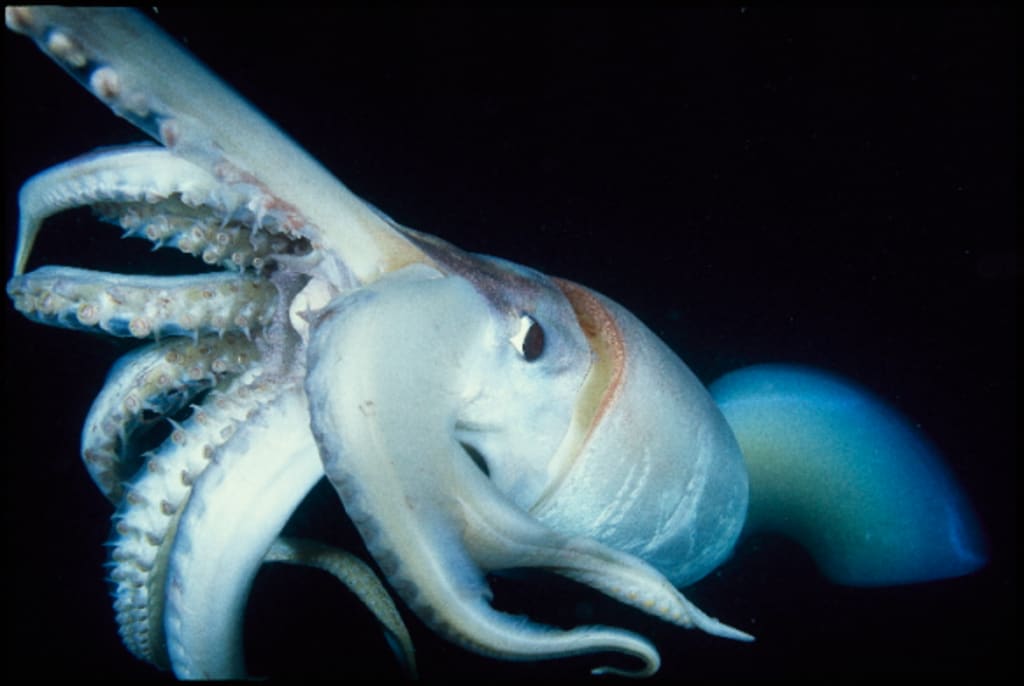
Author's preface: Any materials in quotations or italicized below may have been taken directly from the source page (Wikipedia in all cases) or lightly modified. The modifications may have rendered the material no longer scientifically accurate (of course no guarantee it was to begin with), or it may not have. The reader will have to research for themselves if they are that interested in discovering the truth of the matter.
In 1782, the existence of the sea creature now known as the Humboldt squid was first reported to the scientific world by the Chilean priest and polymath Juan Ignacio Molina. In 1815, 44 years before Charles Darwin, he proposed a theory of gradual evolution in his book, Less Observed Analogies of the Three Kingdoms of Nature. That book caused something of an uproar and it brought charges of heresy which triggered the Bishop of Bologna to order a council of theologians to examine the work. Eventually the council approved the work and cleared Molina of all charges. Unfortunately for Molina that decision was very slow in coming delaying his books publication by many years. Scholars have argued that this cost Molina the chance to be known as one of the forerunners of the theory of evolution. Despite this historical accident he was reportedly well loved by his students and was said to be both mild in his dealings and kind in his character. This stands in great contrast to the squid which he introduced to biology which is well known for its particularly nasty temperament and aggressive behaviors and it is loved by very few, even the fishermen that make their living primarily by fishing for the carnivorous squid.
The Humboldt is also known as the jumbo squid or jumbo flying squid in English and in Spanish as calamar gigante or jibia or pota. They have a propensity for rapid flashing of the colors red and white when captured and because of this are also known as diablo rojo ('red devil'). It is the largest of the Ommastrephid squids, with some individuals reaching 1.5 m (5 ft) in mantle (body) length and weighing upwards of 50 kg (110 lb). The mantle makes up at least half of the animals mass and includes the fins or wings. The remaining portion is roughly split between the arms and tentacles and the head (including eyes and beak). They possess two tentacles each carrying between 100 and 200 suckers. The suckers are lined with razor sharp teeth or hooks which they use to grasp prey and drag it toward their very large and very sharp beak.
"They often approach prey quickly with all 10 appendages extended forward in a cone-like shape. Upon reaching striking distance, they open their eight swimming and grasping arms, and extend the tentacles covered in sharp hooks, grabbing their prey and pulling it back toward a parrot-like beak, which can easily cause serious lacerations to human flesh. These two longer tentacles can reach full length, grab prey, and retract so fast that almost the entire event happens in one frame of a normal-speed video camera. Each of the squid's suckers is ringed with sharp teeth, and the beak can tear flesh, although they are believed to lack the jaw strength to crack heavy bone. The squid are known for their speed at eating; they feast on hooked fish, stripping them to the bone before fishermen can reel them in. Their behavior while feeding often includes cannibalism and they have been seen to readily attack injured or vulnerable squid in their shoal. Until recently, claims of cooperative or coordinated hunting were considered unconfirmed and without scientific merit. However, more recent research has strongly suggested they do engage in cooperative hunting"
They live in shoals which can be as large as 1,200 individuals and can move incredibly fast, upwards of 15mph, propelled by water ejected through a hyponome (siphon) and by two triangular fins. The ejected water generates enough force to send them them flying out of the seas to heights as far as 10 feet or more above the surface. It is this ability to "fly" that has been the source of many myths and legends among the men who fish for them. The legends speak of colleagues or friends "dragged down to the briny depths" by hunting Humboldts flying out of the water and snatching a man who was too close to the edge or not paying enough attention to his surroundings and situation. In some cases it is said the men were first hypnotized by the flashing lights of the squid, putting them into a trance like state and immobilizing them, making them easy pickings for the squid. It is their color generating (chromogenic) behavior that has been the source of most of the legends specific to the Humboldt squid. Those legends tell of men not dragged down to the briny depths against their will by squid flying out of the water to snatch the unprepared or unaware or tranced, but rather men who willingly (of a sort) give themselves to the squid, walking or running or jumping from the sides of the boats they are in directly into the maws of the waiting, hungry squid. It is said these men were compelled to their deaths by one or more Humboldts who used their flashing lights to "hypnotize" and "trance" them and force them to feed themselves to the squid.
"Humbolt squid have two modes of colour-generating behaviour: The entire body of the squids "flash" between the colours red and white at 2–4 Hz when in the presence of other squid, this behaviour likely represents intraspecific signalling. This flashing can be modulated in frequency, amplitude and in phase synchronisation with each other. What they are communicating is unknown – it could be an invitation for sex or a warning to not get too close or, if the legends are to be believed, a hypnotic signal which can induce a trance like state in their potential prey, including humans. Once induced into trance the prey is immobilized and helpless, or in some cases actively moves in the direction of the squid, accelerating its own demise. The other chromogenic mode is a much slower "flickering" of red and white waves which travel up and down the body, this is thought to be a dynamic type of camouflage which mimics the undulating pattern of sunlight filtering through the water, like sunlight on the bottom of a swimming pool. The squid appear to be able to control this to some degree, pausing or stopping it....these two chromogenic modes are not known in other squid species."
Fishermen Julio Ramirez was known among the locals in the small fishing community in Baja, California Mexico where he lived as a historian of the Humboldt. He knew as much about the squid, and the legends about them as anyone. He had seen men tranced by the squid before, it had happened to himself once before. However, in the cases he had seen, and in his own, the trance had resulted only in a brief period of immobility. It had not lasted more than 10-15 seconds. Now however he found himself unsure of where he was or what exactly he was doing. He knew he was walking and had a vague sense that maybe he shouldn't be or that he was heading in the wrong direction. But everything seemed so hazy and fuzzy and light and he was tired, so very tired. He just wanted to lay down and go to sleep. Suddenly he saw flashing lights below him and all around him. They were so beautiful, they would let him sleep. Show him where he needed to go to rest. Something in the back of his mind protested, and he thought he heard voices or shouts of wait and no or something like that, but it was all so far away, so distant. He needed to rest, he was sure of that much and he took one more step forward.
About the Creator
Everyday Junglist
About me. You know how everyone says to be a successful writer you should focus in one or two areas. I continue to prove them correct.
Keep reading
More stories from Everyday Junglist and writers in Fiction and other communities.
Fish are So Gross
I am not going to mince words, fish are gross. By fish I mean any non-microbial (and some microbial) living thing that comes from the water, salt or fresh that humans currently or have ever eaten. My great aversion to fish began in six grade health class when I first learned that a symptom of many venereal diseases was a “fishy odor.” I don’t know about you, but I for one have no desire to eat anything that has any association with venereal disease. Which brings me to the topic of crabs. Another venereal disease and seafood “delicacy’ that some human beings believe is fit for consumption and others curse as their worst one night stand ever. Contrary to popular opinion lobsters are not actually (genetically) all that closely related to cockroaches. However, like all invertebrates they share a common ancestor, they also share one other trait, they are gross. Shrimp are also extremely gross, seaweed is disgusting and gross, and the less said about crayfish the better, particularly if what is said is with their even less appealing redneck nickname crawfish or crawdads. Yuck. Ewww. Nasty. Ugh. I hate fish. You might think that given my hatred of fish I would be happy to sea them dead or dying. You would be wrong, as the only thing worse than the smell of a living fish is how they smell when they are dead. I think I am going to be sick now. Damn fish.
By Everyday Junglistabout a year ago in Fiction


Comments (1)
Interesting