
Human Skein
Children of the Nocteal
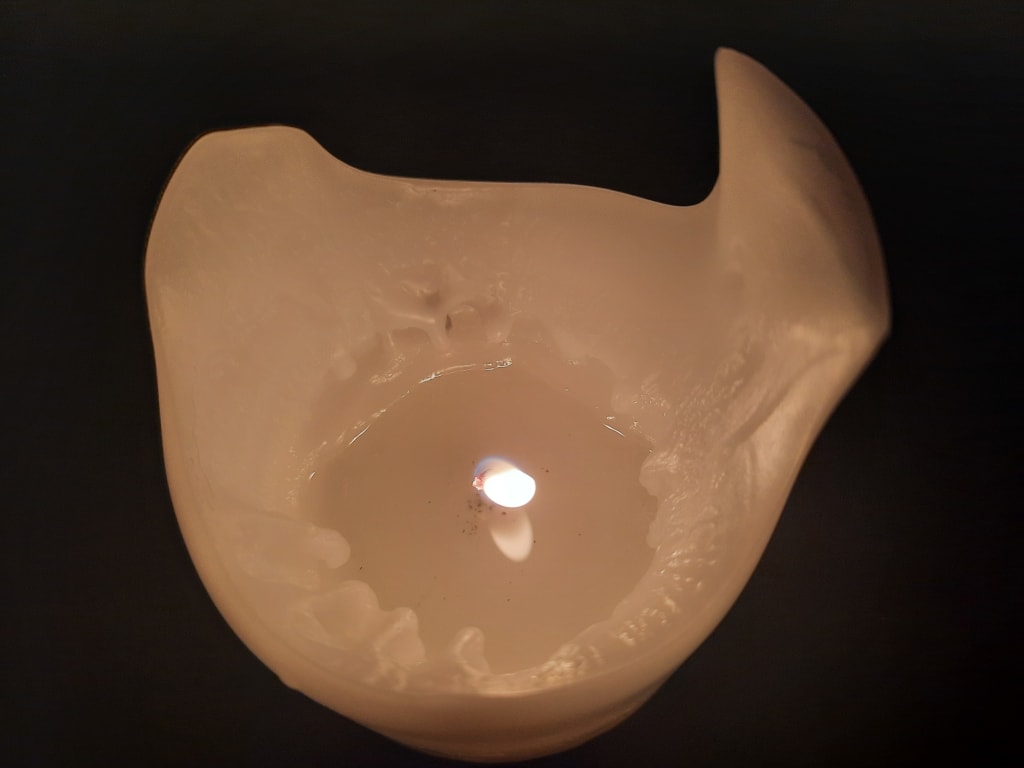
Ash drifts across a broken landscape. The skein’s pearlescent, silk-seeming web below my feet shades the husk of our world pale white. Everything, now, is seen through the gauze of the skein, both protecting and muting. It’s like a hand across the throat, stifling; and like a mother’s breast, too. I love and hate it.
I glance at Raphael. She floats in her own bubble, fifteen-hundred metres above ground. A concussive burst shivers the air, a fountain of fire licks like a festival streamer from a seam in the earth, and black grit washes Raphael’s skein. My own bobs and flutters against the pressure. Raphael grimaces, not from pain but in an effort to see through ash and cloud.
The skeleton of a Fathers’ Dwelling is visible some kilometres in the distance. Responding to my thought, my skein pulses once and flashes towards the ruin. Raphael streaks after me as soon as the air around her is clear of debris.
It is remembered that the Fathers dwelt above ground, and the Mothers below, in earth’s heart. Male comprised the skin; female the flesh. Or so we like to say. The Nocteal weren’t male and female in the same way we are, but humans wanted to think of them in that fashion. Nor was it really that long ago when we thrived under their nurturance—I was an introverted teenager, then; now I’m a gun-shy twenty-fiver—but it feels a lifetime. And they protect us still. I reach out fingers to brush the skein but drop them to my side instead. I’ve felt that satiny glide over translucent webbing thousands of times and it never inoculates me against the memory of the feel of another living being’s flesh. That is irreplaceable.
The Fathers’ Dwelling is like a meat-picked carcass on the hillside. Just the bones of it remain. Delicate atriums have spilled open across blasted land; sweeping halls have crumbled; and the Fathers’ incredible hanging gardens been incinerated entirely in holocaust flame. From this far above, you see the outlines of the buildings as if they are sketched.
Raphael and I descend through the momentary gloom of more eclipsing ashfall, and then we are touching down in what might have been the entrance vestibule of the Fathers’ Dwelling. Our skeins filter toxins and extract oxygen from the acrid air. We are safe in our untouchability. In isolation, we flourish … or subsist, anyway.
It is eerie under the claws of the ruined Dwelling hall. When whole and undamaged, the Fathers’ architecture was petal-like and the material possessed a cobalt lustre. The lustre is gone, the Dwelling is dead, and the ruins are grey.
We pick over the corpse. We are always thorough. So much depends on that. I glide into the murk of a half-fallen tunnel—once an arched hallway joining separate atriums.
Raphael signs to me and I activate my skein’s vibratory amplification ability by focusing my intention.
“Can you see in there?” Raphael says. Her words are clear, a chime in my artificial habitat.
“Not much. I think we can get through.”
I drift deeper, until the bubble of my skein has to automatically shrink to fit the confines of the damaged structure. The remains of the roof look none too stable, but the skein will protect me from an impact.
Raphael says, “The rubble’s too thick. There’s no way through.”
But I can see one, a slit of space spared in the collapse. “Here,” I gesture. My skein reduces until it is like an oil slick over my body, but I can squeeze into the chamber beyond. I feel nothing but the cool enfolding of the artificial skin the Fathers provided me. I wish to feel anything else, just for the novelty of it.
But I’m safe, I think. Safe is good.
I push through the crack in the fallen Dwelling.
“Don’t get stuck, Phil.”
“I’m all right.”
Beyond the tunnel lies a bud-shaped chamber. My heart surges, shooting adrenaline through my body, a pleasant elixir. Momentarily, I see it: a ramp circling into the ground. A cleft into the Mothers’ domain, into the womb beneath the outer shell of our world. Then the vision resolves into a juxtaposition of shadows that my mind, in its feral hope, made into something meaningful.
“Is—is there something?”
I turn and see Raphael peeking through the crack. I wonder briefly that I managed to fit. I glance at my breasts, stomach, legs—as if I might, at some point, have grown skinnier without noticing.
“No, there’s nothing,” I breathe. “It’s empty.”
* * *
I spy him wandering among the dozen drifting skeins outside the common room as soon as Raphael and I return to camp. He is only growing more good-looking as years pass.
“Philomena,” he says and I can’t quite tell if he’s pleased, unhappy or indifferent at our meeting.
“You been Seeking, too, Conrad?” I say and try to smile.
“Yeah.”
“Any luck?” I ask reflexively, knowing—of course—the answer.
“Nah. You?”
I shake my head. “Glad to see you, though. That sweetens a glum day.” I force the smile to remain, not disappear on fleet wings, but grief aches like a painful vaccination through me.
He shrugs. It’s a familiar, characteristic gesture, and for a moment, I’m overcome by memories. Him as a teenager, the two of us after the day’s academy. Lying together in a hanging garden, me straddling his hips. It is not the image that strikes me swift to the chest, though; it’s the memory of the sensation of his bicep under my hand, and the white-hot heat that spikes inside me as I bend and lick his neck, bite his earlobe playfully. There are more memories, a cascade, intimate flashes that I bury.
“You eaten?” I ask.
“No …”
I sweep my hand toward the common room, smiling lopsidedly. “Wanna?”
His expression seizes as if he’s been bitten and then the spasm passes. “Sure,” he says.
Are you?
The camp is ‘pitched’ in the derelict remnants of a Fathers’ Dwelling. Of course, there is no ‘pitching’ involved, but that’s what we call it. Conrad and I waft into the common room. This is a chamber that, remarkably, has survived whole. And it has the all-important Nutrients. Burnt-brown columns striated with minerals rise from the floor. Several other people, all adults, sit cross-legged around individual columns, their skeins lapping against the Nutrients. It is rare to see children. You never see any younger than ten.
Conrad and I skim to an unoccupied column. We engage the Nutrients and begin transfer. Tendrils of Nourishment are conveyed from the column through our skeins to our lips. It’s like being fed by tentacle, nothing in it of the far-distant recollection of a nipple. Tastes a little like bland, earthy soup. Each month, the Nutrients are perceptibly thinner and the forest of columns are lower in height.
Once we’ve eaten, Conrad sits broodingly. At last he mutters, “You know, it’s depressing. So depressing. All this searching and never finding.”
I nod. “I know … but Seeking is our best chance of survival.”
“Well, it’s not working out for us, is it? Perhaps the Mothers have left in search of a way to heal this planet, too.”
“But if we Seek, at least we’re doing something, not just waiting on the Fathers to find the answer and return to us.”
“Yeah, maybe,” he says. “The Fathers should have tried to patch things up with the Mothers themselves, not gone galaxy roaming.”
To hear him say this sounds a little like blasphemy; a shiver runs along my spine, as if at recognition of the forbidden. I guess every child is a little afraid of their parents sometimes.
“We can’t judge,” I say, “since we don’t really know what they fought over.” Maybe human minds can’t comprehend it, anyway. Is ‘fought’ even the right word?
“Listen,” he says, and for the first time his expression becomes decisive—and shaded with anger. An unpleasant sensation rolls over in my stomach. “I’m done with this.”
“With what?”
“I mean, what’s the point. We can’t touch each other. I can’t feel you against me.” He looks fierce, and about to cry.
Tears prick my own eyes. The heart-shaped locket around my neck seems suddenly to weigh heavy. “I think there’s a point,” I say. “I like to talk to you. I like to be near you.”
“It just makes me miss you,” he says.
I look into my lap.
“Well,” he sighs. “I’m going north. I’ll fit in with one of the other camps. Sorry, Phil. It’s just … this is no good.”
And that’s it. The skeins protect me from the impulse to reach out to him. Conrad stands and propels himself from the common room.
I press the locket with my fingertips. The silver is tarnished from a decade of wear against my skin. He gave it to me when touch was still possible, gave it to represent love; but I remember, now, that once they were also given at funerals.
* * *
Conrad is gone six days when Raphael and I set out Seeking again. This time I push us far from camp, flitting across the land, running from my own grief—the sense that when the world shattered, my inner world had too. There is nothing left for me, just a lifetime of isolation, of imprisonment.
Rifts in once-green ridges, volcanic belches of planetary bile, a storm-wracked acid sea; all pass beneath us as we wing towards unexplored territory. I want to find a Fathers’ Dwelling that is unconnected to the others we’ve searched.
An island unfolds below me, and at last I do see a Father-Ruin. We float into a smashed courtyard. There are several half-collapsed corridors branching east and west. I choose one at random. It is choked with rubble and very dark. Raphael’s skein begins to glow behind me, shedding a halo, and I mentally activate my own’s illumination. I set loose a crackle of tumbling debris.
“Careful, Phil,” Raphael cautions. “Don’t bring the ceiling down on you. Don’t get pinned.”
“I think it’ll hold.” I glance above. “I reckon.”
So I snake and wriggle my way further, into crevices that might close around me like venus flytraps.
“Phil, I’m scared.”
I twist my head and look behind at Raphael’s frightened waif’s face. The illumination cast from the crown of my skein almost blinds me in the cramped quarters. “That’s okay,” I say gently. “You go back.”
Her panting echoes as she scrabbles in retreat. It is a sound to trigger anxiety—panic, if you really lose hold of yourself.
The way is blocked by a fallen pillar. I lay my hand against my skein and the skein against the rock, and shove. The stone gives way and I tumble after it into a chasm.
When the shock passes, I will my skein to float; and I pass like cotton down the mouth of the cavity. Below, surreally, are crystalline lattice-like dwellings of the Mothers in all their subterranean beauty.
I touch down and then drift—nervous, palms sweaty, heart quivering—under the lattice arch of an entrance hall.
And there she is, a female Nocteal, a Mother, curled into a teacup depression in a wall. I begin to sob. She awakens; she glides to me in an orb of white light; I feel the feather-touch of her mind as her radiance washes against my skein.
Daughter, how can it be that you survived?
I respond mentally: The Fathers—they sealed us in skeins. But we can’t ever leave them.
The Mother absorbs me into the orb of radiance emitted by her presence and my skein flickers and goes out. I am embraced by the protection of her. And after a decade of solitary cocoon-ment, I share space with another living creature, within her light.
I brush my hand against the scale-dry skin of the Mother. It’s not the feel of a human body, which I remember as like to warm silk—probably a distortion of memory—but the Nocteal is alive. Present and with me in a way nobody has been in the last ten years.
Her thought: Daughter, you will not need that ‘skein’ anymore.
About the Creator
Bradley McCann
Bradley McCann is an Australian writer who has published fiction in dB magazine, FreeXpresSion magazine, online in Connotation Press, and read at Animate, a live magazine, in La Boheme, Adelaide.
Keep reading
More stories from Bradley McCann and writers in Fiction and other communities.
Becca
"Everything is so... flat." Denille said stupidly as she looked around her new neighborhood. She looked around at the muted desert where even the smallest sign of life seemed to have given up. The plant life was shrubs that were half cooked by the heat and where there should have been a lawn, a mess of white rocks laid glistening in the sun. Even the sky looked stretched thin, like the sun had ironed it smooth. She’d moved from Riverside, where at least there were hills, but here in Barstow, everything felt baked and brittle.
By Sara Wilson5 days ago in Fiction
Man Buys a $20 Couch at a Thrift Store — Then Finds $100,000 Hidden Inside
Sometimes life-changing moments arrive when we least expect them. A simple decision, a random purchase, or an ordinary day can suddenly turn into a story that feels almost unbelievable. For one man, what started as a routine trip to a thrift store became a moment he would remember for the rest of his life. It all began with a couch that cost just twenty dollars. A Simple Purchase Jason Miller was a 28-year-old delivery driver who had recently moved into a small apartment in a quiet neighborhood. Like many young people starting out on their own, he was trying to save as much money as possible. His apartment was mostly empty except for a small table and a bed. One weekend, he decided it was finally time to buy a couch. But buying new furniture was expensive, and Jason didn’t have much to spare after paying rent and bills. So he did what many people do when money is tight—he visited a local thrift store. The store was filled with old furniture, secondhand decorations, and shelves of forgotten items waiting for someone to give them a new home. Jason slowly walked through the aisles, checking price tags and imagining what might fit in his apartment. Then he noticed it. In the corner of the store sat an old beige couch. It wasn’t perfect. The fabric looked slightly worn, and the cushions were a little soft. But the price tag caught his attention immediately. $20. Jason couldn’t believe it. For that price, it felt like a great deal. After thinking about it for a few minutes, he paid for the couch and arranged to bring it home that afternoon. At the time, he thought he had simply found a cheap piece of furniture. He had no idea the couch was hiding a secret.
By Shoaib Afridi2 days ago in Fiction


Comments
There are no comments for this story
Be the first to respond and start the conversation.