
How to Live by Yourself After Everything Ends
A very simple Guide

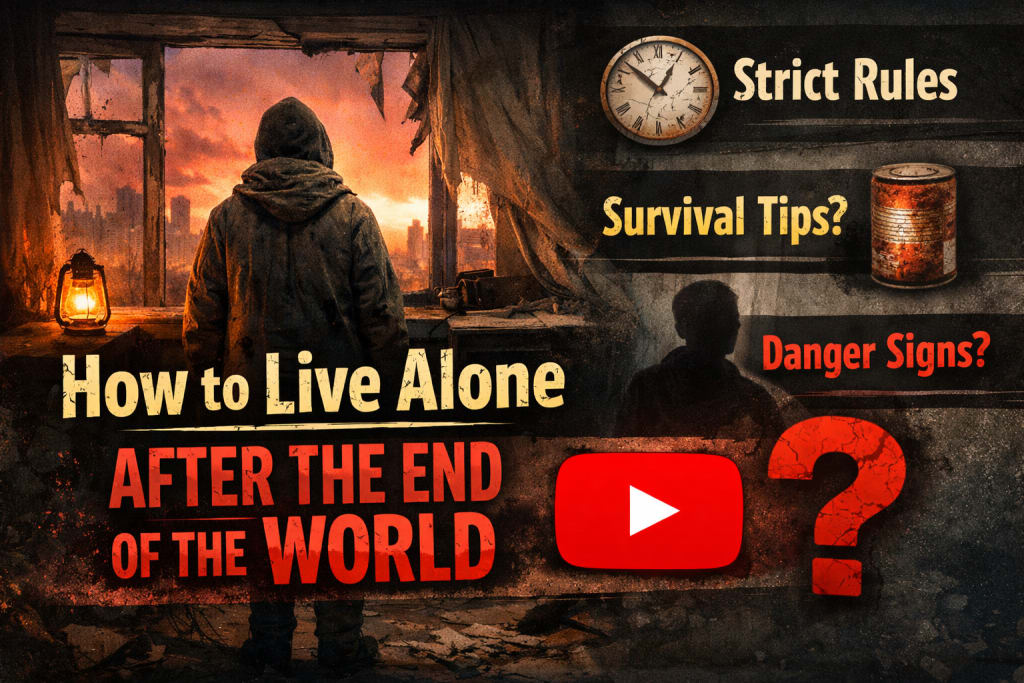
The Psychology of Living Alone After Everything.
A simple guide
Before You Start
Any person who wakes up and finds himself alone should refer to this guide.
Unless you are alone, put aside reading.
In case you believe you are not the only one, read more attentively.
You may feel scared. Or empty. Or calm in a strange way. That is normal.
It is not a book of emotions.
It is about steps.
Steps keep you moving.
Stopping is risky.
Step 1: Wake Up Each Morning at the same time.
Pick a time and stick to it.
It does not matter what time. Morning is better.
Do not stay in bed. Spending too much time lying makes your thoughts even more vocal. Memories come as a result of loud thoughts. Memories can hurt you.
say your name aloud as you get on your feet.
Listening to it makes you remember who you are.
You may need that later.
Step 2: Have a Quick Glance and Enumerate what you see.
Start with simple things.
Count:
- Doors
- Windows
- Chairs
- Rooms
Say the numbers out loud.
Sound makes things feel real.
Do not look at photos yet.
Do not read notes left behind.
Do not open boxes that are marked important.
Those things can wait.
Waiting keeps you safe.
Step 3: Padlock the Sleeping quarters.
Lock all doors.
Even if no one is coming.
Close the curtains at night. Darkness belongs outside.
When there is knocking, be not in a hurry.
One knock is nothing.
Two knocks can be chance.
Three knocks mean memory.
Do not open the door to memory.
Step 4: Learn the New Sounds
The world is silent now but it makes noise.
- Listen and learn the sounds:
- The hum of machines
- Water moving in pipes
- Your own footsteps
How you breathe when you forget to breathe slowly.
List the sounds in your mind.
In case you laugh, do not mind.
When you call my name, and see whether you moved your mouth.
Step 5: Eat on Purpose
Take meals at the same time each day.
Do not wait till you are hungry. Hunger lies.
Use small plates. There is no one else to feed.
Do not cook your favourite foods. It is the smell of old things that will drag you back.
Dine to live, not to be merry.
This is later in case you find food to save later.
Take your time while eating. Food is limited now.
Step 6: Be Careful with Talking
Speaking assists in remembering words.
You can be too talkative and you anticipate responses.
And say not, say only what thou dost:
"I am boiling water."
"I am locking the door."
"I am still here."
Do not ask questions out loud.
Questions encourage answers which might not be actual.
Step 7: Do One Thing Each Day
Pick one task. Only one.
For example:
- Sweep the floor
- Fix a crack
- Carry water
Organize books that nobody will read.
When you finish, stop.
It is natural to feel useless after that.
That kind of feeling translates to you having done enough.
Step 8: Be Careful with Writing
Writing keeps things alive.
That can be dangerous.
If you write, do not use dates. Dates suggest the future.
Do not write feelings. The emotions increase when you nourish them.
Write instructions only.
There are no requests to feel comfortable.
Step 9: Be Careful of Old Things.
Others were attached to individuals whom you adored.
Hold them in your hand at the most not longer than ten seconds.
Notice:
- How heavy they are
- How cold or warm they feel
Put them back where they were.
Do not smell them.
The scent bypasses the mind and goes to the heart.
When you drop something put it back up immediately.
Objects on floor seem abandoned.
Forgotten things feel angry.
Step 10: Go Out Only when you need to.
The sky still looks normal. That is the hardest part.
Wear layers. Feeling covered helps.
Do not look in the windows or in water. Reflections sometimes lie.
In case of footprints, make sure that they are yours.
If they are not, leave.
Do not follow them.
Step 11: Learn the Difference between Waiting and Silence.
Nothing exists where there is no sound.
Waiting is as though something is breathing in.
If you feel watched, sit down.
Inanimate objects are less interesting.
Step 12: Do Not Rehearse Interviews.
You can guess what you were going to say in case of a return.
Do not do this.
Ready-made phrases are disintegrated.
The person will not be the one you envisaged in case one goes back.
You will not be either.
Step 13: Sleep Anyway
Sleep is not giving up.
Pick a corner. Corners feel safer.
It is alright, in case you dream about people.
Cleaning old rooms your mind.
Step 14: Be aware of the Price of Error.
Mistakes include:
- Calling out
- Leaving lights on
- Saving the last good thing
- Thinking in the mansion of the footsteps.
- Forgetting your name
Where you mind your name, take another one.
The abbreviated names are simpler to retain.
Step 15: This Guide may not be So Easy to You.
Some person may be reading this as well.
When you hear pages being turned which do not belong to you, stop.
Do not look up.
Step 16: The Last Step (Read Once)
In case a real person, not a memory, not a shadow, not a voice, should come forth:
- Breathe.
- Say your name.
- Ask their name.
- Believe them.
This is the most perilous step.
You cannot depend on this guide after this.
Why This Guide Exists
Once, there were many people.
They gave advice freely. They described things which did not need description.
The reason to write this guide was that someone did not follow the steps previously.
Someone stayed in bed.
Someone opened the door.
Someone trusted silence.
Someone loved the wrong way.
You have not yet made such mistakes, so, reading this, you are not doing it.
Follow the steps.
Keep going.
And when you are quite certain that you are alone--you are quite certain--shut this guide and tell it all.
Such assurance implies that it is irrelevant.
About the Creator
Edward Smith
I can write on ANYTHING & EVERYTHING from fictional stories,Health,Relationship etc. Need my service, email [email protected] to YOUTUBE Channels https://tinyurl.com/3xy9a7w3 and my Relationship https://tinyurl.com/28kpen3k
Keep reading
More stories from Edward Smith and writers in Fiction and other communities.
Lightning Never Strikes Twice
The distant rumble, the sudden deluge, the crescendo of sound, the flash of light, the explosive energy — it never gets old. I became an amateur storm chaser about two years ago. My wife, Cindy suggested it. Sort of. She said, "Alex, you know this cancer is killing me. I've come to terms with that, but you're smothering me. Go join a band, write a book, or become a storm chaser, for all I care. I love you, but you need a hobby."
By Julie Lacksonen7 days ago in Fiction
REEEEEEEEE!
I'm on a low road right now. There are a literal million things to do and not one of them worth my time. I would rather sit in place and burn but the orbit takes me on its inevitable route 'round the center; and I a center in my own right, around which others orbit, and so on and so forth, ad infinitum, ad nauseum.
By C. Rommial Butler4 days ago in Poets


Comments
There are no comments for this story
Be the first to respond and start the conversation.