

Jacob squinted at the blue EXIT 13 sign ahead and then flicked up his blinker when he spotted the little lightning bolt at the bottom of the steel sheet above the highway.
Once the car had shifted onto the exit ramp, Jacob was welcomed with bright blue and orange lights glowing in the middle of the vast desert.
The vehicle slowed down, pulled into a lot, and stopped over a set of blinking yellow lights that indicated that the induction plate was vacant and ready to charge. Jacob had cut it close - the car had informed him there were twenty miles of juice left before it would pull off to the side of the highway and signal a charging truck to be called to its location. This was not ideal, as the wait times for the truck generally exceeded a couple of hours, and the charging process was several times slower than the plates at the Maxwell stations.
Instead, when the car was parked over an induction plate, charging usually took around forty-five minutes. The process was simple, although the technology had taken several years to be installed in stations across the country.
After letting a sigh of relief escape his lungs, Jacob opened the driver’s side door and watched the blinking lights blend into a slow red pulse. The desert air scorched his skin, but the sun was starting to melt over the horizon, promising the relief of night in south Nevada.
A towering steel post rose from the dirt, wearing the letters “TERMINAL E” in large white font.
Induction charging terminals, dubbed ICTs, were propagating eastward, although Maxwell Motor Vehicles still sold most of their cars in the western part of the country, where their charging stations also greatly outnumbered those in the east. The Maxwell charging stations contained multiple terminals, including at least a couple specific to autonomous trucks of their own design.
Food chains, grocery stores, casinos, and other entertainment outlets had been swift to partner with Maxwell’s EV charging stations, and the company had purchased large plots of land around their stations to accommodate these businesses, resulting in small towns blossoming in otherwise desolate areas.
This particular patch of desert land had claimed the name Hevel, and it appeared that it was an oasis for gamblers as well as Maxwell vehicle owners.
A chain restaurant by the name of Electroplate commonly neighbored the ICTs, where vegan burgers and bland salads with ingredients sourced from vertical farms in metropolitan areas were served by employees in electric blue t-shirts. Jacob had been traveling for a while, and this was to be the antidote for his growling stomach.
The door opened automatically when Jacob was almost close enough to touch the glass and when he stepped inside, a blast of the building’s air conditioning relieved him from the harsh desert climate.
The booths mimicked the design of the charging terminal: occupated booths took on a red glow, while the yellow booths invited diners to sit down. Jacob found a seat at one of the booths closest to the windows pointing towards Terminal E, where his brand new Maxwell Ampere was absorbing power generated by the induction pad. The booth came to life as the yellow glow faded to red and the table itself became an interactive menu on an eggshell white screen. Current diner favorites were highlighted near the top of the menu, with graphs representing items that were in demand. At the time of Jacob’s arrival, the most popular item appeared to be the portobello mushroom burger.
The ordering process was completed on the table’s interface, where Jacob gently pressed the screen a few times to order a tuna burger on a whole wheat bun. Once he tapped the PLACE ORDER button, he exhaled deeply and leaned up against the leather booth cushion behind him, letting his eyelids float down over his eyes.
“Excuse me sir, can I sit here?”
Jacob sprang his skull from against the leather surface and jerked his head to the left and right. However, the source of the voice was from behind, staring at him with large blue eyes sagging over sharp cheekbones.
A tall, slender man with a wiry beard stood awkwardly with his hands firmly planted in his front jean pockets.
Jacob scanned the diner - there were several available tables, glowing yellow to indicate their vacancy.
“Uh, sure. Want something to eat?” Jacob tapped the table, awakening it from its black slumber. He wasn’t exactly sure why he had offered to buy this stranger a meal; he didn’t consider himself a particularly generous man, or a sociable one either. However, he had lacked human interaction the past few days, and he supposed he could use a little conversation.
The blue eyes glowed, and their intensity caused Jacob’s stomach to give a small lurch.
The strange man spoke with a deep, gravelly voice. “Thank you, sir! Well, if you don’t mind, I’ll get one of what you’re havin’.” He sat down and extended five bony fingers for Jacob to grab. Once Jacob had gently gripped the spindly hand, the man spoke again. “You can call me Sol. And you?”
“Oh, uh, Jacob. Pleasure.” His tone didn’t convey pleasure, but he made a mental note to sound more friendly for the duration of their dining experience. Sol released Jacob’s hand and offered a thin smile without showing his teeth.
“It’s wonderful to meet you. I like to make new friends. The world we live in, it’s a lonely one.” Jacob replied while quickly ordering another burger for the table. “Well, I’m happy to be of assistance, Sol. I don’t really meet a whole lot of strangers either.”
The man didn’t reply to this statement, so Jacob continued with a question.
“Where are you from?”
“Not far from here. About twenty miles west. My father, and his before him, and his daddy’s granddad. We’ve been here a very long time.”
“Well, I’m a bit of an outsider. From St. Louis. Been traveling a couple of days now.”
“Why you been on the road so long? You ain’t got a family and kids, or a dog or somethin’?”
Jacob was a little surprised by the second question, to which he fumbled for words.
“Uh, I have a dog back home, but my sister takes him when I’m on the road. Just here passin’ by for work.”
“What does it all mean, Jacob?”
He certainly wasn’t ready for this question; Jacob bit down on his gums and wondered if he wanted to know where this conversation was headed. “Not sure what you’re referring to Sol.” His voice had slipped back into a jagged tone.
“What does a man gain from his toil? And, more importantly, what does the world gain from the work of man?”
Jacob squinted an eye curiously. “From his toil? Well, I, uh, suppose that men… well some people need to feed their families.”
“But for what? So that they may in turn breed another generation to create, and innovate, and procreate?”
Jacob decided to leave this questioned unanswered, and his silence provided an opportunity for Sol to continue. “Man’s eyes are not satisfied with seein’, nor his ears satisfied with hearin’.”
Jacob really didn’t know how to respond to this, but he was saved from doing so when the tuna burgers were delivered by a bushy-haired young man who gave a polite nod as he set the two trays on the table between Sol and Jacob.
“Ah, the truest blessin’. Food from the earth. Will you pray with me, Jacob?”
Jacob, who didn’t consider himself to be much of a religious man, closed his eyes and bowed his head as Sol started praying. Sol thanked God for the food and companionship, asked for safe travels over Jacob, and then suddenly stopped talking. Jacob opened his left eye a bit, and noticed that Sol’s eyes remained closed. The thought of sneaking off danced in his mind for a couple of moments, but instead Jacob finished the prayer. “Father, thank you for feeding us with this food from the earth, and for sustaining us through our travels. Amen.”
“Amen. Let’s see how tuna tastes in the desert, it’s somethin’ I’ve never experienced before.”
There were a few moments of silence, during which the two men tore pieces of tuna from their sandwiches.
“Let me ask you this, Jacob. This new technology, these self-drivin’ cars, these induction chargin’ stations, these fancy casino lights - what do they all bring to mankind?”
This was something that Jacob had a response for. “Well, uh, electric cars are a sustainable solution for travel so that we aren’t, you know, hurting the earth more than we should I suppose.”
“And that’s good, Jacob. That’s good - we ought to look out for our brethren and for the wellbein’ of what God has given to man. But I’m not sure you’re gettin’ the root of what I’m sayin’. These aren’t questions for scientists, or preachers, or billionaires who profit on makin’ people’s lives a little easier. These aren’t questions I like to ask myself a whole bunch. These are things I’m askin’ you as a man - one who seems to see a lot of road and not a whole lot of, uh, human affection. Excuse me for sayin’ so.”
Jacob was a little insulted, but had no counterargument, so Sol continued.
“Is it in our nature to preserve our species? Or to seek out our own pleasures? Or to gain without any sort of end in sight? What I’m askin’ is, why do we do the things that we do, and what are we lookin’ for when we do ‘em? The rich die lonesome, and the poor die poor.”
“I guess, uh, all we can do is live life to the, uh, fullest.”
Sol seemed to respect his response, but followed up with some words of his own.
“But what is pleasure, and what is the end to which it leads? The things we want the most hurt us the worst. Our desires tend to fail us time and time again, that’s somethin’ I’ve learned over the years.”
“Well, I guess we can leave a legacy behind, so that we are remembered once we’re gone.”
“After our time, we’ll be in the ground, just like the rich, the poor, the slaves, the kings and their father’s mamas. We come from the dust, and we’ll go back to it sooner or later as well. And if you want to talk about how much better life is for us now than it was for the past generations, well, our time on earth brings a type of loneliness, that those folks knew nothin’ about.”
Jacob sipped on his water, letting Sol’s statements settle. Sol broke the silence with another question - this time it was one that Jacob felt confident answering.
“What do you do for work, Jacob?” As he asked the question, he appeared to be looking out into the charcoal desert sky.
“Well, I’m a salesman. I sell semiconductors in bulk to manufactures.”
“Sure, salesman, engineer, doctor, musician, we create, we sell, we multiply. But isn’t it all meaningless? What has been is what will be, and what has been done is what will be done.”
“Well I, uh, enjoy my work.”
Sol broke his stare from the window and gave an approving look to Jacob. “Now that is a good thing, Jacob. That is a very good thing. What can we do, apart from enjoyin’ our food, and the breath in our lungs, and the bitterness and rewards of our toil?”
Jacob was startled when Sol stood up from his side of the table, and reached out his hand. When Jacob took it with a firm grasp, Sol spoke to him again for the last time. “God bless you son. I know he has, and I know he’ll continue to do so.”
Jacob sat at the booth for a few minutes longer, and then walked out into the black desert night. There was dust kicked up from the winds blowing through the little town, but the green glow in the distance guided him back to his car.
About the Creator
Keep reading
More stories from Bklyn Stories and writers in Fiction and other communities.
Bros and Bulls
Johnny was frequently asked by potential employers, friends, and strangers about his sudden career shift in his mid-twenties. To this question, he usually just smiled and politely answered that he was making too much money at his old job. However, the more complex story of his decision to leave his home state of New York and move west was not one he shared with more than a few eager ears.
By Bklyn Stories4 years ago in Fiction
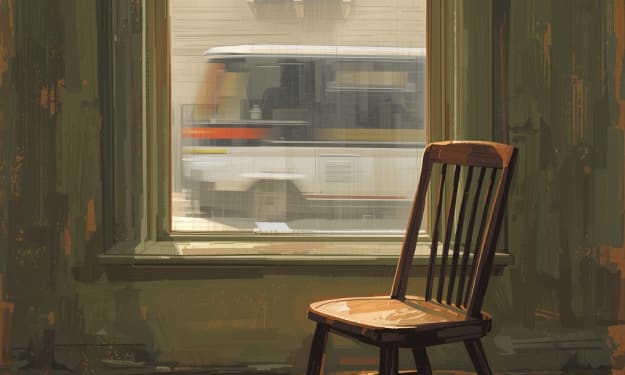
The Chair by the Window That No One Sits On Anymore
The chair is still there, facing the window, exactly where it has always been. Dust gathers on it now, quietly, patiently, like it knows no one is coming back to claim it. Some absences do not leave empty rooms. They leave furniture behind.
By Salman Writesa day ago in Fiction



Comments
There are no comments for this story
Be the first to respond and start the conversation.