
HERO
An abyss reflects not on what material fills it.
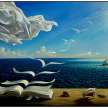

The castle beckoned. Lonely and bleak, slimy gray walls mocking Him, it stood. The Hero gazed from his perch across the abyssal waters at his target. There was but one flimsy bridge that connected the island of which the castle stood atop to the greater landmass where He stood. Huddled inside the deepest keep of the castle was not a man, but an idea. An idea masked behind altruism and a strife for the “greater good;” an idea that called for the subjective moral disposition of the few to command the actions of all. Are there those among the order of man that would benefit from a sense of moral authority? Without doubt the answer to such a proposition would be in the affirmative. However, the Hero had yet exercised his natural intellectual freedom as a man enough to recognize when a tyrannical imposition was on the horizon, and had authored a personal conception of self-realization that allowed for the direct control of his animalistic passions. He was a balanced human. His sense of man brought him from his family and his home to this castle; the beast inside is what will allow him to turn his principles into action.
OF COURSE ideas, especially the darkest ones, can only live in the minds of free creatures. In current scientific literature, the only creature that has freed itself from the constraints of primal behavior has been MANKIND; so the idea inside the keep was, indeed, contained inside the mind of a man. The Hero was unconcerned with the connection that this idea had with man – this idea was not a shadow of a primal past, something that was connected with man, something that few had the courage and passion to accept and control in their personal lives, something that had to be meticulously tempered. This idea was a disease, a disease that would rip each and every lesser man it touched in half were it to continue to fester.
The Man whose mind contained the idea in question had been born an orphan. He was a cunning and marvelously intellectual individual – noticeably lacking, however, in personal conviction, perhaps due to his lack of early moral example. The Man’s entire existence revolved around his own perception of how others perceived him. His being born an orphan had exposed him, at an admittedly young age, to the horrors of those individuals of humankind that had submitted themselves to their basest desires. Whilst living without parental guidance, he had seen the murder, rape, and torture of his fellow man; these experiences instilled a fear inside of him that he had not the intellectual capacity nor passion for freedom to escape from. As he grew older, the Man, cunning as he was, saw that the clearest path to ensure that none of what he had seen previously would be allowed outside the darkest corners of mankind’s existence was through the installation of a universal regulation of social conduct. None who had seen what He saw would ever be opposed to the annihilation of the acts he had witnessed; it was the knowledge of natural instinct of man that allowed his diseased, fear-riddled mind to corrupt first itself, and then the society around it.
RELIGIOUS AUTHORITY was the chariot upon which the Man rode his fears into the gates of man’s souls. “THE ONLY WAY TO ESCAPE THE HORRORS OF MANKINDS BEASTLY BEHAVIORS,” he would exclaim, “IS THROUGH THE ANNIHILATION OF THE PART OF MAN THAT ALLOWS SUCH BEASTLY BEHAVIOR TO SEEP ITS WAY FROM THE PRIMAL ABYSS TO REALISTIC ACTION.” Intellect, as useful as such a thing is, directly allowed the Man to abuse the fears of lesser men and pave his way from orphan boy to the height of religiously motivated political power in the realm. It was the third of his famous (infamous to some freer men) “Three Dictates” that propelled him to his position.
His three dictates as Pater Summum were as follows:
1. Every man of the realm above the age of 16 was to be injected with state-regulated hormonal inhibitors upon each birthday; such an act would ensure that the passions of man would never allow themselves to grow too extreme and corrupt the actions of “free” men.
2. Each and every family within the realm was to be given monthly rations of state-instituted foodstuffs. These food items were carefully selected to be as satisfying in the short-term as they were detrimental to the long-term health of any human who consumed them. (Of course, free food is free food to the lesser intellect, and as such long-term detriment was handily ignored.)
3. Every man was now free from the burden of personalizing his own moral convictions, for the government had now completed that task for them! The government provided a set of social rules and regulations for every man and his family, and as long as they abided by such rules, they were granted patronage and Fatherhood under the supreme authority of the Governing Leaders. The economic and political burden of free men had been lifted – rejoice under the yoke of your Governors!
Some say mankind is weak and cowardly by nature. Some say man is bold and brave by nature, with the cowardly simply being those who oppose nature. The institution of the Man to Pater Summum proved neither of these beliefs true; it is in fact the ignorant man who rules all. Men think little of how their rights as not just free citizens but free men are inhibited when they are fed for free and guided in a universally communal setting. Humans love to walk out of their home every morning and think that their tribe (humanity) accepts them, with little thought to their status as liberated minds in the grander scheme of the animal kingdom. It is intoxicating and contenting to believe that one is accepted; it is scary and unenjoyable to contemplate the ways in which one is intellectually shackled.
It is by these precepts that the realm of the Hero was enslaved. It was not by the base primal desires of his ape antecedents, not by the foreign barbarians of his human ancestors, but by the ignorance of his fellow man that his civilization was put in chains. The Hero remembered how it began – royal armored authorities began parading around the towns in the name of “humanity,” declaring the tenets of the new Pater Summum to be exclusively for the good of Mankind and requested that each individual be a “good human” and accept these rules to “save lives and minds.” Of course, to a learned man like our Hero, it was a foregone conclusion that these requests would soon turn to orders. Those men who were obsessed with their own perception of how others might perceive them were too frightened to be perceived as an “antagonist” in the eyes of the public, or their “tribe.” They succumbed just as quickly, but perhaps with more thought, than the passionless and idiotic amongst the order of men. Without any orderly authority of their own, the archetypal Fatherly role in their psyche which was previously empty was handily and without question filled by the “order” that the new Governing body provided. An abyss reflects not on whether the mass that filled it was corrupted by tyranny or not.
About the Creator
James Cummings
Improvisation is the truest form of artistic freedom
Keep reading
More stories from James Cummings and writers in Fiction and other communities.
Man v Beast
The ridges surrounding the open mouth of the cave dripped with last night’s rainfall. The smoky embers of yesterday’s fire thickened the air. The soft whimpers of my Daughter complimented the drip of the water, muffled only by the gentle hand of my Wife. I stood about midway between my Family and the beast, a distance of mere yards between the creature and my Family.
By James Cummings3 years ago in Fiction
Kitten's Kitchen. Part 3. A dumpling masterclass with Chef Whiskers
Summer passed, and the first cool winds announced the coming of autumn. In the little cottage beneath the lilac bush, everything grew even cozier: the stove crackled in the evenings, bundles of dried herbs hung in the pantry, and jars of preserves stood neatly upon the shelves. Dear Grandmother more and more often allowed her furry pupils to work on their own, for she knew that true skill is strengthened through practice.
By Ludmila Pachadgi7 days ago in Fiction


Comments
There are no comments for this story
Be the first to respond and start the conversation.