
He Died in 1998—But He Just Liked My Post
Sometimes, the dead find new ways to say goodbye.

He Died in 1998—But He Just Liked My Post
Sometimes, the dead find new ways to say goodbye.
It was a little after midnight when my phone buzzed.
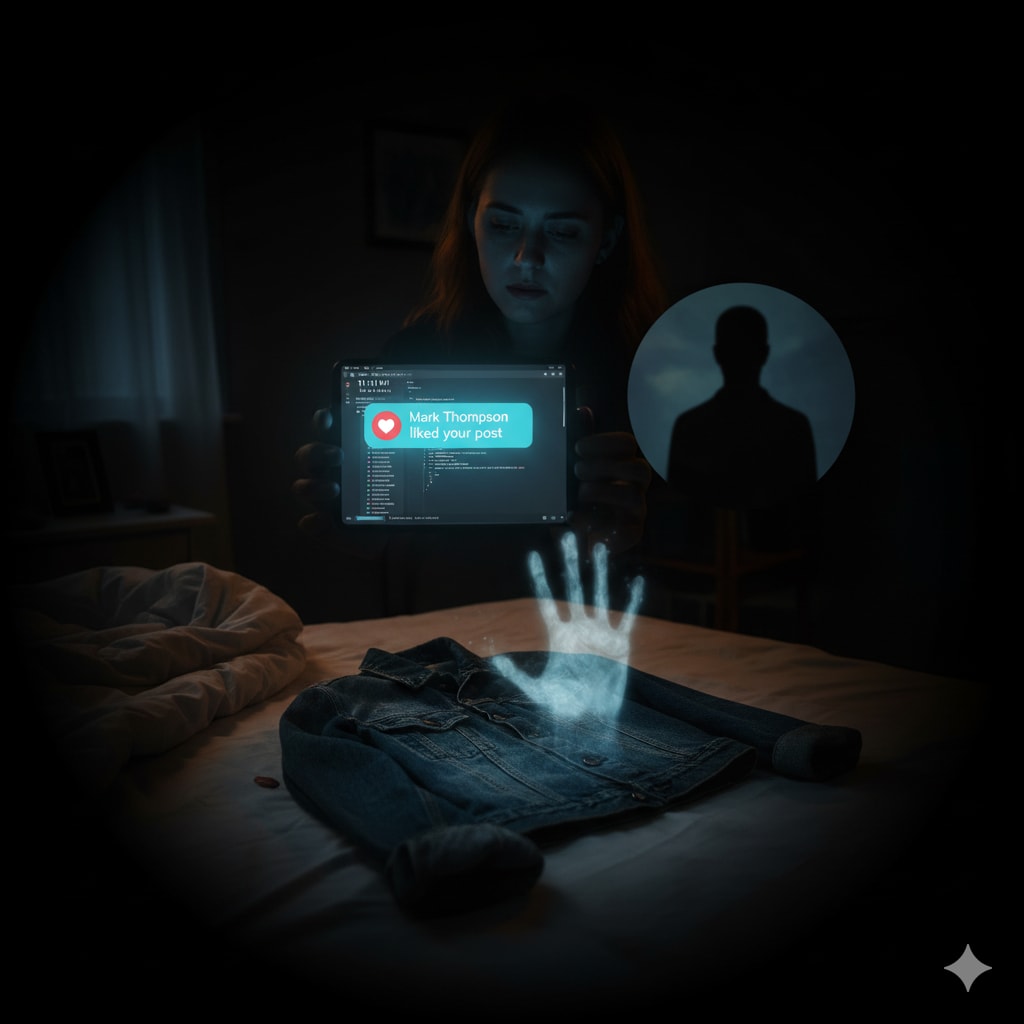
I was half-asleep, scrolling aimlessly through photos from a weekend hike, when the notification flashed across my screen:
“Mark Thompson liked your photo.”
At first, I thought it was a mistake. I blinked twice, rubbed my eyes, and looked again.
There it was — his name, his profile picture, and the tiny red heart beside my most recent post.
For a long, silent moment, my mind refused to connect the impossible dots.
Mark Thompson had died in 1998.
1. The Like
Mark was my first love — or as close as anyone at seventeen can come to understanding love. We met in the art room during senior year, bonded over sketchbooks and late-night phone calls on landlines. He was funny, reckless, and always made everything feel cinematic. When he died in a car crash that spring, the world didn’t just lose a person; it lost its color.
For months, I heard phantom footsteps on the porch, half expecting him to show up, smiling, saying it was all a prank. But grief eventually dulls — not because it disappears, but because you learn to live with the echo.
Years later, I joined Facebook, like everyone else. Back then, social media felt like magic — a place where you could find old classmates and share pieces of your new life. I even made a small memorial page for Mark, uploading scanned photos and stories so his friends could visit whenever they wanted.
That page had been deleted around 2010 when Facebook changed its settings. I never recreated it.
So when his name appeared again — the same photo we used in his yearbook, the same smile I’d tried to forget — I thought maybe someone had recreated the memorial page. But this wasn’t that.
This was a personal account. Active. With posts.
2. The Profile
I clicked his name with trembling fingers.
The profile loaded slowly, as if the internet itself didn’t want to reveal it.
The first thing I noticed was the banner photo — a faded shot of a lake we used to visit just outside town. It was taken from the exact angle of a picture he’d taken in 1997. The same time of year. Same streak of sunset. But this one was clearer — modern — like it had been taken last week.
Then I scrolled down.
There were posts dated just a few days ago.
“Still here.”
“Some memories never fade.”
“The past is closer than you think.”
Each line was cryptic, like fragments of thought whispered into the void. There were comments too, from random accounts — “Glad you’re back!” and “Man, long time no see!” — though none of those accounts had more than a few photos or friends. They looked… fake. Generated.
And then there was one photo that made my breath catch: me and Mark, together at senior prom, my dress the same blue I’d sworn never to wear again. The photo had been uploaded two days ago.
I hadn’t posted that picture in decades.
My hands shook as I scrolled faster. Then I saw a message notification pop up at the bottom of my screen.
“Mark Thompson sent you a message.”
3. The Message
For a minute, I just stared at the screen, heart hammering.
I opened it. The message was short:
“You still have the jacket.”
I dropped my phone onto the bed like it had burned me.
He meant the denim jacket he used to wear everywhere — the one he left in my car the week before he died. It had become my secret relic, tucked away in the back of my closet in a garment bag, untouched for years. No one knew I’d kept it. Not my parents, not my husband, not anyone.
I picked up the phone again.
Me: “Who is this?”
Three dots appeared. Then disappeared. Then reappeared again.
“Goodbye.”
And then the chat vanished.
The profile was gone — deleted, wiped clean, like it had never existed. My notification disappeared too. Even the message thread was blank, a digital ghost erased mid-breath.
4. The Jacket
That night, I couldn’t sleep. The air felt heavy, like the walls themselves were holding their breath.
At 3 a.m., I got up and went to the closet.
The jacket was still there — folded neatly in its bag, just as I’d left it. But as I unzipped the cover, a faint, familiar scent escaped — that old cologne he used to wear, mixed with the faint musk of worn denim.
It shouldn’t have smelled like anything after twenty-seven years.
I sat on the floor, the jacket in my lap, running my fingers over the seams. My mind fought for rational answers — maybe an AI bot scraping old data, maybe a hacker recreating profiles from public archives. But deep down, I knew something about it didn’t fit. The picture, the words, the timing.
It wasn’t random. It was personal.
And it felt… final.
5. The Investigation
By morning, I convinced myself to treat it logically. I worked in tech support — I knew how easy it was to fake an account, to copy a photo, to trick an algorithm. So I started digging.
I searched his name again. No results. I searched image databases for the profile photo. Nothing. Even the photo of the lake — the one I thought might be a recent upload — was missing from Google Maps and any tagged posts.
But I did find one odd thing. In an old Facebook memory from 2009, where I’d tagged the original memorial page, there was now a broken link. And when I hovered over it, the preview text read:
“He’s not gone.”
The line wasn’t part of the post. I hadn’t written it. It wasn’t in the comments either. It was like the system itself had inserted it.
6. The Call
That afternoon, I drove to see Lisa — Mark’s sister. We hadn’t spoken in years, but she opened the door like no time had passed.
Over tea, I told her everything. The notification, the messages, the profile that vanished.
Her face drained of color.
“I got one too,” she whispered.
She pulled out her phone and showed me a screenshot. It was from two nights before mine. A message request, same account:
“Don’t forget the lake.”
Lisa’s hands trembled as she scrolled to another photo. It was the lake again — but taken that morning. She swore she hadn’t been there.
We sat in silence, the air buzzing with something unspoken.
“I had a dream about him last week,” she said finally. “He was standing at the lake, wearing that jacket. Yours.”
7. The Return
That night, I drove out there.
The road was empty, the sky bruised purple with clouds. The lake looked exactly as it had decades ago, still and silver beneath the moonlight. I parked by the edge, got out, and wrapped the denim jacket around my shoulders.
For a moment, I felt seventeen again — cold air in my lungs, the smell of pine, the distant hum of crickets.
I whispered into the stillness, “Mark?”
No answer.
But then — a ripple on the water. Just one.
And in that brief shimmer, reflected in the surface, I saw something that made my heart stop.
A figure — faint, familiar — standing beside me in the reflection, smiling softly. The same smile from the photo. The same eyes.
I turned.
No one.
When I looked back, the ripple was gone.
But on the shore, where the water had reached, something small glinted under the moonlight.
A metal button.
From a denim jacket.
8. The Goodbye
I kept the button. It sits now on my nightstand, cool and real in a world that rarely feels either.
The next morning, the jacket’s pocket was unzipped — I’m certain I’d closed it before. Inside was a folded scrap of paper, yellowed and soft. I unfolded it with shaking hands.
Two words were written in his handwriting:
“Thank you.”
That was it. No explanation, no message, no more notifications after that night.
Just silence.
9. The Echo
It’s been six months since it happened. I’ve stopped trying to rationalize it. Sometimes I still check my notifications at midnight, half-hoping to see that name again — half-dreading it.
Maybe someone hacked an old memorial, or maybe technology really does store more than data — maybe it keeps pieces of us, echoes that know when we’re ready to listen.
Or maybe, after twenty-seven years, Mark simply found his way home long enough to say goodbye.
Because sometimes, grief isn’t about letting go. It’s about learning to hear the voices that never truly left.
And sometimes, the dead find new ways to remind us they were never really gone.
About the Creator
Muhammad Ilyas
Writer of words, seeker of stories. Here to share moments that matter and spark a little light along the way.
Keep reading
More stories from Muhammad Ilyas and writers in Fiction and other communities.
The Day I Stopped Chasing People Who Didn’t Want Me.
Her name was Lena. She was sunlight on a bad day — warm when she wanted to be, distant when she didn’t. I met her at a friend’s party, where she smiled at me like she already knew I’d fall for her. And I did. Instantly, helplessly.
By Muhammad Ilyas5 months ago in Fiction
Bomb Scare
It was 2027, and the world never thought it would happen. A missle hit the United States, but it wasn't where they had anticipated. A little town in the northeast was hit by a missile strike, they didn't know why, and they didn't know exactly where it hit, but they did know it was a coastal community, somewhere between Maine and Delaware.
By Gregory Payton7 days ago in Fiction
Talking Through the Grapevine
Theseus sighed as he picked up a stone and threw it into the ocean. Usually, he would be able to make it skip for at least ten times, even if he was having a bad day. But whether it was because he was sitting on the sand or he just didn’t care, the stone sank with a single plop a half mile away.
By Rebecca Pattonabout 2 hours ago in Fiction
Worth the Wait: Puerto Viejo, Costa Rica
Beach bumming in a small Caribbean beach town sounded like a perfect way to end our 6-month trip through Mexico and Central America. Or so we thought. The foul, fishy stench of rotten seaweed hit our nostrils as we stepped from the cramped bus and looked out at a rather depressing, empty, and underwhelming black sand beach. It was pouring with rain, and we had to quickly fish out our ponchos. We thought, this couldn’t be it, could it?
By Sh*t Happens - Lost Girl Travel6 days ago in Wander



Comments
There are no comments for this story
Be the first to respond and start the conversation.