
Half-Death: Part 1 - On the Eve of Mortis
On the eve of the season in which everything rots, a clever assassin tries cheat Death himself

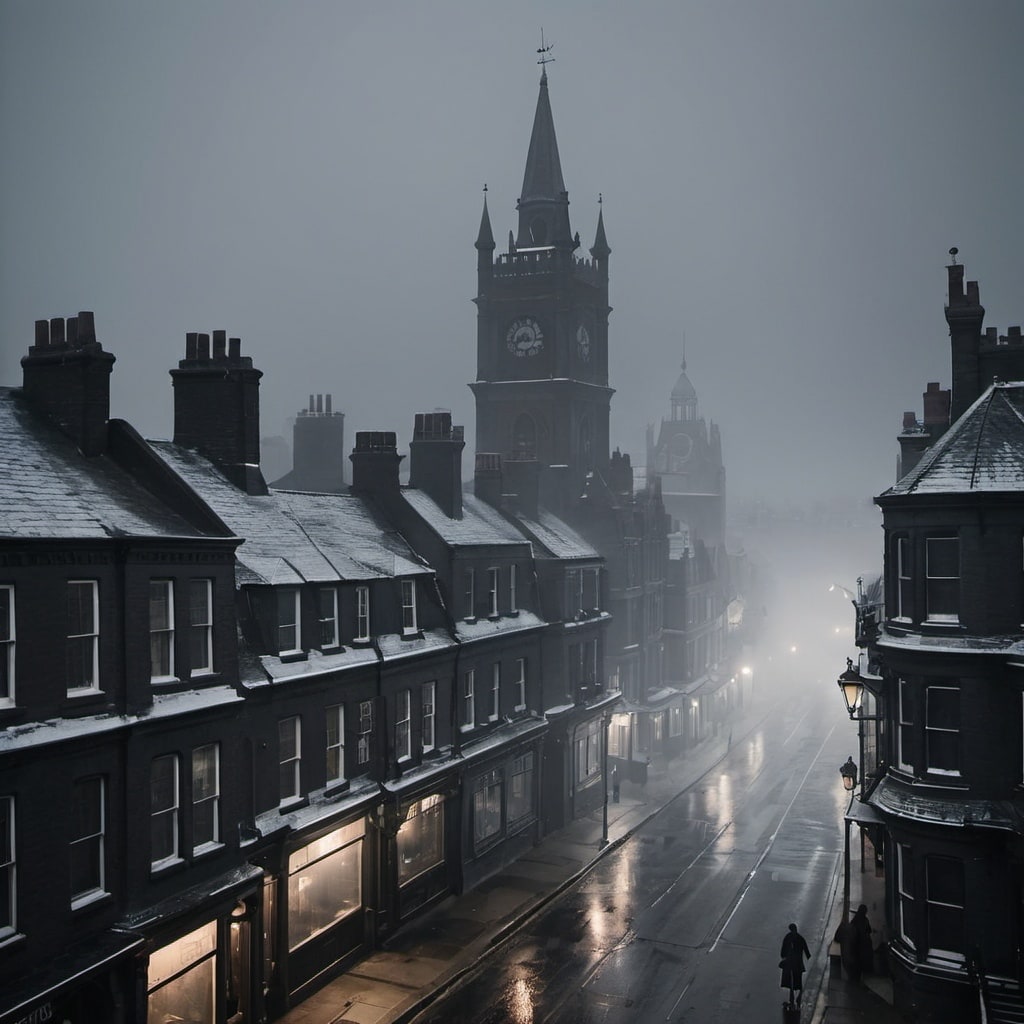
Lurid, Death thought, This one is imaginative.
Death stood over a victim— middle-aged, of modest suit, to match modest income. He had done nothing wrong, or at least nothing more than the average man could be expected to, and yet, here he lay— strangled to death, with white rose petals sprinkled over him: a signature.
Death knelt down on the frost-licked cobblestone, revealing a finger of bone from beneath his sable robe. He touched the lip of the deceased man, and in the moisture, Death gained comprehensive knowledge of the man’s entire life— his thoughts, his dreams, his darkest secrets.
Mr. Reginold Barnaby, Death noted, Husband. Father. Shoemaker. Christian.
Death was searching for a specific piece of information.
Ah, he lamented, killed before his time. Death rose from the body, his great scythe materializing in his hand as he did so. Beneath the shrouded shawl, a vengefulness grew in him. Death did not enjoy being cheated.
The city was aware of Death, not only the ailment, but its personification as well. Organized groups of assassins, serial murderers, and one-time killers of passionate heart— all had met their fair end at the hand of Death. He was the law in this regard. The people of the city understood this, and murder had become a rare crime because of it.
Death kept records on all living beings under his domain, and in the fluids of the recently deceased, he observed their fates on a temporal scale— which he envisioned as an hourglass, hovering over the bodies of the slain. The top of the hourglass filled at birth, and emptied at the allotted time of death. The sands in Mr. Barnaby’s hourglass, however, had not yet been fully spent.
Had his death been accidental— or by some illness of the human experience such as typhoid, suicide, or war— the hourglass of fate would have proved empty, and Death would have been satisfied. This, however, was a murder. This was a transgression against the natural order, which Death maintained.
The city was Colloch. The season was Mortis. It would be the latter half of Winter in a realm such as yours.
In this realm, the seasons were eight, rather than four. Each of the four seasons familiar to you, were instead allocated into two, one mild and one extreme. From June to September, for example, there was Simmer and Swelt, a warm and lively stint, followed by a dry, deadly heat. From September to December, there was Greenpass and Redden, in which the leaves became vividly green and yellow, before blushing scarlet and falling recklessly into the rushing winds below. After December, and continuing on to March, there were Sleece and Mortis. Sleece brought the cold harshness and snowfall indicative of Winter (as you would know it). However, Mortis was something different entirely. The trees did not simply fall leafless, but dead. Their wood became gnarled and twisted and their sap spoiled. Snow did not fall, but a grey frost floated in the air, overtaking every surface with a thin, chilling veneer as it crept. The sun disappeared in a dense, charcoal fog which concealed the sky completely. The temperature remained eerily still at the exact point of freezing during the day, then rose to a humid swelter in the night, optimal for decomposers and bacteria to come alive and feed on the spoils of the old and weak, who could no longer combat the days’ austerity.
It was January now, and Mortis was beginning.
This was the busy season for Death. He would now descend with much more frequency, to help the men and women of Colloch pass to their decided afterlives— and he would begin with Mr. Barnaby.
He hovered his scythe over the carcass, drawing Mr. Barnaby’s soul. A translucent visage of the man rose from it, and at the sight of Death, it was startled.
“Mr. Barnaby,” Death said in a shockingly warm and soothing tone, “Unfortunately, you have now passed from life. Do you remember how this came to be?”
Death enjoyed asking this question. He had seen into Mr. Barnaby’s memories when he touched his lip, and thus witnessed entirely what the man had been through, but it was always interesting to hear the difference in how they had experienced it, for it was almost never accurate.
Mr. Barnaby found himself remarkably calm, as the voice of Death and the weightlessness of his unburdened soul was an incredibly soothing feeling.
He replied, “I— well, I was coming home from a late shift at the factory. I had the closing shift today. Mr. Taylor was not there as he normally would be. His son is sick, so he…”
“Please,” Death interrupted, “You may skip the trifles”
“Oh— very well. You see, Mr. Death is it? Well, on my walk home, I remained rather alert for pickpockets and the like. You know how the streets can be at night, particularly around Mortis Eve, when the desperation begins to set in for some folk. Anyhow, I remember seeing a dark figure weaving to and fro between those buildings over there,”
He pointed away from the wide cobblestone street they stood in, towards a residential area, replete with narrow alleyways.
“And I thought it seemed a mite curious, so I heightened my guard and kept my hand on my pocket book, as a prepared man ought to”.
Already he had misplaced his facts. He had not seen the figure until it was nearly upon him. Death noted this, but allowed him to continue.
“I suppose I could have taken a different way home,” he said, “but I wagered that the street lanterns adorning the main road would provide more protection than the dark alleys of another route. As well, Margerie would have been up worried, as she always is when I have to stay late. I wish she wouldn’t fret so, but such is her nature, and I did not wish to dawdle any longer than necessary—”
“The trifles,” Death reminded him.
“Yes. Apologies,” Mr. Barnaby said, “So, I came up to the well in the middle of the road, and I noticed the figure emerging from the buildings there, and it was coming toward me rather quickly”
Death nodded. This was accurate.
“I was a tad startled at first, because the figure seemed to be rushing at me rather quickly, but as it grew closer, I noticed how small the frame of it was. It was a lady, Mr. Death, and had it not been for her clandestine cloak and covered face, and her aggressive stride in my direction, I would have thought her rather unassuming”.
Death replayed Mr. Barnaby’s memory in his own mind now, with perfect accuracy. The figure did stride aggressively toward him. It was a slender figure, but not certainly female. It could have easily been a man of thin proportions. It held a tangled bit of silver rope in one gloved hand, and its cloak and hood obscured it completely from identification.
Mr. Barnaby continued, “After that, Mr. Death, I’m not entirely sure what happened. Before I could tell forward from backward, she was on me! She had her hands around my throat, I think. She had a terribly strong grip for such a miniscule thing”
Death nodded. The hands he had referred to were not hands at all, but the rope which the figure had brandished. The figure had ducked behind him quickly, with a grace that only practice could have achieved, and swung the weapon over his trachea, before cinching it tight and falling backwards, catching him in its slender legs to hold him steady on the ground. He squirmed for a moment, and then darkness came over him.
“Thank you, Mr. Barnaby, for the thorough account,” Death said.
“You’re welcome, Mr. Death,” he said with a polite smile, “Now I’ve got to be going. Margerie is probably worried sick at the moment. I—”
The smile faded from Mr. Barnaby’s face as realization returned to him.
“I am sorry,” Death said consolingly.
“Not its— its not your fault,”
Mr. Barnaby would have wept, if souls were capable of such biological acts.
Death gave him a moment, and pondered something to himself: No, indeed it is not my fault, and whoever’s fault it was, they knew not to draw blood…
“So,” Mr. Barnaby said sullenly, “what next then? Will my family fall into poverty without me there? Will they lose our home, and die in the cold?”
“I cannot tell the future,” Death said.
Mr. Barnaby nodded emptily. His soul began to feel some of life’s weight again now, though it was not the weight of his own life.
“I can offer you some good news,” Death continued, “You were a Christian man in life?”
“Aye,” he replied.
“And your family, Christians as well?”
“Protestant, all of us”.
(Of course, Death knew all of this already, but distracting a soul with questions always seemed to soften it’s transition from life to afterlife)
“Well,” Death said, “it seems you have done enough in life to please your God. He has already agreed to accept you”
Mr. Barnaby’s face came alight.
“You mean? Heaven?”
Death nodded.
“And my family? Heaven as well?”
“Should your God see it fit when their time comes, of course”.
With this, Death gestured. Mr. Barnaby turned around, and behind him, a portal of white-gold light had opened.
“It appears just as I pictured it,” Mr. Barnaby gasped.
“It would,” Death replied casually.
“One last thing,” Mr. Barnaby said, “Has… my death upset the natural order of things? I mean— from what I understand, a life lost too soon can cause terrible repercussions in the supernatural realm. I just do not want this to affect my family, or prevent them from their afterlife”.
Death was surprised slightly by his astuteness in the supernatural.
He explained, “All living beings have a Tempus Fati, Mr. Barnaby, a ‘Time of Fate’. This is the allotted time that each individual is allowed to live, and it is accounted for exactly, down to the smallest fraction of a millisecond, and then some, by forces beyond. I choose to depict this Tempus Fati as an hourglass, which pours continuously until the individual’s life comes to an end. If your death, Mr. Barnaby, has affected the Tempus Fati of your family, then their hourglasses will have already been readjusted. All is in order now. There is no further need for worry”.
Mr. Barnaby gave a relieved smile, and thanked Death, before turning away, and ascending to Heaven.
After he had gone, Death pondered once more. He had lied to Mr. Barnaby, something he did not like to do.
All will be in order soon, he thought, once I find the figure who killed Mr. Barnaby, and return the balance. Of course, it becomes more challenging when the crime is bloodless.
Blood was a useful tool for Death. In blood, as in other bodily fluids, Death could experience an individual’s life as they had, with perfect accuracy. However, blood spilled by an assassin also gave Death a severe advantage in finding them, as the identity of the assassin could be revealed at the touch of the blood they spilled. Therefore, an assassin who killed without spilling blood— remained hidden from Death.
This method of slaying Mr. Barnaby, Death reasoned, could have been purely coincidental. Though, he had an inclination to believe that it was not — and this disturbed him, for his inclinations were very rarely incorrect.
About the Creator
Noah Husband
Hey there,
I'm a cellular biologist by day, and an aspiring author by evening/night/2:00 in the morning when I drink too much coffee.
Sometimes a short story comes out of it, and finds itself here.
Keep reading
More stories from Noah Husband and writers in Fiction and other communities.
A Wall in a House. Runner-Up in If Walls Could Talk.
If walls could talk, this one would ask you for a goddamn cigarette right about now. I’m joking, of course. Even if you could supply me with one, I’ve got no arms to light it with, no mouth to suck in the smoke with, and no lungs to be blackened by it, because in case I wasn’t clear- I’m a goddamn wall!
By Noah Husband3 years ago in Fiction
Mirror on the Wall
GillVille Drive was a quiet neighbourhood with recently paved roads, manicured lawns, a playground and soccer field, and houses much too large and extravagant for the average person to afford. Some houses had two garages, third floor balconies, backyard ponds, and one even had solar lights in the shape of owls and pinecones lining the walkway to its massive oak front door. This such house was the left half of a duplex. The other half was unoccupied, but balloons of yellow, white, and blue brushed against each other softly in the wind. On each balloon was written the words “open house” with too many exclamation marks. The balloons looked cheap and informal. They stood out for that reason. Two of the yellow ones had already popped. They dangled limply on their string.
By Gillian Corsiattoabout 4 hours ago in Fiction



Comments (1)
Just interesting