
Gods and Goddesses of The Eidru Empire
world building/lore

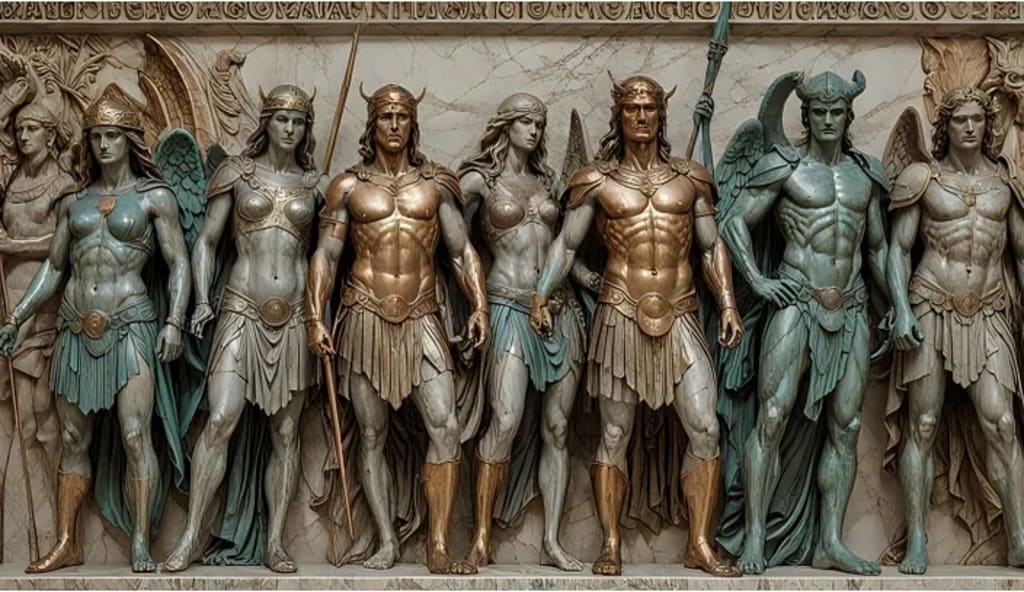
There are various pantheons and forms of religion on a planet as giant and disjointed as Fractallus. There are many animal-formed gods, dozens upon dozens of evil and murderous entities, but only the most accepted Gods and Goddesses from the Continent Xeocun and the Eidru Empire are particularly included here. Deities mentioned most frequently in the story have been highlighted in detail.
⚡️🏛️🔱
Guesis, also known as the Father of Humanity, is the God of civic duty, family stewardship, and loyalty. Both the Eidru and Reophate Empires claim him to originate from their streets. His token icon is an image of a human heart, worn as jewelry or embroidered onto fabric. Many have beautifully carved garnet hearts suspended from delicate chains with charms to represent each member of their family, which double as devotional items to Guesis.
Family reunions and lavish feasts are held the night before a wedding to unite the two families as one in honor of Guesis. Many across the continent and in the Eidru empire host family reunions during the first month of the year in his honor.
Most families revere both the Father of Humanity and the Mother of Heroes in Equal measure, unless they are direct devotees to some aspect of one of these gods or clerical supporters. The first month of the Xeocun Callander is Gueseron, named in honor of Guesis. This month is known by different names on other continents. The emphasis on the Mother and Father on the continent of Xeocun has shaped their entire society.
Dretrix, commonly known as The Mother of Heroes, is the Goddess of honor, glory, and heroism. She is worshipped along with Guesis in a spirit of wisdom and unity.
The most common personal symbolic representation of the Mother is a silver cross with two blue lines, or, if worn as jewelry, angelic sapphires set beginning underneath the crossbars that represent the blade's hilt, meeting under the point of the cross. Small shrines in the form of Carvings, statues, and outcroppings shaped like scabbards are touched with melee weapons in reverence of the Mother, hoping she will bless their attempts.
Worship in Triddam features reenactments of The Mother's deeds and heavily stresses the luck of her birth and circumstances, growing up in the arena. Then, hard work and heroic success, rising from the pit to become a goddess.
Najimanns prefer hunting dangerous animals, and Zillanians go on solo quests for special desert items like flame crystals. Especially if they will fulfil some need or quest. Baijanni worshipers fighting in the arena or feats at sea are common.
The second month, Dretruary, is named in honor of Dretrix and is said to be her birth month. Those born in the same month are considered favored by fortune to become heroes and adventurers. Like the first month, this month is known by different names on other continents. The emphasis on the Mother and Father on the continent of Xeocun has shaped their entire society. Color: Bright blue, Animal: Griffin
⚡️🏛️🔱
Grantabulain, while not as popular in other lands, is a principal deity of the Eidru Empire. The faith of "The callers" has taken the worship of Grantabulain and his areas of domination, control, hierarchy, and stratification to keep their Empire stable, bind and control planar creatures, and relieve themselves of dependence on mortal slaves. His Token icon is a set of manacles. Clerics of Grantabulain only graduate once they have bound at least one creature more physically powerful than themselves into servitude. The Gemstone jet is associated with Grantabulain, and devotees often leave jet chips in offering plates or get ornately carved jet manacles as art objects.
⚡️🏛️🔱
Vidionne, Wentra, and Franzian Goddess of love, beauty, and art - triplets with portfolios of love and compassion, high art and performance, creativity and crafting. Ancient deities, formerly the mother goddess of love and two daughters of the arts, sometime in the pre-megantani era. On other parts of the planet, Vidionne is still seen as the Mother. These sisters are known as the divine splendors, worshipped far and wide, with countless local festivals and minor invocations to their names.
Their Token icon is a Rainbow thread that changes to every color known and unknown. It's woven into cloth, it's plucked to make beautiful music, it's wrapped around all three's fingers as they dance together in unity. The triskelion alternately. Any rainbow flower, gemstone, or piece of clothing can be created or worn in honor of the Divine Splendors. However, Magical Aura Quartz is most often associated with them.
Clerics of Vidionne are known to use weapons and wear armor crafted by loved ones. These totems of faith give worshipers more strength and protection in the battles they may face to protect their loved ones. Wentrans are known for their gifted performance abilities with the weapons they use; what may look like decorative or ornamental weapons or armour are readily used and maintained. Franziens are known to craft their own weapons and armor, infusing their creative energy and blessings into the items.
The twelfth month of Vidia is named for the first of the Divine Splendors, Vidionne, and one of the most popular celebrations, Franzipangian, is held in their honor during Vidia. In the Eidruian Empire, the holiday is dedicated to Queen Jezebel, who was born on that day; however, these deities are worshipped on continents across Fractallus.
Triplets, especially female triplets, are regarded as a blessing of boundless love and miraculous creation. Watched over and favored by the Divine Splendors.
⚡️🏛️🔱
Thomes, the God of nature and the hunt, is a staple deity across the world, though not always known by the same name. He is worshiped in almost every rural territory for his blessing on hunting and self-sustaining foraging. Represented by Flint arrowheads, dozens, if not hundreds, of local festivals and holidays are held in honor of Thomes across the Empire and world from early fall to early winter. His worshipers not only learn to use the bow but also to create their own bows and fletch their own arrows, constantly keeping a handmade stone arrowhead on their person whenever they go out, whether hunting or not.
⚡️🏛️🔱
Solemni is the Goddess of sunfire, war tactics, and battlefield healing. Her worship was transported across the air expanse from the neighboring continent of Aulixuan to Xeocun, becoming the most popular Goddess on Landmass Dustrica, including in the Halfling land of Triddam and the Zabridian provinces. Her clerics traveled across the Air and Water seas to Harctelion, converting citizens of the Eidru empire. The tenth month, Solember, is even named for her. An indication that Solemni has been worshipped in the area since ancient times.
This quick and aggressive spread set the Church of the Callers against the Goddess and her clergy. If the callers win, they will likely subsume Solemni into their small pantheon as an Angel and her servitors as lesser angels and devils under Grantabulain's purview.
A phoenix in flames is Solemni's Token Icon. Many casters who worship Solemni keep Fire birds as Familiars or pets - having their likeness tattooed on their bodies or keeping talismans/ jewelry in the image of a phoenix in flames. The sunrise Orchid is Solemni's favored flower as it resembles a ball of flame, and blooms in the morning with the sun representing the rejuvenation Solemni promises. Clerics receive protection from fire and heat, up to complete protection at the highest levels of competence and devotion. Legends say their highest priests will reincarnate as a being of fire in this realm before taking their place in The Burning Realm of Flame and heat.
Qulnia is an ungendered, ambiguously raced deity of secrets, desire, illusions, and revenge. The Month of Qulnar is named after them. In fact, during the month of Qulnar, Masquerades are held, revelries formerly in honor of Qulnia, that have now lost their greater spiritual meaning. In times past, these would have been dedicated to the deity, with secrets collected, desires satisfied, and vicious acts of revenge perpetrated behind masks under the cover of darkness.
Sects of Qulnia are often even less accepted and more feared than cults of Hantrican, which simply encourage revelries and vice. Qulnia represents all people's drive towards seeking retribution and encourages its supplicants to take it into their own hands, rather than waiting for the civilized wheels of justice to turn on their behalf. The three major deities, Grantabulain, Dretrix, and Guesis, would all encourage seeking legal means of recourse if available. Or that you dominate them socially, not openly skirt social and legal conventions.
Respect for and worship of the various aspects of Qulnia is expressed in various ways. Some may find her purview over secrets and illusions the most important and beneficial. They may gather sensitive information, use illusions to mask what they know or even who they are to protect their secrets, employing desire as a powerful tool in this endeavor.
Qulnia's aspect of revenge is considered the least savory, though most have uttered their name in anger at one time or another. Those who have sought justice and gone unsatisfied, those who have been wronged with no legal recourse. Peasants often call on Qulnia when wronged by the nobility, which some would argue became the more important reason behind vilifying and all but banning their worship by declaring it a dangerous cult.
⚡️🏛️🔱
Thienta is the Goddess of developing high culture and spreading commerce. Many rulers invoke her name when collecting taxes and tariffs. An overflowing gold purse is the token icon of Thienta. Many worshippers of Thienta keep a small purse containing a few gold coins or other primary currency that they never spend, using it as a devotional object. An embroidered patch shaped like an overflowing pouch is also seen as a representation, though most worshippers and all the clergy would have both. Many also wear coins of all denominations as jewelry.
The second month of the Harctellion Callander is Thienary in honor of Thienta, a month for taking accounts and inventories. She's thought to be friends with and presented as a supporter of numerous other deities, such as the Divine Splendors, the Father of Humanity, or Agetuneitas.
Because this deity is worshipped in areas of divergent culture, developing, and highly technologically advanced cultures, her symbol can take on different forms, including various forms of currency. Depictions of her also change, showing her as wearing and using digital or highly advanced magical tech in line with her values of developing and advancing culture.
Hantrican is the God of parties, revelries, and intoxicating substances, though not openly worshipped, cults of Hantrican and bawdy secret societies exist for the nobles to dabble with, and get raucous. These gatherings are openly frowned upon but allowed to proceed, and are attended by many of the same people who cluck at them in their temples and charities.
In every city and major establishment, secret societies and chapters are rumored to be dedicated to many of the socially forbidden faiths. Hantrican stands out since, unlike the more practical but so-called primitive faiths, cults of Hantrican actively encourage upstanding citizens to break laws and stray from perceived traditional Eidruian values.
⚡️🏛️🔱
Emalenquis is the Goddess of Luck, Probability, and Self-Determination. Once widely worshiped across the entire continent of Xeocun, her followers have dwindled. Now revered mainly by the sister races, Gnomes, Halflings, and Goblins, the worshipers have been moved across the face of the continent and redistributed as the Eidru Empire marched across Xeocun.
Halflings focus on her luck aspect, gnomes focus on her probability aspect, and goblins focus on her self-determination, which is likely why they're often seen as rebellious and resistant to direction. The Luck weed is Emalinquis' symbol, and a joyous, mystical one at that.
Halflings all over the Empire tell tales about her gift of luck weeds, and their tiny brethren, clover, which spreads worldwide without cultivation and multiplies seemingly overnight. The first thing to repopulate a once dry, dead patch of earth is usually clover. The halfling people write many tales and parables about luck weeds that highlight the blessing of luck and the importance of making good decisions.
Followers of Emalenquis know that luck runs both ways. It takes good judgment and a ready heart to decide which a year, day, or event will bring for them. Many carry charms charged with "good luck" or empty charms to soak up the "bad luck."
Gnomes rely on probability tables and statistics to make decisions. Using them for guidance in almost every area of life. It is an ingrained part of Gnomish society, and to stray from the charts would, by Gnomish standards, mean catastrophic failure.
Goblins focus on Self-determination. Though Goblins are small and relatively weak, they pride themselves on living independently and working hard to earn a wage. This can lead to some people looking down on Goblins, seeing them as uncooperative and resistant to assistance, rather than self-reliant and hardworking.
Rhudite is the gnomish deity of invention, ingenuity, clockwork, and mechanical constructs. It is represented as a circle of gears turned with a crank. Any gear can be used as a token icon and is carried by her worshipers, sewn onto clothing, and so on. They are masters of clockwork, creating massive mechanized factories and monuments. The Ticking Heart Cathedral in Spanner's Toss is one of the most elegant examples of its dedicated contributions.
Baganor is the Gnomish God of alchemy and chemical magic. They are depicted as a Gnome amid an Alchemical laboratory, holding a beaker aloft. A corked vial is Baganor's token icon. Worshippers both wear visual representations of filled vials and carry vials with them to honor and attract blessings from Baganor. Natural salt crystals and mercury are two of the most popular items used to fill vials.
Atsiny is the Halfling god of plant medicine and alchemical healing. Tridammian Halflings from the Neighboring landmass of Dustrica worship several gods that differ from those of their colonial overlords. Atinsy is often confused with the Gnomish god Baganor by Eidruian humans, but they are distinct entities. Gnomes transform what were technically once natural substances into harsh chemicals and magical regents. The Halfling way is quite different; they use the regents whole, or at least untransformed. Worshipers of Baganor look down on Atinsy as being a more primitive faith, and the Worshipers of Atinsy dislike the waste and ill effects brought on by the products of Baganor's faith.
Lamantrera is a Dwarven deity of natural laws and inherent scientific and magical principles. Some combination of the elements represents this deity. A fountain spewing from the living stone with a tree planted in the center of the stone, water flowing from its leaves into the pool, and molten metal flowing in a channel around it.
Dwarven citadels, grown of the natural stone and raised into the sky, with the Dwarven connection to Fractallus, and its natural forces taught by Lamantrera, often have fountains like this. Dwarven artists depict more elaborate gardenscapes in every art form imaginable, with this at the center
Spectronomer is the Elven god of secret research. Most see the Elves' citadels on Xeocun surrounded by impeccably maintained old-growth forests and assume they are like the elves of stories or the Whorl Elves of the great expanse, riding trees they've grown. The Elves of Xeocun are the inheritors of incredibly advanced knowledge and technology. It is unto a god to them, and they worship the miracle of DNA in the form of Spectronomer, represented by a spiral rainbow ladder to the stars. (double helix)Many Researchers have the holy symbol, Spectronomer's Ladder, tattooed on their inner forearm. of them.
⚡️🏛️🔱
Migdilina is the Ancient Goddess of waters, seas, lakes, and rivers. The Planet Fractallus has a very curious structure, and the substantial continental plates floating above the swirling gaseous core below are all covered in water that never seems to run out. Many people around Fractallus worship Migdilina for providing and keeping their continents filled with the water they need to drink, travel, grow food, and live. Those dedicated to her worship keep a variety of instruments, from the simplest, such as dousing rods used by clerics in farming villages, to the most advanced technologies, including barometers and humidity gauges, which are utilized on other continents and Harmonian Isle by hydrologists.
Emnia is the Goddess of sailors, ships, and naval battles, worshiped by naval officers and merchant sailors alike. Some see her as a beautiful mermaid, others as a ship captain sailing the seas endlessly, taking up all those fallen onto her eternal crew. Emnia's Token icon, worn or included in art, is an oar draped in a fishing net. When a sailor dies irretrievably at sea, their mates, if possible, go to shore and set up a memorial for them - planting an oar, draping a net over it, and leaving some token of their life in the net. Every ship is a house of worship, and every sunrise is a song of praise to Emnia. Sea glass is a fitting token of her mysterious and beautiful blessing.
Braxalinnis is the Ethereal Goddess of the stars and navigation across land, sea, and aerial expanse. She is depicted in art as the face and arms of a woman in a vast, billowing gown of the night sky, holding a sextant in one of her hands. Twin to Ewadan, she's represented by token icons: a star and a sextant. None travel, and do not call upon her name. The Starfire crocus is the favored flower of Braxalinnis. Only during the darkest hours of night do the Starfire crocus bloom, and only then do the Followers of Braxalinnis fully emerge to gaze at the stars and bask in the crocus glow.
Ewadan is the God of darkness and the night. A pair of glowing yellow eyes represents Ewadan. In a magical world with threats that can see like day, many seek protection in the fearsome night. The protection provided by the God of the night supposedly keeps travelers in the night, those working under the light of the red and green moons, and anyone out and about in the lurking night safe. Clergy and worshippers of Ewadan travel the roads and forests at night, offering assistance and protection from threats.
The twenty-second month, Ewada, is named in honor of Ewadan. On the winter solstice, people stay up all night, praying to Ewadan, the God of darkness and the night, for protection in the nights of the coming year. He is the twin of Braxalinnis.
Twins of opposite genders are considered blessed by Braxalinn and Ewadan - often referred to as children of the night and stars.
⚡️🏛️🔱
Agetuneitas is the God of law, order, and equitable judgments. He is depicted as an ancient, wizened, and gigantic figure, stationed on a throne carved into a mountain range, holding a great scroll proclaiming his decisions. Dozens of Tunies attend him, robed lesser assistants and paralegals, who flit and fly about. He is sometimes depicted with more elven features or dwarven proportions, although most portray him with the striking features of an aged human. Many heading into court call on his name, hoping for a just outcome.
While most worship him and his court as a God, the Church of the Callers in the Eidru Empire has used a propaganda campaign to glorify him as an Angel under the dominion of Grantabulain. Many farmers still make an offering to Agetunetius, the God of law, order, and judgments, in the sixth month, so that they and their families might see fair dealings all year.
⚡️🏛️🔱
Trinsia is the ancient Goddess of the field and plow. Whenever a catastrophe drives society to an agrarian level, she is revered as a savior. She is the foundation of humanity. Those continuing to fill in the foundation, even in times of more stable growth, call on her name. Carrying a seed in a vial on a cord or pressing flowers in a book, some even use spells to preserve excellent picks from their field, adding pieces to an ornate shrine as they grow magnificent produce under Trinsia's blessing.
Sambyonne is the Goddess of Agriculture, fertility, and the seasons. While Trinsia is ancient and revered across a vast portion of Fractallus, Sambyonne and her Brother, Dryone, are much more recent additions and are only known on a few continents. Sambyonne has more developed rituals and sacrifices. The long years and extensive growing calendar are demanding for the farmers of Fractallus. Sambyonne has numerous celebrations to keep the farmers going all year.
Dryone is the God of Storms; though too many or too strong a storm can undoubtedly be a bad thing, the brother of Sambyonne is thought to bring the precipitation farmers need to grow their crops. Very few people worship one and not the other. In fact, Dryoneon is the third month when Thunderous storms stir and awaken monsters and men throughout the lands, a time known for war and attacks. Peasants spend rainy days inside making new scarecrows dedicated to Dryone in Dryoneon.
Slintong is the Giant God of Ice and frost, blowing winter across the lands of Birgriid. Cloaked in a constant haze of flurrying snow and carrying a blade carved of blue glacial ice, Slintong is rumored to wander the massive ice-encased mountains that crown the top of the land of Birgriid. The Ice Witches and Frost Giants of the Frozen northwestern landmass carve remarkable frozen effigies of Slintong in reverence to his supposed power to keep sending the frozen winds down from the mountains. Wielding a blade carved of ice is one of the most popular ways to honor Slintong.
⚡️🏛️🔱
Wellspring is the ancient deity worshipped as the creator and opener of all fonts between the planes, and as such, the giver of life to many lands. Who opened the Fonts to Fractallus, or when? Evidence shows they predate every known structure and civilization on Fractallus. So, they couldn't have been opened by any advanced inhabitants of the planet, though they have been utilized by some since. Artifacts, cities, and even satellites have been built around these unimaginably powerful sources of energy or matter.
Dendronica is another Ancient Goddess and is known as the whisperer of souls. Shuttling the good and bad alike to their final destination, presiding over the transition between states of being. She is nominally worshiped by most on Fractallus. A white skull on a black background is the traditional symbol of Dendronica.
Visual reminders are found in homes of all kinds, from the most humble farmhouse to the grandest palace. Her devotees and worshipers regularly wear a skull motif and revere her judgments by closing each day with a settling of regrets, that they may pass with a settled soul. Mourners wear black and white, and memento mori in the shape of a skull are considered precious gifts of a loved one after they have passed on to the next realm.
K.B. Silver
About the Creator
K.B. Silver
K.B. Silver has poems published in magazine Wishbone Words, and lit journals: Sheepshead Review, New Note Poetry, Twisted Vine, Avant Appa[achia, Plants and Poetry, recordings in Stanza Cannon, and pieces in Wingless Dreamer anthologies.
Keep reading
More stories from K.B. Silver and writers in Fiction and other communities.
Bomb Scare
It was 2027, and the world never thought it would happen. A missle hit the United States, but it wasn't where they had anticipated. A little town in the northeast was hit by a missile strike, they didn't know why, and they didn't know exactly where it hit, but they did know it was a coastal community, somewhere between Maine and Delaware.
By Gregory Payton7 days ago in Fiction
To The Groom
For those who don't know me, I'm Carley, and this toast is for the groom, Matt, or should I call him the wedding specialist, God knows he's been at the Department of Marriage License Bureau enough times. According to the lady who works there, fourteen times to be exact. This toast is also for Nicole, someone who finally got him to the alter, my hat's off to you, or should I say, my garter belt. Matt, you should recognize it from when you took it off me, when we were together. "Many Happy Years Together, if you last that long. Anyway Cheers!"
By Susan Payton3 days ago in Fiction



Comments
There are no comments for this story
Be the first to respond and start the conversation.