
Gambler's Hope
A struggle with quiet addiction (AI image)
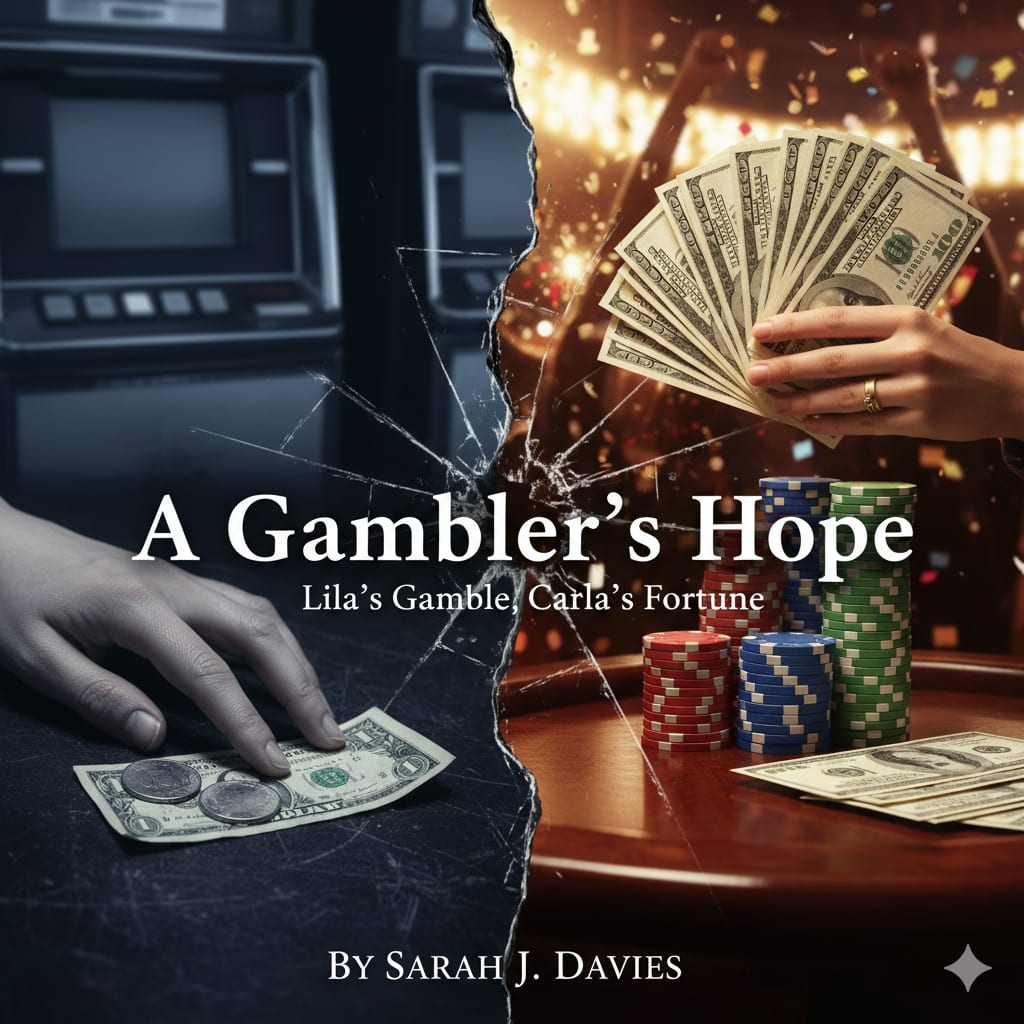
A Gambler's Hope
by Theodore Homuth
Homuthbooks.com
Lila sat at the slot machine, her fingers trembling as she fed another crumpled bill into the flashing maw. The casino’s neon glow bathed her in a false promise of fortune, the air thick with cigarette smoke and desperation. She was down to her last twenty, rent due in three days, and the electric bill already two weeks late. But the pull of the lever, the spinning reels, kept her rooted. One win, she told herself. One win could fix it all.
She wasn’t always like this. Years ago, Lila had a steady job at a diner, a small apartment, and dreams of saving for a little house with a garden. But the casino opened a mile from her place, and the first time she walked in, just for fun, she won $500 on a penny slot. The rush was electric—better than any drug, brighter than any joy she’d ever known. She felt invincible, like life had finally handed her a golden ticket. That night, she bought drinks for strangers and laughed louder than she had in years.
But the wins were rare. Most nights, like tonight, the machine devoured her money with cold indifference. The reels stopped, mocking her with a mismatched row of cherries and sevens. “Damn it!” she hissed, slamming her fist on the console. A nearby gambler glanced over, unimpressed, then turned back to his own losing streak. Lila’s chest tightened with rage—not just at the machine, but at life. The unfairness of it all. Why did it always have to be her? Why couldn’t she catch a break?
She checked her phone: another text from her landlord, a reminder of the $900 she owed. Her car needed repairs after breaking down last month, and the hospital bill from that sprained ankle still loomed, unpaid. Every time she clawed her way toward stability, something—car trouble, a medical bill, a “sure thing” bet that wasn’t—knocked her back into the red. She was drowning, and the casino was her only lifeline, or so it felt.
Lila’s sister, Carla, didn’t have these problems. Carla gambled too, but somehow, she always walked away with thousands. Last year, she’d won $10,000 on a poker table and bought a new car. The year before, a $5,000 slot payout funded a trip to Vegas. Lila hated her for it—not because she didn’t love Carla, but because her sister’s luck was a mirror to her own failure. At family dinners, Carla would shrug off her wins like they were nothing, while Lila sat in silence, burning with envy. Her cousins, her uncle—everyone seemed to have a story of a big win, a lucky break. But Lila? Nothing. Her family felt less like kin and more like strangers who’d been handed the life she deserved.
She pulled the lever again. The reels spun, teasing her with near-misses. Her heart raced, then sank as they settled on another loss. “This is bullshit,” she muttered, shoving her chair back. A cocktail waitress offered her a drink, but Lila waved her off. She couldn’t afford it, not even the free ones—they always led to tips she didn’t have.
Yet, there was that one time, six months ago, when she’d won $2,000. She’d screamed so loud the whole casino turned to look. For a week, she was on top of the world—paid off her phone bill, bought new shoes, even treated herself to a steak dinner. Life felt possible again, like the universe had finally noticed her. But then the car broke down, and the $2,000 was gone in days, swallowed by repairs and late fees. The high of winning made the fall back into debt even harder.
Lila knew she should stop. She’d promised herself a hundred times: no more gambling until she was back on her feet. But every time she tried to save, to work extra shifts, something broke—a pipe, her fridge, her spirit. The casino was her only shot at a miracle, the only place where hope still flickered, however faintly. She dreamed of the big win, the one that would pay off her debts, let her start fresh, maybe even leave this town. But deep down, a quiet voice whispered that it might never come.
She fed her last bill into the machine, her hands steady now, resigned. The reels spun, and for a moment, she let herself believe. Just one break. That’s all she needed. The reels slowed, and her breath caught. Two cherries. Her pulse quickened. A third cherry lined up, and the machine erupted in lights and sound.
“Jackpot!” the screen flashed. $1,500.
Lila screamed, tears streaming down her face. She was alive again, electric, unstoppable. This was it—her moment. She cashed out, clutching the ticket like a lifeline. For one night, life was perfect.
The next morning, Lila woke with the jackpot ticket still crumpled in her hand, a tangible reminder of her fleeting triumph. She smoothed it out on her kitchen counter, staring at the numbers: $1,500. It wasn’t life-changing, but it was enough to cover rent and maybe chip away at the electric bill. For the first time in months, she felt a flicker of control. She brewed a pot of coffee, the cheap kind that tasted like burnt regret, and allowed herself to dream. Maybe she could pay off the car repair loan next month. Maybe she could even save a little, start rebuilding.
But the casino’s pull lingered like a bad habit. As she sipped her coffee, her phone buzzed with a text from her coworker, Marla, who’d been at the casino last night too. “Girl, you hit it big! Coming back tonight to keep the streak going?” Lila’s thumb hovered over the reply. She wanted to say no, to promise herself she’d use the money wisely, but the memory of last night’s high—the lights, the cheers, the feeling of being someone—gnawed at her. She typed back, “Maybe,” and hated herself for it.
By noon, she’d cashed the ticket at the casino’s cage, the clerk sliding her a stack of crisp hundreds. She paid her landlord through a mobile app, wincing as $900 vanished in seconds. The remaining $600 felt like a fortune in her pocket, but it was already spoken for—electricity, groceries, maybe a payment toward the hospital bill. She told herself she’d be smart this time. No more gambling. She’d go back to the diner, pick up extra shifts, and grind her way out of debt.
But on her way home, her car sputtered, the check engine light blinking ominously. At the mechanic’s, the news was grim: a busted fuel pump, $400 to fix. Lila’s stomach dropped. She handed over the cash, her “fortune” now down to $200. The mechanic, sensing her distress, offered a sympathetic shrug. “Bad luck, huh?” he said. Lila wanted to scream. Bad luck was her life’s theme song.
That night, she sat in her dim apartment, the single bulb overhead flickering like her resolve. The $200 sat in an envelope on the table, taunting her. She could stretch it for groceries and a partial bill payment, but it wouldn’t be enough to keep the lights on past next week. Her mind drifted to the casino, to the possibility of another win. Just one more, she thought. Double it, and she’d be back on track. The rational part of her brain screamed to stop, to put the money in the bank, but the gambler in her whispered louder: You’re due for another win.
She was back at the casino by 9 p.m., the envelope’s contents now a mix of fives and twenties. The slot machines sang their siren song, and Lila found her usual spot, the one that had paid out last night. “One more time,” she muttered, feeding in a twenty. The reels spun, and for a moment, she was lost in the rhythm, the anticipation. But the machine was merciless. Twenty after twenty disappeared, and within an hour, she was down to her last five dollars.
Fury boiled in her chest. She wanted to flip the machine over, to scream at the world for its cruelty. Why was it always her? Why did Carla get to win thousands while she scraped by on nothing? She thought of calling her sister, begging for a loan, but the thought made her sick. Carla would just lecture her, tell her to quit gambling, as if it were that easy. As if Carla’s own wins weren’t the result of the same addiction.
Lila played her last five, the reels landing on another loss. She stood, her legs shaky, and stumbled toward the exit. Outside, the night air was cold, slapping her awake. She checked her phone: a new text from her landlord, thanking her for the rent but reminding her of late fees still owed. Another from the hospital, threatening collections. She leaned against the casino’s brick wall, tears stinging her eyes. The $1,500 was gone, and she was worse off than before.
Back home, she sat on her sagging couch, staring at the envelope, now empty. She thought of her family, their smug stories of wins and vacations, their lives untouched by the grind that defined hers. She felt alone, abandoned by luck and kin alike. But even now, a tiny spark of hope flickered. Maybe tomorrow, she thought. Maybe the next spin would be the one. She hated herself for believing it, but she couldn’t stop. The casino was her prison, her church, her only shot at salvation. And so, she’d go back. Because what else did she have?
About the Creator
Theodore Homuth
Exploring the human mind through stories of addiction, recovery, and the quiet places in between.
Keep reading
More stories from Theodore Homuth and writers in Fiction and other communities.
Shadows of Potential
Shadows of Potential Elias Voss adjusted his tie in the reflection of the polished glass doors of Vortex Dynamics, the nonprofit's sleek facade gleaming under the Toronto midday sun. It was 2019, and the building— a modern edifice of chrome and tinted windows— masqueraded as a mental health outreach center, promising "healing through innovation." Elias knew better. This was the Clinic's front door, a veneer of legitimacy over the shadows where real work happened. At 32, he was still hungry, still convinced that places like Black Site 53 could rewrite the broken scripts of human minds. Delilah Kyros had recruited him personally, her words electric: "We don't patch souls, Dr. Voss. We forge new ones." He'd signed on without hesitation, blind to the costs that would come later.
By Theodore Homuth6 months ago in Fiction
Magic
Note from the Author: I want to let you know that this is an unusual story, and it has been written purely from whatever is in my unconscious mind, because before I start writing, I get into a flow state that reaches my unconsciousness. I also write in my subconscious mind, which is like a mid-flow state between the conscious and unconscious mind.
By Denise Larkin7 days ago in Fiction
me, me, me
when i read back my poetry it screams “me, me, me” on my screen in bold letters and i can’t shut it up — most days, i cannot make any other words out; i want to throttle a thousand versions of the me gone by, i want to throw myself from a figurative balcony, i want to sink a sword into every pen i’ve held
By angela hepworth4 days ago in Poets


Comments
There are no comments for this story
Be the first to respond and start the conversation.