
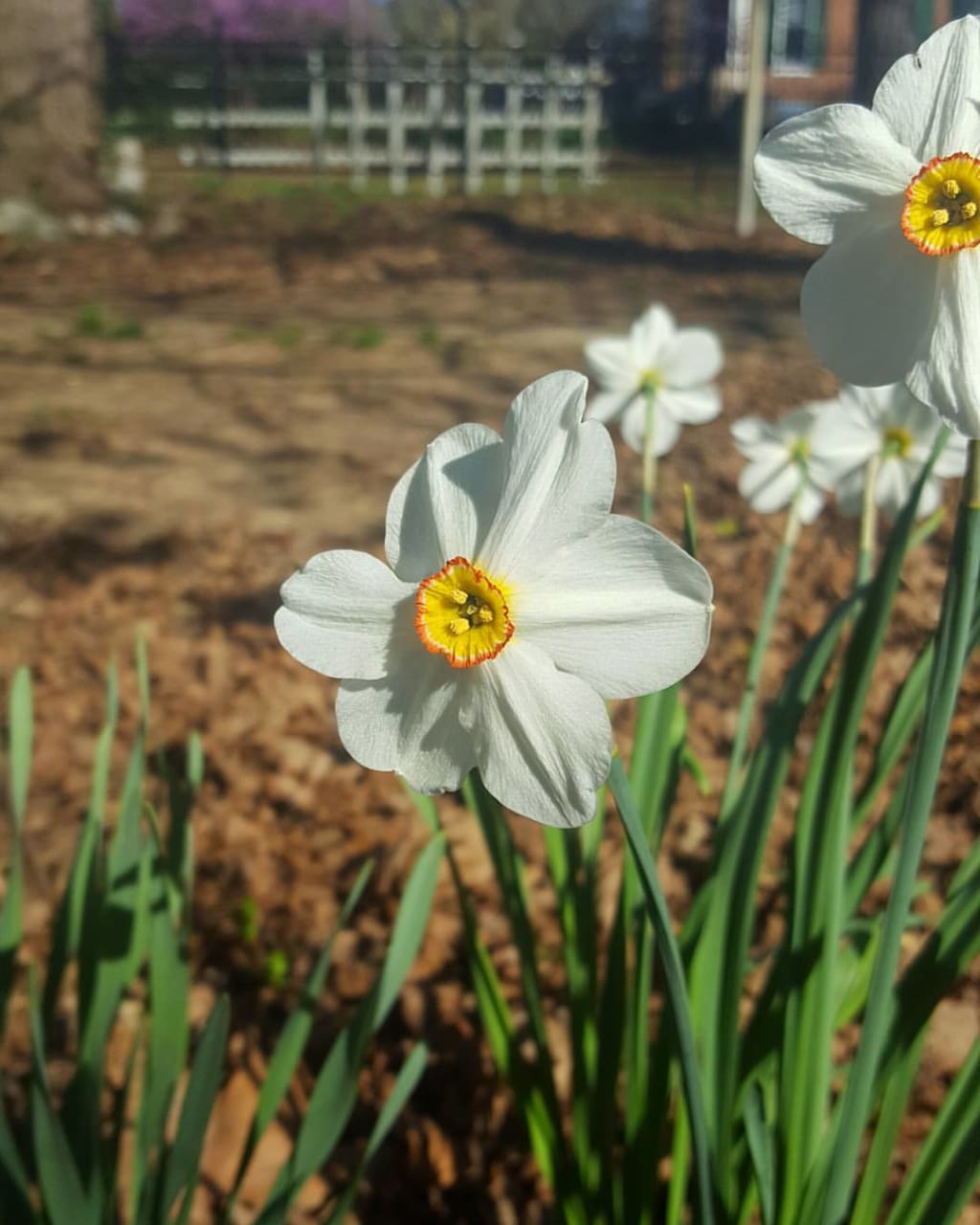
He had known who he was for years. It had happened all at once when he was nine years old – one moment he was only himself, and then he caught a glimpse of that cart, full of flowers, and he became two people.
Alistair Drummond had not been particularly remarkable, in his day or after. He was a farmer, and a son of farmers. He was a quiet child, and he grew into a quiet man. He had a knack for music, and a nice voice, but he sang for no one but himself for many years. When Elizabeth came into his life, he would begin to sing for her. When their child came along, Alistair sang for him too.
The boy standing in front of the flower cart was not a son of farmers. He had barely been permitted to play in the dirt, and while he played the piano well enough for the overstretched teacher his parents paid, he was no musician. In short, there was no thread to tie him to Alistair Drummond.
Until there was.
The old lady with the flower cart was a fixture at the market, and the boy had been there with his family many times before. Perhaps it was the music that played, or the way the clouds arranged themselves in the air. But when the boy looked at her that day, four months and 15 days after his ninth birthday, the old lady melted away.
She was young now – maybe fifteen, the same age as the boy’s sister – and she was with her father as they called out prices and pressured young couples passing by a different flower cart. Her blue-eyed gaze fixed on the boy. She walked over and gave him a bright yellow daisy.
“It matches your hair,” she said. But that couldn’t be right. The boy had black hair.
“What’s your name?” she asked.
“Alistair” came out of his mouth, a name the boy had never even heard before that moment.
The scene continued in his mind even as the boy came back to his world. The old lady who used to be young was smiling at him. She plucked a yellow daisy from her cart and brought it to him. She had the same blue eyes, and even as laugh lines and years had changed her face, she had the same smile.
“What’s your name?”
He told her, but it felt like a lie already. In his mind, in Alistair’s world, his mother had already called him away, but not before he caught glimpse of the girl’s sister, peering out from behind the cart, too shy to help her father. Maybe that was it. Maybe this was just the day Alistair saw her for the first time.
The boy wandered away from the cart, back to his mother.
It wasn’t as hard as it seemed to be two people at once, the boy found. Alistair’s memories merely played on top of his own. Sometimes – oftentimes, really – they were quiet. Memories of walks in the hills by himself, working the fields in silence with his father, listening to his mother read at night by the fire.
The boy found himself turning in earlier and earlier so that he could close his eyes and listen to this other mother tell him bedtime stories. Tell them. It was summer and he would take long walks alone, watching Alistair’s world unfold before him.
So it went for years. Alistair’s parents died when he was only seventeen, and the boy moved out as well. He had found a cabin on the outskirts of a quieter town. It was days away from his family. Secluded now, he lost sense of himself – although he had not been only himself for many years. He came to understand that he was Alistair; he had always been Alistair.
This was merely a fact. Alistair didn’t ponder whether everyone was two, three, or even more people at once. He didn’t wonder why he could never have future memories, although he cheated enough to find his own marriage record, to Elizabeth, and the birth announcement for their son. He couldn’t bring himself to look for obituaries.
The marriage to Elizabeth wouldn’t be until he was twenty-two, and at twenty Alistair had no memories of her. In his second life, however, he guessed that she must be the flower-seller’s younger daughter. She flitted in and out of his memories, prettier and older every time. In his first life Alistair never paid her more than polite disinterest, no matter how much Alistair the second wished to look at her just a few seconds longer.
The days and years passed for him, as if in an unending daydream. In his first life he had been a farmer, and in this one he still grew his own food but made his living writing. It wasn’t a good living, sure, but it was enough. Words left unsaid to Elizabeth poured out of him. It was the only glimpse of the future he was allowed to have – poems and songs that spilled out of him and onto the page, describing the curve of her neck or the ring of her laugh.
He lived this way: secluded, solitary, and rarely speaking for many years. Elizabeth came into his first life at twenty-one, but not his second. The years he spent with her were the first time Alistair truly felt alienated from himself.
In his first life, he was deliriously happy. There were hardships, of course, but nothing weighed him down. In his second life, watching the first unfold, seeing the ghosts of his wife and son move through his cabin, he felt only despair.
Perhaps this was hell. Alistair and Elizabeth were not religious and rarely went to church despite how she insisted just after Johnny was born. Perhaps, he considered one night, lost at the bottom of a bottle, that had been enough to sentence him to hell, to relive a life of happiness that didn’t exist.
Alistair was solitary in both of his lives, but by twenty-six he was a full recluse in the second. Poems and songs still poured out of him, but he was hollow. Any visit to town – once a month during warmer months and never, if he could manage, in the snowy season – attracted funny looks and the occasional whisper. He heard someone say once that it was as if he lived in a dream world. He chuckled at that. They were right after all.
The year he was twenty-seven, he managed not to see his birth family at all. He usually went only twice a year, but that year, a particularly dark one, he had begged off. Near his usual summer visit, he cited a longsuffering illness. When his winter visit came along, he just ignored the letters.
The following summer, however, his mother guilted him back. She complained of his father being at death’s door and his elder sister being widowed by an accident. There were several nieces and nephews that asked after him.
Alistair relented and planned a trip home.
As suspected, his father merely had a mild cold, and the children barely remembered him. Alistair’s sister Marina was indeed widowed, though she didn’t seem very grieved by the situation.
He had only been there three nights when, their parents and her children already in bed, that they helped themselves to several more glasses of the wine they’d had with dinner. She looked at him, as if deliberating a confession, and then said with a slight slur, “I know you’ll never tell. I love my children. I might have a dozen more if I could. But I didn’t like being a wife.”
The Drummonds, in Alistair’s mind, were having a quiet night. Elizabeth was sewing, Alistair was reading, and Johnny was amusing himself with the dog or asking for stories. Perhaps that was why Alistair wanted to tell his own truth.
“I would like to be married,” he said slowly. “I have been before.”
Marina laughed. “When?”
“Back before either of us were born.”
“I don’t understand.”
“I used to be someone else. A farmer named Alistair. I met a woman – back then – when I was 21 and, well, being married to her was the most amazing thing to ever happen to me.” He met her eyes. “I’ve known since I was a kid. I can honestly only think of myself as Alistair these days.”
Marina nodded slowly. “Tell me more.”
They talked well into the night, until they were both sober again. He couldn’t guess why she believed him. He sounded insane to himself, and he knew it was true. Still, Marina nodded, and when she addressed him as Alistair, he cried with joy.
The children woke them with giggles and prods to the arms and face entirely too early the next morning. They’d fallen asleep in the parlor.
Marina insisted that Alistair accompany them to the market that morning, a task that he had planned on skipping in favor of long walks on the grounds alone. Finally, he relented, and Marina set about her secondary task – convincing him to shave and clean up. He couldn’t imagine why she insisted so, but he finally caved to that as well.
The man that looked back at him was a stranger. He was used to another face looking back at him, but this one was pale and sallow. He tried to make himself smile, but the result was even more alien.
There was no begging off now, though. He sighed and met his family downstairs to go.
The flower seller was still there, although she sat quietly beside the cart now, letting her children and grandchildren solicit on her behalf.
He excused himself from his family and went to her. “You probably don’t remember me. You gave me a flower many, many years ago.”
She looked up at him, squinting a little. “It can’t have been that many years. You’re still very young, dear.”
He smiled at this, though it still felt unnatural. “Have you always lived here?”
“Oh, no. I used to live in a village far from here, but I moved when I married.”
“You had a sister, didn’t you? Elizabeth.”
“One of several sisters. She passed quite a while ago and unfortunately quite young. But to happier things! A flower for your lady?”
“I’m afraid I haven’t got a lady, but I’ll take three anyway – the daisies?”
So far, he had avoided information about Elizabeth and his deaths. He had something now.
He thanked the lady and gave a daisy each to his mother, sister, and niece. The little girl took it shyly, still unsure of him, but asked her mother to tuck it into her hair, nevertheless.
“The flower-seller used to be my sister-in-law,” he whispered to Marina.
“So, you lived recently. Do you think you were born as soon as he died?”
“I don’t really want to know.”
She shrugged. “Come, we need to go to this shop.”
“I’m worn, I think I’ll just –”
“It’s the last place we have to go, Alistair. Be reasonable.”
He couldn’t imagine what was so special about it. It was one of the lucky shops that merely had to open its doors and have someone stand outside looking friendly during market days. Still, he followed Marina and the children inside.
Marina chattered with the stand owners, and he caught some whisp of “my brother in town…” The place smelled wonderful, at least. It smelled like… Elizabeth.
Marina was calling him, carefully referring to him as “brother” in public. He turned to see what she wanted, but his eyes found the dark-haired woman instead…
And the world fell.
As sure as he was Alistair, she was Elizabeth. She looked nothing like the blonde, willowy beauty in his secondhand memories, but he knew her nevertheless. Here, all along, and he may have missed her!
She stared back at him too, but so were Marina and her son. The boy looked concerned, but Marina seemed amused.
“You look like you’ve seen a ghost,” she said.
“Ahh, forgive me.” He stepped forward and tried to manage his warmest smile for Elizabeth.
“This is Miss Adele Woods. Miss Woods, my brother. He’s only staying the week, I’m afraid, but we take what we can get.”
Adele-Elizabeth smiled and offered her hand to him. “Do you live far?”
“Two or so days’, depending on the weather. I could certainly come home more than I do.”
“You grew up here, yes? We must have met.”
“I’m certain I would remember you, Miss Woods. I don’t think we’ve ever met in this life.” He could almost feel Marina’s eyes on him as the half joke slipped out of his mouth. Miss Woods showed no recognition. He was certain though; this was her.
Marina cut in, “Miss Woods, when is your next tea party? Brother, dear, Miss Woods puts a party together every week to try her newest teas. You should stay for one.”
“I’m sorry, Mrs. Delfield. I never have them on market weeks. It won’t be until next Wednesday.”
Marina tapped Alistair’s arm playfully. “I mean it, you must stay.” She looked back at Miss Woods. “He is a writer, I’m afraid. It’s hardly a profession that needs him away from us so often.”
Alistair looked back to Marina. “Yes, perhaps I will.”
His sister finished her purchases and thanked Miss Woods. Alistair didn’t think he could speak again in her presence, so he merely ducked his head in respect and followed his sister out.
They walked in silence for a few moments, until they were well away from the shop. Marina hooked her arm into his and said cheerfully, “I’ve been trying to scheme a way for you to meet Miss Woods for years, but you evaded every attempt. I assume that I was right in thinking you two would get along?”
Alistair had been holding his breath, he realized now. “I think it’s too early to tell, from one conversation.”
“Oh, is it? ‘Not in this life, Miss Woods,’ isn’t that what you said? Cheeky devil,” she huffed.
“But you didn’t know…”
“No, but she’s ever so kind, she keeps to herself, and she reminds me a lot of you. I just always assumed you two would like each other. If you think she might be Elizabeth, well…”
“I wonder how much she knows. If she’s like…like me, or not.”
Marina smiled at him. “I guess you’ll have to stay a few extra days to find out.” Then she called out to the children and hurried away.
Alistair extended his stay. His parents were overjoyed. Even the children cheered, having warmed up to him and his improved mood. The old Alistair had been pushed to the back of his mind. They lived a quiet life, the three of them, and his current life was anything but.
His niece and nephew were forever begging for his attention; his sister often wanted to stay up late and talk while his parents roused them early to some social event. His mother had even developed an interest in gardening, to all of their shock, and asked for his opinion often. He did not have the opportunity to see Miss Woods again.
His mother was either privy to Marina’s schemes or had decided herself they would make a good pair; when Marina mentioned taking him to the little party, she insisted on altering the nicest shirt and trousers he had brought.
“You really can’t walk in looking like a farmer, my dear, and it’s far too late to actually order something from the tailor.”
“Mother, I –”
“I won’t hear it. I can do a neat enough job, just as good as any tailor.” She tutted as she marked where she would take in. “You are so thin, son. If you ever need help over on your little farm you know –”
“I do.”
She nodded, and the next few evenings she would pull out his clothing to fix.
Wednesday came, and he could hardly stow his anxious jitters for the entire day. Marina insisted that it would be a grown-up outing, without the children or their parents. The children begged and whined, but his mother merely had a smirk.
“You look very nice,” his sister said when they were alone.
“I’m nervous.”
About the Creator
Keep reading
More stories from Alana Bielarski and writers in Fiction and other communities.
₩hen ₣⬭rbidde₦ ⎣⭗v∑ Drew ⚬n〰 In₹xplicable ✧〰 🔫 ₮∈⊂hη⭔↳⭔ℊγ T⚬⇴Carry ⚬ut the ₮∈☈☈ible ⊅∑structi⚬n ⚬f 🅱isbee, 🅰riΖ⚬na
⚡🌵↯~Located in the Mule Mountains of southern Arizona is the Sonoran desert. In the Year of Our Lord 1880, troves of minerals & metals were discovered in that rocky terrain by a prospector named Judge DeWitt Bisbee.
By Lightning Bolt ⚡4 days ago in Fiction




Comments
There are no comments for this story
Be the first to respond and start the conversation.