
Faith and Agony in 1865
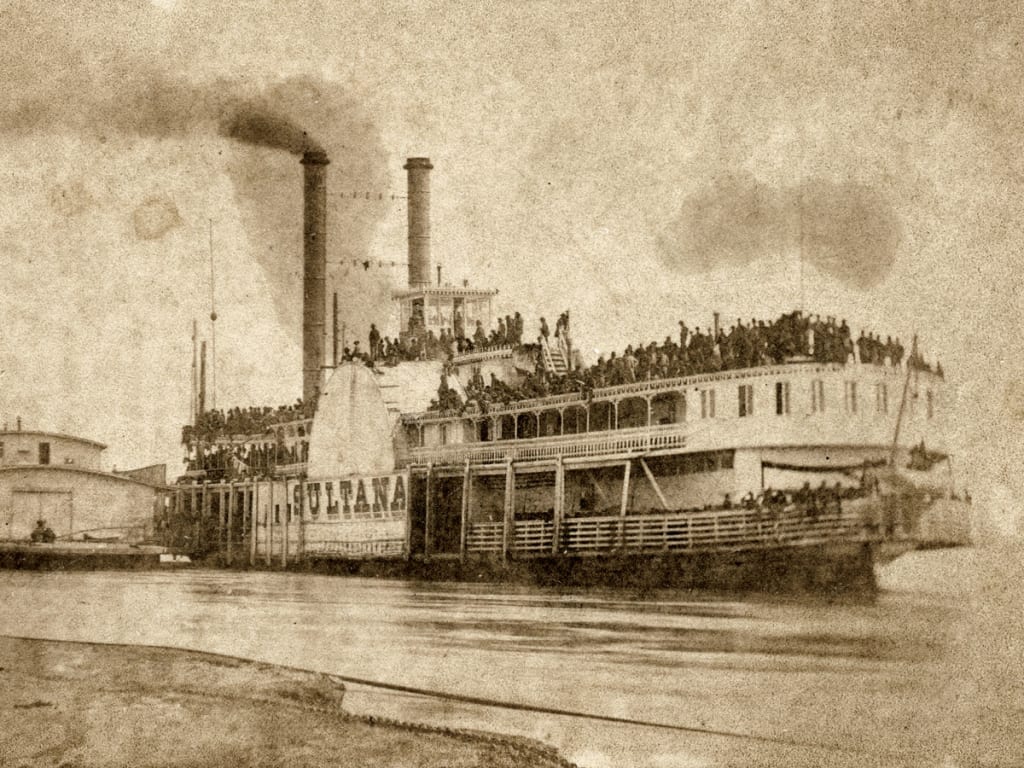
The Sultana was the greatest maritime disaster in US history
As we slowly approached Camp Sumpter, our noses were struck with a foul odor which caused many of the men to retch. All of us were accustomed to the stench of death and decay. The roads we’d marched for the past three years were littered with corpses whose lingering scent overpowered the air. This was much worse than decomposing flesh, a smell I never thought could be bested. Even our Confederate captors winced.
We expected the rancid odor to dissipate as we moved forward. Instead, the noxious aroma grew more powerful and continued to do so as we approached the gates of Andersonville, as Camp Sumpter was more infamously known. There, our other senses were allowed to participate in the assault.
Our eyes were greeted by the sight of thousands of walking dead skeletal shells of what once had been average gentlemen sitting around in disgusting filth with blank expressions on their forlorn faces. Their sunken, hopeless eyes were almost more pathetic than their emaciated frames. Entomological vermin fed upon these men who, in turn, fed upon the insects. The pitiful cries of agony uttered randomly throughout the encampment created a symphony of despair.
It was here that the final nail was laid to rest in the coffin that had once been my unwavering devotion to what I thought had been an all-loving benevolent God.
I had left my small Michigan town with enthusiasm when called upon to fight for the unity of our nation. On the Sunday before I packed up for the 15th Michigan Volunteer Regiment, my pastor had just given a wonderful sermon about duty and honor. With every word, I felt he was speaking directly to me.
He said the cause was about more than just patriotism. It was deemed a Moral Imperative. Any soldier fighting for the Union was doing so with God’s direction. Was anything more honorable?
I’d been devoutly Christian and knew my Bible forwards and backward. Knowing that I would be God's instrument in smiting his enemies filled me with pride.
It had never occurred to me that the men I’d be firing my weapon at held the same conviction. How could my enemy be so forthright about fighting for God as well?
Being young and a bit foolhardy, I’d gotten myself captured early in the war. The Confederates took me to Salsbury prison camp in North Carolina in November of 1861. The camp was filthy and overcrowded and at the time I thought it were a terrible circumstance to endure. My imagination had not yet considered how fortunate we were to have a relatively plentiful supply of provisions.
While there, I struck up a conversation with a Confederate guard who pointed out that God wholeheartedly sanctioned slavery. He took great pleasure in reciting passage after passage in our Holy Bible and I could offer nothing to refute him. It made me worry that I had, perhaps, overlooked other tenets of my Presbyterian ideology.
In short time, I was released in a prisoner exchange, which occurred frequently in those days, and made my way back to the front. I corresponded with my Paster Heywood about dogma and events back home during this period. Somewhat dismissive of my concerns, he assured me my Southern counterparts had it wrong and that the New Testament had somehow negated much of the Old. This didn’t sit well with me. At any rate, Pastor Haywood told me my family was well and my steamfitter apprenticeship was anxiously awaiting my return. I resolved to continue this discussion with him later.
For much of the next year, we spent more time marching than fighting. We were under McClellen's command and he was hesitant about sending us into battle. Our collective foolishness thought the war would be over quickly and I hoped for a chance to use my rifle before it happened. I got my wish during a few skirmishes in North Carolina. At one point my round hit a fellow squarely in the face. Rather than feel proud, I was horrified.
The man I shot was not more than a boy. It was ghastly to see the life exit his body. Watching a man die is sobering in a frightful way. The boy howled in agony and gurgled on his own blood. The sight of it made me ashamed. For a brief moment, I tried to talk myself into feeling righteous. I was doing God’s work, I reminded myself. I was unifying the country.
I wondered about this young man and our families back home. To his, I was a monster. To mine, I was a hero. Neither sat well with my conscience.
We eventually participated in a few large battles in addition to the more frequent skirmishes. Somehow I managed to stay alive although I did endure a few injuries. Time at the military hospitals made me question my faith even further.
The scale of suffering was more than I’d been prepared for. Hundreds upon hundreds of men were being killed and disfigured and my beloved God did nothing though it was in his power to stop it. I tried to sift through the memories of many sermons by Pastor Heywood to reaffirm my faith but sadly, the words now seemed hollow, spoken by someone who could never fathom these kinds of atrocities.
Being a prisoner at Andersonville was even worse. Over 30,000 prisoners were held in a stockade meant for 10,000 at most. Four hundred prisoners died each day and by war's end over 13,000 would be taken from disease and starvation.
On most days I’d wake forlorn, distressed over my ongoing hunger and the chances of my continued survival. Much worse was the loss of the comfort my beliefs in God had once provided. I’d lost my faith in mankind, God, and myself. I was an empty shell of a man.
Our only source of water was a creek that had gone stagnant from human waste building up as a dam. There was no respite from the hot sun as tents were in short supply. Gangs preyed on the most vulnerable, stealing items like buttons or even handfuls of maggots directly from an infected leg. Our rations, when they were available, consisted of a cup of cornmeal, salt, and either a sliver of rotten bacon or a handful of beans. Thanks to our collective malnutrition, no one had the strength to do anything but wallow, quite literally, in our misery and filth.
During this perpetual hunger and weakness, I had much time to revisit the faces of the men whom I had killed or maimed. They haunted me in the few hours of sleep I managed to get but what I woke up to was even more frightful.
The men had debased into lower animals, grunting with glee if they managed to catch an unfortunate sparrow which they would devour whole in a matter of seconds. With marked anticipation, acquaintances watched and waited for a doomed man to take his last breath so that they may raid his body of shoes and tattered clothing. I wondered what kind of God could allow such suffering and indignity. Not a benevolent one worthy of worship, certainly.
I could not imagine what the sight of me looked like. I was dirty, covered in a film of soil that may never fully wash off. My dark hair fell out in clumps and my eyes had begun to sink deep into my skull. My skin itched and there were sores all over oozing every color of vile fluid.
One morning I awoke and gazed upon the gaps in the fenceline. I was weak and dizzy and surely suffering from scurvy among other ailments. I could see the forest and what were surely coniferous trees and stalks of woodsorrel from which I might alleviate some of my complaints. Hunger caused me perpetual pain. This state of circumstances was a torture that I could no longer endure. Why was the cure to my scurvy placed within my field of vision? All of my hope and resolve to survive was leaving my earthly body and surely I’d succumb to its failings soon.
I cried out to the God I no longer believed in for some mercy. I begged for a sign.
At that moment, I turned away from the fenceline and attempted to cry but there was not enough water in my body to produce tears. I was severely despondent, my eyes clenched in a darkness I hoped would take me.
Then I heard something.
Was it cheering? Certainly, it was a joyful utterance attempted by the masses around me.
I did my best to question a staggering man.
“War is ending!” he proclaimed with a toothless face twisted into what might have been a smile.
“For certain?” I asked, skeptical, as we’d heard these claims before.
“Seems like it this time,” he answered.
I tried my best to cry again, this time for better reasons.
Not only had some hope been restored but also my faith, somewhat. I was grateful to have it back, even if it were still somewhat dubious and half-hearted. My religion was connected to so much of my previous life and having been absent from it felt like a betrayal. Would God forgive me? I vowed to atone for my transgression upon my return to Michigan.
Preparations began for a prisoner transfer to Camp Fisk in Vicksburg, Mississippi. It was thought we could ride out what remained of the war with better provisions provided by the government. I joined over 5,000 men to make the journey.
The end of the war was declared on April 9, 1865. We had just reached Camp Fisk and finally had access to bread and meat. There was clear water and new uniform shirts. Even a doctor was available.
The way God had brought me back felt like the story of Job, except I had failed. I was ashamed of myself. With all the torture and misery in the immediate past, I was easily turned back toward the light and love of my true creator. Would he accept my failings? When my time came, would I bask in his ever-loving Glory?
Not long after our arrival at Camp Fisk, we were told that steamships would be available for us to make the journey to Ohio where we would be formally discharged. Our commander informed us that 1400 would be gathered to board the Sultana, one of the first steamships to make the journey. I was desperate to be among them, as my constitution could not bear another day. It was with great luck that 1400 was increased to 2000 and I was included. I took this as a personal message from God himself.
We reached the dock expecting a much larger vessel. The Sultana was an impressive steam-powered paddle boat but it did not seem capable of carrying all of us in addition to the passengers already contracted. It was rumored there was even an alligator on board.
Despite misgivings over the uncomfortable conditions, I said my thankful prayers to God for this glorious ship that would be taking us home. New lives were about to begin. Surely we could endure a few more days of crowding. This ship was my salvation, a gift from my almighty.
We were packed like sardines in a tin. The Sultana was only designed to hold 247 people and our numbers were over 2000. Captain James Mason assured us her fine ship could accommodate us. He claimed he didn’t want to leave anyone behind, making it sound like he were performing a great kindness. We learned later he’d received large sums for each soldier and tried to maximize his compensation.
On April 25th, our ship took us north on the Mississippi. Spring floods made navigation difficult. Onboard, it was difficult to maneuver as well, but packed-in soldiers were in good spirits and made room for us to stretch on occasion.
On the next day, I tried to make my way to the engine room where I’d hoped to learn a little something I could add to my steamfitter education. The workers were genial and offered me some respite from the crowding above. It was there I learned the Sultana had just undergone a temporary repair. I examined the fittings and found them unsatisfactory but I was merely an apprentice and dared not speak up. How I wish I had.
That evening we reached Memphis and unloaded 200 men, which was of little consequence to our comfort. It was a hot night and despite some breathing room in the engine compartment, I made my way to the lower deck where I intended to stand near the stern. It took me all night to reach the outer circle of standees near the rails. At 1 am we resumed our journey and for a short while, I enjoyed a slight breeze.
At 2 am the first boiler exploded.
Chaos erupted as passengers tried to move away from the fire and falling debris with no room to run or even walk. Everything happened so quickly. The pilothouse was destroyed minutes later in another explosion and with the next I was thrown overboard.
I could barely swim in the rushing muddy waters surrounded by my fellow passengers, many of whom had died. Large parts of the ship floated nearby but none were sufficient to be used as flotation assistance. The majestic Sultana was in flames and the accompanying screams brought me back to the dark places in my mind. As the river took me, I wondered where I would go.
About the Creator
Nancy Gwillym
I'm a soon-to-be retired paramedic in NYC. I'm also a crazy cat/bird/etc lady who writes stories. Thank you for reading!
Reader insights
Nice work
Very well written. Keep up the good work!
Top insights
Compelling and original writing
Creative use of language & vocab
Easy to read and follow
Well-structured & engaging content
On-point and relevant
Writing reflected the title & theme
Keep reading
More stories from Nancy Gwillym and writers in Fiction and other communities.
A Well-Oiled Machine
I dreamt of the apple orchard, the one on my grandfather’s farm. I can smell the dewy air of those crisp fall mornings in the field. We would fill our baskets to the brim eventually but not before some requisite chasing and hiding. How exhilarating it had been to throw rotten apples like snowballs at each other, after climbing to the highest branches that would support the weight of a child!
By Nancy Gwillym4 years ago in Fiction
Bomb Scare
It was 2027, and the world never thought it would happen. A missle hit the United States, but it wasn't where they had anticipated. A little town in the northeast was hit by a missile strike, they didn't know why, and they didn't know exactly where it hit, but they did know it was a coastal community, somewhere between Maine and Delaware.
By Gregory Payton6 days ago in Fiction


Comments (5)
I admire🥰 your profile and I've just followed you ✨ Looking forward to connecting more with you💐
I really love your content and how it's crafted , I love it and happily subscribed , you can check out my content and subscribe to me also , thanks for this beautiful one
Thanks for sharing
The truth through the industrial revolution. That was marvellous.
Great work