
Every Clock Stopped at 4:17 — And No One Knew Why
A Clock That Refused to Forget One Mome

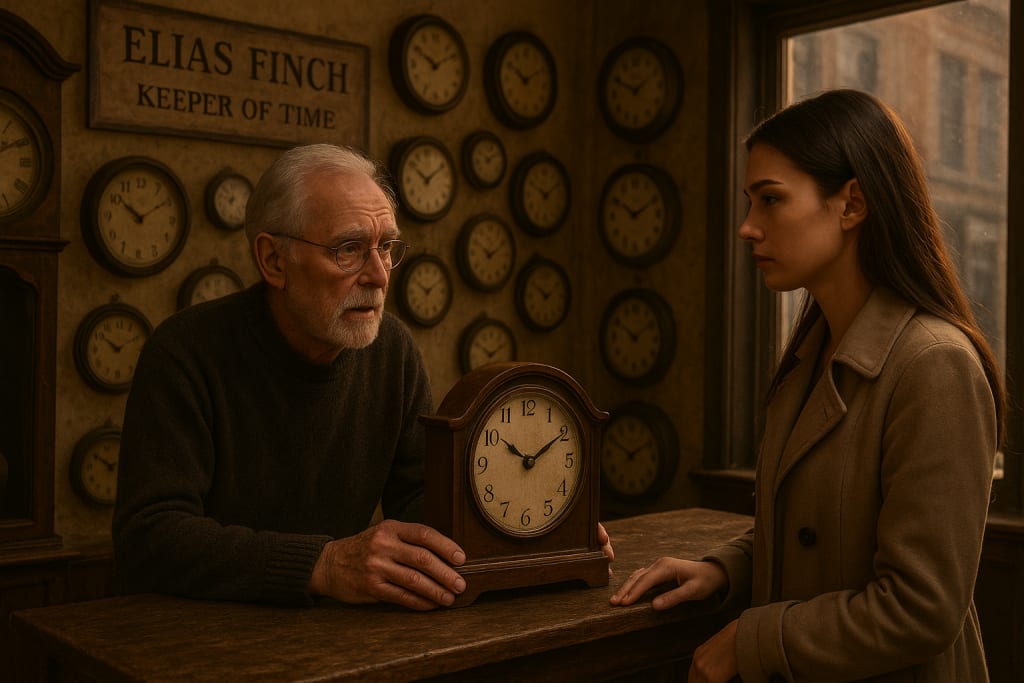
Every clock in the shop stopped at exactly 4:17.
Not one second before.
Not one second after.
No one noticed at first.
Except the man who had been waiting for it.
⸻
On the corner of Maple Street, between a quiet bakery and an old bookstore that smelled of dust and paper, stood a small clock repair shop. Most people walked past it without slowing down. Those who did look inside always felt something strange, though they could never explain what it was.
Inside the shop, dozens of clocks covered the walls.
Round clocks.
Square clocks.
Grandfather clocks that stretched toward the ceiling.
Tiny pocket watches that had outlived their owners.
Above the door hung a faded wooden sign:
Elias Finch — Keeper of Time
Elias Finch had repaired clocks for most of his life. No one remembered when he had first arrived on Maple Street. He simply existed there, day after day, surrounded by ticking.
To others, it was noise.
To Elias, it was memory.
Each clock told a story. Not with words, but with silence, pauses, and moments frozen between seconds.
Every morning at exactly nine, Elias unlocked the shop, brewed tea, and listened. He listened not to hear if clocks were broken—but to hear if they were hurting.
One rainy afternoon, the bell above the door rang softly.
A young woman stepped inside, folding her umbrella. Her eyes moved slowly across the room, as if she were afraid to touch anything.
“Good afternoon,” Elias said gently.
“I hope I’m not late,” she replied.
“Time is patient,” he said. “What brings you here?”
She placed a small wooden clock on the counter. It was old and scratched, its hands frozen at 4:17.
“It was my grandmother’s,” she said. “It stopped years ago. No one could fix it.”
Elias picked it up carefully.
“This clock isn’t broken,” he said quietly.
The woman frowned. “Then why doesn’t it work?”
“Because it remembers.”
She laughed nervously. “That’s not possible.”
“Leave it with me,” Elias said. “Come back tomorrow.”
That night, long after the shop closed, Elias examined the clock alone. The mechanism was perfect. No rust. No damage.
Still, it refused to move.
When Elias touched it, the ticking around him faded.
Suddenly, he was no longer in the shop.
He stood in a warm living room. A younger woman—his customer’s grandmother—held the clock tightly in her hands.
“It stopped when he left,” she whispered. “At 4:17.”
The scene changed.
The woman was older now. The clock sat untouched on a shelf.
“I won’t fix it,” she said firmly. “Some moments should stay where they are.”
Elias stepped back.
He understood.
When he returned to the shop, he did not force the clock forward. He allowed it to move again—slowly, gently—starting exactly where it had stopped.
The next day, the young woman returned.
She gasped when she saw the clock ticking.
“It’s working,” she said. “But it didn’t jump ahead.”
“No,” Elias replied. “It remembered first.”
She held it close, tears in her eyes.
“Thank you.”
Years passed.
Elias repaired hundreds of clocks. Some marked beginnings. Some marked endings. Some refused to move until their owners were ready.
Then one winter morning, the shop did not open.
Inside, every clock had stopped.
All at 4:17.
On the counter lay a note:
Time never disappears.
It only waits to be remembered.
About the Creator
Mudasir Hakeemi
I am poor boy
Keep reading
More stories from Mudasir Hakeemi and writers in Fiction and other communities.



Comments
There are no comments for this story
Be the first to respond and start the conversation.