
Ethical Implications of AI in Healthcare
Navigating the Ethical Frontier: AI's Impact on Healthcare

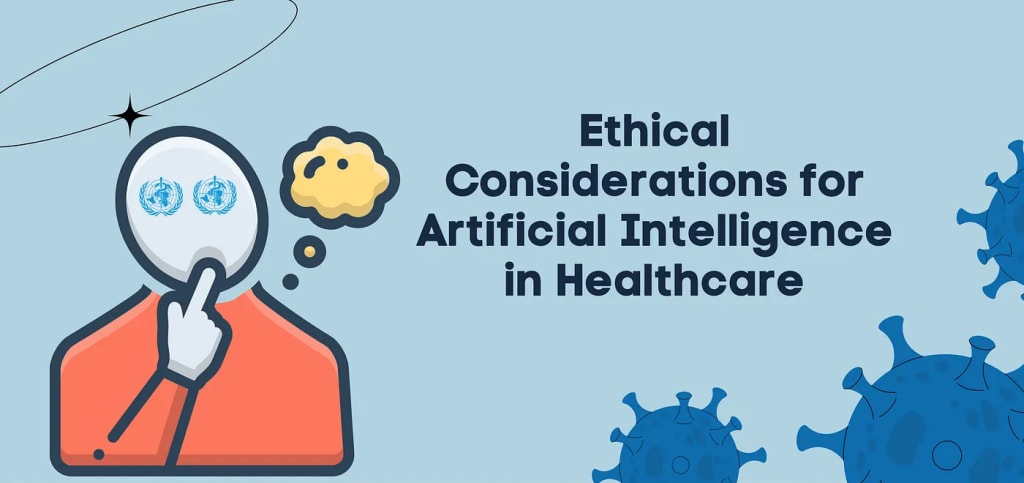
In the fast-evolving landscape of healthcare, artificial intelligence (AI) has emerged as a powerful tool promising improved diagnostics, personalized treatments, and streamlined operations. However, as AI integration becomes more widespread, ethical considerations loom large. From patient privacy to algorithmic bias, the ethical implications of AI in healthcare demand careful navigation and thoughtful discourse.
The Promise of AI in Healthcare:
AI holds immense promise in revolutionizing healthcare delivery. Machine learning algorithms can analyze vast amounts of medical data to identify patterns and predict patient outcomes with unprecedented accuracy. This enables early detection of diseases, personalized treatment plans, and optimization of healthcare operations, ultimately leading to improved patient care and outcomes.
Privacy and Data Security:
One of the foremost ethical concerns surrounding AI in healthcare is the protection of patient privacy and data security. With the proliferation of electronic health records and wearable health monitoring devices, sensitive patient information is increasingly vulnerable to breaches and misuse. Striking a balance between leveraging data for AI-driven insights and safeguarding patient privacy requires robust data governance frameworks, encryption protocols, and adherence to strict regulations such as HIPAA (Health Insurance Portability and Accountability Act).
Algorithmic Bias and Fairness:
AI algorithms are only as unbiased as the data on which they are trained. In healthcare, biased algorithms can perpetuate disparities in diagnosis and treatment across demographic groups, leading to inequities in patient care. Addressing algorithmic bias requires diverse and representative training datasets, transparent model development processes, and ongoing monitoring for bias and fairness. Moreover, clinicians must exercise caution in interpreting AI-generated insights and remain vigilant against reinforcing existing biases in medical decision-making.
Accountability and Transparency:
As AI systems become increasingly autonomous in diagnosing and treating patients, questions of accountability and transparency come to the forefront. Who is responsible when an AI algorithm makes a medical error? How can patients and healthcare providers trust AI-driven recommendations without understanding the underlying decision-making process? Establishing clear lines of accountability, implementing explainable AI techniques, and ensuring transparency in AI algorithms' functionality are essential for fostering trust and accountability in AI-enabled healthcare.
Ethical Decision-Making in AI Healthcare:
Navigating the ethical complexities of AI in healthcare requires a multidisciplinary approach that integrates medical expertise, technological proficiency, and ethical reasoning. Ethical guidelines and frameworks, such as the IEEE Global Initiative on Ethics of Autonomous and Intelligent Systems, can provide invaluable guidance for stakeholders in designing, deploying, and regulating AI systems in healthcare. Moreover, fostering open dialogue and collaboration among clinicians, data scientists, ethicists, and policymakers is essential for collectively addressing ethical challenges and upholding patient-centered care principles.
About the Creator
Henry Delfino
I provide insights on emerging trends like space exploration, AI, climate, and sustainable agriculture. Stay informed on global issues.
Keep reading
More stories from Henry Delfino and writers in Fiction and other communities.
Looking to the Stars: Advancements in Space Exploration and the Search for Habitable Planets in 2023
As humanity continues to push the boundaries of what we can achieve, advancements in space exploration and the search for habitable planets beyond our solar system are at the forefront of scientific and technological progress.
By Henry Delfino3 years ago in Fiction
Pandora’s Burden
“My brother warned me to not accept gifts from the one who commissioned you,” said Epimetheus to the woman clad in silvery raiments standing at the entrance to the temple. Her silver tiara and the silver rings on her fingers and toes glinted in the firelight cast by torches set on either side of the doorway. Lingering in the shadows, beyond the reach of the flames as she was, he could not tell what she held in her hands. At first what appeared to be a box was perhaps a funerary urn, or maybe merely an apple.
By J. Otis Haasa day ago in Fiction
The Message I Received at 3:17 AM That Changed Everything
It was 3:17 AM when my phone buzzed. I wasn’t expecting any messages at this hour, and yet, there it was—a notification that made my heart skip a beat. The sender’s number was unfamiliar, a string of digits that didn’t seem to exist. At first, I thought it was a prank or a wrong number. But as I stared at the screen, a shiver ran down my spine. The night was silent except for the faint hum of my air conditioner. I had been reading on the couch, a cup of coffee growing cold beside me, when the message arrived. The glow from the phone screen illuminated my face in the otherwise dark room, and the words on it were simple, yet terrifying: “I know what you did.” My first reaction was disbelief. Who could know? And what exactly did they mean? I quickly checked my call log, my messages, even my social media—but nothing seemed out of place. My mind raced through every memory, every small secret I thought I had buried safely. Nothing made sense. I tried to brush it off. Maybe it was just a spam message, or someone trying to scare me. But deep down, I couldn’t shake the unease. Another buzz. Another message. “Check the drawer under your desk.” I froze. My desk. The one place I kept my old journals, letters, and random keepsakes. Hesitation gripped me, but curiosity got the better of fear. I walked over to the desk, my steps slow and deliberate, trying to avoid making a sound. The drawers were ordinary, the top one containing my stationery. But the second drawer… it was slightly open. I hadn’t left it that way. My hands trembled as I pulled it fully open. Inside was an envelope, yellowed with age, no name on it, no stamp. Just my initials written in hurried handwriting. I picked it up, my heart pounding so hard I thought it might burst from my chest. The envelope contained a single sheet of paper. The handwriting was familiar—it was my own. I had no memory of writing this letter, yet reading it sent chills through me. The message inside described events from a week ago, tiny choices I had made, conversations I had forgotten… and ended with a warning: “If you ignore this, everything will be revealed.” Panic set in. I checked the room again. Every light, every corner, every shadow seemed alive. The air felt heavier, as if something unseen was watching me. My phone buzzed again, this time with a single word: “Now.” I didn’t know what to do. Should I call the police? Should I delete everything? My instincts screamed to run, but I couldn’t leave the envelope behind. Something about it demanded attention, a silent command that I couldn’t ignore. Slowly, I unfolded the paper again. The words seemed to shift, almost as if the letter itself were alive. Memories I had blocked came rushing back—the lie I told my best friend, the small theft at a local store I thought no one noticed, the message I sent to someone I shouldn’t have. All of it documented here, perfectly detailed. How was this possible? How could anyone know so much? Suddenly, the room’s temperature dropped. My breath became visible in the faint light of the phone. I thought I saw a shadow move in the corner of my eye, but when I turned, nothing was there. My phone buzzed once more. Another message: “You can’t hide anymore.” Fear turned into a strange clarity. I realized that this was more than a threat—it was a reflection. The envelope, the messages, the unknown sender… it wasn’t about someone else. It was about me. About the parts of myself I had ignored, the secrets I thought I could bury, and the truth I had avoided facing. I spent the rest of the night going through everything I had ever hidden, every journal, every memory, every tiny choice that made me who I was. By morning, I felt exhausted but different. The fear hadn’t disappeared, but it had shifted into understanding. I couldn’t change the past, but I could face it—and maybe, just maybe, write a better future. To this day, I don’t know who sent the first message at 3:17 AM. Some nights, I still feel the chill when my phone buzzes, a reminder that the past never truly leaves us. But I also know this: sometimes, the scariest messages lead to the most important revelations. And every time I think I’ve escaped my past, I check my phone… just in case.
By Baseer Shaheen 7 days ago in Fiction



Comments (1)
Hey there, just wanna let you know that this needs to have the disclaimer added to the beginning or ending, stating that it was created with the help of AI 😊