
Emotional Control: The Silent Power of Elite K9 Training
"Inside the Mind of a Police Dog: How Emotional Control Beats Instinct Every Time

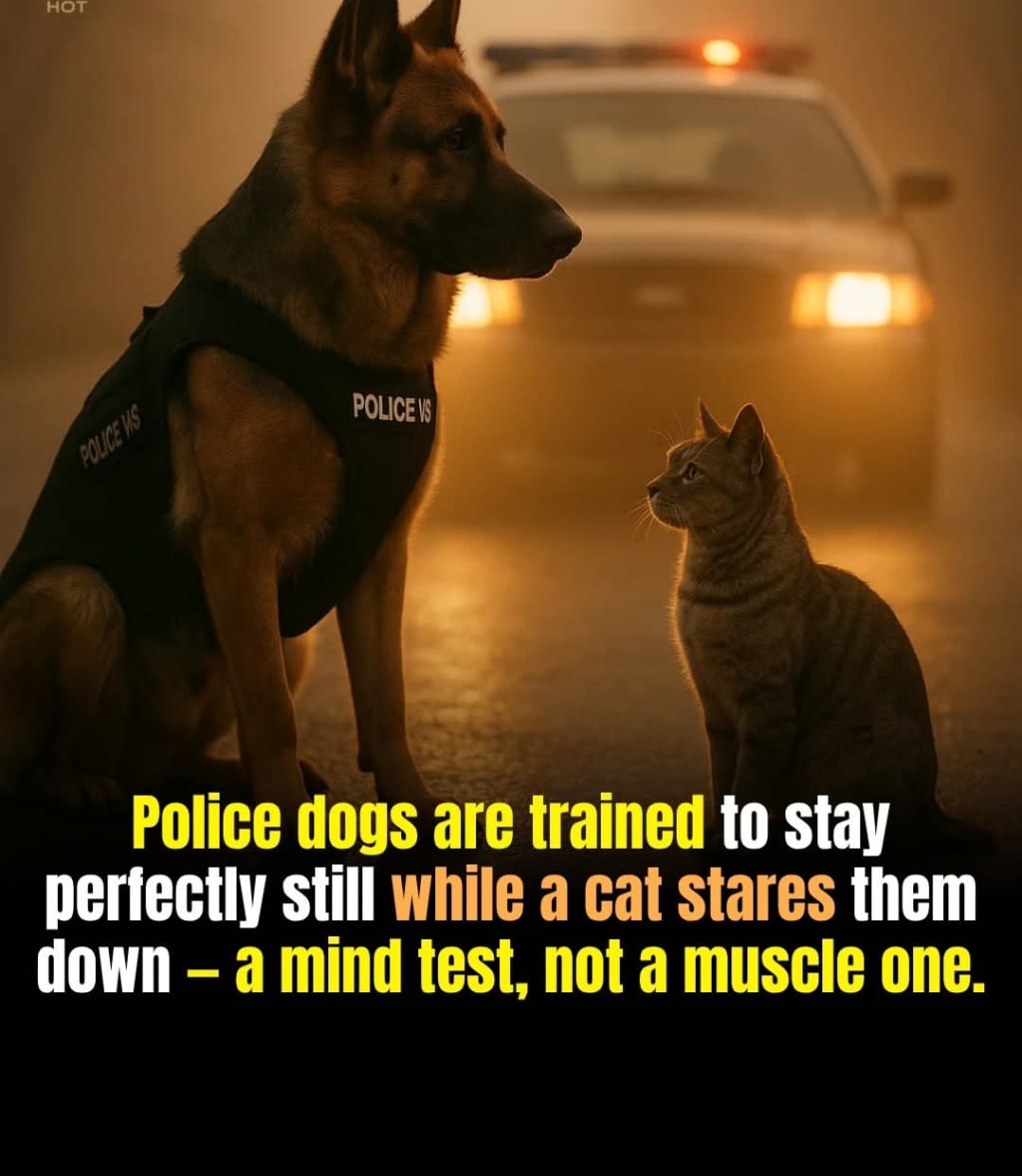
In the world of elite K9 units, obedience is just the starting point. These dogs are not simply taught to respond to commands—they are trained to override instinct, to master the chaos within before facing the chaos outside. Perhaps nothing captures the depth of that training more than one deceptively simple test: remaining perfectly calm while a cat gets close enough to brush against them.
To most of us, this might seem trivial. A cat walks by, the dog stays still. But to the K9 handler and the neuroscience-informed trainer, this is a high-stakes psychological exam—a moment where instinct, emotion, and discipline collide.
Why a Cat?
The choice of a cat isn’t accidental. Unlike a toy or a decoy, a cat is unpredictable. It moves erratically, stares boldly, and suddenly darts—flicking on every switch in a dog’s prey drive. For even the most well-trained animal, this kind of stimulus is a raw challenge. It’s not about hearing a command and obeying it; it’s about battling thousands of years of evolutionary wiring that says: “Chase.”
The dog’s brain, just like a human’s, has layers. Deep inside is the limbic system, often called the “emotional brain”—the part that handles fear, aggression, and pleasure. It’s this system that activates when a K9 sees a cat. Muscles tense, adrenaline surges, heart rate spikes. Fight-or-flight kicks in.
But the K9 unit isn’t built to fight instinct with force. Instead, they’re trained to reroute it. Through countless hours of social conditioning, repetition, and positive reinforcement, the dog learns something extraordinary: that control is more rewarding than impulse.
Discipline Over Instinct
What’s being taught here isn’t obedience. Obedience is about following commands. Emotional discipline is something else entirely. It’s about developing the neurological resilience to pause, to assess, to choose rather than react. In humans, we’d call it emotional intelligence or executive function.
This same capacity—resisting impulsive reaction—is what underlies high-level decision-making in people. Neuroscience studies have shown that the prefrontal cortex, the brain’s control center, plays a major role in inhibiting automatic responses. The more we train our brains to pause and reflect, the more control we gain over how we behave under pressure.
That’s what elite dogs are trained for. In a crisis—a gunshot, a scream, a sudden movement—they can’t just rely on instincts. They must read the room, wait for cues, and know when to engage and when to hold.
This isn’t about suppression—it’s about intelligent response. And in both dogs and people, it’s not easy.
Control in Chaos
Imagine what it takes to remain still when everything inside you says to move. The K9 who can sit calmly while a cat brushes its tail across their nose is not demonstrating obedience. They’re showing mastery. That calm exterior masks an intense inner focus—an effortful resistance of what their instincts scream at them to do.
In law enforcement, this kind of restraint can mean the difference between escalation and resolution. A K9 that lunges at the wrong moment could create panic, injure an innocent bystander, or destroy evidence. But a dog that waits, that reads the subtle movements of its handler, is an asset not just for detection or defense—but for judgment.
This is emotional discipline in action. It’s the ability to remain grounded while the world around you shifts rapidly. And in that regard, there’s something profound for all of us to learn.
Would You Pass the Same Test?
Humans, like dogs, have instincts. Anger, fear, desire, revenge—they surge through us in response to triggers. Social media, political arguments, personal betrayal—these can provoke just as strongly as a flitting cat. And yet, what separates impulsive reaction from thoughtful response is the same skill elite dogs are taught: the capacity to wait.
Could you sit calmly while someone invaded your space, mocked your beliefs, or triggered your deepest fears? Could you resist the urge to lash out, to run, to respond emotionally?
In our culture, we often glorify action—speaking out, clapping back, standing up. But the real strength may lie in hesitation. In stillness. In choosing not to be moved by provocation.
Because in the real world, that pause—that half-second of control—can save relationships, reputations, and sometimes even lives.
The Psychology of Stillness
Psychologists have long known that self-regulation is one of the most important predictors of success. Whether it’s a child resisting the temptation of a marshmallow or an officer deciding whether to escalate a situation, the ability to delay reaction is key.
Dogs don’t learn this overnight. It takes structured environments, emotional bonding with their handlers, clear expectations, and consistent reinforcement. Humans, too, need structure, clarity, and practice to build the same skills.
The good news? Like any muscle, emotional discipline grows with effort. Meditation, breath control, journaling, therapy, or simply pausing to reflect—these are the human equivalents of sitting calmly while a cat dances at your feet.
In the end, the cat test isn’t really about the cat. It’s about what happens in the stillness—when instinct is overridden by intention. Elite dogs pass that test not because they’re broken of their nature, but because they’ve mastered it.
And maybe the real question isn’t whether a dog can do it.
It’s whether we can.
About the Creator
Israr khan
I write to bring attention to the voices and faces of the missing, the unheard, and the forgotten. , — raising awareness, sparking hope, and keeping the search alive. Every person has a story. Every story deserves to be told.
Keep reading
More stories from Israr khan and writers in Fiction and other communities.
Colorado Couple Missing Since 2011 Found Dead in Abandoned Mine Eight Years Later
Colorado Couple Missing Since 2011 Found Dead in Abandoned Mine Eight Years Later A haunting mystery that tormented two families and baffled authorities for nearly a decade was finally laid to rest in 2019. The remains of Sarah Bennett, 26, and Andrew Miller, 28—two Colorado residents who vanished without a trace in 2011—were discovered deep inside a long-sealed uranium mine in Utah’s unforgiving San Rafael Swell. The revelation brought closure, but also raised chilling new questions about how and why they ended up there.
By Israr khan8 months ago in Fiction
The First Rainbow Baby
Pitter-patter, pitter-patter. The rain fell in rhythmic splatters, slowly slowing, but still constant. Mira rolled onto her side pulling the blanket tight against her ears, but still she could hear chitter-chatter and scurrying feet of the creatures that refused to sleep in the lower decks.
By A. J. Schoenfeld2 days ago in Fiction




Comments (1)
yes silent is power