
Dusk's Hollow Hunger
Sometimes in the woods, darkness doesn’t hide you—it hunts you.

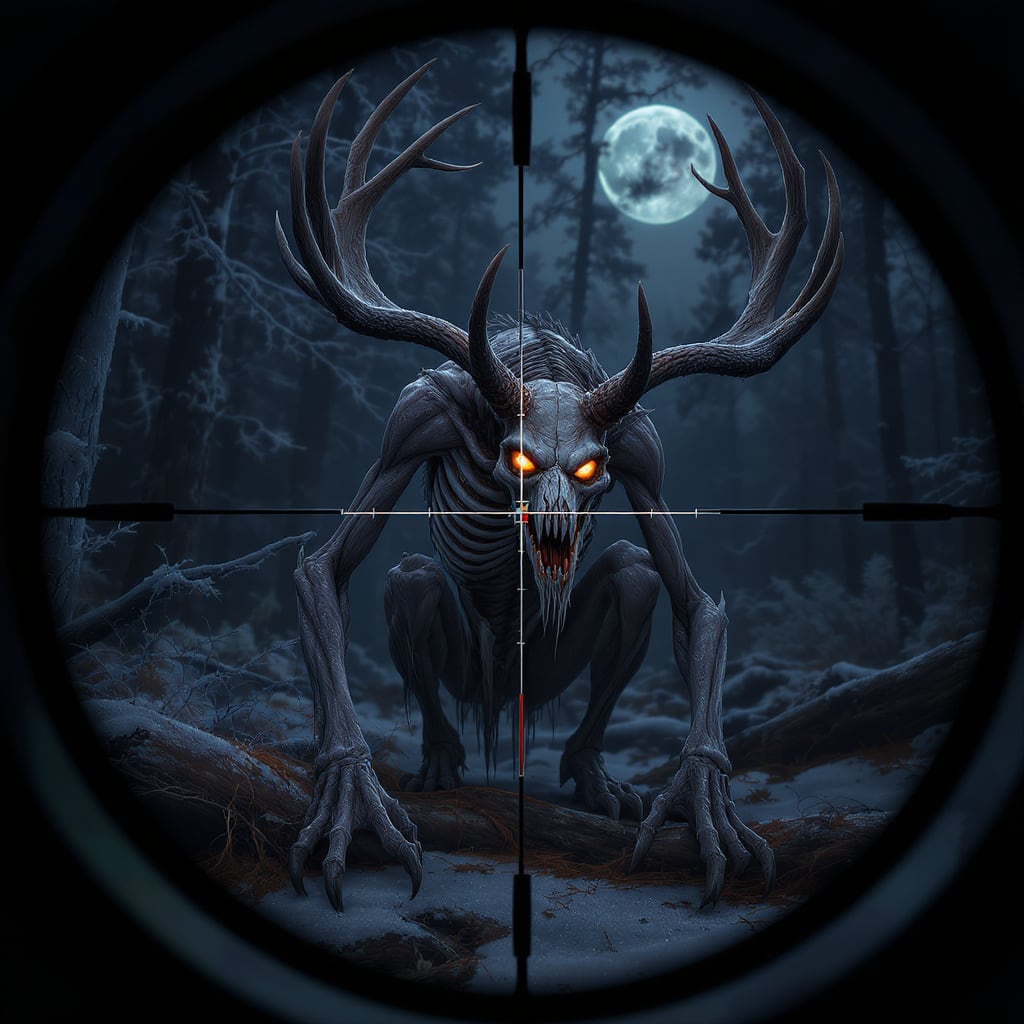
The swamp was starting to freeze over, thin plates of ice forming between the black humps of cedar roots. Calder shifted in the elevated blind, the wood under him groaning as if in protest. His backside was numb from the cold planks, and the stale tang of old gun oil clung to the air inside. They’d been here since before first light, their breath hanging in pale clouds that drifted and died in the open slots of the shooting windows. The faint smell of damp cedar rose from the boards with every creak, mixing with the metallic bite of frost.
Bishop sat opposite, hunched forward, his rifle laid across his knees.
“Last light’s coming fast,” he muttered, glancing at the purpling tree line. The air smelled of resin and cold earth; somewhere deep in the cedars, a frost-laden branch gave a sharp crack, like a bone snapping under weight.
Both men froze.
Bishop’s hands slid to his rifle, lifting it in one slow, practiced motion. Calder mirrored him without a word, the soundless choreography of years hunting together.
Through the crosshairs, Calder saw it—a white-tail buck stepping cautiously onto the run, frost glittering along its flanks. The animal’s breath plumed in quick bursts, catching the last threads of sunlight like ghostly ribbons. The smell of damp soil and distant musk drifted up on the still air.
He adjusted his aim, finger brushing the trigger.
The buck’s ears twitched. Its head turned—not toward the blind, but toward the shadows just beyond the cedar line.
A heartbeat later, it bolted, crashing through the brush with desperate speed, white tail flagging once before vanishing entirely.
Bishop, still scanning through the scope of his rifle, muttered, “What spooked it?”
“Not sure. Wasn’t us,” Calder answered, his voice low. He swept the rifle barrel in a slow arc, glassing the tree line through his own scope.
That was when the forest went dead still.
No wind. No birds. Even the settling groans of the trees seemed to hold their breath. The silence had a weight to it, as if the woods themselves were listening.
Then the cold deepened—fast, like someone had opened a door to midwinter. The air turned sharp, needling through gloves and into the bones. Frost began to creep along the inside edge of the shooting slot, curling like white veins across the wood. Calder could see his breath plume thicker, slower, as though the air itself had grown heavier and was pressing back into his lungs.
Bishop shifted, eyes narrowing. “You feel that?”
A second later, he sniffed, brow furrowing. “Do you smell that?”
Calder didn’t answer. The air had changed—gone was the sharp bite of pine and the damp musk of swamp. Now it carried something older, sour beneath the frost, like dry rot left to fester, laced with a faint, almost sickly sweetness. The kind of smell that clung to the back of the throat and wouldn’t wash out.
He kept scanning, the rifle steady in his hands. Somewhere out there, beyond the cedar line, the dim light broke into shifting fragments through the trunks. For a moment, it seemed as though the shadows themselves were folding in on each other. Then whatever had unsettled the deer was gone—swallowed by the low light and the tightening cold.
“Yeah,” Calder said. “These woods get creepier every year.”
Bishop grunted his agreement, slinging his rifle across his back and shifting his weight toward the ladder. The blind creaked in protest.
“Come on,” he said, “night’s not going to make it any less creepy. Let’s get out of here.”
Calder didn’t move. He kept his rifle shouldered, scanning the tree line with slow, deliberate arcs. Something gnawed at his gut—a deep, wordless pull, the old animal sense that eyes were on him.
“Go ahead,” Calder murmured. “I’ll cover you.”
Bishop froze halfway through turning. The words landed with a weight that didn’t belong to the blind or the hunt. The last time Calder had said something like that, they’d been halfway around the world, sweeping through dust-choked alleys and darkened rooms, every corner a question mark. Back then, the air had smelled of cordite and sweat; here, it was frost and rot—but the tone was the same.
“What’cha feeling?” Bishop asked, remembering how many times his friend’s gut had kept them alive.
“Watched,” Calder said flatly. “Now go on—get down and head for the cabin. I’ll be right behind you.”
“Famous last words,” Bishop muttered, easing toward the ladder. The boards gave a slow, complaining groan under his weight.
Calder kept scanning, tracking each flicker of movement—or what might have been movement—through the scope. He tested every shift and shadow, holding his sights on anything that felt out of place, listening for the smallest betrayal in the silence.
Bishop’s boots met the ground with an icy crunch. “You coming?” he called softly.
“Yeah,” Calder said. “Go on now, I’ll be down in a—”
His voice cut short. Through the scope, his sights locked onto a shadow that seemed denser than the rest. It didn’t sway with the trees. It didn’t belong.
Then it rocked forward, like a predator readying itself for that fatal sprint.
“Jesus… mother of Mary,” Calder breathed, disbelief catching in his throat.
Through the scope, the details snapped into cruel focus—skin stretched thin over jutting ribs, so pale it almost glowed in the moonlight. Its limbs were too long, joints bent in ways that made no sense, the fingers ending in claws that hooked like skinning knives. From its skull jutted massive, twisted antlers, black as wet bark, the tines catching stray light like blades. Its eyes—God help him—burned a molten orange, alive in the dead cold. The mouth hung open in a grin too wide, teeth long and jagged, wet with something that steamed in the frigid air. Frost clung to its hide, and strands of sinew trembled between its hands as it shifted its weight.
“Bishop,” Calder said, low and sharp.
And as if the thing had heard—no, understood—its head snapped upward, locking eyes with him.
Then the whole of it moved—an eruption of muscle and bone, closing the distance with impossible speed for something so big, so heavy.
“What, Cal?” Bishop’s voice came from somewhere below.
“Run, motherfucker, run!” Calder barked, firing once, the recoil punching his shoulder. The creature flinched but didn’t fall. He racked another round, fired again, the muzzle flash lighting its face in split-second strobe—closer now, far too close.
To Bishop’s credit, he didn’t hesitate. He broke into a dead sprint, boots hammering the frozen ground. No questions asked—too many years in the military, too many doors kicked and alleys cleared side by side, had welded them into something close to symbiotic. If Cal said run, Bishop fucking ran.
Calder stayed in the blind, working the bolt with practiced violence, raining rifle shot after rifle shot into the charging shape. He knew he wasn’t putting it down—every hit staggered it for barely a heartbeat before it surged forward again—but he was slowing it… just enough.
Each report cracked through the night like a hammer on ice, the muzzle flashes flaring in the blind’s gloom. Calder’s breath came in sharp bursts, smoke and cordite mixing in the cold air. The thing kept coming, closing the gap in long, loping strides that chewed through the distance as if the snow and roots weren’t even there.
Bishop could almost feel whatever was behind him creeping closer with every stride. A rifle round smacked into the frozen earth just to his left—an errant shot from Calder—but that wasn’t what worried him.
The cabin surged into view through the trees, but his mind snagged on a single, chilling thought: he couldn’t remember which of them had left last, and if the door was locked, he had no idea where the key was.
He wanted to look back, but he knew pulling any energy from this desperate sprint would cost him dearly. His imagination filled the gap instead—something like death itself was chasing him, and in his mind’s eye he was a single scythe-swing away from being cut down. The sickly, rotting stench that filled his burning lungs told him whatever it was… it was close. Too close.
Bishop hit the cabin steps in a leap, boots hammering the planks, hand closing on the latch as his other arm slammed into the door. Mercifully, it gave way, and he was through the threshold in a heartbeat, spinning to swing it shut behind him.
That’s when he saw it.
“Fuck!” he barked, slamming the door in its face. The impact from the other side rattled the hinges and rocked the whole frame.
“Good wood… good wood… good wood…” Bishop muttered like a prayer, as whatever was outside raked and pounded at the barrier, trying to tear its way in.
Then came another rifle crack from somewhere beyond the cabin. A heavy thud, and the assault stopped. A shadow—huge, angular, and wrong—flashed past the window to his right, vanishing into the tree line.
***
“Hammer, this is Longshot. Do you read me? Over.”
For a second, Bishop almost didn’t register the voice—then remembered the walkies they carried for when the woods separated them. He pulled his from a coat pocket, thumbed the transmit button.
“Longshot, I read you loud and clear. Where’s that unholy bastard?”
“Not sure,” Calder came back, voice tight but controlled. “It’s keeping the cabin between us, so I can’t line up a shot. Not that it was doing fuck-all anyway. What’s your status?”
Bishop swung his rifle off his back and crossed to the gun cabinet in the corner. They both had sidearms stashed there, and right now his hands itched for something heavier. The hunting rifles were fine for deer, but this thing wasn’t deer—it was something you put down quick, or it put you down instead.
“I’m loading the Berelli,” Bishop said, pulling the shotgun from its place. “Where’d you put the shells?”
“Damn right, that’s my man. Cabinet drawer, left side.”
Bishop yanked it open. The shells were stacked in neat rows, red plastic winking under the lamplight. He started feeding them into the tube, each round clicking home with the satisfying finality of a decision made.
“You got a plan?” Calder asked through the comms.
“You were always the plan,” Bishop shot back. “There’s a reason they call me Hammer. I’m about to go outside and escort your ass in here.”
“Not sure I like that plan,” Calder radioed back.
“You can’t stay out there, Cal—you know that. You’ve got maybe an hour, two tops, before you won’t be able to feel a damn thing.”
“I already can’t feel a damn thing,” Calder said. “It got cold hella fast when that thing showed up… it’s—” He hesitated, voice tightening. “It’s not natural.”
“What do you think it is?”
“I don’t know. Skinwalker, loup-garou… the fucking devil, as far as I can tell.”
Bishop chewed on that, rifling through half-remembered campfire stories and the kind of warnings old locals gave with a straight face.
“I think… I think it’s a Wendigo,” he said finally. He racked the shotgun, the sound sharp in the cabin’s silence, and began moving room to room, clearing corners and checking locks like he’d done in a hundred mud-walled houses overseas.
There was a pause on the line. “What the hell is a Wendigo?” Calder asked.
Bishop’s voice came back low, deliberate. “Old Algonquin legend. Spirit of winter and starvation. Shows up when the cold and the hunger get bad enough to drive a man crazy. They say it’s what you turn into if you eat human flesh to survive—skin stretched thin, bones like a skeleton, always starving, no matter how much it eats. Hunts the living for meat… but it also takes your mind. Makes you see things, hear things, until you’re walking right into its jaws.”
Bishop finished clearing the cabin, moving with the same methodical sweep he’d used in a hundred combat zones. The windows all had heavy wooden shutters—solid pine, reinforced with crossbars—that could be closed and latched from the inside. Even if the thing broke the glass, it would have to tear through those to get in.
And maybe it could. Hell, probably it could. But by the time it did, it would have a twelve-gauge in its face.
For now, the place was as fortified as Bishop could make it.
“Okay, Cal, I’m about to come get you,” Bishop said into the walkie, moving toward the door.
He froze mid-step. Something shifted above him—heavy, deliberate. The faint groan of roof timbers under weight.
Calder’s voice came through, tight and urgent. “Hammer, hold. The enemy is right over the door.”
Bishop adjusted his grip on the shotgun, angling it toward the ceiling. “What’s it doing?”
“Just sitting there,” Calder said. “Almost like it’s waiting for you to come out.”
Bishop’s mouth twisted into a humorless grin. “Fucker’s got better intel than we ever did.”
“Longshot, you got a shot?” Bishop asked.
“Yeah, I had a shot—I took the shot. Put one right into him. Didn’t do a damn thing but piss him off.”
“Yeah, well, I bet it still hurts like hell. He wouldn’t be using the cabin as cover if it didn’t.”
“Fair,” Calder muttered. “Taking another. Let’s see if this moves him.”
A rifle cracked through the silent night, echo rolling across the swamp. Then another.
“Oh… fuck me,” Calder’s voice came back, tight with strain.
Bishop keyed the mic. “What now?”
“I got bad news… and fucking worse news.”
“Bad news.”
“I’m out of bullets.”
“Worse news?”
“It just jumped from the roof into the next tree in line. This damn thing can climb.”
Bishop’s stomach dropped. “Cal, get down—now! Get out of there!”
He didn’t wait for a reply. Bishop shoved the door open and exploded out into the cold, shotgun raised high, eyes raking the black tangle of branches overhead.
There were maybe five trees between the cabin and the blind. Bishop caught movement in the third one from the cabin—something big, shifting with uncanny speed. He brought the shotgun up, but there was no clear shot; the Wendigo moved like a damn squirrel, always keeping the trunk between itself and the barrel.
Cal had started climbing down, but one glance over his shoulder told him slow and steady wasn’t going to cut it. He jumped.
The landing went bad. His ankle buckled under his weight, a white-hot jolt of pain stealing his breath. He wasn’t a young soldier anymore.
Bishop swore. He knew exactly what came next.
The Wendigo did what any hungry, mad predator would do with fallen prey—it pounced.
Cal’s eyes went wide, the first time Bishop had ever seen raw fear on the man’s normally calm face. The thing was airborne, a nightmare silhouette against the dim sky, moments from tearing into him.
The Berelli roared. The Hammer brought it down hard. The blast caught the monstrosity in the side, sending it twisting mid-air in a spray of frost and shadow.
It flew over Calder, hitting the ground in a heap a few feet away.
“Move, soldier!” Bishop barked, firing another round. “Get your ass up—now!”
Calder shoved the pain out of his mind and forced himself upright, half running, half limping, as Bishop kept unloading on the Wendigo.
One shot sheared part of its antlers clean off, but it still rose—still refusing to stay down.
Calder passed Bishop, their eyes locking for a single heartbeat. Everything was said in that look. Calder was behind; Bishop would lead the retreat.
The Wendigo took the last shell full in the chest and barely staggered.
Bishop turned and bolted, easily catching up to Calder and half-carrying him forward with his momentum. The cabin loomed ahead, cabin door still open. Both men burst through the threshold, spinning together to slam the door home.
The Wendigo hit it again, the impact rattling the frame—but the barrier held.
“Fucking good wood,” Calder said, breathless.
“I know, right?” Bishop shot back, grinning despite himself.
***
It wasn’t until the first rays of dawn that the cabin door creaked open. Heaven help anything that might have been standing on the other side—because Calder and Bishop, armed to the teeth, would have unleashed holy hell on anything that so much as twitched.
But there was nothing.
For a moment it almost felt like they’d dreamed it—some fevered nightmare conjured by the cold and the dark. Then they saw the damage. The cabin’s exterior was shredded, the door gouged with deep furrows where claws had raked again and again.
The ground outside was littered with its tracks, each one too large, too long, to belong to any known animal. And there, half-buried in the frost, was a broken piece of antler—jagged, black at the base. Neither man would touch it.
Through the night they’d waited the thing out. It had tested them twice more—once at the door, once at a window. Both times Bishop’s shotgun had answered, the blasts echoing into the dark. After that, it kept its distance, but never far enough to forget.
Bishop had field-dressed Calder’s ankle, wrapped it tight, and kept the man upright when he faltered. Neither of them had slept, and they looked it. But it wasn’t the exhaustion that hollowed their eyes.
It was something else.
Sometime after midnight, Bishop’s walkie had crackled to life. Calder’s, dropped in his fall, must have been lying somewhere out there in the dark.
And through it came a voice.
It complained about how hungry it was. How cold it was. How badly it wanted to come inside. How it needed to come inside.
That voice was the reason that, for many nights to come—no matter where they were—both men would always, without fail, leave the light on.
- END
About the Creator
Dblkrose
They call me D. I write under Dblkrose. My stories live in shadow and truth. I founded Black Spyder Publishing to lift my voice—and others like mine. A brood weaving stories on the Web. www.blkspyder.com | [email protected]
Baron Midnight: Unearthed
Mama Noire’s parlor pulsed with the scent of copal and cinnamon — a thick, sweet veil curling through the room like the breath of ancient spirits. Candlelight flickered across walls adorned with relics: withered black roses sealed in glass bottles, faded photographs pinned within hand-carved frames, bone beads looped around wooden crucifixes. At her feet, chalked veves glowed faintly, humming with old power.
By DblkroseExclusive • 8 months ago
Becca
"Everything is so... flat." Denille said stupidly as she looked around her new neighborhood. She looked around at the muted desert where even the smallest sign of life seemed to have given up. The plant life was shrubs that were half cooked by the heat and where there should have been a lawn, a mess of white rocks laid glistening in the sun. Even the sky looked stretched thin, like the sun had ironed it smooth. She’d moved from Riverside, where at least there were hills, but here in Barstow, everything felt baked and brittle.
By Sara Wilson5 days ago in Fiction
Follow The Rules
One of the things that was always trotted out was: "If you have done nothing wrong, you have nothing to fear" That would be fine if the systems worked properly and were transparent and above board. People were told that slight changes were needed to ensure the safety of them and their families, and people generally accepted it.
By Mike Singleton 💜 Mikeydred 8 days ago in Fiction


Comments
There are no comments for this story
Be the first to respond and start the conversation.