
Dune: Part Two — A Sci-Fi Masterpiece That Earns Its Epic Status
A Breathtaking Fusion of Visual Spectacle and Philosophical Depth That Redefines Modern Sci-Fi Storytelling

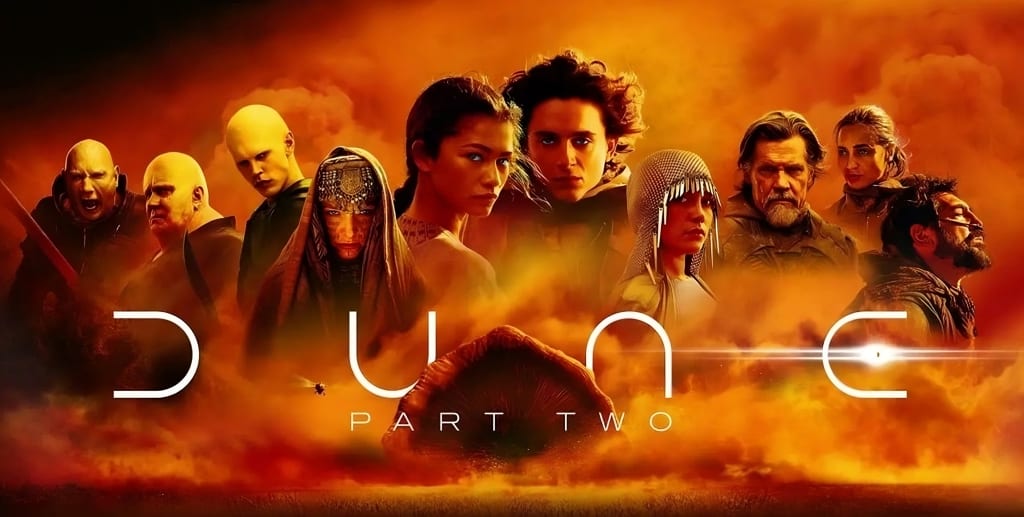
In an age dominated by reboots, remakes, and rehashed franchises, Denis Villeneuve’s Dune: Part Two arrives not just as a sequel, but as a cinematic event. Picking up where the first installment left off, this chapter doesn’t just raise the stakes — it explodes them across the desert landscape of Arrakis in a symphony of sand, prophecy, and power.
Clocking in at nearly three hours, Dune: Part Two wastes no time reimmersing the viewer into the gritty, richly textured world of Frank Herbert’s iconic novel. While Part One was often criticized for its exposition-heavy pacing, Part Two unleashes its narrative momentum with the force of a sandstorm. What follows is a confident, layered, and emotionally resonant film that solidifies the Dune saga as this generation’s definitive science fiction epic.
The Story Evolves
Paul Atreides (Timothée Chalamet) is no longer the boy plagued by visions of a mysterious future. Here, he fully steps into his messianic role, navigating both political intrigue and the spiritual weight of prophecy. His transformation from reluctant heir to charismatic leader is at the heart of this film, and Chalamet delivers his most nuanced performance to date. He is both magnetic and vulnerable, caught between fate and free will.
Zendaya’s Chani, who had limited screen time in the first film, becomes a fully fleshed-out character — fierce, skeptical, and vital. Her chemistry with Chalamet crackles with an intensity that adds an emotional undercurrent to the film’s grandiose scope. But it's not just a love story; it's a relationship forged in rebellion, one that challenges the very destiny Paul is expected to fulfill.
Visually Stunning
Greig Fraser’s cinematography continues to be jaw-droppingly beautiful. Every frame is composed like a painting: sweeping desert vistas, the haunting minimalism of Fremen caves, and the terrifying scale of the sandworms. Hans Zimmer’s score, once again, is thunderous, otherworldly, and deeply affecting — a perfect companion to the film’s thematic gravitas.
The action sequences are meticulously choreographed, but never gratuitous. From guerrilla skirmishes in the desert to intense hand-to-hand combat, the battles are brutal, grounded, and emotionally charged. One standout scene — a duel in the deep sands under starlight — is destined to be iconic.
Themes of Power, Faith, and Identity
What elevates Dune: Part Two beyond typical blockbuster fare is its cerebral backbone. This isn’t just a story about good vs. evil; it’s about the seductive nature of power, the danger of blind belief, and the complexity of revolution. Villeneuve doesn’t shy away from the uncomfortable — he leans into it. As Paul becomes the prophesied "Muad’Dib," we are invited to question whether destiny is divine or manufactured.
The film draws clear parallels to real-world political and religious movements, but never in a heavy-handed way. It challenges the viewer to consider how myths are born — and who pays the price.
The Supporting Cast Shines
Rebecca Ferguson returns as Lady Jessica with even more depth and intensity, grappling with her son’s transformation and her own role in the Bene Gesserit’s grand plan. Newcomer Florence Pugh as Princess Irulan brings an icy intelligence that hints at deeper intrigues to come, while Austin Butler’s Feyd-Rautha is a chilling new villain — unpredictable, brutal, and mesmerizing.
Stellan Skarsgård’s Baron Harkonnen remains grotesquely magnetic, and the expanding political chessboard adds layers of complexity that fans of the book will appreciate — but casual viewers won’t find overwhelming, thanks to Villeneuve’s elegant storytelling.
Final Verdict
With Dune: Part Two, Villeneuve cements his place among the great sci-fi directors of our time. It’s a film that demands to be seen on the biggest screen possible — not just for its spectacle, but for its boldness in marrying deep philosophical inquiry with blockbuster scale.
It’s rare to see a sequel that not only lives up to its predecessor, but surpasses it in almost every way. This is not just a continuation; it’s a culmination. And yet, with more of Herbert’s sprawling saga still to tell, it also feels like just the beginning.
About the Creator
Fazly Rabbi Taimur
Writer of quiet truths and raw reflections. I explore the emotions beneath the surface to create connection and comfort through soul-centered storytelling—for the feelers, the seekers, and those still finding their way.
Keep reading
More stories from Fazly Rabbi Taimur and writers in Fiction and other communities.
Where Reality Ends: Tales Born Between the Lines
There is a place that exists just beyond the reach of certainty, a world neither fully imagined nor entirely real. It lives in the creases of old notebooks, in the spaces between spoken words, in the silence between heartbeats. This is the realm where reality ends—and tales begin.
By Fazly Rabbi Taimur11 months ago in Fiction
Bomb Scare
It was 2027, and the world never thought it would happen. A missle hit the United States, but it wasn't where they had anticipated. A little town in the northeast was hit by a missile strike, they didn't know why, and they didn't know exactly where it hit, but they did know it was a coastal community, somewhere between Maine and Delaware.
By Gregory Paytona day ago in Fiction
The Man in Seat 23
The man in Seat 23 boarded the plane after everyone else. I noticed him immediately. Not because he looked unusual—he didn’t. In fact, he looked completely ordinary. Dark jacket, small travel bag, calm expression. But something about the way he walked down the aisle felt… wrong. Almost like he already knew everyone on the plane. It was a late-night flight from Chicago to Boston, the kind where most passengers try to sleep through the journey. The cabin lights were dim, and the quiet hum of the engines filled the silence. I was seated in 22A, by the window. Seat 23A, directly behind me, had been empty when boarding started. I remember clearly because I had leaned my seat back slightly, enjoying the extra space. But now the man was there. And he was watching me. I could feel it. You know that strange feeling when someone’s eyes are fixed on you? That uncomfortable awareness crawling across your skin. I tried to ignore it. The plane began taxiing down the runway, the engines growing louder as we prepared for takeoff. Outside the window, the runway lights streaked across the darkness like glowing lines. Then my phone buzzed. I glanced down. One new message. Unknown number. The text read: “Don’t look back.” A chill ran down my spine. Slowly, I turned my phone over and locked the screen. I told myself it was nothing. Probably a spam message. But then my phone buzzed again. Another message. “He’s sitting right behind you.” My heart began pounding. I forced myself not to turn around. The plane lifted into the air, pressing me back into my seat as the city lights shrank below us. Another buzz. I hesitated before opening the message. “Seat 23.” My throat went dry. I finally turned slightly, pretending to stretch. The man behind me was staring directly at me. His eyes didn’t move. Not even when I caught him watching. I quickly faced forward again. This was ridiculous. Just a coincidence. Maybe someone on the plane was messing with me. But another message appeared. “He knows what you did.” My stomach twisted. What did that mean? The cabin lights dimmed further as the flight attendants began preparing for the overnight portion of the flight. Passengers settled into their seats. Someone a few rows ahead started snoring. Everything felt strangely normal. Except for the man behind me. And the messages. My phone buzzed again. “Do you remember Boston?” A memory flashed through my mind. Three years ago. A rainy night. A narrow street. Headlights. And a moment I had spent years trying to forget. My breathing became shallow. I typed a reply before I could stop myself. “Who is this?” For a moment, nothing happened. Then the reply came. “Turn around.” I slowly turned. The man in Seat 23 was still staring at me. But now he was smiling. Not a friendly smile. A knowing one. He leaned forward slightly. “You remember me now, don’t you?” he said quietly. His voice was calm. Too calm. “I think you have the wrong person,” I said quickly. The man tilted his head. “No,” he replied. “I don’t.” My phone buzzed again. But this time, the message wasn’t from the unknown number. It was from my airline app. Seat Change Notification. Confused, I opened it. My seat had been changed. From 22A to 23A. I frowned. That didn’t make sense. I looked back at the man. “You’re in my seat,” I said. He smiled again. “No,” he said softly. “You are.” Suddenly the cabin lights flickered. Just for a moment. But when they came back on… Seat 23 was empty. The man was gone. I looked around quickly. No one seemed to notice anything strange. Passengers were sleeping. Reading. Watching movies. My heart raced as I stood up. “Excuse me,” I said to the flight attendant nearby. “The man sitting behind me—where did he go?” She looked confused. “What man?” “The passenger in seat 23.” She checked her tablet. Then frowned. “There’s no passenger assigned to seat 23,” she said. “That’s impossible,” I said quickly. “He was just there.” She shook her head. “You’re the only person assigned to row 22 and 23.” My chest tightened. “What?” She turned the screen toward me. Seat 22A — Me Seat 23A — Me “That must be a system error,” she said casually. “But there was someone sitting there,” I insisted. The flight attendant looked slightly concerned now. “Sir… you boarded last,” she said. “You were the only passenger in this section.” My mind spun. That wasn’t possible. I had seen him. Spoken to him. Then my phone buzzed again. A final message from the unknown number. I opened it slowly. The text read: “You can’t run from yourself.” And suddenly… I remembered. Boston. Three years ago. The rain. The street. The man I hit with my car. The man I left behind. I never told anyone. Never reported it. I told myself it had been too dark. Too fast. Too late. But now I understood. Seat 23 was never another passenger. It was me. The part of me that had been sitting behind my conscience for three years. Watching. Waiting. And reminding me that some passengers… Never leave the flight.
By Baseer Shaheen about 21 hours ago in Fiction
Guard Your Battery
Why are some people so attractive just by standing there? It’s not because they are "likable," but because they don’t need everyone to like them. I realized later that truly charismatic people allow themselves to be criticized, but they never criticize themselves. They never try to please the world; instead, the world stops to watch them.
By Emily Chan - Life and love sharing3 days ago in Poets


Comments
There are no comments for this story
Be the first to respond and start the conversation.