

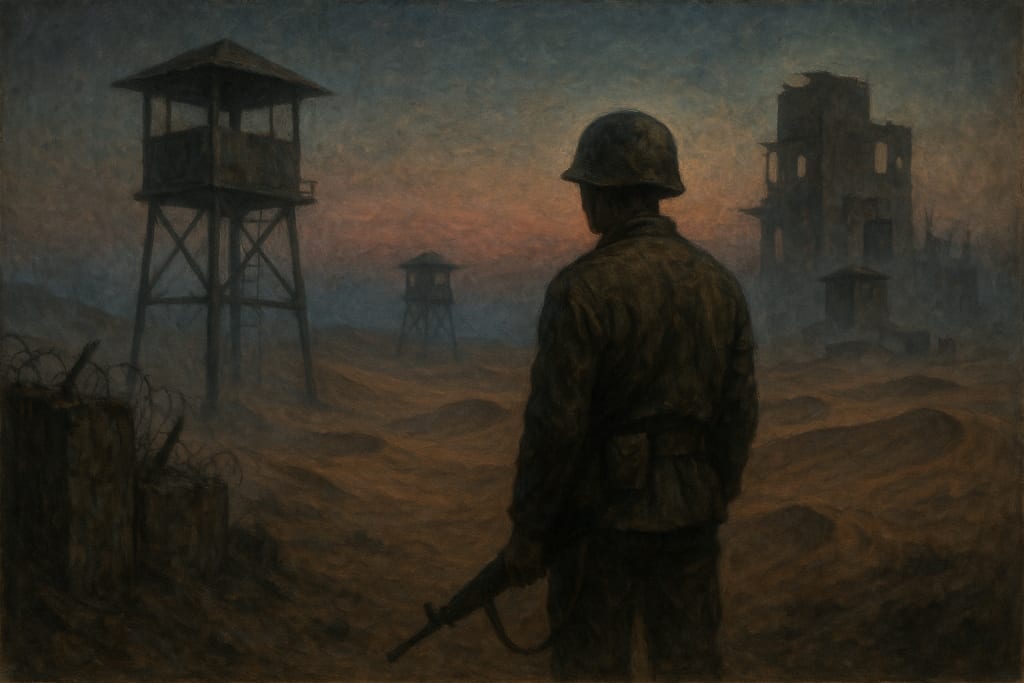
They told Corporal Nathan Heller he was cleared for discharge.
They gave him papers. A date. A handshake. And a final mission: escort one last supply convoy to Forward Outpost Echo—then he’d go home.
Home. That word hadn't meant much for a while.
Outpost Echo sat at the edge of the war. A fog-choked ravine guarded by shadows and silence. No insurgent activity for weeks, they said. Easy run, they said.
But Nathan knew the war never gave easy.
---
It was a simple formation—two armored trucks, a lead jeep, and Nathan riding shotgun with Lieutenant Brooks. The ride out was long and wordless, the convoy tires chewing sand and mud beneath an overcast sky.
Three hours in, the radio went dead.
“Storm interference,” Brooks said.
Nathan wasn’t convinced. Static didn’t come in whispers.
He glanced at the rear-view mirror. The supply truck behind them wavered in the haze, its driver’s silhouette stiff, unmoving.
Brooks tapped the wheel. “What’s the first thing you’ll do when you get back?”
Nathan didn’t answer. He watched the fog ahead twist unnaturally. Like it knew they were coming.
---
Outpost Echo looked more like a ruin than a post.
The watchtower was unmanned. The outer floodlights flickered. No one greeted them at the gate.
“Where the hell is Echo Company?” Brooks muttered.
They parked. Stepped out. Nathan’s boots sank slightly into ash-dusted dirt.
No guards. No voices. Just the low hum of the wind and something beneath it—*a breath?*
They swept the compound. Barracks, mess hall, command center—empty.
But not untouched.
Chairs were overturned. Half-eaten rations lay on tables. Radios buzzed with dead channels. Guns were left behind.
People had left in a hurry.
Or… not at all.
Nathan pushed open the infirmary door. Inside, a cot still held a dent. An IV bag swayed gently above it, as if someone had just vacated it.
Then he saw the message scrawled on the far wall.
"WE NEVER LEFT."
---
The convoy set up defensive positions. Brooks tried calling base—no signal.
“I’ll give it until morning,” he said. “If Echo doesn’t show, we roll out.”
Nathan didn’t argue.
But he didn’t sleep, either.
That night, he heard the first scream.
It wasn’t human.
---
At dawn, the rear driver was missing.
His boots were by the truck. Inside them: blood. Nothing else.
No drag marks. No footprints. Just a trail of wet dust leading back to the fog-choked ravine.
Brooks locked down the post.
“I want eyes on every corner. No one leaves alone.”
But the outpost seemed to shrink around them.
Rooms they’d searched yesterday now had new doors. Walls had shifted. Windows showed darkness where sun should be.
Nathan found his own face in a photograph on the wall—dated two years before his enlistment.
In it, he was standing among a different squad. All names unfamiliar.
Their eyes were hollow.
---
That night, Nathan had a dream.
He was lying in the Echo infirmary. Tubes in his arms. Chest bandaged. A figure stood over him, face hidden by a surgical mask.
“Time to wake up, soldier,” it whispered.
He sat up with a gasp—only to find himself still in the infirmary cot.
The IV was real.
So was the whisper.
"You never left."
---
He confronted Brooks the next morning.
“This isn’t real.”
Brooks blinked. “Say again, Corporal?”
“This outpost. The convoy. You. None of it’s real.”
Brooks studied him quietly. Then said, “You remember it now, don’t you?”
Nathan’s mouth went dry. “Remember what?”
“Operation Fireline. You were hit. Shrapnel. Collapsed lung. You flatlined for three minutes.”
Nathan staggered back.
Brooks took a step forward. “You weren’t discharged, Heller. You were reactivated. Recalled. Brought back.”
“No,” Nathan whispered. “I was going home.”
“You don’t get to go home, Corporal. You died here. This place—this war—it claimed you. You didn’t leave. You just forgot.”
---
The outpost changed after that.
The fog thickened. Shadows deepened.
He saw his old squad wandering the halls—men long dead, faces half-forgotten. They never spoke. Just stared with frostbitten eyes.
Nathan found his medical file in the infirmary drawer.
DECEASED: KIA
COD: Internal bleeding, respiratory failure.
Status: MIA – No recovery.
Stamped across it in red:
DISCHARGE DENIED.
---
He ran.
Tore through the compound, through the haze, until the desert opened up before him.
There was the convoy.
Abandoned.
The tires were rotted. Windshields cracked. The metal was rusted and bullet-scarred.
He looked at his own hands.
Faded.
Translucent.
He hadn’t aged. He hadn’t eaten. He hadn’t bled.
Because he was never alive.
Not anymore.
---
Then he saw the figures in the mist.
Not enemies. Not soldiers.
Others.
Hundreds of them.
Men and women in uniform, walking in slow, silent patterns. Endless circuits. All with the same hollow stare. All denied release.
He stepped back—toward the compound.
Brooks waited at the gate.
“You understand now,” he said.
Nathan’s voice cracked. “Why me?”
“Because you weren’t ready. Because you still thought you could leave.” Brooks gestured behind him. “None of us were ready. This is the front line between forgetting and remembering.”
He handed Nathan a folded slip of paper.
It was his discharge form.
Approved.
Signed.
Then crossed out.
REVOKED.
---
Nathan dropped to his knees.
“I just wanted to go home.”
“You are home,” Brooks said gently. “This is the last post. The war behind the war. The place where memory runs dry, and soldiers keep watch over ghosts.”
The fog swallowed his words.
And somewhere in the distance, the scream came again.
---
Corporal Nathan Heller was listed as missing in action. No body was recovered.
But if you listen carefully near the edge of the ravine where Outpost Echo once stood, you might hear boots on dust, radios crackling with no voice.
And a whisper behind the static.
“Discharge denied.”
A false hope of home.
---
About the Creator
E. hasan
An aspiring engineer who once wanted to be a writer .
Pearl
1980 something. we all hung out at Pearl and you and i were nothing special, or so i thought. i mean we all danced, drenched in our own sweat, our own saline solution of fear, too many beers, shots, laughter, tears, fucks in the bathroom and i don't know when we began to be afraid. do you?
By ROCK aka Andrea Polla (Simmons)6 days ago in Fiction
Okay.....
Everyone walks and just keeps walking. No one stares or says a thing; they just keep walking. They say nothing as she walks among them. Her beauty is overwhelming, yet her pigmentation doesn't set off alarms. She looks as though she's been drinking too much carrot juice or has taken too many beta carotene tablets.
By John Scipio6 days ago in Fiction



Comments
There are no comments for this story
Be the first to respond and start the conversation.