
Derelict of Duty
Oh Captain, My Captain, Uncharted Course Clear


The series of events that reversed the course of Jefferey Gates’ life are seared into his conscience. Dubious about the value, or even the existence, of conscience until that day, those events brought it to fire-breathing life, the slumbering dragon first stirring with his sister’s irritating morning phone call.
“It’s Anthony,” Melony had coughed-up between sobs. Anthony is his nephew; his sister’s only son.
“What’s wrong now,” he’d coldly replied. His intellect was once run by the cold condescending calculations of the chief executive and largest shareholder of the world’s dominant online retailer. He could afford no other manner of mind. Everything is about seeing the course before everyone else. And the course here was obvious. Anthony was a drug addict, and he was tired of being the one to intercede; to place opportunity at the feet of the uncouth, ungrateful youth simply because he could ‘afford it.’ He was so tired of it, in fact, that he’d ignored three calls from Melony before finally giving into the fourth.
“This is different, Jeff,” she weightily insisted. “He’s lost. Gone. On the streets somewhere. And the police have done everything they’re willing to do.” The depth of despair in her voice was enough to trouble even him. Sentimentality was a weakness that he could seldom afford, even in his rare time off; but this had a different feel to it. The pathos evoked by his sister’s tone was commanding in its wretchedness; possessing in its frailty. To the great astonishment of the most celebrated captain of industry, the sound of his little sister’s utterly defeated, deflated voice provoked pangs in his heart.
A seventeen-year-old truant, Anthony hadn’t been home for over a month. Melony assumed he’d been staying at the home of one of his older loser friends, if you can call such places ‘homes’ with a straight face. But early that morning her neighbor had seen him during her coffee run in downtown Portland, dirty and disheveled, in a clear state of self-neglect. According to the distressed neighbor she’d tried to talk to him, but he’d rebuffed her, then pridefully puffed-out his chest and spat in her direction before turning and scuttering off the opposite way, a filthy, tattered trench coat dragging at his heels.
Begrudgingly, Jeff acceded to taking the day off, and, through a colleague, found and promptly engaged the services of a reputable PI in Portland. Working from his last known whereabouts at the place of the early morning confrontation, the PI proved most proficient, quickly identifying Anthony and, on orders, confronting him for a second time. With every affect of kindly consideration that he could muster, the PI requested that Anthony call his mother or uncle, both of whom were worried about him.
“Worried?! Hah!,” he’d reportedly sneered. “My uncle?! Please. Tell that pompous prick that if he wants to talk to me he can fuck-off with all the hired help and drag his aristocratic ass down here himself!”
Backing off, the PI was nevertheless able to track Anthony to a derelict apartment building adjacent to the city’s northern waterfront. The building was in shambles, having been badly burned, then torn apart, during the height of the BLM rallies, its one-time renters fleeing in horror.
From Washington State, it took Jeff less than an hour for he and his bodyguard to fly into Portland, another half hour to reach and briefly engage the PI downtown and, within two hours of being informed of Anthony’s location, he was on the scene. Money buys everything. Everything but the ability to escape the tyranny of the troubled heart.
He’d seldom seen such a place, much less entered. It reminded him of the pictures he’d once skimmed over in the New York Times showing the remnants of Iraqi war zones following our ‘emancipations.’ Half of the six story structure, the side opposite the river, had been blackened by a recent fire. Portions of the roof were missing, as were most of the windows. Shattered glass, stones, and debris of every order littered the gloomy grounds. The homeless had encircled the structure with a tented encampment, sad shelters strewn about of every type and color of fabric, with many of their occupants aimlessly wandering through the resulting mishmash, several gyrating, dancing, mumbling and stumbling in tribute to the day’s pain-mitigating intoxications. But the real shock came when he and his bodyguard, Samuel, crossed the threshold of the missing double doors once guarding the entrance into the lobby.
It wasn’t the fact that the open area was the unlawful domicile of dozens of the most pitiful people anyone could ever lay eyes on, to the extent that, in his initial impression, at least, creatures seemed their more apropos designation. It wasn’t the disrepair, the garbage, or even the foul mixture of excrement, urine, alcohol and who knows what else bombarding his nasal canal and inducing tears of protest from his eyes. It wasn’t even that early emergence of half-conscious guilt attempting to pry its way into his defiant awareness; that purposefully-buried, half-formed comparison to his own circumstances that just barely managed to lay a finger upon him when he walked down the streets of Seattle, and which now seemed to be readying to reach for his throat. He’d mentally prepared himself for such discomforts, though their reality proved more difficult to swallow. No, the real shock hit when he recognized someone immediately, right there in the toilet bowl of hell! And it wasn’t Anthony.
Warren Zucker had been his best friend at Princeton. They’d met during his first computer science class, and had laughed about the instructor’s horrid body odor whenever he leaned over them to point something out on their computers. They quickly became close. They were both nervous, vulnerable kids in those days, not the titans that they were destined to become. Yet here was one of those two titans being gnawed at by Zeus himself, torn to shreds by the hounds of Hades, the personification of wretchedness; a man he’d known to be brilliant, and possessing of the brightest of futures, and who, upon last report, was reigning over a reputable, lucrative software company right there in Portland.
How?! What could possibly have…
The sheer dumbfounding, numbing effect of the encounter purged his search for his nephew from his mind, though Anthony would come to him within an hour, as flabbergasted to stumble upon his uncle there (uncertain if it was the drugs) as his uncle was to find his best friend from university. Zucker… It surged up from the chasm of his lost memory, in this most unreal rejoining... a rare young man who’d shown him the tender truth of authentic understanding and friendship for the first time, and maybe last time, in his wildly successful life. Jefferey got in close to him, sat upon something, not even noticing what it was, and peered into his once ambitious, beaming companion’s now listless, lifeless eyes.
The hours unfolded with fleeting ease after that, even as his bodyguard, Samuel, hand tremoring on his hip, pleaded for them to leave, with darkness descending and the activity in and around the building increasing in both population and intoxicated intensity, many encircling to witness the wonder of their ‘Zucks’ engaged in some sort of strange rags-and-riches ritual. It took Zucker a few minutes before awakening to who had sat down next to him, ten minutes more to cast off his stupor to the extent of being able to form full sentences, and another half hour before he really got into the nitty gritty of it all. But eventually the dam broke, bursting forth with the flood that would cast Jefferey towards his new, true purpose.
Warren Zucker’s daughter was only twelve when a next door neighbor’s ungentlemanly interest led to her rape and murder. Inconsolable, bouncing between fits of fury and utter dejection, his wife Rebecca, the woman whom he’d fallen in love with his sophomore year at Princeton and moved to Portland to start a life with, the love of his life, killed herself. She’d been on her way to see her therapist when, crossing St. Johns Bridge, she’d suddenly pulled over and parked her car, blocking the right lane. To honking horns and cries of indignation at her indecency for interfering with their day, she’d hurled herself over the side and plummeted four hundred feet to her death, the Willamette eventually depositing her six miles downstream. Warren imagined that her memories of playing in the park and listening to music beneath the bridge with their daughter, Tanya, had overtaken her, crushing her heart, followed by her body.
“I should have been with her… I should have been with her… I should have been with her…” He repeated it over and over again to his one-time companion, and it was clear to Jefferey that he’d been caught in the self-reproach countless times before, so difficult was it to pull him from the tortured track.
Warren had a mental breakdown, then was forced to resign, and eventually lost everything.
Upon hearing this tale in detail, Warren seeming to omit nothing, caught in the current of the broken dam’s cathartic demands, something came over Jefferey. He’d gained a sort of tunnel focus upon the pain pouring from his friend, his emotions wracking him in a way that he’d never known, awakening him to a reality that had been hidden away until now. Looking around the space, he’d peered into the genuinely curious, the horribly weathered, the inebriated faces, one of whom was his own nephew’s, who stared at his seemingly sympathetic uncle with disbelief. Jefferey noticed their smudges and smears, their imperfectly-fitting, hole-ridden attire, their unholy need of medical attention and real refuge. Somewhere in his hollowed-out heart he fissured, and from the fissure something sprouted.
Standing, he walked to the middle of the gutted, shabby lobby. Looking around the room, there must have been near to a hundred people, most of whom were fixated upon him, the man in the five-thousand-dollar suit. His throat seized for a moment, then, quietly, seeing Anthony at his side, he reached into his wallet and pulled out the cash, uncounted. Handing it to Anthony, he urged him to go with a few of his friends and buy as much food as he could, then return. He then handed his Rolex to a little boy, who peered up at him like he was Moses. Seeing a woman shivering in the corner, futilely attempting to comfort her young daughter sitting on the cold concrete floor beside her, staring at him with a mix of confusion and disdain, he removed his coat and approached in order to place it around her. She shrunk back in self-defense at first, but soon accepted the act of kindness, her face sinking into a sea of heart-broken gratitude. Some sliver of humanity yet survived after all, her eyes seemed to say.
That was the inception of Jefferey Gates’ reformation, and the reform has been taking shifting, soaring shape ever since, becoming the very beacon of human hope. He looked into the ownership of the abandoned building the next day and, within a month, had acquired it. Working with his lawyers, he remade it into a homeless shelter, the finest in the city, and personally administered it for its first few months. With that experience, the honor of the revolutionary activist sprung from his heart, and he realized the extent of his power. He could heal people. He could buy away their misery and grant them comforts and opportunities whose value were exponential compared to what he had been taught and long believed was valuable, his former investments yielding next to nothing by comparison.
He stepped down from his gilded throne, liquidating his shares and activating his resources. He began buying similar abandoned buildings, transforming them into lease-to-own tenements, charging far less than it would require to recoup his investment. He started seeking the most needy and desperate, paying off medical and student debts and mortgages that were gradually decimating the lives of those unable to continually bear their burden, their families perpetually, violently splashing in the attempt to keep their heads above water. His whole-hearted returns became his addiction, revealing massive unrealized wealth. ‘Maybe I can do even more,’ he thought; ‘actually remake systems and societies.’
He bought businesses, tore up their contracts, and initiated the business collective revolution, giving them to their employees-turned-part-owner-operators, everyone granted a piece of the bottom line based upon the relative estimated value of what they brought to the operation. He formed a non-profit dedicated to making those of limited means part-owners of their professional endeavors, and owners of their own homes far sooner than they otherwise would have been able, providing logistical, legal and financial support throughout. He backed the tiny home movement, pushing minimalist concepts past the legal roadblocks set by developers. He bought extensive rural properties in places once containing the highest concentration of Native Americans, then, approaching their chiefs in their typically meager lodgings set upon poor lands, offered them lush lands, requesting that they honor their old traditions and way of life, and hopefully invite him to visit. He enacted a similar strategy in the Polynesian, giving the natives of the Pacific Islands a bigger piece of the pie that had been violently torn from their tables.
And all the while there was Warren and Anthony beside him, agents of the revolution that started with shock, then awed everyone with the extent to which hearts and minds aligned in solidarity, backed by the honorable sense of duty which only the heart reveals, may remold life’s forever malleable reality.
About the Creator
Nick Jameson
Of the philosopher-poet mold, though I'm resistant to molds. I'm a strongly spiritual philosophical writer and progressive ideologue. I write across genres, including fiction, non-fiction and poetry. Please see my website infiniteofone.com.
Keep reading
More stories from Nick Jameson and writers in Fiction and other communities.
Flip Pond
Alexander Trappings’ favorite time of day is the early morning. Really, it’s the only time he cares about. It’s life before death. He purposefully rises before his wife, Ruth, and prepares his large morning French press. Black coffee. Straight to the point. No adulterants. And with the steeping, freshly ground beans he also steeps himself, in some combination of his own and others’ imaginings and ruminations.
By Nick Jameson4 years ago in Fiction
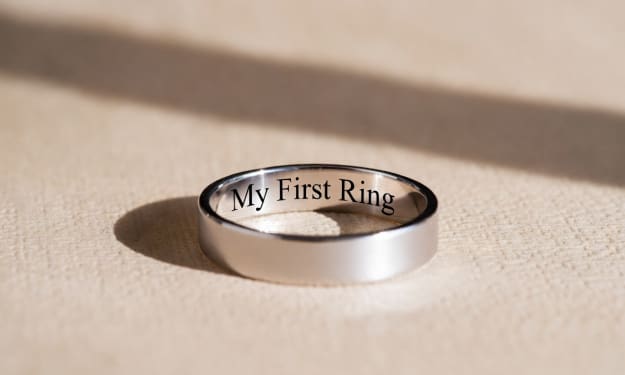
My First Ring
I was nineteen when I wore my first ring, and it wasn’t diamond-studded or heirloom-worthy. There was no velvet box, no trembling proposal, no audience holding its breath. It was simple, thin, and slightly loose on my finger. But to me, it felt enormous—heavy with meaning, expectation, and a quiet kind of bravery I didn’t yet know how to name.
By Engr Bilal7 days ago in Fiction



Comments
There are no comments for this story
Be the first to respond and start the conversation.