

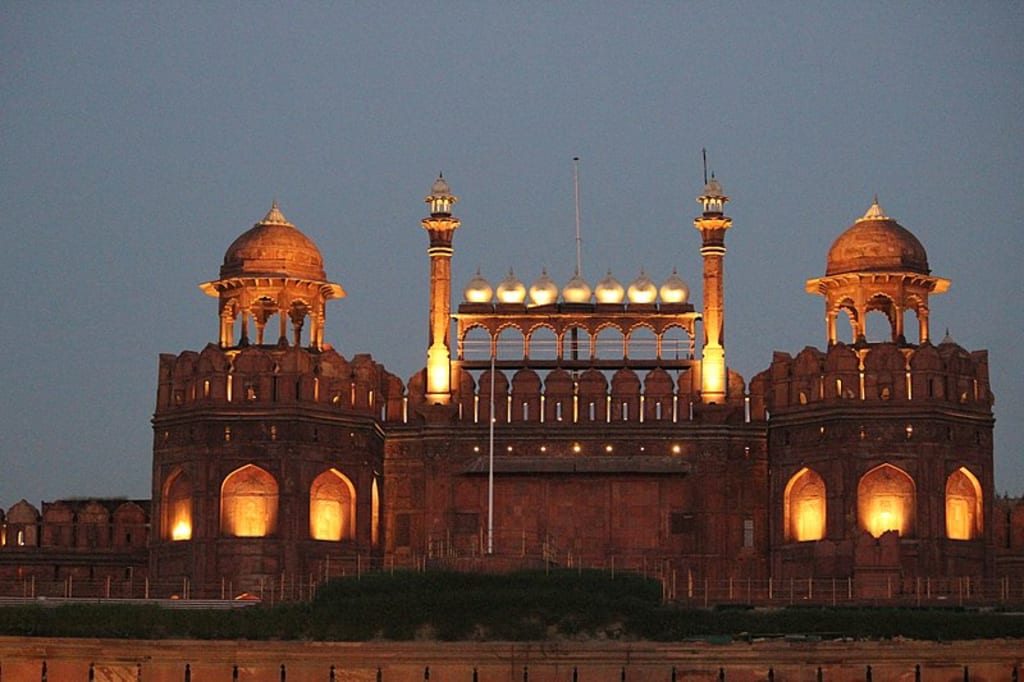
The Delhi Lal kila , also known as the Red Fort, is a historical fortress located in the heart of Old Delhi, India. This imposing structure was built by Mughal Emperor Shah Jahan in the 17th century and is one of the most popular tourist destinations in the city.
The Red Fort spans over 250 acres and is surrounded by high walls made of red sandstone. The walls are over 30 feet tall and have two main entrances, the Lahore Gate and the Delhi Gate. The Lahore Gate is the main entrance and faces towards the famed Chandni Chowk market.
The fort is an architectural marvel and is a testament to the grandeur of the Mughal era. The intricate carvings and details on the walls and domes of the fort are a fine example of Mughal architecture. The fort is also home to a number of important structures, including the Diwan-i-Aam, the Diwan-i-Khas, the Rang Mahal, and the Khas Mahal.
The Diwan-i-Aam, also known as the Hall of Public Audience, was where the emperor would meet with his subjects and listen to their grievances. The hall is an open courtyard surrounded by columns and is covered by a roof supported by two rows of pillars. The Diwan-i-Khas, on the other hand, was the Hall of Private Audience, where the emperor would meet with important dignitaries and guests. This hall is smaller and more intimate than the Diwan-i-Aam and features a beautiful throne made of gold and silver.
The Rang Mahal, or the Palace of Colours, was the residence of the emperor's wives and mistresses. This palace is decorated with intricate floral designs and is surrounded by a pool of water that reflects the beauty of the palace. The Khas Mahal, or the Private Palace, was the residence of the emperor and his family. This palace is a three-story structure with ornate balconies and is made of white marble.
The Red Fort is also home to a number of other important structures, including the Hayat Bakhsh Bagh, which is a beautiful garden with fountains and water channels, and the Moti Masjid, which is a small mosque made of white marble.
One of the most interesting features of the Red Fort is its sound and light show. The show is held every evening and depicts the history of the fort and the Mughal era through a stunning display of lights and sound effects.
The Red Fort is an important symbol of India's history and is also a UNESCO World Heritage Site. It has been the site of many important events throughout India's history, including the Indian Rebellion of 1857 and the Indian independence movement. The fort is also the site where the Indian flag is hoisted every year on Independence Day, which is celebrated on August 15th.
Visitors to the Red Fort can explore the various structures and palaces inside the fort, and can also enjoy a leisurely stroll through the beautiful gardens. The fort is open to visitors every day except on Mondays.
In conclusion, the Delhi Lal Qila or the Red Fort is a beautiful and historic monument that is a must-visit for anyone traveling to Delhi. Its grandeur and beauty are a testament to the skill and artistry of the Mughal era, and its importance in Indian history makes it a significant cultural landmark. A visit to the Red Fort is a journey through India's rich past, and a chance to appreciate the country's incredible architecture and history.The fort is named for its distinctive red sandstone walls, which stretch for over two kilometers and rise to a height of up to 33 meters. It is an excellent example of Mughal architecture, blending Islamic, Persian, and Indian styles.
The fort complex comprises several buildings and structures, including the Diwan-i-Am (Hall of Public Audience), where the emperor would receive his subjects and listen to their grievances, and the Diwan-i-Khas (Hall of Private Audience), where he would meet with important officials and foreign dignitaries.
Other notable features of the fort include the Rang Mahal (Palace of Colours), which housed the emperor's wives and concubines, the Moti Masjid (Pearl Mosque), a small mosque made of white marble, and the Hayat Bakhsh Bagh (Life-Bestowing Garden), a large garden with fountains and water channels.
The fort was designated a UNESCO World Heritage Site in 2007 and is now a popular tourist attraction, drawing millions of visitors each year. It is also the site of several cultural events and celebrations, including the annual Independence Day ceremony, during which the Indian prime minister delivers a speech from the ramparts of the fort.
About the Creator
Keep reading
More stories from writers in Fiction and other communities.
Again
The sun pierced through the gaps in the bamboo blinds across our bedroom window. Though I was already on the precipice between the waking and the sleeping world, I allowed myself the leisured pleasure of basking in the quiet contemplation that came only from lying alongside the slight but warm curves of my dear Marguerite.
By Paul Stewartabout 21 hours ago in Fiction
Wild Card Weekend Recap: What Happens Now?
I think I figured out why I love Wild Card Weekend so much. It's because it's the first playoff anything of the calendar year. The NFL season starts in the fall, and once upon a time, the champion was crowned either on or slightly before New Year's. The evolution of the NFL schedule has resulted in the playoffs starting just into the New Year, and currently, the final week of the season falls on the first weekend of the New Year, with Wild Card Weekend coming a week after that. So yes, chronologically, the NFL's Wild Card Weekend serves as the first playoff anything of the calendar year.
By Clyde E. Dawkins7 days ago in Unbalanced




Comments
There are no comments for this story
Be the first to respond and start the conversation.