
Deep Underground
A dream where silence, fear, and obedience were the only rules.

I rarely have dreams. It happens so infrequently that when they do appear, I immediately know they are different from the usual nothingness of sleep. This one was exceptionally strange. That night I spent long minutes, almost obsessively, trying to memorize every detail—places, colors, emotions—as if I subconsciously knew I could not allow it to disappear.
It began innocently.
I was with my younger brother at a metro station… or perhaps a train station. Even now I cannot say for certain what kind of place it was. It felt suspended between the two, as if it existed somewhere in between. We talked for a while. I no longer remember what about, but the conversation quickly turned into an argument. Our voices rose, and soon we were fully focused on each other.
And then everything changed.
Out of nowhere, a group of young people appeared. There were maybe ten, maybe fifteen of them, all around fifteen to twenty years old. They surrounded us tightly, without explaining their intentions in any way. Before I could ask a single question, the platform we were standing on began to descend.
We immediately stopped arguing.
Confused and shocked, we tried to understand what was happening. The platform moved slowly but relentlessly downward. Very deep. The people around us stood in silence, closing in tighter and tighter, leaving us no room to move. No one spoke. Absolute silence.
After a while, we reached the bottom.
We were deep underground. One of the boys shouted:
“We’re here!”
Only then did I notice other platforms—elevators full of people who had been brought down in exactly the same way as us. Surrounded, guided forward, without the right to ask questions. All the groups were merged into one large column, led by a single chieftain and his guards.
The first rule was simple: do not touch the water. It kills.
To demonstrate, the chieftain chose one of the captives and threw him into a pool. The water looked completely normal, but the moment it touched his skin, it began to dissolve his body, as if he had never existed.
People were terrified. No one moved. No one screamed.
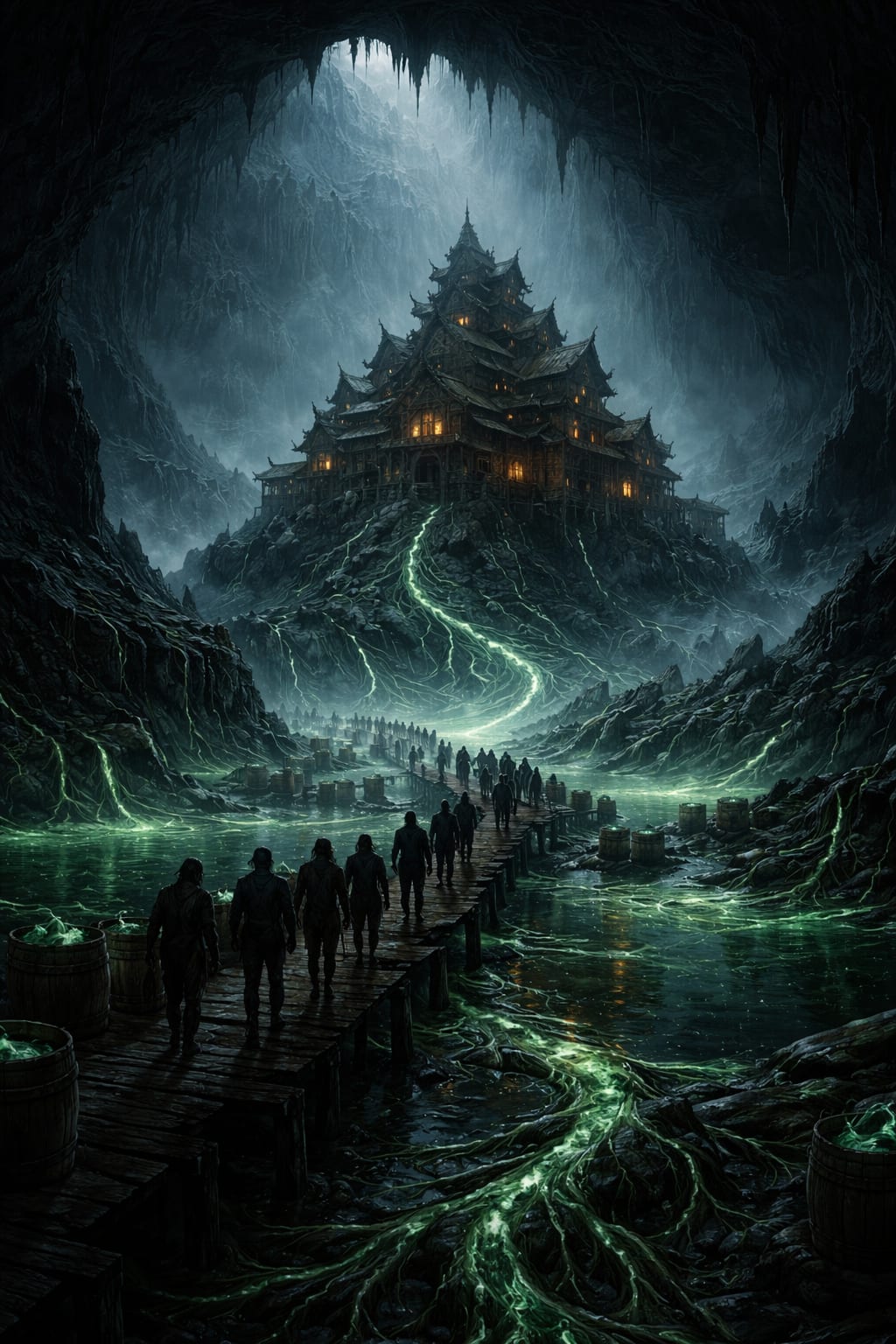
The surroundings looked like a winter landscape—mountains loomed in the distance, and the deadly water was everywhere, yet there was no snow. Instead of trees, strange pulsating veins ran through the ground, spreading like roots, even though there were no trees at all.
In silence, we marched toward a hill. At its peak stood an enormous palace, built entirely of wood.
Inside, there were only women.
They were dressed elegantly, impeccably, yet completely devoid of emotion. Without a word, they prepared food, set the tables, and brought out meals. We were seated at long tables, and the chieftain said:
“Eat and regain your strength. You will need it.”
After dinner, we were assigned our task.
Using a strange device, we were to extract a substance from the pulsating veins. No one explained what it was—it looked like thick, green blood. We were instructed to wear gloves and be careful not to spill it on ourselves. It, too, was lethal.
The substance was stored in barrels, but no one said why.
Contact between prisoners was forbidden. We communicated only through gestures and nods. Anyone who broke the rules died. They were taken to the main node of the veins—an enormous, tumor-like mass. A maw would open, and the unfortunate person was placed inside and digested, becoming more of the green sludge.
All personal belongings were taken from us. Somehow, I managed to hide my phone. I tried to contact the woman I loved, but there was no signal so deep underground.
At the end of each day, the chieftain and his trusted followers would select one or two people, offering them a chance to join their group. At the same time, someone was always sacrificed—to ensure fear continued to rule over us.
This time, it was my younger brother.
He was thrown into the tangle of veins and ceased to exist.
I wanted to do something. To move. To scream. Another prisoner stopped me, risking his own life.
“My sister was sacrificed too,” he whispered. “You won’t change anything. Don’t even try.”
I lowered my head.
The chieftain approached me, felt my pocket, and asked:
“What’s this?”
A phone.
“You will share your brother’s fate… or we’ll give you another chance.”
He grabbed my arm and ordered me to march toward the mountainside, above the water, where narrow walkways were suspended.
“If you cross and somehow survive this hostile environment, you’ll be lucky.”
I asked:
“Are you sure?”
He replied:
“No. We’ll shoot you before you succeed. Those are the rules.”
He looked slightly sad. And that surprised me the most.
At that moment, the dream ended.
I don’t know what happened next
About the Creator
Piotr Nowak
Pole in Italy ✈️ | AI | Crypto | Online Earning | Book writer | Every read supports my work on Vocal
Keep reading
More stories from Piotr Nowak and writers in Fiction and other communities.
404: Reality not found
Chapter 1 – The Beginning When this story started, my life looked completely different from what it is now. I had been stuck in an amphetamine cycle for a few years, one I couldn’t escape anymore. Days blurred together—work, nights, loneliness. Everything felt like a smudged picture, and I no longer knew whether I still had any control or if I had lost it long ago.
By Piotr Nowak2 months ago in Chapters
The Persistence of Elpis
Everything disastrous in that household had been Epimetheus's idea, and Myrto had worked for the family long enough to know that when the master of the house said something like it's perfectly safe, just don't open it, the correct response was to begin mentally cataloguing which of your personal belongings could be easily replaced.
By Tim Carmichaelabout 15 hours ago in Fiction



Comments
There are no comments for this story
Be the first to respond and start the conversation.