
DECODING THE MAN FROM A NON-EXISTENT COUNTRY
DOES TIME TRAVEL REALLY EXIST? WILL THE FUTURE AND PAST BE CHAOSED?


On a summer day in Oia in 1954, at Haneda International Airport in Tokyo, Japan, passengers streamed through passport control. Everything seemed normal until a middle-aged, well-dressed man approached the immigration counter. Customs officers examined his thick passport, and suddenly, an eerie silence fell. The passport appeared valid, containing visa stamps from numerous countries, but there was one inconsistency. It was issued by a country called Taured, a nation that didn't exist on Earth.
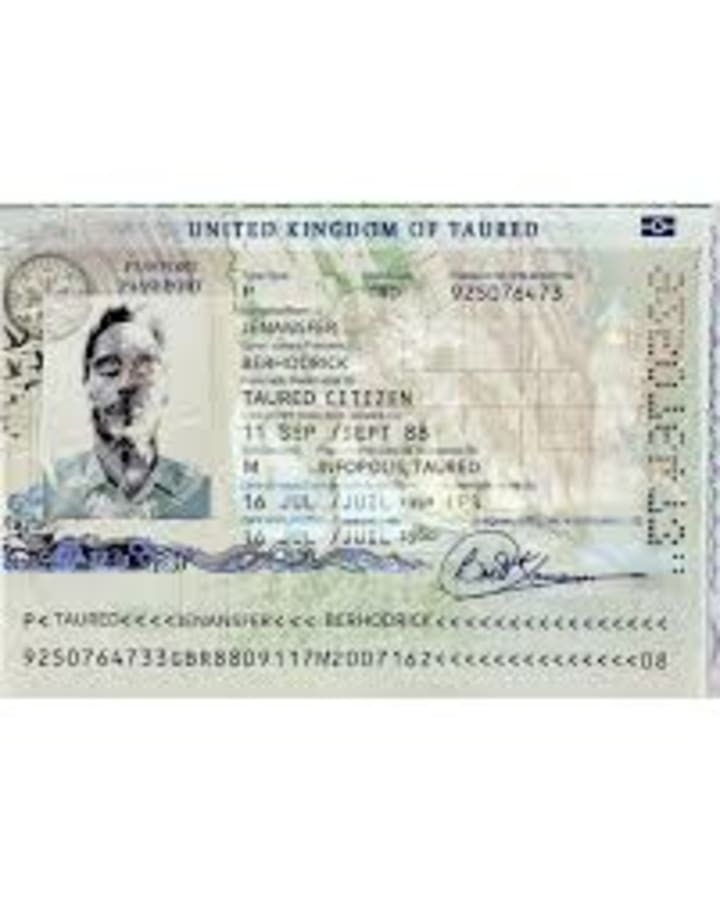
The man was immediately detained for questioning. He became agitated and insisted that Taured was real, a country that had existed for over 1,000 years and was located somewhere between France and Spain. The Japanese immigration officials were astonished.
They showed him a world map and asked him to point out where Taured was located. The man unhesitatingly pointed to Andorra, the small Pyrenees island nation nestled between France and Spain. He frowned in confusion at the map showing Andorra instead of Taured, even angrily suggesting the map was wrong or someone was playing a trick on him.
The customs officers became increasingly suspicious of the strange passenger. They examined his identification and luggage more closely. The man spoke primarily French but also communicated fluently in Japanese, enough to answer questions without an interpreter.
He identified himself as a frequent business traveler, as his money contained various European currencies, and his passport showed he had traveled extensively, including entering Tokyo previously. He provided travel documents and stated that this was his third business trip to Japan that year. However, when the officers called him to verify the information he provided, things became even more mysterious.
The Japanese company he said he was going to meet claimed they had never heard of him. The company he claimed to represent didn't exist. His name wasn't on the hotel's reservation list, and even the bank listed in his ledger didn't exist.
Faced with this standoff, with Japanese officials insisting Tourette didn't exist and the man stubbornly claiming it did, authorities decided to investigate thoroughly. Unable to verify his identity, they detained him overnight.
He was taken to a hotel near the airport, and two security guards were stationed outside his window all night. His room was on a high floor, had no balcony, and the window didn't offer a clear view for an escape. They believed the stranger wouldn't be able to leave until the next morning when the investigation resumed.
But the next morning, the man had mysteriously vanished. When the staff opened the door, they were astonished to find no one there. The mysterious guest was gone.
All his identification papers, passport, flight data, and other related evidence had disappeared from both the room and the airport security office. The puzzling thing was that the security guards hadn't seen him leave. The door was intact, and the window was on a high floor, impossible to open.
The man simply vanished into thin air, leaving behind a host of terrifying questions. Who was he? Where did he come from? How did he obtain a Taured passport? Was he a time traveler, a stranger from a parallel universe, or simply a genius con artist? The story of the man from Taured was born in this way, a thrilling and eerie urban legend that draws people in, making them contemplate the possibility of space travel or movement between parallel worlds. After more than half a century, the Taured man remains shrouded in mystery.
Many theories have been put forward to explain it, from parallel universes and time travel to an elaborate hoax, or even conspiracy theories about government intervention or supernatural forces. The parallel universe theory, or cosmic drift theory, is the most famous and imaginative. According to this theory, the mysterious man may have slid into our world from a parallel universe where Taured was a real nation that existed for thousands of years.
Perhaps in his universe, Taured was the country of Endora that we know, only with a different name, and the man from Taured inadvertently stepped through a spatial rift, beyond our reality. His bewilderment and anger upon seeing the map of Taured's universe serve as evidence for proponents of this theory. He came from another dimension, where the history of physics unfolded differently.
Those who seek and theorize about the multiverse point out that modern science does not reject the possibility of parallel universes. The multiverse theory in quantum physics suggests that countless parallel realities may exist alongside our own. Therefore, they argue that the man from Taured's case could be a rare example of interdimensional travel, where the man inadvertently stepped through a portal to another world, trapping someone there.
Details such as his sudden disappearance could be interpreted as him returning to his own universe before authorities could uncover the truth. While seemingly outlandish, this theory has captured the imagination of many who enjoy science fiction and paranormal phenomena. However, it should be noted that the parallel universe theory has absolutely no verifiable evidence in this case.
All arguments are based on speculation from the story itself, as there is no scientific observation to confirm that a person could slip into another universe and then disappear like that. Therefore, this remains more of a fictional scenario, a way to explain something seemingly illogical with a possibility even stranger than the illogical itself. The Time Travel Hypothesis: Besides parallel universes, time travel has also been raised as a potential explanation.
According to this hypothesis, the man could be a time traveler who accidentally ended up in 1954. If he came from the distant future, it's possible that during his time, the nation of Taured had formed or transformed from Endora into another country called Taured. He could have come from the past or an alternate history where Taured once existed but for some reason is absent from our history.
The time travel theory attempts to explain some details. For example, if he came from a different future or past, the man might have carried a passport and documents from his own time, which, in the context of our 1954 era, is not unlike reality. His disappearance could also be interpreted as him returning to his own time after his time travel mission had ended.
Some who enjoy the mystery link this incident to secret experiments such as the Philadelphia Experiment or Project Montauk, which are rumored to have involved time travel and dimensional travel. Perhaps the Taured man was a victim or participant in a time experiment, thrown into Tokyo in 1954 and then retrieved back to his original time.
However, similar to the multiverse hypothesis, there is no concrete evidence to suggest that this man traveled through time. To date, time travel remains beyond the capabilities of experimental science, and most stories about time travelers are largely legends. Therefore, this hypothesis mainly enriches the story with a more sensational aspect rather than offering a truly reliable explanation.
The most widely accepted hypothesis, and one I agree with, is that the Torres Man story is actually a hoax or a fabrication based on a real event, albeit far less sensational. The crucial clue lies in the name John Alan Coulter Zegras, an international con artist who was arrested in Japan in 1960.
Zegras's case is believed to be the real-life prototype of the Torres Man legend. Who was John Alan Coulter Zegras? He was arrested by Tokyo police in 1959 for using a forged passport and committing illegal acts. According to records, Zegras, then 36, entered Japan with his Korean wife in October 1959 and traveled extensively in the Middle East and Asia using this forged passport.
Notably, Zegras's passport stated his nationality as belonging to a non-existent country called Torres, spelled similarly to Torres, and was stamped as issued in Tamanrasset, the capital of Torres in the southern Sahara desert. In reality, Tamanrasset is a province in Algeria, and Torres may be a mispronunciation of Tuareg, the name of a nomadic group in the Sahara. The passport was written in a strange, unidentifiable language, and Zegras often displayed a statement stamped below the forged national emblem to convince customs officials in various countries to believe his documents.
Thanks to this, he was able to travel to many places without suspicion, so when he arrived in Japan and encountered overly cautious officials, Zegras, lacking sufficient funds, attempted to withdraw money through forged checks at a bank and was discovered. Upon his arrest, he fabricated a sensational story, claiming to be a World War II pilot, a spy for the United States, and even an FBI and CIA agent who had carried out missions in Japan.
Zegras also claimed to be a naturalized Ethiopian and a spy for General Nasser in Egypt, sent to Japan to recruit volunteers for the Arab bloc. All of these claims were later verified as complete fabrications. The Tokyo court prosecuted Zegras for illegal entry and fraud, sentencing him to one year in prison in December 1960.
Immediately after the sentencing, Zegras threatened to commit suicide by cutting his wrists with a piece of broken glass he had concealed on his person. Fortunately, he was intervened in time and survived. Eventually, because the time he had spent in pretrial detention was almost equal to his sentence, Zegras was released immediately after the trial, considered to have served his sentence, and deported from Japan.
He left Japan to seek a new life in a new country, and disappeared from historical records. No one knows his real name or true origins, a con artist shrouded in mystery. I think Zegras's case provided the raw material for the legend of the man from Torres.
In fact, the name Torres, or simply Torres, and the story of the forged passport appeared in the press in 1960. The Province of Canada published an article titled "The Man with His Own Country."
The description stated Zegras claimed to be a naturalized Ethiopian and a spy for Colonel Nasser, along with a passport stamped in Tamarazet, the capital of Torres, south of the Sahara Desert. Earlier, in late July 1960, a British MP even recounted Zegras's story before the House of Commons as an example of passport security loopholes. He described Zegras using a passport with an unknown language from the Torres Strait Islands and traveling the world without any obstacles before being captured by the Japanese.
Clearly, historical documents are real; between 1960 and 1961, there were records of a person using a Torres Strait Islander passport, or rather, a Torres Strait Islander named Zegras. However, he did not mysteriously disappear as the urban legend suggests; on the contrary, he was arrested and imprisoned according to legal procedures. So how did a true story about a rocket island transform into a mysterious legend of a time traveler? Perhaps over the years, the Zegras incident was passed down orally and embellished. The writer Jacques Belger mentioned a version of the story in the 1970s, but added that the man from Torres was arrested in 1954 and admitted to a psychiatric hospital.
This detail is completely wrong. In 1981, the book *The Directory of Possibilities* recorded the story of the man from Torres as a strange anecdote, further spreading the misspelled Torres as Torres. By the early 21st century, stories of a man from another dimension arriving at Haneda Airport in 1954, complete with the details we know, began appearing on Japanese paranormal websites.
The Torres passport pointed to Andorra on the map, was guarded, and then mysteriously disappeared. From there, the global internet embraced this recorded story and spread it widely as an urban legend. Thus, the hoax hypothesis is arguably the most plausible.
The Torres legend actually originated from a real scam by John A.K. Zegras, but over time it has been distorted into a fantastical time-traveling story. Or if the above explanation isn't enough to convince you, there's another one. The Mew Sound Theory: Government Cover-up, Strange Entity, and Secret Experiments. Besides the above theories, many proponents of the Mew Sound Theory have put forward unusual scenarios to explain the Torres incident.
Some speculate that the Japanese government or an international organization may have secretly captured the mysterious man and covered up the entire event. In this line of thought, the absence of documents or press reports from 1954 mentioning him could be due to information being erased or kept highly secret to avoid public panic. The man may have been secretly interrogated by intelligence agencies, even murdered, or permanently detained for research.
Those who subscribe to this theory argue that an interdimensional traveler, if real, would certainly be an object the government wants to keep secret to exploit his knowledge or technology, rather than publicly revealing it to the world. This could explain his overnight disappearance, not a spontaneous vanishing, but rather his abduction orchestrated by authorities. Another variation of this Mew theory is the speculation about extraterrestrial beings or supernatural entities.
Could the Torres man be an alien or a human-disguised entity attempting to infiltrate the world? Supporters of this idea cite his many similarities to the outside world. He had no nationality, his passport was illegible, like an alien creating an imperfect cover. When detained, perhaps his accomplices or his own supernatural abilities allowed him to escape without a trace.
It sounds like a science fiction movie plot, but this theory still holds sway in the paranormal community because it further emphasizes the mysterious nature of the event. Additionally, there are theories linking the Torres incident to top-secret scientific experiments. As mentioned, some people are thinking of time travel experiments or military space portals.
They envisioned that in 1954, some laboratory might have triggered an experiment and inadvertently transported a person from another universe to Tokyo. Although they immediately tried to recover the subject, the man had vanished. This scenario blends government and science, creating a compelling conspiracy theory.
The government knew about time travel but covered it up and erased all traces. Of course, all of this is just speculation, as there is no concrete evidence that such experiments took place, nor any records related to Torres. In short, conspiracy theories stemming from government interference, alien creatures, and secret experiments, however unsubstantiated, are part of the Torres legend, reflecting human tendencies.
When we can't find a satisfactory explanation, we tend to think of complex and mysterious scenarios behind the veil of secrecy. The story of the man from Torres possesses the primal allure of an unsolved mystery. It blends reality with the surreal.
To date, much of the evidence suggests it's merely a legend and a hoax. But it's this very struggle between reality and illusion that makes people want to believe in the bizarre. We live in a world where everything seems to have been explored and explained, so stories like the man from Torres are like a door opening to a realm of endless possibilities, suggesting that perhaps among the crowds passing through customs every day, there's someone who doesn't belong here.
And what makes this story interesting isn't necessarily the fact that a mutant travels through time in real life, but the notion that we may only know a small part of our reality. The story of the man from Torres, whether true or not, raises a question: if one day you encountered a man with such an illogical identity, what would you do? Would you believe him? Or would you dare to think that the veil separating worlds has thinned a little? Such mysteries stand before the boundary of perception, where reality and fantasy blend indistinguishably. Ultimately, the man from Torres may just be a fabricated story, but it will live on as a modern legend.
It reminds us of humanity's passion for exploring the unknown, the allure of supernatural theories, and a cautionary tale about things that seem too fantastical. When night falls and you're in a strange airport, look around; perhaps among the crowd, someone is holding a passport from a country that never existed.
About the Creator
HieuDinh
- Loves nature, likes to grow ornamental plants such as succulents, lotus (participates in volunteer activities to plant forests, protect forests in the locality)
- Loves dogs and cats (participates in local wildlife rescue activities)
The Persistence of Elpis
Everything disastrous in that household had been Epimetheus's idea, and Myrto had worked for the family long enough to know that when the master of the house said something like it's perfectly safe, just don't open it, the correct response was to begin mentally cataloguing which of your personal belongings could be easily replaced.
By Tim Carmichaelabout 8 hours ago in Fiction




Comments
There are no comments for this story
Be the first to respond and start the conversation.