
Cultivating Hope
How do you save a world that doesn't want to be saved?

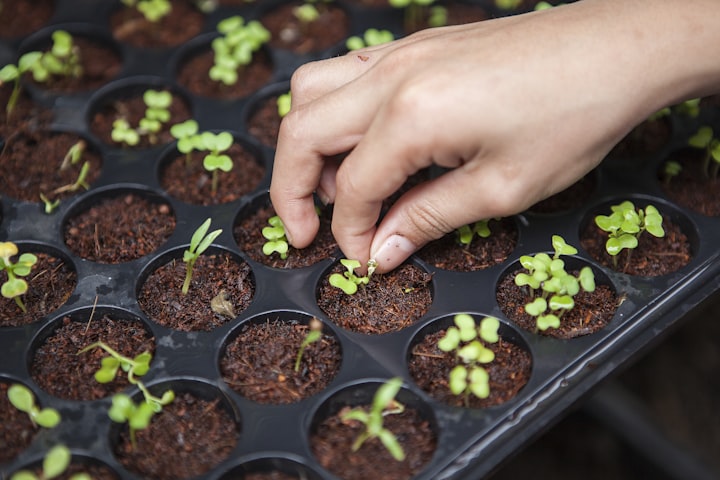
The human race had been operating on borrowed time. We’d torn apart our world and continued doing so when every scientist agreed it would be the end of us. The safe havens we created when water became more precious than air, when the earth was scorched by the sun and then man-made horrors, were only meant to weather the storm for a while.
Well, the clock had stopped ticking.
“We checked and verified the data no fewer than ten times before bringing this to you.” The lead researcher said the moment I opened my mouth. I closed it, pressing my lips together and swallowing. As if that would stop my racing thoughts. As if that would refute the evidence before my eyes.
“What...what can we do?”
The members of the research team all shared glances before turning back to me. “We were hoping you could tell us.”
My eyes caught on the findings before me. Food production was fine for now, but the biodiversity was minimal. We knew this; we’d only had so many plants inside the protective shielding when the war wiped out everything else. But with so little diversity in the plants we grew, entire fields of crops were falling to a single parasite, even with the extensive genetic modification we’d done. The projections gave us about a decade before catastrophic crop failures would starve us. New plants would need to be introduced as soon as possible.
From my own research, I knew radiation levels outside the shielding had fallen enough to be of minimal concern. But the plants out there were wildly mutated. For every hundred plants I brought in for study, maybe one was safe enough to cultivate. I’d exhausted everything within twenty-five miles of the city. We needed a source of clean, safe plants to add to our city — even better, different species of fish, wildlife, birds, even people.
We needed to find the other Light Cities, assuming they’d survived as we had. I even opened my mouth to say so, but...the council had always been adamant that we be self-sufficient, that no one was to travel to another city. Such insularity had protected us in the beginning, but now?
It would kill us.
Heaving a sigh, I gathered the papers together and closed the folder. “Give me a few days.” My voice wavered. “I’ll bring this to the doctor.”
* ~~~ * ~~~ * ~~~ * ~~~ * ~~~ * ~~~ * ~~~ * ~~~ *~~~ * ~~~ * ~~~ *
Ten minutes later I was on a streetcar, taking the most direct path I could find to my boss’ lab. The setting sun burned in the sky, but flowering vines only allowed a small kaleidoscope of sunlight onto the path of the streetcar. A year ago those vines had just barely begun to climb the building. Rather than trying to keep them away, the people who used the streetcars decided to coax the vines to create shade. They’d erected trellises, how hardly discernible through the blanket of green.
People moved along beside us; separate paths for bikes and pedestrians wound through the relatively open space. A few large, old trees provided more shade for picnics or weekend naps. Whichever areas were not designated heavy-duty turf were filled with short, dense shrubs, herb plants, flowering plants, or small ponds with little larger than a koi living in them. Despite the hour growing later, the pedestrian path to the streetcar stop had been crowded. People were heading home for the day.
It was nearing nine when I opened the door to the R&D center. The lights inside were dimmed, most people home for the weekend. I followed the brightest light in the office and found my boss hunched over his tablet, books and papers spread across the table in no apparent order. Doctor Hambright greeted me warmly, but all I could do was hand him the packet and wait silently while he looked over the findings. I knew he’d reached the same conclusion as me when he slumped back into his seat, rubbing the bridge of his nose and taking measured breaths. I sat next to him, trying to find anything to break the silence smoothly. He had a map spread out on the table and, strangely, a book on numerical ciphers. Tucked in the corner was a familiar piece of paper — I’d found it in a book, thought the list of coordinates was strange, and handed it off to the doctor.
“Did those coordinates mean anything?”
Doctor Hambright stopped rubbing his face, but his expression was grave. “I’m not sure. I’ve been trying to figure out what sort of encryption structure they used. If we had a key...” He paused, brow furrowing. “Where did you say you found it again?”
“Stuffed in a book.”
“What book?”
“It was an encyclopedia, plant classifications.”
“Which plant was on the page?”
I thought for a moment, spinning my necklace. The delicate silver had been coaxed into the shape of a heart, and it was the only piece of my mother that remained. The place the paper was in the book had seemed like a useless detail at the time, but Doctor Hambright was asking as if it were important. “Tomatoes, I think. Common red garden tomatoes.”
He nodded, thoughtful, but said nothing more until he returned to look over the packet I’d brought him. “Do you agree with the team’s findings?”
“I looked over the figures a few times. Nothing looked out of place.” A non-answer, but also an answer.
“Only a decade…”
There was nothing to say to that either; we both knew it was a bad situation all around.
“What are your thoughts on a solution, Rayne?” He was still looking at the papers, transfixed the way I had been at first.
“The plants outside our shield domes are too...varied, if you get my meaning. Too much mutation from radiation. We know they can’t cross-breed well with the plants we have here, even from the same genus.” The doctor hummed to show he was still listening, and I continued. “The best option would be finding plants from other Light Cities. They would probably keep extra seeds on hand, like us, and they'd have the diversity we need.”
“You’re right, but traveling to another city is illegal. Anyone attempting to do so would not be allowed to return. Not to mention we don’t know where to go to find another Light City.”
“I know.” I said simply. “Do you think the council would let us out — and let us return — if we explained?”
“I don’t know. They could very well jail us for mentioning it.”
“But it’s a matter of the entire city’s survival!”
“It is.” He finally turned to me, and the piercing expression in his gray eyes pinned me to my seat. “So the question is how do we get out?”
I didn’t tell him that getting out would be the easy part. It was everything after that that set my heart racing and palms sweating. If we failed...the city would fail with us.
About the Creator
Keep reading
More stories from Kira Lempereur and writers in Fiction and other communities.
Becca
"Everything is so... flat." Denille said stupidly as she looked around her new neighborhood. She looked around at the muted desert where even the smallest sign of life seemed to have given up. The plant life was shrubs that were half cooked by the heat and where there should have been a lawn, a mess of white rocks laid glistening in the sun. Even the sky looked stretched thin, like the sun had ironed it smooth. She’d moved from Riverside, where at least there were hills, but here in Barstow, everything felt baked and brittle.
By Sara Wilson6 days ago in Fiction

Comments
There are no comments for this story
Be the first to respond and start the conversation.