


"You always start at sixty percent of what you want to pay."
David had been daydreaming at work, as he often did. This one had been an old favorite, involving the setting of an historical fiction he liked to read, and a scenario centered around himself that called for bravery and honor.
"I know how to make a deal." The other replied, defensively.
His coworkers appeared to be arguing about money, and power. Perhaps who was better at wielding the two.
They spoke and gestured with the mannerisms of famous businessmen and media personalities that they identified with; insistent superiority and substituting volume where reason failed. When discussing the art of the deal didn't clarify who was better versed, they talked about their scotch collection, the value of their clothes, their watches...
David was reminded of a summer camp he attended as a child on a little island on a lake. The water was clear with hints of blue, the air was cottonwood and dragonflies, and the swept-earth paths connecting all the cabins were bumpy from the roots of great old trees.
Camp councilors sorted everyone by age into cabins, and then the children of each cabin sorted themselves into a hierarchy. The process was rigorous and contentious. Being as young as they were, they had not yet many laurels of their own, so they borrowed some of their parents'.
"My dad has the most money!" One might say, or "mine has the biggest muscles," and then strike a powerful pose.
Mail day was an important factor in these deliberations. Once per week mail from home would be shipped out to the island, sorted, and distributed to the campers. Designer tees, jewelry, a portable television complete with built-in DVD player... These things were excessive, maybe, for a camping trip, but they could be powerful status symbols too.
The first year that David attended camp, he discovered how big of a deal mail-day turned out to be, and when his councilor handed him a parcel from home he found that he was afraid to open it.
It was a standard cardboard box, medium in dimension, wrapped in coarse brown paper and sealed with yellow tinted packing tape. Anything at all could be inside.
"I'll open it later," he remembered telling his new friends in response to their anticipatory expressions. He tried to sound offhanded, as though a box was just a box. In retrospect it played pretty well, too.
David's coworkers were still in animated discussion when the floor manager made his round.
"Ear plugs in!" He said gesturing towards his own pair of spongy orange guards, nestled securely in his ears. David and his coworkers obliged, of course, as always. The floor manager gave a thumbs up and an encouraging smile, and continued his patrol. He was wearing a checkered button-up tucked into brown slacks, a Blackberry clipped to his waist. They were wearing matching blue coveralls, dusty from use.
The company had implemented mandatory hearing protection some time ago to keep up with the updated workplace safety guidelines. Their work-floor was a cavernous space full of stainless steel machines that resembled rollercoasters. Each one would churn out thousands and thousands of newspaper pages; the A1 page rollercoaster would meet up with A2, A2 with A3, and on and on it went along tracks that rumbled consistent and loud. At the end of the rollercoaster the finished papers would arrive at an assembly line. It was there that David and his coworkers stood, piling them into cardboard boxes on a wooden pallet, to be forklifted away.
The great rumbling of the steel rollercoasters were muted now, as David moved from newspaper, to box, to pallet, over and over again, mind already starting to wander in search of somewhere more stimulating.
There was probably a time, David reasoned, when it was conventional to send a simple letter with well wishes to the little island on a lake. Something to keep the homesickness at bay. He guessed that somewhere along the line, someone's parents took the liberty of sending a box of chocolates to accompany their letter. Maybe they meant it as a warm gesture, but to the other parents in the community, such upstaging may as well have been a declaration of war.
The bar hadn't stopped rising since, it seemed. What was good enough to earn the badge of status in the summers of his childhood hardly cut it anymore. More and more it seemed that you could just up and drown trying to keep up with the trends.
On the other hand, there are philosophies that deem the whole competition misguided. Some instead hold true that food is food, clothes are clothes, and a box is just a box. Or maybe some just need that to be true, considering the circumstance.
About the Creator
Keep reading
More stories from O.S. Lawrenchuk and writers in Fiction and other communities.
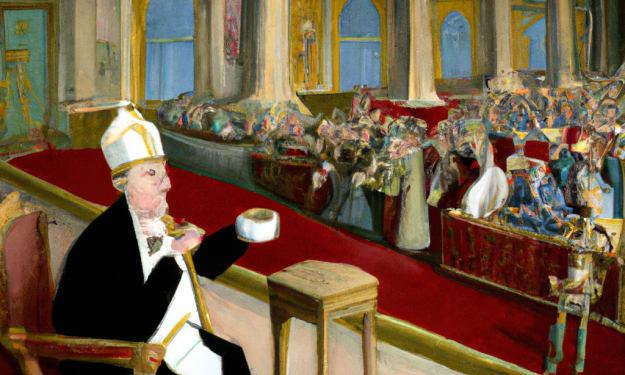
The Lesser Deliberations of the Papal Court
1. Prologue The Pope took his coffee black. It was brought to him promptly by a servant, polished shoes echoing off marble floors, and set beside his gilded throne on a silver tray. Steam caught on a draft wafted an aroma both pleasant and strange to his nose. It was earthy and nutty, with a hint of caramel; distinctly different from the wines and ales he was accustomed to. So Inviting, the Pope thought, though the sentiment was somewhat undercut by the way his servant winced as he placed his fingers on the handle of the ceramic cup.
By O.S. Lawrenchuk3 years ago in Fiction



Comments
There are no comments for this story
Be the first to respond and start the conversation.